
To celebrate her birthday year (see previous blog, and pretty much every conversation in the Emu household for the last twelve months), Mrs E decided that she needed to do something special. Specifically, her requests/demands were a) a big hike, b) access to a great deal of cold water for swimming purposes and c) a remote location that defined ‘getting away from it all’.
After a certain amount of digging about, we settled on the Kungsleden trail in Swedish Lapland. The Kungsleden (King’s trail) runs for 440km, almost all above the Arctic Circle, from Abisko to Hemaven. You can start the hike in Abisko and, over seven days, go 107km south to Nikkaluokta. If you look at these points on a map, these are the two places on the first part of the trail that feature a road – the only access between the two points is on foot, helicopter or in the winter months, by snowmobile. I mentioned this to someone before we set off, and he asked if we were planning to hike all the way. I said that we’d actually decided to travel by helicopter, which I thought was a brilliant joke, but he just looked at me like I was a complete prat. Perhaps both things were true.
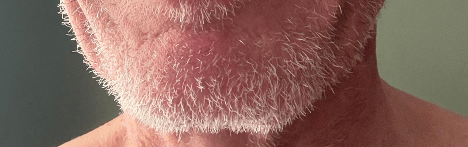
Anyway, you can camp along the trail or stay in one of the Swedish Tourist Federation (STF) huts, all of which are about a day’s hike apart. There’s no electricity, no running water and no mobile phone coverage, but the huts have beds, cooking facilities and, if you’re lucky, a wood fired sauna, which, together with nearby fjords or rivers, is how you keep clean. So far, so idyllic, although one of the drawbacks is that you do have to carry everything that you’ll need for a week on your backs. You do have access to water at the huts, you can drink from the rivers and fjords, so that’s something, but you’re still looking to carry 42 dried meals between you, which you’ll be unsurprised to hear, is quite a weight. By the time the food had been packed into Beasts One and Three (see previous blog) there was little room for anything else. Mrs E had read that the maximum carrying weight of a backpack should be no more than 10% of your body weight, so the first weigh in of about 12kg meant that we were going to have to put on some serious timber in order to cope. We managed to trim the pack weight back down a bit by losing any non-essentials, like a change of clothing, and I decided to sacrifice my razor, a marginal weight gain, perhaps, but one that would allow me to cultivate my first ever ‘rugged outdoorsman’ look. I’ve never really seen the attraction of beards, being one of those people who has ready access to a mirror, but maybe here was an opportunity to see why people choose to look like serial killers. If you’re reading this and are currently in possession of a beard, apologies – I’m sure you have your reasons, I just don’t know what they are.
Anyway, back to the trip. We organised ourselves through the wonderful Alpine Exploratory agency in Edinburgh; they’d asked us to ensure that a) we were able to read and navigate with a map and compass in bad weather, b) we were adequately insured including helicopter rescue cover and c) we were carrying a GPS device to call for help where necessary. We addressed all of these points by a) asking our friend A to show us the ropes, and after a quick lesson, could quite easily navigate from one side of a football pitch to another in broad daylight b) asking our travel insurance company if we were covered, receiving the breezy reply that people with this cover got rescued by helicopter ‘all the time’, and c) went on a Swedish tech rental website (who knew?) and arranged to hire a Garmin beacon device for a knockdown price. In the event of course, none of this was necessary – we followed well worn paths in reasonable weather; saw a few helicopters, none of which were for us; and found no use for the very tempting SOS button on the side of the Garmin.
So other than putting the bins out, gaining a large amount of weight and cancelling the milk and papers we were ready to go.
And on the 4th of July, we set off, by taxi/train/train/plane/bus to Stockholm, and then the next day by bus/plane/bus up to Abisko where the Abiskoturistation marks the start of the Kungsleden. We were expecting the tourist station to be a mountain hut but it turned out to be fairly up market with very Swedish restaurant. Abisko is next to a road so allows people to travel to the start of the route, and I guess also allowed for fresh food to be delivered; not a situation we were likely to see for the next few days so we loaded up on as much decent food as we could, easing seamlessly into breakfast the next day.
We set off on day one, walking south from Abisko to Abiskojaure. It had been raining, so the rocky path was hard to navigate with slippery and muddy bits and an unfamiliar 10kg of extra weight on our backs. We soon got into a rhythm though, and started to enjoy the amazing hills and mountains as we came out of the forest and headed towards our first proper hut. The hut could sleep up to 62 people and most of them decided to use the kitchen at the same time, but we managed to rehydrate some unappetising dahl, which frankly could’ve done with a bit of mango chutney which we’ve forgotten to bring. Cleaned up, and then headed to the 8 to 9 pm mixed Sauna shift, with a variety of shape, sizes and optional swimwear. I decided to embrace the whole Swedish sauna ethos and before long I’d not only got naked and sweaty in front of a whole load of disinterested strangers, but was bounding down the lake for a cool/freezing dip. In my mind I was looking like a still from Health and Efficiency magazine– of course in reality I probably looked more like an old git covered in mosquito bites who needed to shave. And then have another shave. Speaking of which, the beard was beginning to look like a big mistake and there was no going back until I was to be reunited with my razor in Stockholm. There are no bathrooms on the Kungsleden and no mirrors, so I was reliant on Mrs E’s views on how well it was taking shape. I asked what I looked like unshaven and without missing a beat, she said ‘a nonce’.
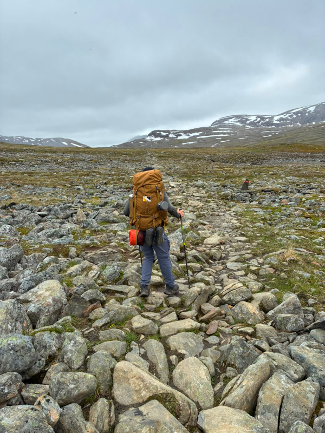
Second day of hiking took us from Abiskojaure to Alesjaure, a distance of 22km – that doesn’t sound very much, but it took us around eight hours excluding stops. It was forecast to rain for most of the day, and the forecast turned about to be correct, making progress over the rocks a bit tricky. We’d bought capes that covered us and our backpacks, so these went on for most of the day, making us look like orange and black plastic hunchbacks trudging across the valley floor. But we kept dry, which was the main thing, we just had a bit of kit envy at our fellow hikers who had kit that made them look a bit less cumbersome. In later days we’d get quite nostalgic for the rain as it did at least send the mosquitoes away; they were literally a big irritation throughout the hike, we were bitten while we were walking, and in the dormitories when we slept, and even through our clothing. We had some deterrent spray that was pretty useless – we’d bought it on a previous trip abroad and couldn’t translate the label properly, so for all I know it may have been a mosquito encouragement spray. I also had some mosquito treatment cream that I’d bought in Japan, but again, I was unable to read the label, so for all I know I may have been rubbing itching cream onto the bites – that’s certainly what it felt like. Ridiculous climbs on really rocky paths, perilous board walks across marshland, a bit of wading across rivers, and some more climbing. Very grateful for the poles, and because the ground was so unpredictable, the tendency was to be looking down as the time, so we had to force ourselves to stop and look around. Mrs E summed it up nicely – every review we saw was like the front of an atlas – beautiful still lakes, waterfalls cascading down from the snowcapped mountains, it was absolutely stunning all day long, even in the rain. We dragged ourselves up the climb to the Alesjaure hut at about 5 pm, completely knackered and complaining about Beast related injuries in our legs and shoulders. However, the combination of rest, rehydrated food, ibuprofen, and a sauna/nude skip down to a freezing lake had us nicely sorted out in fairly short order.
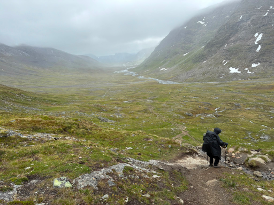
Day three, and another testing hike, this time to the basic mountain hut at Tjäktja – no sauna, no shop, so everyone on the hike was looking forward to smelling especially ripe for the next 24 hours. It stopped raining, giving the mosquitoes a chance to get involved, but that was almost worth it – the views over the mountain passes were amazing again. The last climb seemed to last forever, but was really only about 3 km, hiking above the snow line and into more rockiness, then finally dropping down to the scariest suspension bridge so far, spanning a little canyon complete with waterfall and glacier, and leading to the hut.
Being without the Internet, we played a game which we will call ‘impossible fact checking’, in which we tested our memories with no option for fact checking, and no penalty for being wrong. Recommended for the next time you’re without internet access. Today’s topics included trying to remember :
- The lyrics of the second verse of “Two Little Boys” by Rolf Harris
- Whether Rolf Harris was still alive
- The names of all the places we stayed on previous hikes
- The chronology of all Belle & Sebastian/Beatles albums
- The name of that town that my sister really likes, in the borders, where we stopped on a bike ride last year
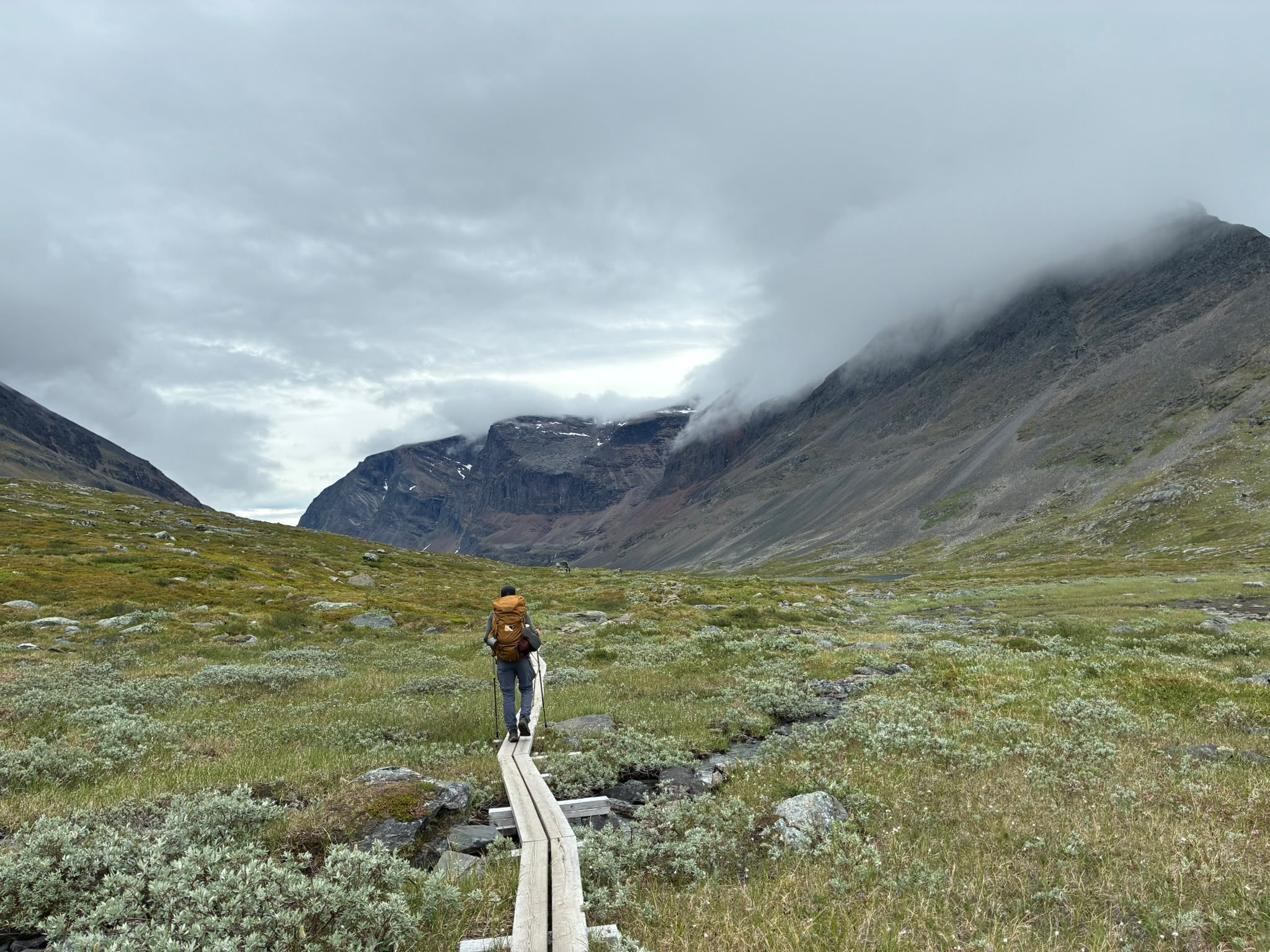
Day four took us to the highest part of the Tjäktjapasset pass – a sharp climb of about 4 km to the peak at 1141m, where we found the rescue hut and some other tired hikers, before descending through more atlas-cover-worthy wilderness to the maze of rivers and lakes and onto Sälka, across another wobbly suspension bridge and into the little array of huts, these ones including a sauna, with adjoining river. We were sharing a hut with a wonderful family of hikers, three adults and four kids, the youngest of which was nine, putting us to shame on endurance. The 13-year-old boy was super keen on the wood burner, so we ended up in a very hot hut keeping us nice and warm after the dip in the nearby pool, where the waterfall delivered freezing cold water straight off the glacier. There’s plenty of wood about at the hats, which is odd initially as there are no trees for miles – we’re above the tree line and partway above the area where snow and ice were permanently on the mountain side. The wood and everything else that the huts need for the summer gets delivered by snowmobile every spring. They also take away all the recycling (hikers are expected to take their non-recyclable rubbish away so my rucksack was full of empty packets of freeze-dried rations by the end of the trip). But if you look at the logistics of this it’s amazing – in addition to delivering several tons of firewood, they also deliver all the hut construction materials (there was a new toilet block at every camp which looked amazing but smelt like four day old Glastonbury) plus gas canisters, and for huts with shops, enough supplies for hundreds of hikers.
Meanwhile, the beard continued to develop. Still no access to a mirror, so was checking in with the very non-beard-friendly Mrs E. Day 4 update was a severe eye roll and ‘It just makes you look old’. Apparently it’s extremely grey, so I was hoping to return home with a bit of a Gandalf look about me. Seriously considered a cloak and a staff for the Gatwick leg.
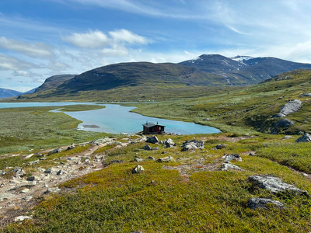
Day 5, and the hiking was beginning to feel a little easier – the route was still full of boulders so it was very slow going, but the packs were getting a little lighter with each meal we’d eaten, and it was a very pleasant 14 km mainly downhill to the huts at Singi. We were coming out of the Tjäktjapasset now, with its super-wide valley floor and huge lakes reflecting the mountain ranges. The Kungsleden carries on south for about another 300 km, but we were going to head east to Kebnekaise the next day. We got to Singi by about 1430 and spent a very relaxed few hours hanging out with some new Swedish/Finnish friends, learning a bit about this and that and breaking off occasionally to head for a dip in the river. We had a useful discussion about Scandinavian stereotypes, these are of course mixed depending on which part of Scandinavia you’re from, but there does seem to be a common grudging respect for the Finns, who seem to be harder in spirit than all the others. They talked about the sauna world championships as an example. The last of these was in 2010 after the final between a Russian and a Finn was called off after six minutes – both finalists were taken to hospital with severe burns and the Russian, who was later found to have been using banned painkillers, died.
Taking the left turn to Kebnekaise the next day, we headed out of the main valley and into the Laddjuvagge valley. It takes quite a while to climb the numerous false peaks as you get to the top of the pass, scrambling over yet more rocks as you do but once you get to the top, the rewards are so worth it.
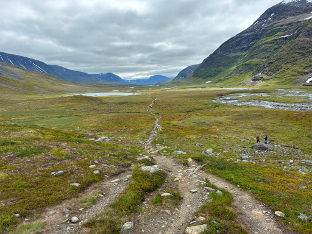
As you drop down to the Laddjuvagge you notice that the sides of the valley are much more severe, with less space around the rivers, but walking next to the river is fun – it’s fast flowing which reduces the mosquito population and, of course crystal clear. Before we left, we were given differing advice about water purification but took our lead from a couple of Swedes, who told us that (of course) you could drink straight from all the rivers. So like all the other hikers, we did, and the cold water tasted exactly as cold water should, ie of nothing. Climbing over a couple of bluffs, we went past a Sami encampment – there are a few of these on the route but no one and no reindeer to be seen – the reindeer go high up in the mountains to get away from the mosquitoes, and the Sami spend this time of year rounding them up in order to manage the reindeer count later in the summer. Eventually we went round a bluff and saw the scattered buildings of Kebnekaise. Kebnekaise, like Abisko Turiststation, is a few pegs above where we stayed for most of the walk. The dining room, for example, featured proper meals that weren’t just made by pouring hot water onto freeze dried soya mince. There were hot showers. There was power. Oh, and drainage. And where there is hot and cold running water there will also be a mirror, so the beard was seen for the first time in a week. I think it’s safe to say that it was not a strong look. There was a reasonable amount of it, but it was almost all grey and the overall effect was less rugged outdoorsman and more ‘helping police with their enquiries’. Part of the problem was that it was a bit patchy on the cheeks, so I suppose I could have shaved the sides and go for the hipster jazz cat look, but what would be the point in that? I’d still have that ‘helping police’ look but with added rhythm. So it needed to go, but with a few days left before returning to Stockholm/my razor, there were still likely to be a few parents escorting their children away as I shuffled towards them, and I wouldn’t have blamed them in the least.
The other great thing about reaching Kebnekaise was that there was mobile reception, England were playing in the World Cup quarter final against Norway that night – it kicked off at 2300, so it was going to be a challenge with a 0630 start the next morning but it felt like a must-see opportunity. Despite significant technical preparation involving VPNs and network permission, I couldn’t get a stream to work, so asked a group of Danes if I could join them – they were crowded around an iPad and very much rooting for Norway but were really welcoming and we had the sort of conversation that people in bars always have when they’re watching football matches. The game went to extra time, at which point we were joined by a German guy, who, for some reason was determined to talk about fishing with one of the Danes. Just as my Dad would be able to recall in great detail Geoff Hurst’s third goal in the 1966 World Cup final, I will always remember Bellingham’s winner in extra time, as, just as it went in, the German passed his iPhone across to one of the Danes, to show a picture of a fish he’d caught. And because the head of the fish was pointing towards the Dane, it looked very much as if there was an enormous arctic char swimming across the pitch to celebrate the goal. Day seven, and the last hike, along to the lake at Láddjujávri where we cut the hike to Nikkaluokta down to about 14km by taking the boat, which drops you off next to the Enok restaurant, ‘famous’ for its reindeer burgers.
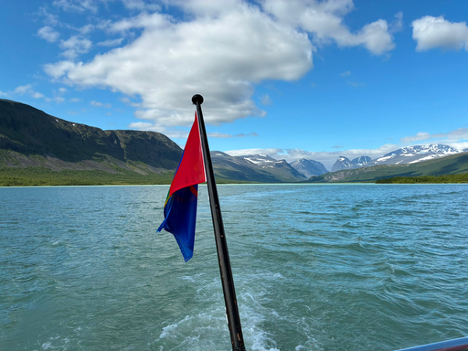
When you get to Nikkaluokta there are a couple of huts, a visitors centre, and a car park, and most importantly a road, where you patiently wait for one of the two daily buses that can take you to Kiruna.
Kiruna is one of those towns which is probably more interesting to read about than to stay in. It’s a mining town, and the mining has been so enthusiastic that it has opened up all sorts of cracks and fissures underneath the town centre. Subsequently, the entire town has had to be relocated 3-5km away, starting with the church, which was moved over two days in 2025. We stayed in a fairly nondescript Holiday Inn, with a room overlooking the car park, which was a bit of a come down from the previous week. But during our brief stay we each had multiple showers, pizza, beer and a breakfast that wasn’t porridge and dried milk. Also, a chance to reflect a bit on what was a stunning hike in the wilderness. Thoroughly recommend it for lots of reasons, there was a bit of a detox about it, the landscapes were stunning, everyone we met was super nice, and Mrs E got everything she wanted out of her holiday. Except for the beard, for which I can only apologise.

 The Emu