Into the great wide open

To celebrate her birthday year (see previous blog, and pretty much every conversation in the Emu household for the last twelve months), Mrs E decided that she needed to do something special. Specifically, her requests/demands were a) a big hike, b) access to a great deal of cold water for swimming purposes and c) a remote location that defined ‘getting away from it all’.

After a certain amount of digging about, we settled on the Kungsleden trail in Swedish Lapland. The Kungsleden (King’s trail) runs for 440km, almost all above the Arctic Circle, from Abisko to Hemaven. You can start the hike in Abisko and, over seven days, go 107km south to Nikkaluokta. If you look at these points on a map, these are the two places on the first part of the trail that feature a road – the only access between the two points is on foot, helicopter or in the winter months, by snowmobile. I mentioned this to someone before we set off, and he asked if we were planning to hike all the way. I said that we’d actually decided to travel by helicopter, which I thought was a brilliant joke, but he just looked at me like I was a complete prat. Perhaps both things were true.

Anyway, you can camp along the trail or stay in one of the Swedish Tourist Federation (STF) huts, all of which are about a day’s hike apart. There’s no electricity, no running water and no mobile phone coverage, but the huts have beds, cooking facilities and, if you’re lucky, a wood fired sauna, which, together with nearby fjords or rivers, is how you keep clean. So far, so idyllic, although one of the drawbacks is that you do have to carry everything that you’ll need for a week on your backs. You do have access to water at the huts, you can drink from the rivers and fjords, so that’s something, but you’re still looking to carry 42 dried meals between you, which you’ll be unsurprised to hear, is quite a weight. By the time the food had been packed into Beasts One and Three (see previous blog) there was little room for anything else. Mrs E had read that the maximum carrying weight of a backpack should be no more than 10% of your body weight, so the first weigh in of about 12kg meant that we were going to have to put on some serious timber in order to cope. We managed to trim the pack weight back down a bit by losing any non-essentials, like a change of clothing, and I decided to sacrifice my razor, a marginal weight gain, perhaps, but one that would allow me to cultivate my first ever ‘rugged outdoorsman’ look.  I’ve never really seen the attraction of beards, being one of those people who has ready access to a mirror, but maybe here was an opportunity to see why people choose to look like serial killers. If you’re reading this and are currently in possession of a beard, apologies – I’m sure you have your reasons, I just don’t know what they are.

Anyway, back to the trip. We organised ourselves through the wonderful Alpine Exploratory agency in Edinburgh; they’d asked us to ensure that a) we were able to read and navigate with a map and compass in bad weather, b) we were adequately insured including helicopter rescue cover and c) we were carrying a GPS device to call for help where necessary. We addressed all of these points by a) asking our friend A to show us the ropes, and after a quick lesson, could quite easily navigate from one side of a football pitch to another in broad daylight b) asking our travel insurance company if we were covered, receiving the breezy reply that people with this cover got rescued by helicopter ‘all the time’, and c) went on a Swedish tech rental website (who knew?) and arranged to hire a Garmin beacon device for a knockdown price. In the event of course, none of this was necessary – we followed well worn paths in reasonable weather; saw a few helicopters, none of which were for us; and found no use for the very tempting SOS button on the side of the Garmin.

So other than putting the bins out, gaining a large amount of weight and cancelling the milk and papers we were ready to go.

And on the 4th of July, we set off, by taxi/train/train/plane/bus to Stockholm, and then the next day by bus/plane/bus up to Abisko where the Abiskoturistation marks the start of the Kungsleden. We were expecting the tourist station to be a mountain hut but it turned out to be fairly up market with very Swedish restaurant. Abisko is next to a road so allows people to travel to the start of the route, and I guess also allowed for fresh food to be delivered; not a situation we were likely to see for the next few days so we loaded up on as much decent food as we could, easing seamlessly into breakfast the next day.

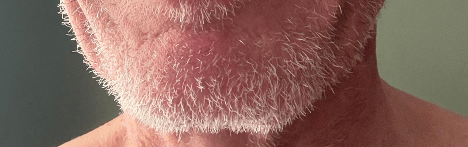
We set off on day one, walking south from Abisko to Abiskojaure. It had been raining, so the rocky path was hard to navigate with slippery and muddy bits and an unfamiliar 10kg of extra weight on our backs. We soon got into a rhythm though, and started to enjoy the amazing hills and mountains as we came out of the forest and headed towards our first proper hut. The hut could sleep up to 62 people and most of them decided to use the kitchen at the same time, but we managed to rehydrate some unappetising dahl, which frankly could’ve done with a bit of mango chutney which we’ve forgotten to bring. Cleaned up, and then headed to the 8 to 9 pm mixed Sauna shift, with a variety of shape, sizes and optional swimwear. I decided to embrace the whole Swedish sauna ethos and before long I’d not only got naked and sweaty in front of a whole load of disinterested strangers, but was bounding down the lake for a cool/freezing dip. In my mind I was looking like a still from Health and Efficiency magazine– of course in reality I probably looked more like an old git covered in mosquito bites who needed to shave. And then have another shave. Speaking of which, the beard was beginning to look like a big mistake and there was no going back until I was to be reunited with my razor in Stockholm. There are no bathrooms on the Kungsleden and no mirrors, so I was reliant on Mrs E’s views on how well it was taking shape. I asked what I looked like unshaven and without missing a beat, she said ‘a nonce’.
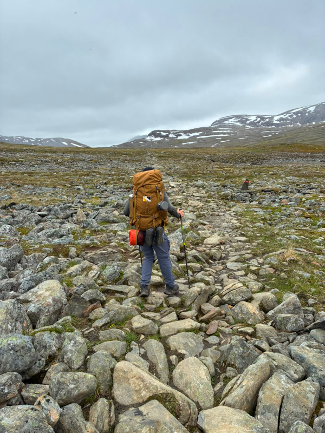
Second day of hiking took us from Abiskojaure to Alesjaure, a distance of 22km – that doesn’t sound very much, but it took us around eight hours excluding stops. It was forecast to rain for most of the day, and the forecast turned about to be correct, making progress over the rocks a bit tricky. We’d bought capes that covered us and our backpacks, so these went on for most of the day, making us look like orange and black plastic hunchbacks trudging across the valley floor. But we kept dry, which was the main thing, we just had a bit of kit envy at our fellow hikers who had kit that made them look a bit less cumbersome. In later days we’d get quite nostalgic for the rain as it did at least send the mosquitoes away; they were literally a big irritation throughout the hike, we were bitten while we were walking, and in the dormitories when we slept, and even through our clothing. We had some deterrent spray that was pretty useless – we’d bought it on a previous trip abroad and couldn’t translate the label properly, so for all I know it may have been a mosquito encouragement spray. I also had some mosquito treatment cream that I’d bought in Japan, but again, I was unable to read the label, so for all I know I may have been rubbing itching cream onto the bites – that’s certainly what it felt like. Ridiculous climbs on really rocky paths, perilous board walks across marshland, a bit of wading across rivers, and some more climbing. Very grateful for the poles, and because the ground was so unpredictable, the tendency was to be looking down as the time, so we had to force ourselves to stop and look around. Mrs E summed it up nicely – every review we saw was like the front of an atlas – beautiful still lakes, waterfalls cascading down from the snowcapped mountains, it was absolutely stunning all day long, even in the rain. We dragged ourselves up the climb to the Alesjaure hut at about 5 pm, completely knackered and complaining about Beast related injuries in our legs and shoulders. However, the combination of rest, rehydrated food, ibuprofen, and a sauna/nude skip down to a freezing lake had us nicely sorted out in fairly short order.
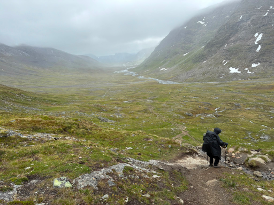
Day three, and another testing hike, this time to the basic mountain hut at Tjäktja – no sauna, no shop, so everyone on the hike was looking forward to smelling especially ripe for the next 24 hours. It stopped raining, giving the mosquitoes a chance to get involved, but that was almost worth it – the views over the mountain passes were amazing again. The last climb seemed to last forever, but was really only about 3 km, hiking above the snow line and into more rockiness, then finally dropping down to the scariest suspension bridge so far, spanning a little canyon complete with waterfall and glacier, and leading to the hut.

Being without the Internet, we played a game which we will call ‘impossible fact checking’, in which we tested our memories with no option for fact checking, and no penalty for being wrong. Recommended for the next time you’re without internet access. Today’s topics included trying to remember :

  • The lyrics of the second verse of “Two Little Boys” by Rolf Harris
  • Whether Rolf Harris was still alive
  • The names of all the places we stayed on previous hikes
  • The chronology of all Belle & Sebastian/Beatles albums
  • The name of that town that my sister really likes, in the borders, where we stopped on a bike ride last year
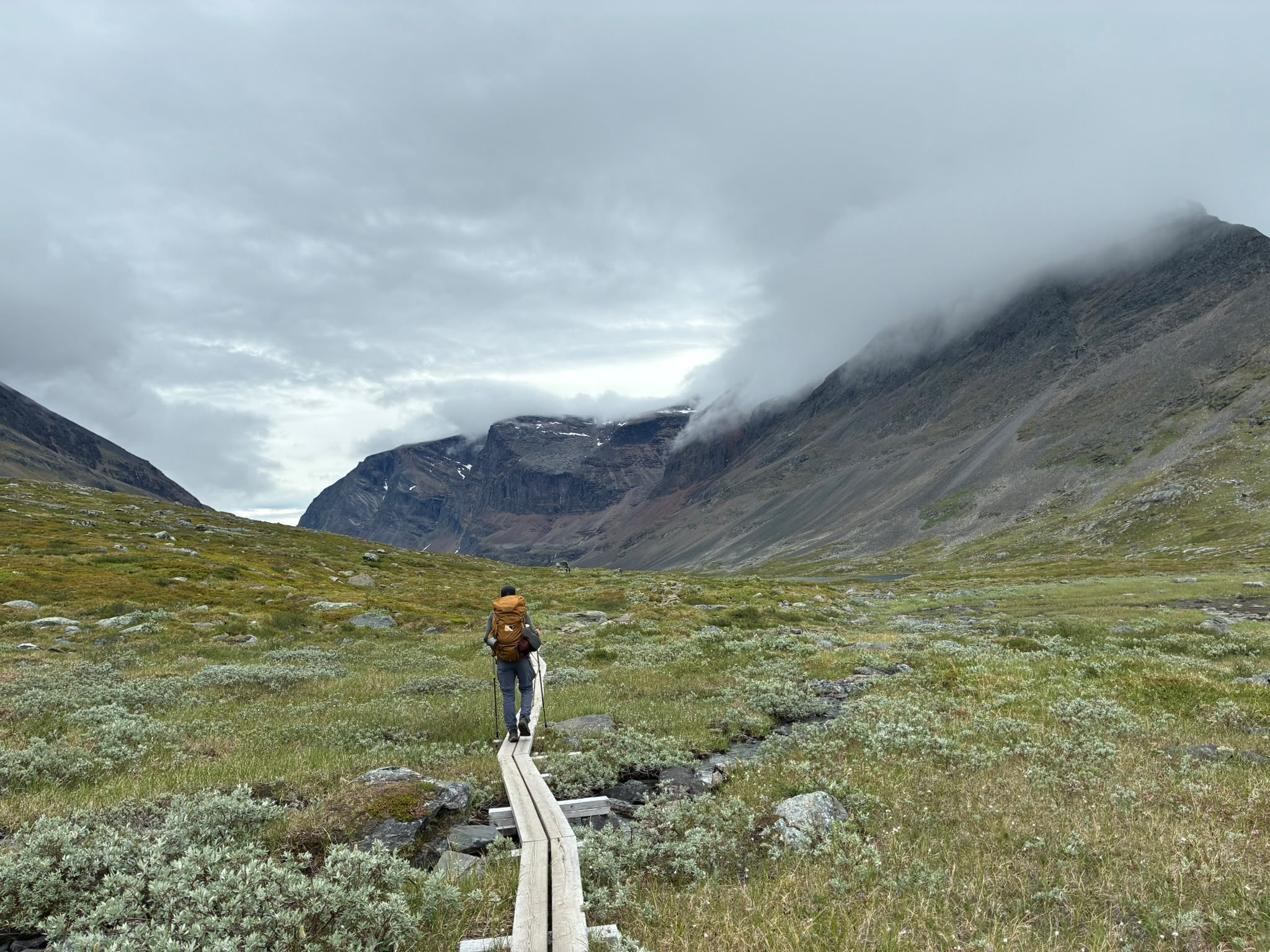
Day four took us to the highest part of the Tjäktjapasset pass – a sharp climb of about 4 km to the peak at 1141m, where we found the rescue hut and some other tired hikers, before descending through more atlas-cover-worthy wilderness to the maze of rivers and lakes and onto Sälka, across another wobbly suspension bridge and into the little array of huts, these ones including a sauna, with adjoining river. We were sharing a hut with a wonderful family of hikers, three adults and four kids, the youngest of which was nine, putting us to shame on endurance. The 13-year-old boy was super keen on the wood burner, so we ended up in a very hot hut keeping us nice and warm after the dip in the nearby pool, where the waterfall delivered freezing cold water straight off the glacier. There’s plenty of wood about at the hats, which is odd initially as there are no trees for miles – we’re above the tree line and partway above the area where snow and ice were permanently on the mountain side. The wood and everything else that the huts need for the summer gets delivered by snowmobile every spring. They also take away all the recycling (hikers are expected to take their non-recyclable rubbish away so my rucksack was full of empty packets of freeze-dried rations by the end of the trip). But if you look at the logistics of this it’s amazing – in addition to delivering several tons of firewood, they also deliver all the hut construction materials (there was a new toilet block at every camp which looked amazing but smelt like four day old Glastonbury) plus gas canisters, and for huts with shops, enough supplies for hundreds of hikers.

Meanwhile, the beard continued to develop. Still no access to a mirror, so was checking in with the very non-beard-friendly Mrs E. Day 4 update was a severe eye roll and ‘It just makes you look old’. Apparently it’s extremely grey, so I was hoping to return home with a bit of a Gandalf look about me. Seriously considered a cloak and a staff for the Gatwick leg.
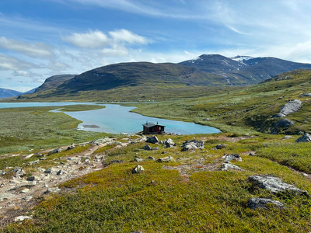
Day 5, and the hiking was beginning to feel a little easier – the route was still full of boulders so it was very slow going, but the packs were getting a little lighter with each meal we’d eaten, and it was a very pleasant 14 km mainly downhill to the huts at Singi. We were coming out of the Tjäktjapasset now, with its super-wide valley floor and huge lakes reflecting the mountain ranges. The Kungsleden carries on south for about another 300 km, but we were going to head east to Kebnekaise the next day. We got to Singi by about 1430 and spent a very relaxed few hours hanging out with some new Swedish/Finnish friends, learning a bit about this and that and breaking off occasionally to head for a dip in the river. We had a useful discussion about Scandinavian stereotypes, these are of course mixed depending on which part of Scandinavia you’re from, but there does seem to be a common grudging respect for the Finns, who seem to be harder in spirit than all the others. They talked about the sauna world championships as an example. The last of these was in 2010 after the final between a Russian and a Finn was called off after six minutes – both finalists were taken to hospital with severe burns and the Russian, who was later found to have been using banned painkillers, died.

Taking the left turn to Kebnekaise the next day, we headed out of the main valley and into the Laddjuvagge valley. It takes quite a while to climb the numerous false peaks as you get to the top of the pass, scrambling over yet more rocks as you do but once you get to the top, the rewards are so worth it.
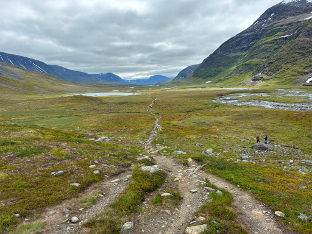
As you drop down to the Laddjuvagge you notice that the sides of the valley are much more severe, with less space around the rivers, but walking next to the river is fun – it’s fast flowing which reduces the mosquito population and, of course crystal clear. Before we left, we were given differing advice about water purification but took our lead from a couple of Swedes, who told us that (of course) you could drink straight from all the rivers. So like all the other hikers, we did, and the cold water tasted exactly as cold water should, ie of nothing. Climbing over a couple of bluffs, we went past a Sami encampment – there are a few of these on the route but no one and no reindeer to be seen – the reindeer go high up in the mountains to get away from the mosquitoes, and the Sami spend this time of year rounding them up in order to manage the reindeer count later in the summer. Eventually we went round a bluff and saw the scattered buildings of Kebnekaise. Kebnekaise, like Abisko Turiststation, is a few pegs above where we stayed for most of the walk. The dining room, for example, featured proper meals that weren’t just made by pouring hot water onto freeze dried soya mince. There were hot showers. There was power. Oh, and drainage. And where there is hot and cold running water there will also be a mirror, so the beard was seen for the first time in a week. I think it’s safe to say that it was not a strong look. There was a reasonable amount of it, but it was almost all grey and the overall effect was less rugged outdoorsman and more ‘helping police with their enquiries’. Part of the problem was that it was a bit patchy on the cheeks, so I suppose I could have shaved the sides and go for the hipster jazz cat look, but what would be the point in that? I’d still have that ‘helping police’ look but with added rhythm. So it needed to go, but with a few days left before returning to Stockholm/my razor, there were still likely to be a few parents escorting their children away as I shuffled towards them, and I wouldn’t have blamed them in the least.

The other great thing about reaching Kebnekaise was that there was mobile reception, England were playing in the World Cup quarter final against Norway that night – it kicked off at 2300, so it was going to be a challenge with a 0630 start the next morning but it felt like a must-see opportunity. Despite significant technical preparation involving VPNs and network permission, I couldn’t get a stream to work, so asked a group of Danes if I could join them – they were crowded around an iPad and very much rooting for Norway but were really welcoming and we had the sort of conversation that people in bars always have when they’re watching football matches. The game went to extra time, at which point we were joined by a German guy, who, for some reason was determined to talk about fishing with one of the Danes. Just as my Dad would be able to recall in great detail Geoff Hurst’s third goal in the 1966 World Cup final, I will always remember Bellingham’s winner in extra time, as, just as it went in, the German passed his iPhone across to one of the Danes, to show a picture of a fish he’d caught. And because the head of the fish was pointing towards the Dane, it looked very much as if there was an enormous arctic char swimming across the pitch to celebrate the goal. Day seven, and the last hike, along to the lake at Láddjujávri where we cut the hike to Nikkaluokta down to about 14km by taking the boat, which drops you off next to the Enok restaurant, ‘famous’ for its reindeer burgers.
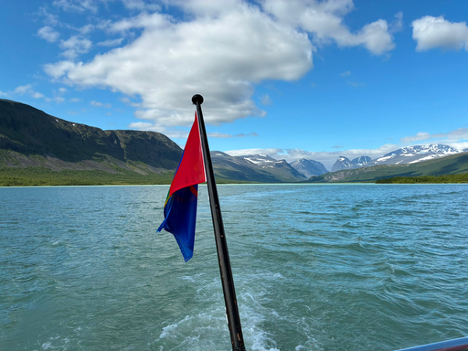
When you get to Nikkaluokta there are a couple of huts, a visitors centre, and a car park, and most importantly a road, where you patiently wait for one of the two daily buses that can take you to Kiruna.

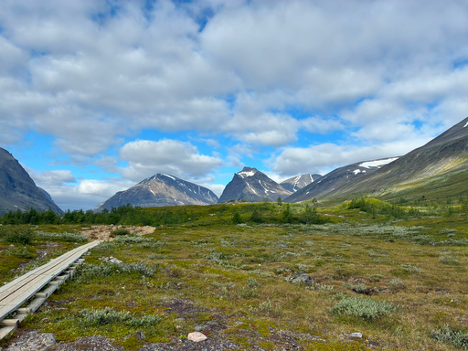
Kiruna is one of those towns which is probably more interesting to read about than to stay in. It’s a mining town, and the mining has been so enthusiastic that it has opened up all sorts of cracks and fissures underneath the town centre. Subsequently, the entire town has had to be relocated 3-5km away, starting with the church, which was moved over two days in 2025. We stayed in a fairly nondescript Holiday Inn, with a room overlooking the car park, which was a bit of a come down from the previous week. But during our brief stay we each had multiple showers, pizza, beer and a breakfast that wasn’t porridge and dried milk. Also, a chance to reflect a bit on what was a stunning hike in the wilderness. Thoroughly recommend it for lots of reasons, there was a bit of a detox about it, the landscapes were stunning, everyone we met was super nice, and Mrs E got everything she wanted out of her holiday. Except for the beard, for which I can only apologise.
Il fait chaud, et J’entends une souris

This is turning out to be quite the year for Mrs E. Although her birthday falls in May, the fact that it’s (whisper it gently) a milestone birthday means that she’s demanded a treat each month, to make the most of what has become her ‘special year’. 

There is a pattern to the months already. Each one has been marked by a trip to an airport, where she can be whisked away to some exotic location, ideally one that has a good supply of cold water and ideally bottles of cider. If we were still the generation that took phrasebooks on holiday then we’d have marked very specific pages in our books. As it is, we now know how to ask for wild swimming directions and cider in five different languages. if only we could understand the answers. 

Anyway, this being May, the demands were amplified, with the actual birthday specified in some detail as follows:

A)  a trip to Hatton Garden to buy the ‘ultimate bracelet’ 

B) a couple of celebratory ciders to admire said bracelet in the sunshine, with an occasional dip in mood because that she loved it so much that it seemed a shame that she’d only get another twenty years of wear from it

C) a trip across London for a further cider with BFF

D) a further pre-Theatre cider ahead of…

E) …a truly awful production of David Hare’s Teeth and Smiles, only really rescued by the appearance of Rebecca Lucy Taylor. Mrs E is something of a RLT superfan, she’s seen her twice this year already as Self Esteem and is coming to Camp Bestival for the first time this year, specifically so she can ignore the band I’m in, as we play (on a very small stage) while SE plays at the same time (on a very big stage). 

F) a quick curry at the wonderful Dishoom in Covent Garden, complete with sparkling birthday cake 

G) a race across town for the best ever (and eye wateringly expensive) G&T at the Cafe Royal

Quite the day, really, and it really wouldn’t be a celebration for us if we didn’t try to balance that light debauchery with a little hard work. And May’s hard work came in the form of a little trek in Provence. The plan was to take the train to Paris and then on to Avignon, while still nursing the birthday hangovers, then head out from Avignon and make our way towards Arles over the next four days. There’d be a bit of hiking, using the bags we were planning to use for July’s big trip to Sweden, maybe a bit of river swimming on the way, some nice places to stay, and ending up doing some cultural stuff in Arles. 

In the event, our hiking plans were limited as temperatures in Provence started to knock on the door of 40 degrees. Our first warning of this came on the TGV to Avignon, which broke down about 20 minutes outside Paris with an electrical fault that knocked out the air conditioning. Three hours later, the train was on the move again, unfortunately this time in the opposite direction back to Paris, where we’d have to board another train, which seemed to have everything working, and we headed south again. We reflected on the passenger reaction to the whole episode, in which several hundred people were sweating like pigs in a hot tin can but in which there was no over-reaction, no outward annoyance; no swearing; just a few Gallic shrugs at the time and a nice orderly and polite transfer once we got to Paris. I’d like to have had the same experience at home to compare  (obvs ‘I’d like’ is a figure of speech). 

Anyway, we got to Avignon, where it was very hot, and started walking the next day, when it was even hotter. Apart from the challenges of hiking with heavy bags in +36 degree heat, we had another particular issue. Regular readers* will recall that our rucksacks were last used for the Portuguese Camino, and were christened Beast One and Beast Two, on account of their weight. You know when you were a kid and you saw a beetle on its back, legs flailing away because it didn’t have the strength to turn itself over? Well, if either of us had fallen backwards while strapped to B1 or B2, that would have been us. B2 has the added disadvantage of having a squeak, and the added added disadvantage of being strapped to Mrs E. Mrs E is intolerant of many things, often things that to you and me might be quite innocuous. Examples include anyone who whistles, people who think they’ve invented cold water swimming, children with pretentious names and insufficient wiping down of kitchen surfaces. And to that list, we can now add Things That Squeak. To be fair to her, it was quite annoying, although at least regular, even and relatively quiet. So it didn’t really interfere with the quiet reverie of  the beautiful Provence countryside. But the irregular outbursts of ‘For f***’s sake’ coming from Mrs E did. These shouts cut through the reverie like an air attack warning, and always managed to take me by complete surprise. We tried repacking the bag, adjusting straps, bending the plastic frame and anything else we could think of, but to no avail. Eventually after about three hours in the heat we gave up, sweltering, and decided to get a bus to our next hotel. 

The same pattern for the next couple of days – set off in beautiful sunlight, get overheated, react violently to the squeakiness, then find a way to get to our destination before Mrs E kicked B2 over a cliff. 

I’m hoping that I’ve not given you the impression that hiking in Provence is anything but glorious fun – challenging and astonishingly beautiful countryside, excellent footpaths, not much traffic from cars or hikers. Just ridiculously hot,with a constant squeak, and occasional Tourette’s outbursts from Mrs E. 

On our return home, Mrs E had a final shout at Beast 2 as it was kicked into the spare room. I researched ‘ways to fix a squeaky Osprey rucksack’ and the internet was as helpful as ever, suggesting a variety of silicon oils and restitching patches, but in the end I asked Osprey for help. Well, who knew that every one of their rucksacks had a lifetime guarantee? Send it off to us, they said, we’ll fix it or recycle it and we’ll hurry a repair or replacement back to you. After a couple of days, where I like to imagine that the Osprey trainee technician was sent out on a long hike with a tape recorder and a profanity dictionary, they just sent back a replacement. Just like that. And it arrived. And (so far) it doesn’t squeak. Quite frankly, the best birthday present ever. 

As I write, we’re just embarking on yet another hike with Beast One and Beast Three. We’re going to the arctic circle, but if B3 starts squeaking and the wind is in the right direction, you should be able to hear Mrs E’s reaction wherever you are in the world. Wish all four of us luck x

*Hi, how are you doing? We should go for a drink some time. How about the smallest pub in Norwich? We won’t need much space. 

Unfinished business

Well, the last Emu blog received quite a bit of attention. Thanks for that, although I’d hope that the rise in stats wasn’t entirely due to a morbid interest in the infection levels of Mrs E’s feet. If it was, for you, then I suggest you take yourself off to onlyfans, where there are specialist subscriptions for the likes of you.

If you have a more healthy interest in the follow up to the last blog, however, do read on. Because minutes after getting home on one foot, Mrs E decided that there was some unfinished business on the Camino Portugués, and that that business was to be finished just as soon as she had two workable legs. Optimistically, she decided that should be within six weeks, so I was set to work rebooking hotels (tick), rerouting routes (tick) and claiming on travel insurance (no tick, another story, unfortunately).

And so, around six weeks after our shameful exit, we were heading off again to Santiago de Compostela, this time jammed in to a Ryanair flight along with about two hundred Spurs supporters, all headed to Bilbao for the Europa League final the following day. ‘But Bilbao is nowhere near Santiago de Compostela’, I hear you cry. Well, apparently any flights and hotels for Bilbao were stupidly expensive, so, according to the Spurs supporter that I spoke to, it made much more sense to get a plane in the right general direction, then hire a car and drive the 6 hours to stay in Santander, then get a train to Bilbao for the game, then do the whole thing in reverse the next day. Luckily for him, they won the game, otherwise that would have been a really long trip back. Our hearts go out to the long suffering Man United supporters of course, one of whom I heard in the passport queue, worrying that he didn’t know what he’d do if they didn’t get a win out of the final, because ‘we need to get something from this season’. Poor lamb.

Anyway, back to the walk. Despite Mrs E’s enthusiastic atheism, she’d had her doubts when getting injured, thinking that she may have been struck down by the spirit of St Isabel. This thinking went back to around 7am on the morning when we crossed from Portugal into Spain, where we’d settled into a conversation with a particularly stern American man and his son. The conversation ended at the point where Mrs E said that she had no truck with this religious nonsense, and was only really doing the walk so she could get to the end. It turned out that the Americans very much did have truck, and were absolutely on the route to get whatever spiritual lift (and possible guidance through purgatory) from the hike. We spent the subsequent boat journey avoiding eye contact and conversation, and grunted our goodbyes on the Spanish pier, at which point they shot off like rabbits in a completely different direction to the route markers, and we never saw them again. And only an hour later, the heavens opened, Mrs E’s feet got soaked, blisters were formed, infections were developed, and before too long she was in Vigo hospital on a drip, wondering if St Isabel was working in a very mysterious way. I mention this now, because on part two of the walk, Mrs E was a bit more open about the chance of getting a spiritual lift. After all, part of the point of the pilgrimage was to suffer in the name of something that you believed in, and it would be a shame if you couldn’t have that something to help the suffering along. And towards the end of the walk I saw a side to her that is normally very well hidden, offering factor 50 to women who looked a little red round the shoulders, stopping to offer Nok cream to people with sore feet, and generally putting herself about like she was the living embodiment of Saint Isabel.

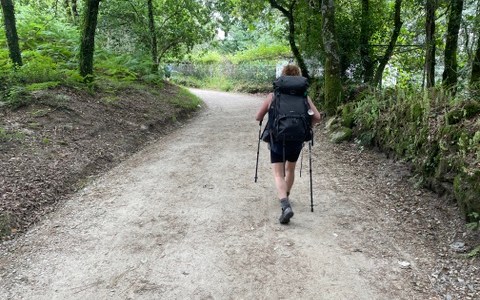
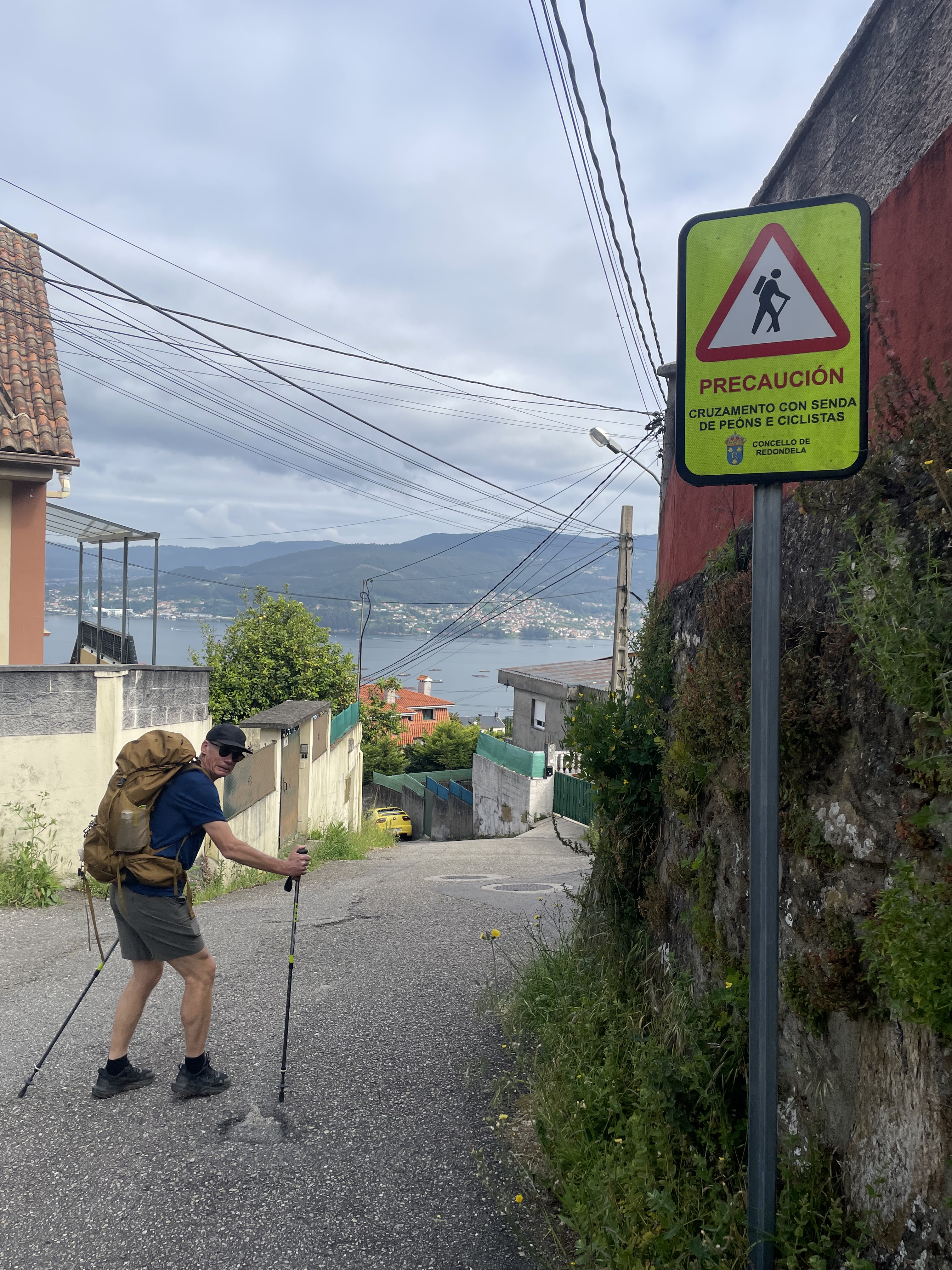
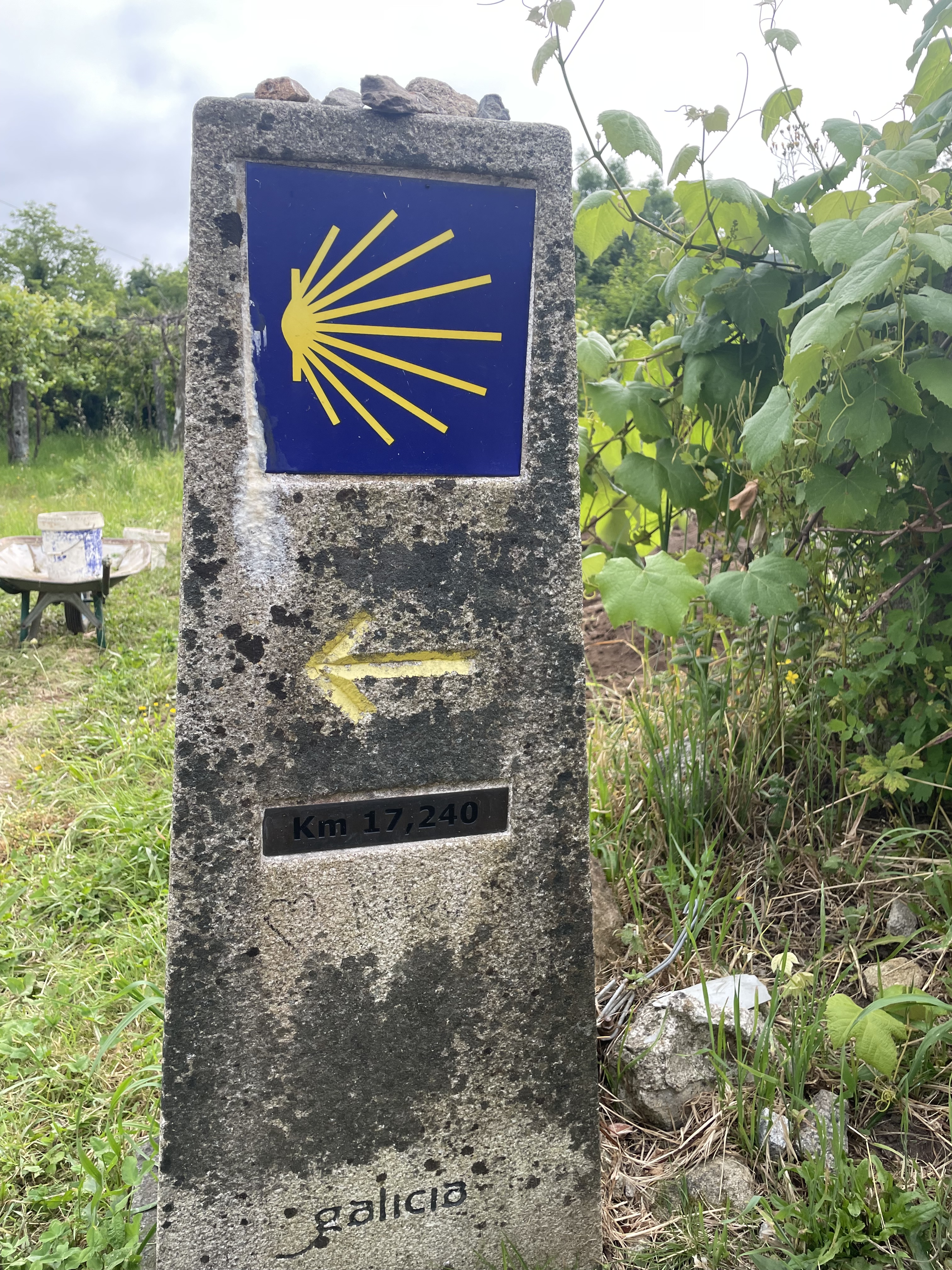
To day one then, and we strapped ourselves into Beast 1 & Beast 2. I appreciate that this will mean more to you if you’ve read part one of this blog, but if you haven’t, this might be time to use your imagination and possibly remind yourself of what a terribly sordid mind you have. Anyway, an easy four hours in the sunshine, out of Vigo and north east along the coast to Redondela. Lots more people on the route than in March (unsurprisingly) and already sorting themselves into a hierarchy. At the top of the hierarchy are the pilgrims who are carrying their own gear in big rucksacks and staying in albergues, which are the hostels on the route. Next level down are those, like us, who are carrying their own gear but have opted to stay in cheap hotel rooms, primarily to avoid sleeping and snoring in noisy dormitories. These two levels can also be separated by the use of wooden staffs for balance, as opposed to walking poles, which mark out the seniority of pilgrims, as well as Tolkien characters. Next level down are the hikers who’ve arranged to have their luggage transported between stages. This is a very good idea if, say, you can’t function without hair straighteners and a travelling library of an evening, and it’s something that we’ve done in the past on other walks, but it kind of minimises the suffering. There really is nothing like the feeling of 10kg on your back to make you lean forward onto your stick and at least form the silhouette of a medieval pilgrim:

Anyway, the hikers with day packs can be spotted by their excellent posture and practiced overtaking manoeuvres. A little further down the list are the cyclists, who have a varied approach to overtaking notification, and still seem to be doing the same distances as the hikers. And finally the guys who have hired electric bikes for a couple of weeks, and freewheel cheerily by on the uphills, occasionally smoking a fag. Somewhere in this hierarchy are the horse riders, who can also receive certificates for completing the Camino; we didn’t see any of them though, I suspect they’d go out early to avoid the crowds and the heat.

A bit of reflection on the spiritual journey as we wandered along. This pilgrimage lark obviously means lots of things to lots of people, and we spent a bit of time talking about what those things might be, concluding largely that they were to make sense of and manage mortality, something that I’m obsessed with, and of which Mrs E has a much more mature and nonchalant view. So, a few happy miles chatting about death, during which we planned each others funerals – I can’t give you the detail of the conversation for reasons of sensitivity, but I can tell you that a) I’d really like to be around for my dry run, including the wide variety of guest speakers that Mrs E plans to invite and b) Mrs E, after her last walking adventure, has opted to be cremated in an open toed coffin.

Day one ended fairly early at Redondela, a really lovely town where it would be rude not to sit in the town centre with a cold glass of Estrella and a couple of plates of tapas. So we did.

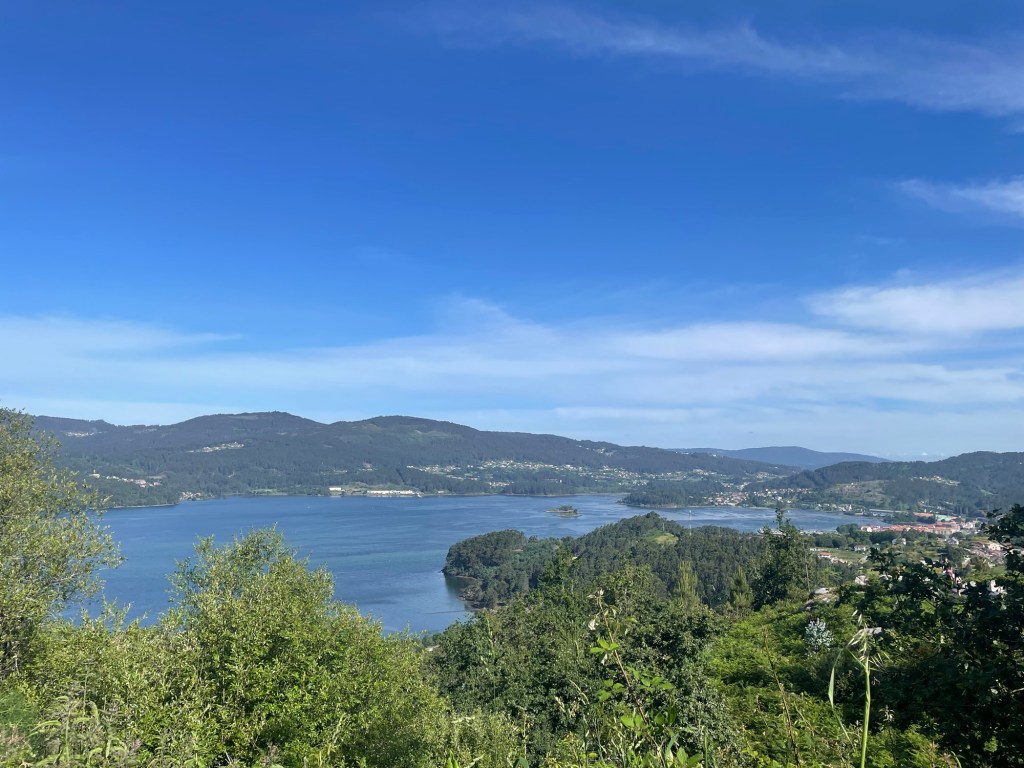
Redondela to Pontevedra the next day was a bit further, and took around six hours, with a couple of fairly gnarly climbs in the sun, but eased by some really great tracks in the forests, sometimes allowing us to look left and down to the inland sea of Enseada de San Simon. All a bit too much for Mrs E, who was missing cold water even more than spiritual awakening.

Pontevedra is another lovely town, the sort of place that you could happily retire to and write that novel that you’ve always promised the world. Although in reality, your days would be just as fulfilling if you were watching the world go by with a coffee in the morning and a beer in the evening, separated by a serious siesta in the daytime. Really must get round to that one of these days. On the subject of books, Mrs E decided that a good use of our time would be to get me started on some productive and rewarding work for a change. She’s been saying for some time that I ought to write a book, so suggested that we spend the several hours from Pontevedra to Caldas des Reis working out the main character and plot lines from a number of lucrative novels. Figuring that Richard Osman is all the rage at the moment with a series about unusual detecting, we agreed that we should create a new character called Santiago Jones, who solves a number of crimes on Camino routes, mainly by interviewing fellow hikers. Santiago Jones will have some detective skills, but we couldn’t agree on the specific traits that would set him aside from other gumshoes. On the understanding that no idea is a bad idea, we agreed that he should be something of a modern polymath. He can play any musical instrument, speak and understand any language, and make any animals do his bidding. He has a good understanding of martial arts, and will normally carry an axe, along with a staff carved from a tree branch from the garden of his late lamented mentor. He is also proficient in gymnastics, archery, boules and imitating birdsong. The first few mysteries that Santiago Jones will solve (copy these at your peril, Osman) are provisionally titled Murder on the Camino Portugués, the Mystery of the Masked Pilgrim and The Compostela Massacre.

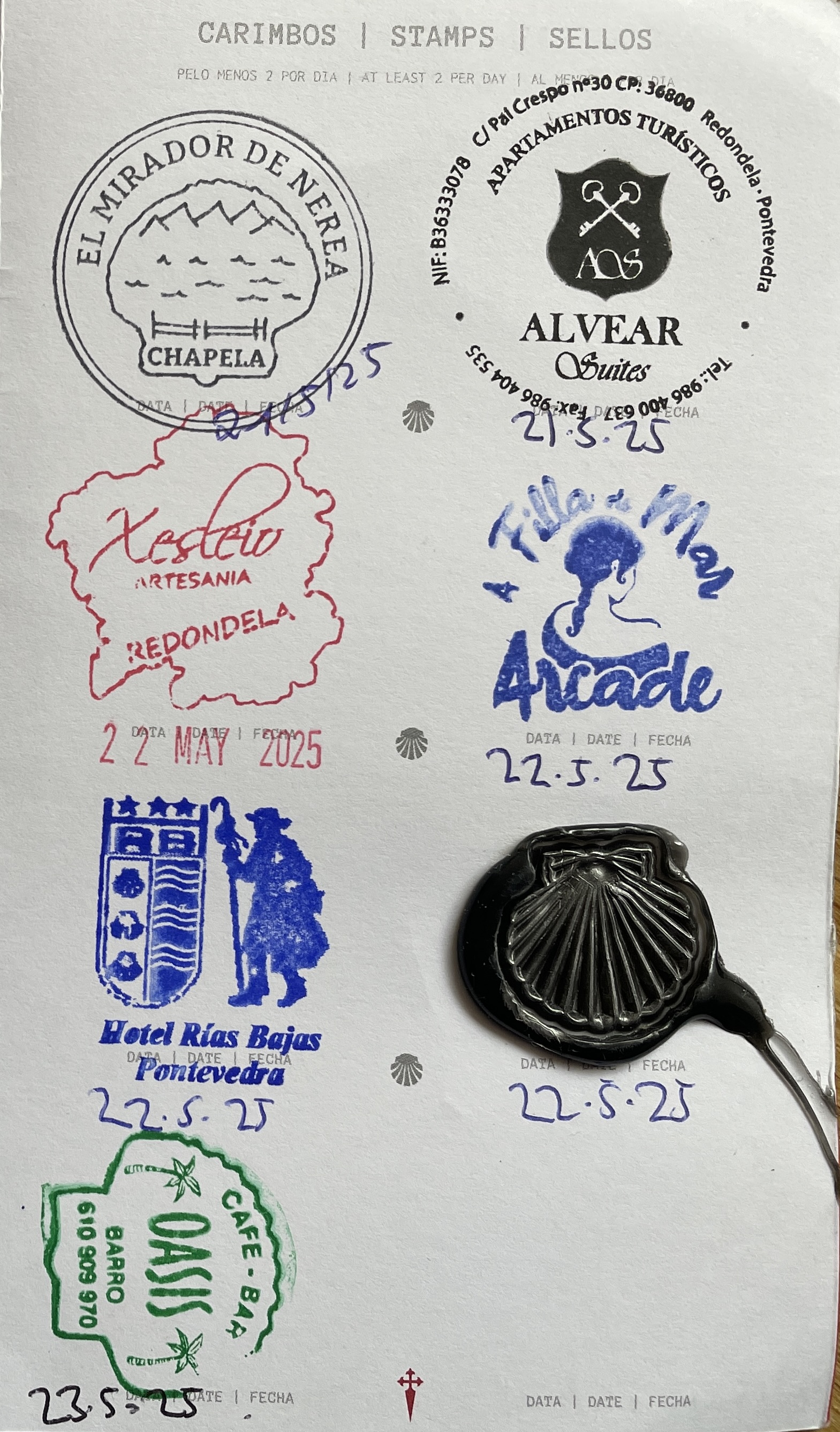
Pontevedra to Caldas de Reis next, and another six hours, very hot walking, but with a gentle breeze. And the mildest camembert, tee hee.* There was a big bump in the middle of the route, where we stopped at a very strategically placed van, serving food and drink. I mentioned in the first blog about getting your Compostela card stamped en route, which would mean that you would get a certificate at the end, and Mrs E was delighted to get by far the most elaborate stamp yet, finished in black wax with silver detailing. Also explained the length of the queue at the van.

At the end of the stage, Mrs E had unfortunately developed a problem with her right eye. ‘It’s not affecting my walking’, she declared, tripping over her walking pole for the 15th time, ‘I just need some chloramphenicol’. We went to the chemist, and were directed to the doctor around the corner, where we google translated ourselves into a waiting room. This was beginning to feel familiar from our last saga, but we were seen really quickly by a doctor who did a full assessment involving fluorescein, lots of torch work and folding Mrs E’s eyelid back with a fairly chunky retractor. Mrs E remained cheery throughout the process, testing out her new Duolingo vocabulary (already an impressive 500 words) with a doctor who disappointingly spoke perfect English. She was also chuffed with a prescription for chloramphenicol, sagely agreeing with the doctor that this was a very wise diagnosis. As the prescription was being stamped, she reached into her bag and brought out the Compostela documents, asking the doctor to stamp these as well. I’m still not sure that she was joking. Anyway, back to the chemist, paid the massive prescription charge of €4, and reflected on the wonders of the Spanish healthcare system. As I write this, Mrs E has just returned to work to a criminally understaffed hospital where all nurses and doctors are being offered voluntary redundancy to meet cost challenges…

Caldas de Reis to Padron the next day, and a slightly shorter five hours, but with another bump half way. With only two days to go, and the merger of the coastal and the mainland Portuguese camino routes behind us, it was getting to be a bit busier. Good in lots of ways, and we met some lovely people, and exchanged ‘Buen Camino’s with loads of other pilgrims, but the solitude of the previous walks became something that we began to miss. And certain voices managed to cut through the countryside like knives. I wished I’d had the ability (like Santiago Jones) to speak lots of languages, cos some of the conversations were so animated and so long – sentences that seemed to last for ten rapid fire minutes without drawing breath – it really made you wonder what they were about. It’s quite difficult to put a lot of distance between you and other hikers, unless you stop to take a picture, at which point you inevitably find that they stop as well. It’s like being in a very polite marathon but at a much slower pace. Similarly to marathons, the technique for overtaking is quite challenging. It might take you twenty minutes to make up fifty metres on someone, because you’re walking at such a similar pace. So if you go past them, you have to speed up a bit, otherwise you’ll end up getting under their feet. Obviously you’ll give them a cheery ‘Hola, Buen Camino’, but what then? Sometimes you might fall into an easy conversation and spend the next few hours chatting away, and maybe swapping addresses and making promises to holiday together some time (this has genuinely happened to people I know), but more often you’ll have a brief chat, then remember that you need to complete your overtaking manoeuvre. Timing is crucial here, as there is a danger that you end up continuing to chat over your shoulder, which is uncomfortable at best. Anyway, it’s a bit like being one of those lorries overtaking uphill on a motorway. It takes for ever, and you do wonder once it’s done what the point actually was.

Padron is another lovely town, tiny steep streets and beautiful stone buildings , and it would be really peaceful were it not for the endless procession of pilgrims enthusiastically trooping through. Still, I guess if you’re going to have a tourist trade, peaceful religious pilgrims who want to be tucked up in bed by ten and who eat like horses are the ones you’d want.

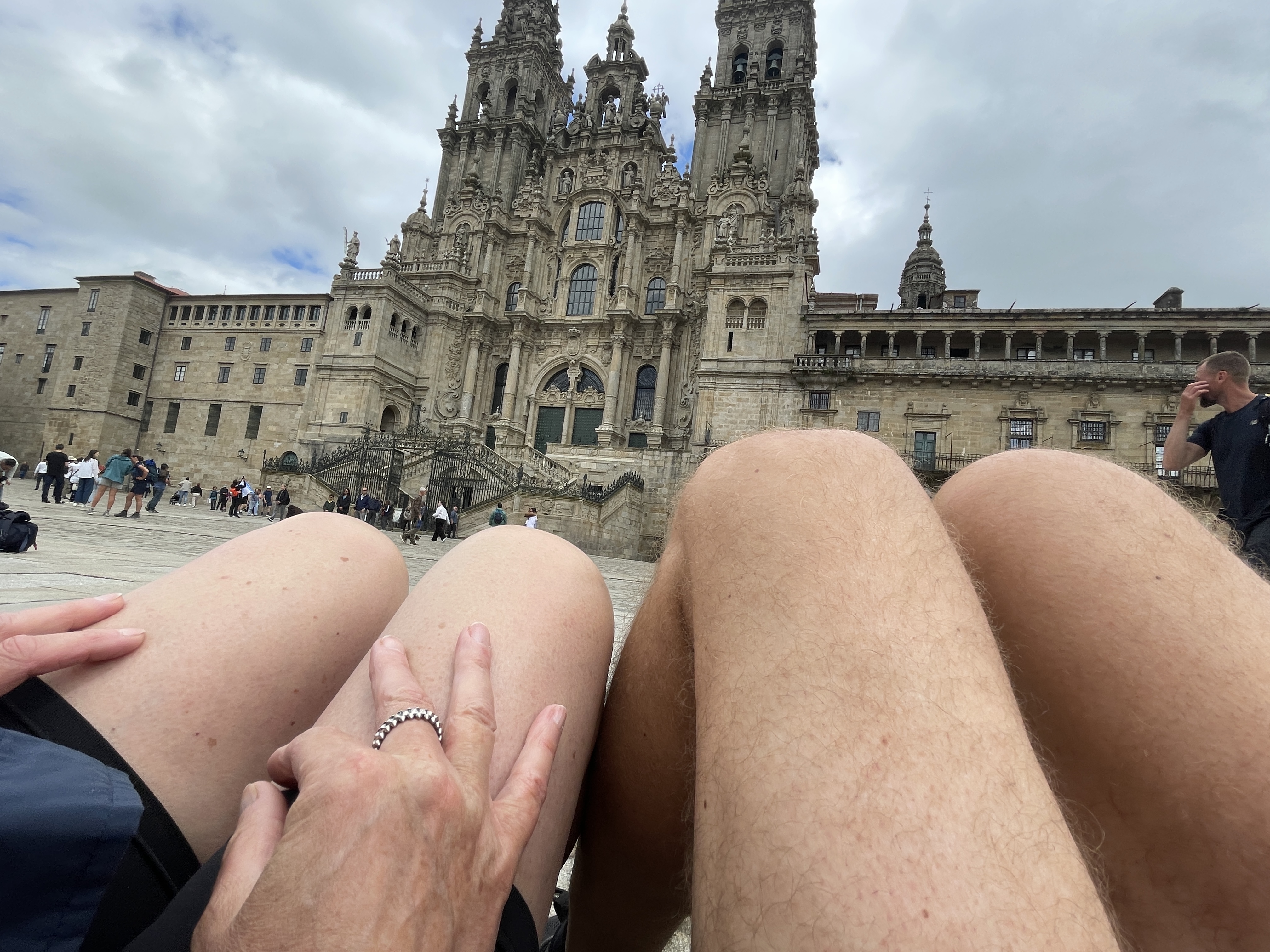
We were tucked up in bed a little later than ten and by the time we got to the 0730 breakfast, the locusts, or, as we will call them, mountain bikers, had already filled their capacious lycra clad stomachs and back pockets with pretty much everything that the buffet had to offer. Consequently we left for the longest leg with fairly empty stomachs, reminding ourselves that breakfast is a much overrated meal anyway. But this did mean that we managed a reasonably early start, and it was overcast until about 2pm, so perfect weather for the parade into Santiago at around 3. By the time we got to the outskirts of the city, we didn’t need signs any more, we just followed the snaking trail of pilgrims all the way to the cathedral, where we did all the things that you’re supposed to do at this point – sighed a bit, took pictures, posed for more pictures, sent messages home, took our shoes off, and lay in the sun with our heads facing up to the top of the cathedral.

Santiago de Compostela is a gorgeous city, and completely dominated by the cathedral, which in itself is astonishing. We’d been in it before on another adventure, but didn’t feel that we could justify seeing the relics of St James or touching the back of his statue above the altar until we’d finished the Camino. But we had now, so we did, and felt fairly good about it. Not quite a conversion, but maybe a bit more respect for people who have a belief system that means that a bit of suffering goes a long way. And if that long way means that there’s a bit less time spent in purgatory, well that’s just peachy. Mind you, we had an interesting conversation with a couple of hardcore pilgrims at the airport, where we considered whether taking a coach to all the key points, getting Compostela stamps and certificate for a couple of days travel was cheating. And having concluded that it was, then so was staying in hotels, sleeping in beds, not working your way from stage to stage to pay for your meals, wearing anything other than sandals and a robe, not carrying a staff and not walking home afterwards. So maybe we’re all cheating a bit, and maybe that’s the life lesson we need to learn about trying a bit harder next time.

So, until next time, Buen Camino!

  • This joke courtesy of ‘A Bit of Fry and Laurie’ c1986. In the same sketch, SF says ‘I stooped to pick a buttercup. Why people leave buttocks lying around I’ll never know’ ABOF&L made us very happy for a very long time.

Organised Grime

I’d been to Sicily once before, when I was young, naive and, for the duration of the entire trip, drunk. It was a university hockey tour, and probably not the best way to explore Sicily’s culture, geography and people. I look back on the trip with a bit of a shudder, but try to remind myself that everyone does stupid and reckless things when they’re young.

This time was going to be very different. Me & Mrs E wanted to walk the Magna via Francigena, which is a pilgrimage path running from Palermo through the centre of Sicily to Agrigento, and we were promised that we’d (and I rather obviously quote…):

  • Roam the pure natural landscape of Sicily’s rural backcountry
  • Stay in villages full of history, such as Sutera, with its Arabic maze of alleys
  • Experience the enthusiasm, hospitality and pride of the Sicilian people
  • Try traditional Cannoli pie filled with ricotta, pistachios and candied orange

That sounded like exactly the sort of things that we should be doing in March, so off we went.

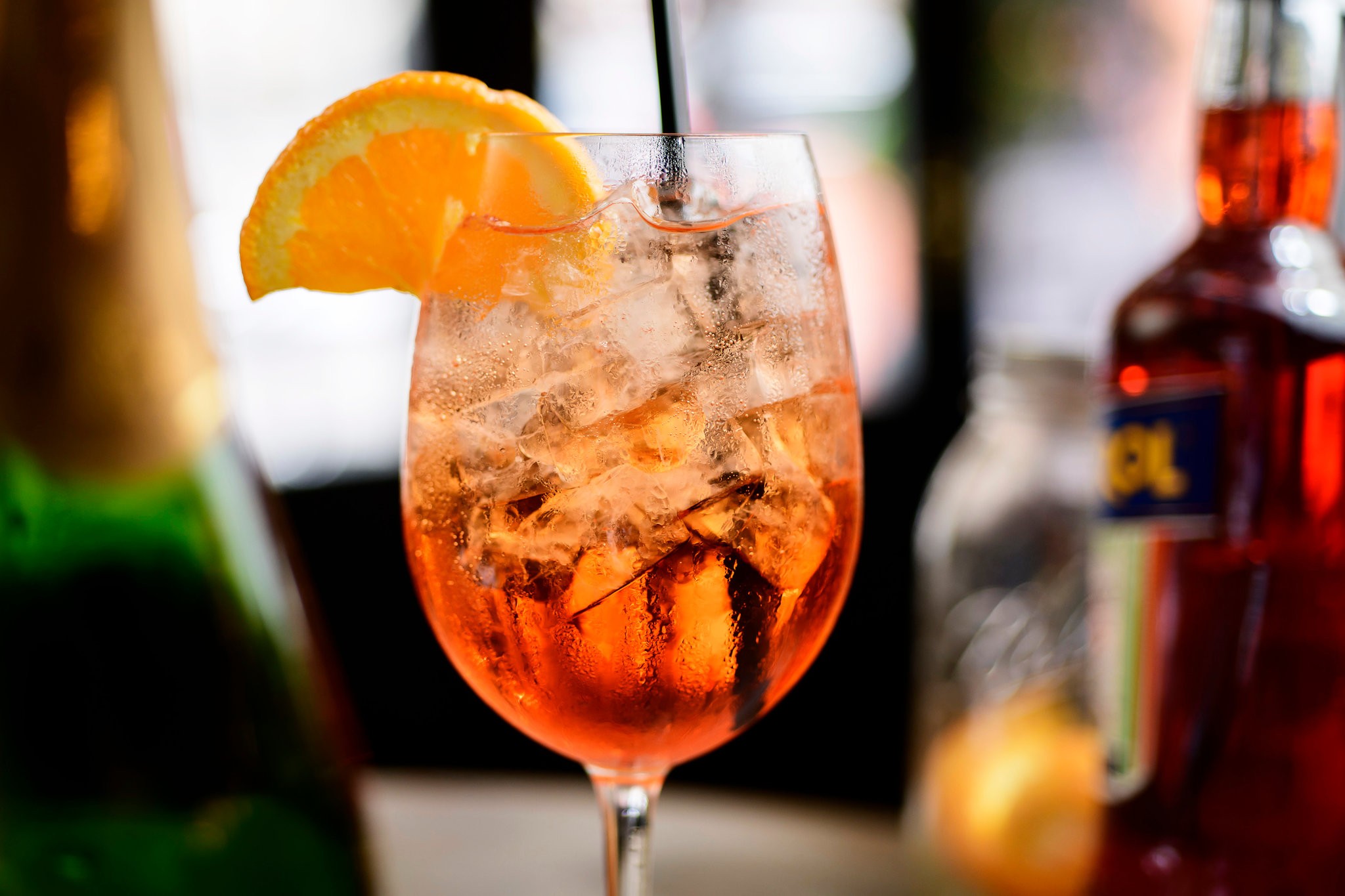
Our arrival in Palermo was a bit less idyllic – it’s a big city, and the airport train took us to the centre through some fairly ropey areas, depositing us outside the central station, with Google maps assuring us that we had a 10 minute walk across to our hotel. Half an hour later, having wheeled our cases through cobbles, kerbs and lots of litter, we found the hotel, checked in, and wandered around Palermo looking for our dream candlelit trattoria. One brightly lit vegan burger later, we found a bar that served Mrs E some weapons grade Aperol spritzers , together with huge plates of bruschetta and chips, which were, apparently, a gift from our host, who must have thought that we looked hungry. Our Italian is very limited, so our conversation was a bit stilted, but it did allow him to say “Hello Baby” a number of times at various volumes, and to establish that Paul McCartney and Mick Jagger were both still alive, and that he’d like to visit us in Liverpool at some point. We made arrangements to come back after the walk for further entertainment.

We had a taxi pick us up in the morning to deliver us to Santa Cristina Gela to start the walk. Again, a challenging conversation but we did establish two important things. Firstly we should always follow the red and white path markings. And secondly that GPS was a very good thing indeed. There was some other stuff that may or may not have been about Mussolini and railways, but that was much harder to follow and probably best ignored.

Our walk to Corleone started gently on undulating, soft green grass tracks, shortly giving way to a bit of mud. The first 10km was fine, but then the mud started getting wetter and wetter and turned from mud to clay, and before too long was adding a couple of pounds to our boots.

We heard a couple of days later that Sicilians call people from Corleone ‘Men with feet of clay’, which I don’t think is intended as a compliment, but maybe we were acting like natives with our stupidly heavy boots. We discovered that many of the paths that we took doubled as streams, and quite enthusiastic streams as well, as it had started raining just as we’d started the walk. This meant going down was really scary, and going up was even worse. At one point, we went down a steep muddy path/river bed for about 2km, all the time looking at a river below which our notes said should be crossed carefully, and a grass/mud climb the other side that looked almost vertical. We managed to get across the river, with very fast water coming up to our thighs, and just about got to the top of the other side, despite picking up clay on our boots with every step. I tried to reassure Mrs E that not every day would be like this. I had absolutely no reference point to be able to say this, other than my sunny optimism, which was getting a bit of a soaking of its own. Mrs E was also less excited than me on the result of the Norwich game (a 3-2 win away at Millwall) which came through about half way up the climb.

Finally made it into Corleone, which most people will associate with The Godfather. Don Corleone is fictional of course, but there’s quite a lot of early mafia history which emanates from Corleone, and if we’d not been covered in mud and arriving two hours after it closed then we would have had a wander around the mafia/anti-mafia museum.

Instead, we trudged to the hotel, where we were greeted by power cuts and some firm instructions that we should be taking off our boots, after which we were directed, freezing, barefoot and outside, to the room furthest away from the main building, presumably because we offered a health hazard to other residents. Between our room and the main hotel there were an astonishing number of lights on every tree and every wall, and possibly giving a clue as to the source of all the power cuts.

Washed most of the mud off and opted to eat in the hotel, partly as it was still chucking it down and partly as it was the only place open in the town. An interesting experience, and again not quite the rustic candlelit trattoria that we’d hoped for – I don’t think I’ve ever been in somewhere so brightly lit, except when the power went off. We were ushered into the main eating area, and took a seat near the middle, and just as we sat down Mrs E asked if we could move – there was a smell coming from the middle of the room that was going to impact her dining experience. The smell came from the centre table, where a man in dungarees had sat, and Mrs E was absolutely right – he absolutely stank of urine, which appeared to have made its way onto the yellowing hoody that he wore under the dungarees. Feeling a bit more charitable than Mrs E (Norwich’s away win was still making me very upbeat), I suggested that he might be a local farmer, and that we shouldn’t judge, because it “might not even be his own piss”. This reasoning wasn’t really appreciated, and we noticed that the many other diners were also moving tables, so that we created a kind of neutral doughnut around the poor smelly bloke.

A succession of waitresses came to see us, our attempts to point at things on the menu and ask for them didn’t seem to work at all, and eventually the third waitress agreed that the point and say “Si” approach was acceptable, despite her attempt to upsell us the risotto. All of the staff looked as if they would much rather be somewhere else, but it may be that they were undergoing some sensory deprivation testing. In addition to the assault on their noses and the blinding lights, there was a sound system that would have done justice to one of the larger Ibizan clubs. It was mainly tuned into a local radio station, but at one point managed to mash up the radio with the football commentary from the huge TV screen in the bar, together with some romantic ballads on the restaurant speakers. A special mention for the only male member of staff, for whom the name ‘Lurch’ might well have been invented. Wordlessly and aimlessly he wandered between tables, occasionally picking something off one table to put it down somewhere else. His bow tie, which presumably had begun the evening at a steady East-West setting, had begun moving around of its own accord, a bit like a revolving tie with a very flat battery. Halfway through our meal it had gone from ESE-WNW to a jaunty SE-NE, and by the time we left it was creeping gently towards true north. Maybe that’s how you wear a bow tie in Corleone. But it’s Corleone so maybe best not to ask.

Up early the next day for the next leg, a 21km trek into Prizzi, which would have been stunning if it hadn’t been tipping it down with rain again. We’d had a hasty breakfast, sped up by the surprise arrival of Urine Man, who popped into the restaurant for a coffee and left behind a distinct reminder of the night before.

Walking up and out of Corleone past olive groves and broken down farms, an idyllic walk spoilt only by the amount of fly tipping on the side of the paths. Fly tipping feels like it’s something of a national pursuit round here – whole bathroom suites and tiles at one point, collections of kitchen contents next, clothes thrown onto the road, a bin liner which was split open and was spilling out human hair, and loads of plastic bottles and cigarette packets, often with branding that I’d not seen for years at home. I mentioned to Mrs E that there were loads of Chesterfields on the road, and she told me about an hour later that she’d been impressed that I could tell the type of sofa that had been dumped, just from a few springs and cushions. Alarmingly, there were lots of disposable gloves on the side of the road as well – now why would that cause any concern?

We saw no one else walking, but a couple of drivers took a bit of interest in us. The first one stopped his car so that he could shout a long and enthusiastic message of support, complete with lots of positive hand action. We decided that, as this was clearly a great place to waste enemies, that he was using us as potential alibis. He might well have been responsible for some of the disposable gloves. A few km later, a jeep overtook is up a hill and the driver jumped out, asking if he could take our photo, as his web site publicised the Magna Via Francigena pilgrimage. Or at least, that’s what we thought he said. There was definitely something about his web site in there, but it would have to be really specialist for a picture of two muddy tourists in walking gear for us to be the March calendar picture.

We saw a bit of wildlife, in the form of giant frogs, most of which had been flattened on the road, and vaguely domesticated dogs, many of which decided that we were deserving of a lot of attention.

Sicily has a number of dog breeds, but we mainly drew the attention of the Maremmano-Abruzzese sheepdog. These dogs, which look like oversized white labradors, are bred to protect sheep, and to bark if they see anything out if the ordinary, which definitely included us.

Apparently they’ll also attack, if provoked, and will only stop once the shepherd calls them off. Frustratingly, we saw a great many dogs, and no shepherds. Mrs E read up about the dogs later and found articles suggesting they weren’t recommended for keeping as pets in towns and cities, as all they did was bark all the time. Which led, naturally, to a conversation about Solomon, a dog who we will always miss when we go away, but will wish he could shut up within minutes of getting home.

Finally started the long climb into Prizzi, and with about 1km to go a car pulled up and the driver jumped out, addressing us by name, which was a bit unnerving, until it turned out that it was Salvatore, who owned the Airbnb that we were staying at that night. He’d noticed it was raining and asked if we wanted a lift for the last bit, but we took a look at the state of each other and the cleanliness of his car and thought better of it.

We met up with him later when we’d arrived and it turned out that he’d been a driving force behind the Magna via Francigena route – he assured us that the worst of the mud climbing was behind us, and pointed us to the only restaurant open in Prizzi that night, a very brightly lit Pizzeria which turned out to be staffed and frequented entirely with cast lookalikes from The Sopranos. At one point, Christopher’s double came in for a takeaway, while Uncle Junior held court with dozen of his family. Truly bizarre.

Prizzi is one of the towns that had offered houses for sale for €1, to anyone prepared to live in them for a couple of years. In some areas you’d also get a grant of up to €30k to spend on the property, again if you committed to live there. Cammarata, where we were walking to next, had made headlines a couple of years ago by waiving the €1 fee. You get the dilemma when you go through the towns – these are idyllic places to live but there’s no work about, and an aging population. There’s some indication that the incentives might have drawn some younger people back home, but from what we saw, probably 90% of the houses were shuttered up, and of the few people we did see, they were even older than us.

Not that we actually saw any people on that day’s walk. We did 25km on a very hilly path, mainly through the Carcaci nature reserve – more beautiful views over the mountains and deserted forest roads as we climbed up to just under 1000m. All was well until the rain kicked in again, this time with some added wind, which soon turned ridiculously strong. By this time we were descending along a cliff road, with vehicle detours in place because of falling rocks. It was probably the only really scary part of the trip, and we arrived in Castronova, making quite the bedraggled entrance into the only bar in town, and immediately being ushered into a side room for the sake of the public good, where the barman brought us hot chocolate and cannola, and suddenly all was right with the world.

We were half way through the walk now, and were in fairly good shape other than Mrs E’s blisters, which hadn’t been helped by having the previous three days walking in soaking wet socks and boots. The next day was to Sutera, another impossibly pretty town surrounding the Monte San Paolina, and it was only 15.5km, so we thought we were in for an easy hike. In reality, it was another tough one, the initial climb up to Aquaviva Platini was a challenge, then followed by a long and very muddy ridge walk to the long road up to Sutera.

Worth it for the views alone though, and we were sustained by a long round of ‘Finding The Band In The Hardware Shop’, with winning entries including Sister Sledgehammer, Sheryl Crowbar, Paint Guns and Hoses, Barbecue Streisand, U Bend 40 and Earth Wind and Firelighters.

We stayed a couple of hundred metres downhill from Sutera, and again, there was only one restaurant open, which was a little way away. Our B&B host was appalled at the idea that we might want to walk to it in the dark, so she called the owner, Franco, and arranged for him to give us a lift. Don’t think we’d get that sort of service at home. Anyway, we got picked up in a knackered Fiat with no suspension left, and we’re despatched at breakneck pace to Franco’s restaurant, where we had the best antipasti we’d had all week, then the best pasta we’d had all week. We both almost fell asleep at the table, as we had to wait for Franco to finish his pizza deliveries and lock the restaurant up, but well worth it nonetheless, and to get us home at a reasonable hour, Franco went for a PB on the way back.

From Sutera to Racalmuto then – another long day punctuated by stunning views, and very lively dog interactions, the scariest one being with six loud and lively sheepdogs at once who seemed to be keen on herding us toward their sheep, then immediately away from them. More stunning valley views and with the bonus of decent weather, the walk took around 7.5 hours – Mrs E concluded that her cut off point, for future reference, was six hours, which I look forward to forgetting when we plan future trips. Todays best game was ‘Famous People In Hospital’ and winning entries included Urinary Tract Geller, Cancer Ian McKellen, Jennifer Canestan, Rib Separatori Amos, Gina Lolladentalbridgeida, The Monty Burns Unit, and my personal favourite, The Brighouse and Gastric Band.

As ever, it was another climb into Racalmuto to end the day’s walk, but this time into a town centre with loads of pedestrians and cars. We managed to find somewhere to sit and watch what was going on, as we’d not seen so many people in one place since Palermo. It turned out to be a funeral at the church in the town square – we were assured later that it was normally much quieter, and sure enough, when we sought out the only restaurant open a couple of hours later, there was nobody around. There was a bit of confusion at the Airbnb that we’d booked before then though – we assumed that when we’d been let in, that we had the whole flat to ourselves, and so set up camp in the kitchen. I offered to get our boots cleaned, as the next day was the last day of walking and was mainly on the road – we didn’t want to trudge a load of mud into our last hotel in Agrigento. So I set to, cleaning hopefully the last bits of clay in the kitchen sink, which took a lot more time than I thought. Just as I was getting to the end, there was a loud Ciao Ciao downstairs, and into the kitchen stomped a vision in leather trousers, leather waistcoat and a very stern expression, which turned pretty thunderous when she saw what I’d been doing in her kitchen sink. Going ballistic is an overused expression, but completely valid in this case, and for the first time since we’d landed in Sicily, I was very glad that I couldn’t understand Italian. I did, however, get the gist, and apologised as much as I could, and also established that there were two other parties taking rooms in the apartment and that the kitchen was only to be used for breakfast. Cruella, who Mrs E had named within seconds of meeting her, was in charge of breakfast, which unsurprisingly the next morning turned out to be a rather spartan affair. But completely served us right.

And so to the final day, a short (11.5km) hike up to Grotte and then largely downhill on roads into Caldare, where we got a train into Agrigento. Still beautiful, particularly the start, but more houses, (mainly) chained dogs and litter as we headed towards the coast, so we were pleased to be able to get the train. We got into Agrigento and walked what Google maps had told us was 20 minutes to the hotel, and which ended up as 45. We really wanted to see the Valley of The Temples and were told at reception that it was a 15 minute walk, so Mrs R bandaged up her blisters and off we set for the last trek of the holiday. Unfortunately we took a wrong turning, ending up 45 minutes later at the wrong entrance, but that mattered a lot less as soon as we started to hike up the hill to see the temples. It would be worth going to Sicily just to see this archaeological site – it’s over 2,000 acres in size and is brilliantly preserved – The Temple of Concordia is the most stunning, and the one that you’ll see on the tourist sites – built in the 5th century BC and still looking pretty good:

We were knackered and ideally would have got in a bus back to the hotel, but there weren’t any buses or taxis, so we trudged up the hill back to the hotel, packed away our walking boots, popped Mrs E’s blisters, showered, and went into the restaurant to celebrate. It ended up being a bit of a muted affair, as we were both so knackered, but we still had a couple of days ahead in Palermo where we could get the right side of an Aperol spritzer or two, so we looked forward to that instead.

Next day, to the station and the train back to Palermo. Slightly demoralising to take 2.5 hours to cover slightly more distance than we’d taken six days to walk, but I guess the train had a lot less mud to contend with. And Palermo in the sunshine was lovely – really stylish and as effortlessly cool as many of the other Italian cities we’d been lucky enough to visit. An afternoon at the No Mafia Memorial was suitably sobering, but the Aperol was calling, and it was only a short walk away…