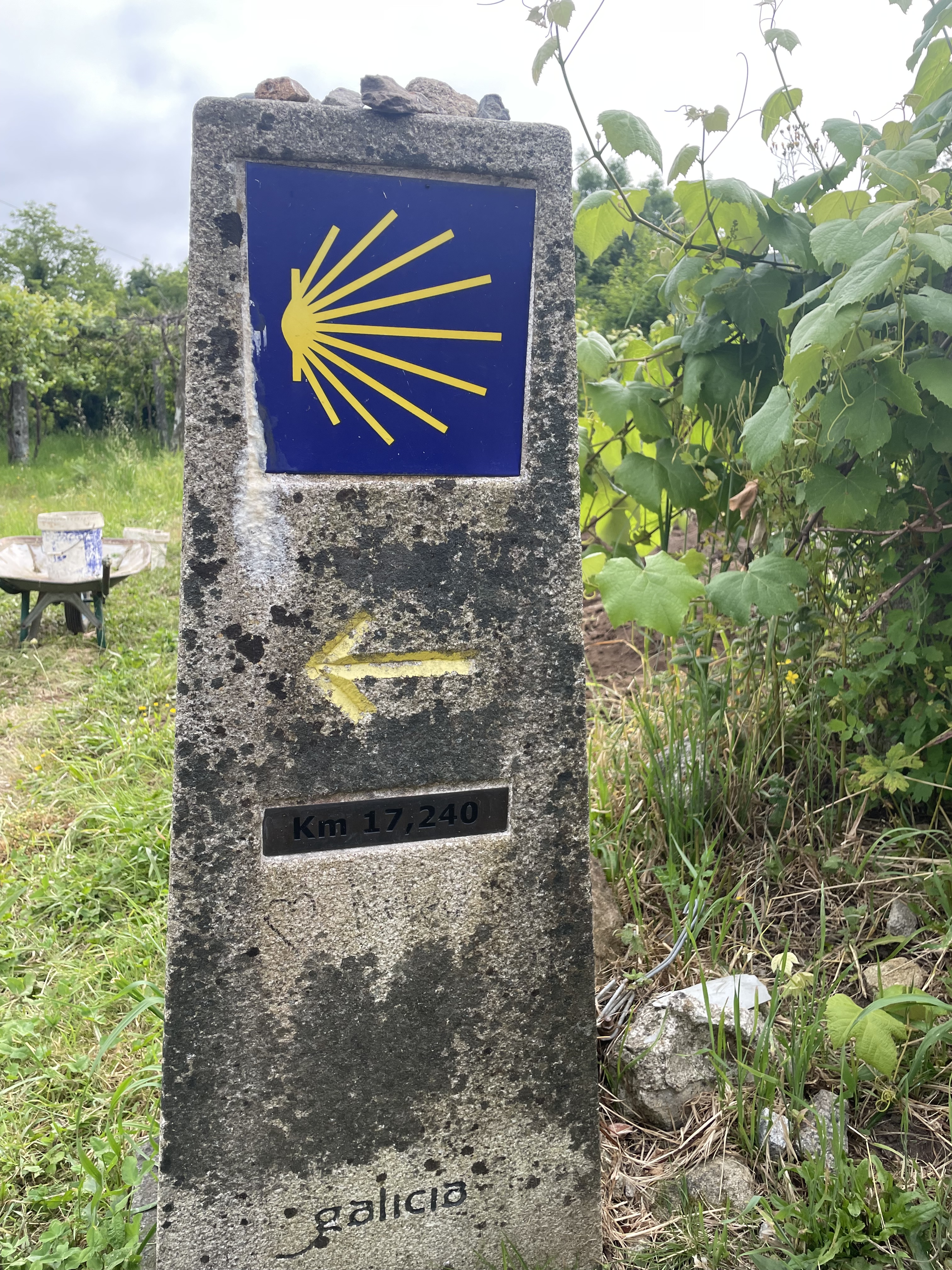
First avowed intent

If you know about the pilgrim Camino network in Europe, then skip this bit. If you don’t, then buckle up, because, even if you don’t fancy yourself as a modern pilgrim, it’s still fairly special.

The legend of St James is that his remains were brought to Galicia for burial where they were lost, and only found after a hermit followed a bright star (I know you think you’ve heard this before, but carry on) to the burial spot in what is now Santiago de Compostela. Word got back to King Alfonzo, who ordered the cathedral to be built on the burial site. The relics are still there, and have been verified by various popes, so they’re definitely the genuine article…

So, after the cathedral was constructed, it became a place of pilgrimage, as part of the general ‘suffer on the way to see the relics of St James and you’ll buy yourself an indulgence which will speed your way through purgatory’ process. 2025 is a special year, as indulgences are actually available to modern pilgrims (although you need to be catholic, take confession and jump through a couple of other hoops before you get a certificate).

Queen Isabel made the pilgrimage twice in the 14th century and she later became a saint, which we both saw as a strong incentive for the walk. Well, you’ve got to have dreams, haven’t you?

The Camino network starts from many places in Europe, but most notably Spain, France and Portugal. People do the pilgrimage walks for lots of reasons, and there are, understandably, lots of enthusiastic Christians that look on it as a spiritual adventure. I reflected on this quite a bit over the days we were walking/hobbling/sheltering from the elements, wondering how much the positive and negative parts would be magnified if we’d have been travelling with St Isabel, for example. Btw, let’s abbreviate her to SI now. I’ve a feeling she’ll be featuring quite a bit as we travel toward Santiago. In fact, let’s see what happens by telling the story of the walk…

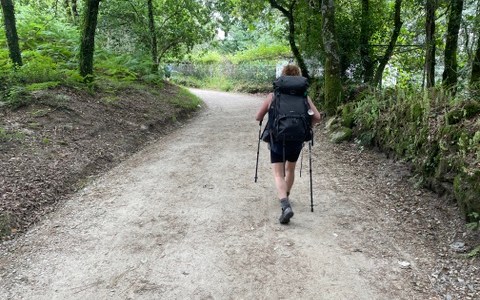
Day one, and we headed out of Porto. I should have mentioned that there were four of us on this trip. Me, Mrs E, and two unpleasantly large rucksacks, which we will call Beast 1 and Beast 2. We’d packed lightly, taking whatever we thought we could get away with, but even so, the packs seemed to weigh a ton. We’d managed a 15 mile walk with full packs the previous weekend, and all had been well, but we’d not taken more than a few steps before Mrs E and Beast 2 were struggling to get on.

‘I’m not going to get on with you for two weeks’, she said, probably addressing the pack.
‘Let’s just get out of Porto’, I helpfully suggested.

If you’re planning to do this trip, please note that it takes about four hours to get out of Porto. By now, packs had been adjusted and there was just a bit of back pain to put up with. Unfortunately, Beast 2 was still complaining, with a squeaking noise that no adjustment could shift.

‘I really can’t put up with this any more’, Mrs E announced, again, probably addressing the rucksack.

By now we were skirting around Porto airport, and the squeaking was still audible over the sound of the planes taking off and landing. Mrs E was getting even more frustrated with Beast 2.
‘Why doesn’t yours squeak?’ she demanded.
Then I may have told a slight untruth, which even SI might have forgiven.
‘Oh, mine squeaks all the time’, I fibbed.
That seemed to settle things nicely. As long as Beast 2 wasn’t making it personal, and as long as Beast 1 was also being annoying, all was right with the world, and even though the squeaking continued for another three days, it was never mentioned again.

Eight hours and 30km later, we got to our hotel, just outside Vila de Conde. Many pilgrims choose to stay in Auberges, which are hostels along the route, where you pay about €15 a night for the opportunity to sleep in a dormitory along with other pilgrims. We’d decided, in a Christian-like spirit, not to impose our snoring on others, and to stay in rooms with comfortable beds and bathrooms, and decent breakfasts. Not sure this was quite the pilgrim spirit, and I think SI would have preferred a more spartan arrangement, but who knows? We’d prebooked the hotels and it would be a shame to not use the rooms, after all.

A fitful night’s sleep for Mrs E – I’d dropped off nicely as usual but she was kept awake initially by the floorboards creaking (‘Just imagine you’re on a boat, and it’s the sound of the timbers’, I helpfully said, going to sleep myself on the second syllable of timbers). This kept her awake for an hour or so, before a rowdy group assembled at the bar just below our room. This was the final straw, so, wearing a fetching ensemble of nightdress, walking trousers, fleece and sandals, she marched down to reception and asked for another room. Apparently (this was, after all, during my REM phase), she did so between tears, only managing to blurt out


‘I’m very tired and tomorrow I have to walk the caminho!’
over and over again.


Unsurprisingly, the group was moved to another part of the hotel. A few hours later, fully refreshed, I asked her how she’d slept. I received what Paddington fans might remember as a ‘hard stare’.

Day two, and a recovery from that tetchy start, with a walk along the coastline to Esposende. We’d seen some horrendous news from Southern Portugal about storm Martinho, which had caused loads of damage through storm rain, floods and gales in mainland Portugal. It hadn’t spread too far north yet, but it was expected to make an appearance in the next couple of days, so we enjoyed a really good hike across boardwalks and forest tracks, met a few more pilgrims on the way, and started to hear a few ‘Bom Caminho’s’ as we went along. We even managed a few of our own – there were hikers going in the opposite direction, towards the Fatima shrine, between Porto and Lisbon.

Beasts 1&2 were being slightly better behaved, although at least one of them was still squeaking away.
We saw a lot of the sea – we’d hiked in Galicia before so we knew it could be a bit lively – it would have been great for surfing, had it not been for the coastline, which was very very rocky. Frustrating for Mrs E, whose idea of a perfect morning includes a sea or river swim, ideally at around 5°C – we’d even packed towels just in case we wanted to interrupt eight hours of walking with a bracing dip – but it was not to be.
Anyway, 26km later we were in a comparatively crappy hotel, grabbing food at the only veggie restaurant in town, and back for a thankfully undisturbed sleep.

Which brings us to day three. When me and the two chuckle brothers (see previous two wheeled adventures) reminisce about our bike touring trips, we often mention the ‘day from hell’, an 80 mile ride in the Netherlands, where it started pouring as soon as we set off, where we were all soaked to the bone within 30 minutes, and where the rain just kept on giving and giving, only relenting with about one mile left to go. You may be ahead of me here, but day three was our day from hell. Storm Martinho had decided to take a trip North, and although it didn’t bring the destructive winds from a few days before, it definitely tried hard with the rain. We lasted ok for the first hour, with our ‘waterproof’ coats keeping us fairly snug, but apparently there is a limit to how waterproof a coat actually is, and our limits were both about an hour, with at least another six to go. And our feet were soon sitting on top of a layer of puddle, sock, puddle and shoe.

Absolutely everything was soaked. I suggested to Mrs E that if we looked on this as a true pilgrimage then we might want to think of these conditions as a test of our faith. (She didn’t agree). At times it felt a bit like that scene in Forrest Gump, when Lieutenant Dan ties himself to the mast and shouts to God ‘Is this all you’ve got?’ in the storm. But the rain eased off a little after four hours, and we began to count down the distance to Viano do Castelo. But Martinho hadn’t done with us yet, and as we crossed the bridge from Cabadelo, it decided to pick up with renewed enthusiasm.


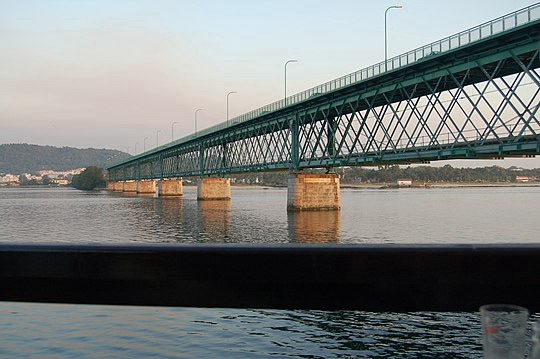
A word about the bridge. It’s called the Ponte Eiffel, (designed by yer man Gustav), it’s made of steel, it’s 645m long, and the top floor, where the traffic and pedestrians go, is completely open, except for a guard rail on each edge. I don’t know how high it is off the water, but definitely high enough that you don’t want to look down. There was no way that we were going to take a picture in that weather, so here’s one that someone took in drier times :

I suppose looking down wasn’t really an option anyway. The rain was so bad that you just had to concentrate on looking ahead. The wind was incredibly strong, and blowing from the sea, threatening to throw us into the traffic at any point. I decided that the best approach was to put my left arm over the guard rail to hold on there when the wind really gusted. Every now and then I’d turn round, and I remember being quite surprised to see that Mrs E was still on the path. Anyway, it took about 10 minutes to cross, one of the scariest things we’d ever done, and at the end, completely drenched and with no feeling left in our hands, we tried to find somewhere to shelter to see where our hotel was. Unable to operate a wet phone with broken thumbs, we guessed, and fortunately headed in the right direction. We made something of an entrance to the very posh hotel, dripping water on their shiny wooden floor and refusing to sit down on their pristine seats. Recovered a bit to sign in, but only managed to do so by holding a pen in my fist and moving it randomly around the registration form.
We managed to get into our room without too much further embarrassment, and made a check of clothing that needed to dry. Because we’d packed very light, almost everything needed to be worn again the next day, so, dressed in dry shorts and T-shirts, we borrowed an umbrella and found the town laundrette. Not quite Nick Kamen, but not far off.

Day 4 brought further storms which would apparently be ‘over in a couple of days’. Most of our clothes were relatively dry and we were quite keen to keep them that way. We’d noticed other pilgrims on day three wearing huge capes that covered them and their rucksacks, and also wearing smug smiles as they eased past our shivering forms. Was it wrong to envy other pilgrims? SI wasn’t around to ask, so we decided not, and so I set off after breakfast, again in shorts and umbrella, to a tiny shop that we’d noticed the night before, that had a handwritten ‘ponchos’ sign in the window.
‘Don’t get yellow’, Mrs E helpfully called out, as I headed off into the monsoon.


As it happened, colour was the least of the issues. My Portuguese is beyond rusty, and the elderly lady at the shop was not only very Portuguese but also very deaf. Eventually we established that:
a) she did sell ponchos
b) that she only had one left (in blue)
c) they were €7
d) that she’d go and look out the back for another one
e) there wasn’t one out the back
f) the one hanging up could be for sale
g) but on closer inspection it had a number of rips and tears
h) so was neither use nor ornament (I’m paraphrasing the Portuguese here, of course)
i) that she could help me no more so here was the change from €10
j) that there wasn’t another poncho seller in the town
k) that our business was was concluded


Then, apparently as an afterthought, she held the torn (yellow) poncho out to me, presumably to dispose of as I saw fit.
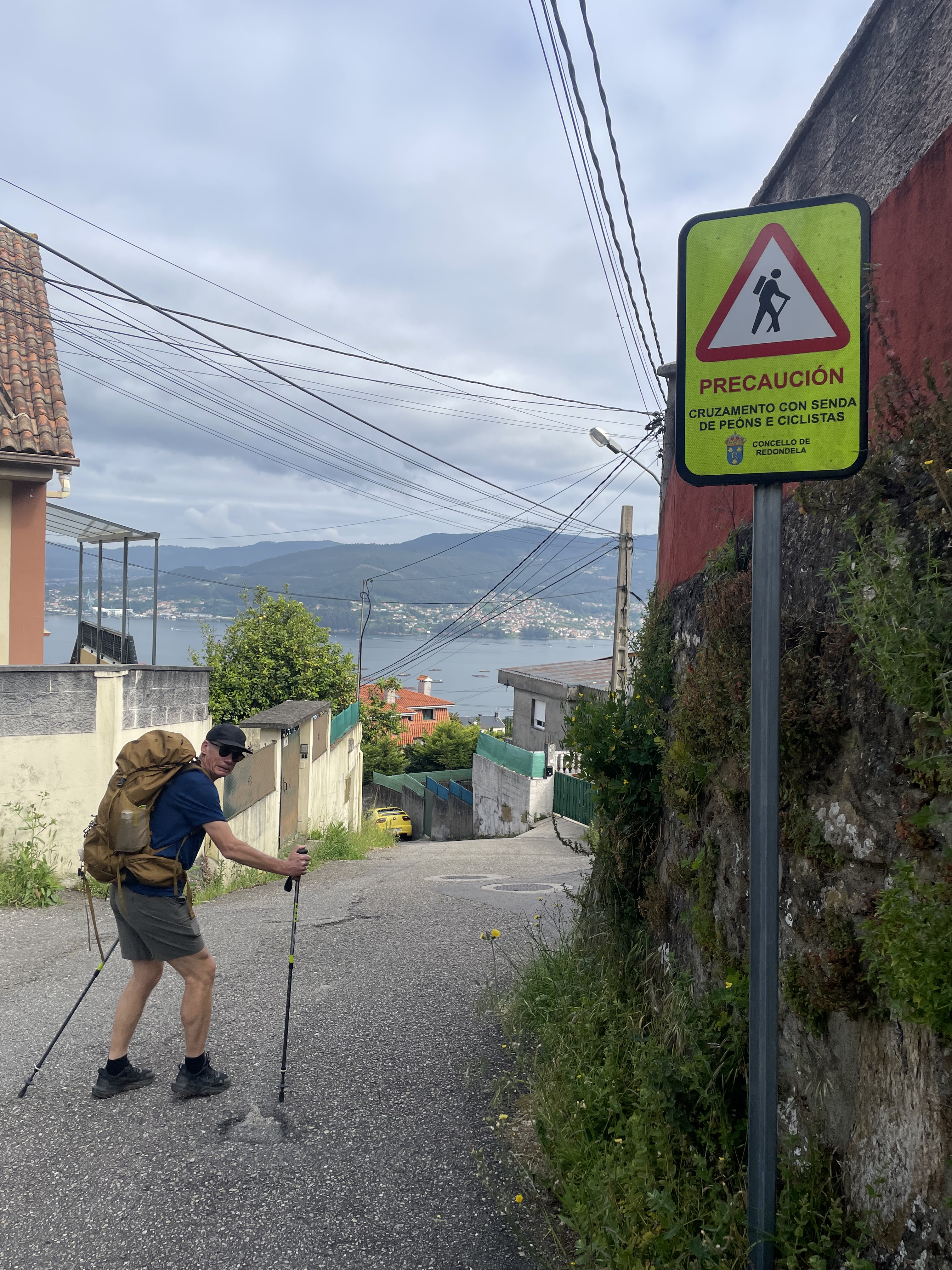
And so it was that we set off, with both of us and the two Beasts covered with the flimsiest of plastic covers, Mrs E in a fetching blue, and me in a less fetching yellow number, looking very much like I’d recently been attacked with a Stanley knife. This is the first picture we took. Possibly not our finest, but I’m very keen on the porthole look that my wife has gone for. I think it’ll catch on.
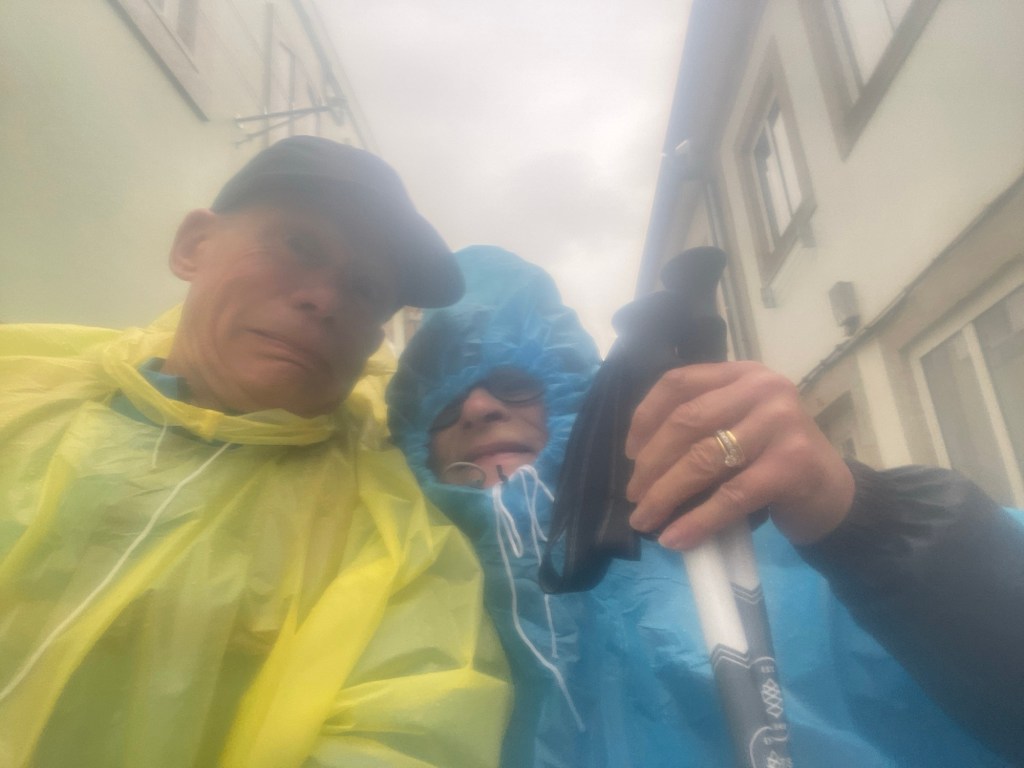
The rain kept up for hours, we were marginally drier than the day before, except where our legs and arms emerged from the cape (and for me, below the numerous slashes).
We hiked through some lovely forest and went up and down what would have been challenging rocky paths, but, because of the weather, were challenging river beds. At one point, we took shelter in a bus stop and both independently thought about checking the bus timetable. We had to cross a river on giant stepping stones, each about a meter apart, with precarious falls on each side, and only mentioned the bus option to each other afterwards, by which time of course, we couldn’t go back.


We’d agreed after day one that we’d try to drink water every hour, just to have a break, and this was a good tactic, or it would have been had it not been for the process of needing to go to the loo every hour as well. This is challenging on a walk at the best of times, but in pouring rain, with full packs, hiking gear, ponchos and hands so cold that fingers and thumbs were inoperable, it proved particularly challenging. Obviously the challenges took different forms. I managed with very little precision using some ungainly thumb work. Mrs E found a balancing point that looked oddly like an outtake from Teenage Mutant Ninja Turtles, quite elegant in her own way, but requiring a partner to lift Beast 2 off her back in order to reassemble her lower clothing.
We’d completed these manoeuvres, thankfully, when we met up with a couple of German women, who we walked with for a couple of hours, and the change of conversation and company meant that the miles went by much faster. Said goodbye to our German friends as we reached Amoroso, as they were staying there, but we still had another 10k to go, as we needed to get to Caminha, on the Portuguese border. This was hard work, as it started raining again, every now and again it would stop, there’d be a little bit of drying out, then it would start again.
‘I’ve really had enough of this’, said Mrs E, as we climbed yet another hill. And then a miracle happened. I might have mentioned in the past that Mrs E has a real aversion to whistling, and there, at the top of the hill, sheltering under a huge umbrella was a whistling man. A tunelessly gormless whistling man at that.
I turned to my long suffering wife who, incidentally, hadn’t been able to see anything out of her porthole since the morning as her glasses had been covered in rain.
‘What if there was something at the top of this hill that really annoyed you even more than the rain? But that you could just walk away from?’
‘Yeah, like that’s going to happen’
And so it was, at the top of a hill in northern Portugal, in pouring rain, a gormless man whistling a tuneless tune under a huge umbrella, miles away from anywhere, found the contents of a blue and a yellow cape, covering ridiculous hunchbacks, openly laughing at him. SI would not approve.
On the way downhill from the whistling twit, Mrs E managed some further good news. Beast 2 had stopped squeaking. Maybe the beast had been tamed.
Eventually we got to Caminha, and checked into a creepy hotel which was full of dark winding corridors with ‘staff only’ doors shutting just as we turned each corner. And, for some reason, a glade plugin on every available power outlet. Rarely wared, as they say in Norfolk.
We were on the Portugal/Spain border and needed to get across the Minho river. The hourly ferry wasn’t running, but we managed to book a water taxi, which was as billed as a ‘speedboat for six’, at 0830 in the morning.

So Day 5 started with a walk to the dock, and a chilly wait with other pilgrims for the speedboat for six.
Actually, it started a bit before then – Mrs E was determined not to have wet feet any more – she’d started to get some really nasty blisters from walking in wet socks and shoes. To her delight, she found that a plastic sanitary bag from the bathroom was just right to cover her sock. But only one sock, so the day started nice and early with her asking the night porter for another bag, a challenge that probably wasn’t helped by her miming that she wanted it, not for its original use, but for her foot. The night porter struggled with the challenge, especially when trying to enlist the help of the breakfast cook, but eventually returned with a couple of carrier bags, so Mrs E set off on day five with a sanitary bag on one foot and a large plastic bag on the other. Meanwhile, the speedboat turned up dead on time, and sped us across the river in under five minutes. This was a relief – if we’d not got the boat we would have had to wait until 1430, or take a 15km diversion via an inland bridge.

So we set off into Spain, where, thanks to Mrs E’s 30 day streak on duolingo, we felt much more relaxed with the language, seamlessly switching from ‘Bon Caminho’ to ‘Buen Camino’. Of course it started raining almost immediately, but it was soft and light and intermittent rain, so we were wearing our ridiculous capes for fun rather than function. It turned into a long day though; the stages so far had pretty well matched the suggested routes in our guidebook, but we wanted to stay in a hotel a bit further into the next stage, so we ended up walking for eight hours, and covering about 30km.
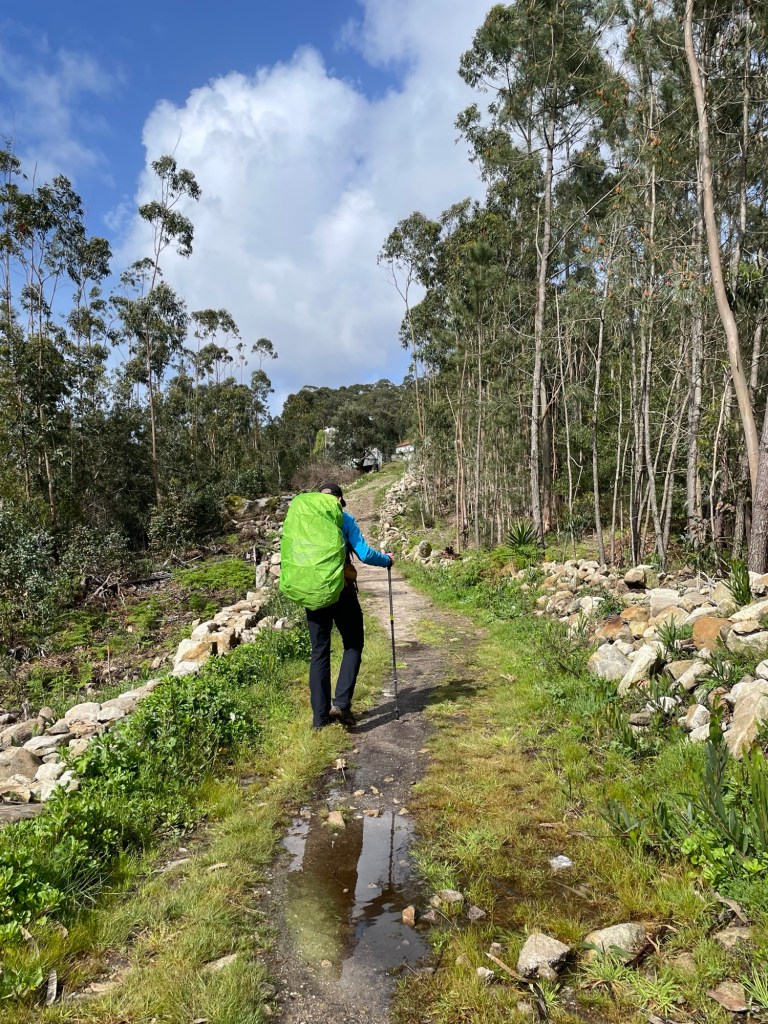
The last couple of hours were quite hard work – Mrs E had blisters from wet socks on the previous couple of days, so we trudged down the hill to what ended up as a fantastic hotel with its own hydrotherapy spa – unbelievable luxury – we looked and felt completely out of place in the posh reception with our rucksacks and muddy trousers, but this mattered a lot less by the time we got to the spa, where Mrs E found a freezing plunge pool and looked as happy as I’d seen her for several days.

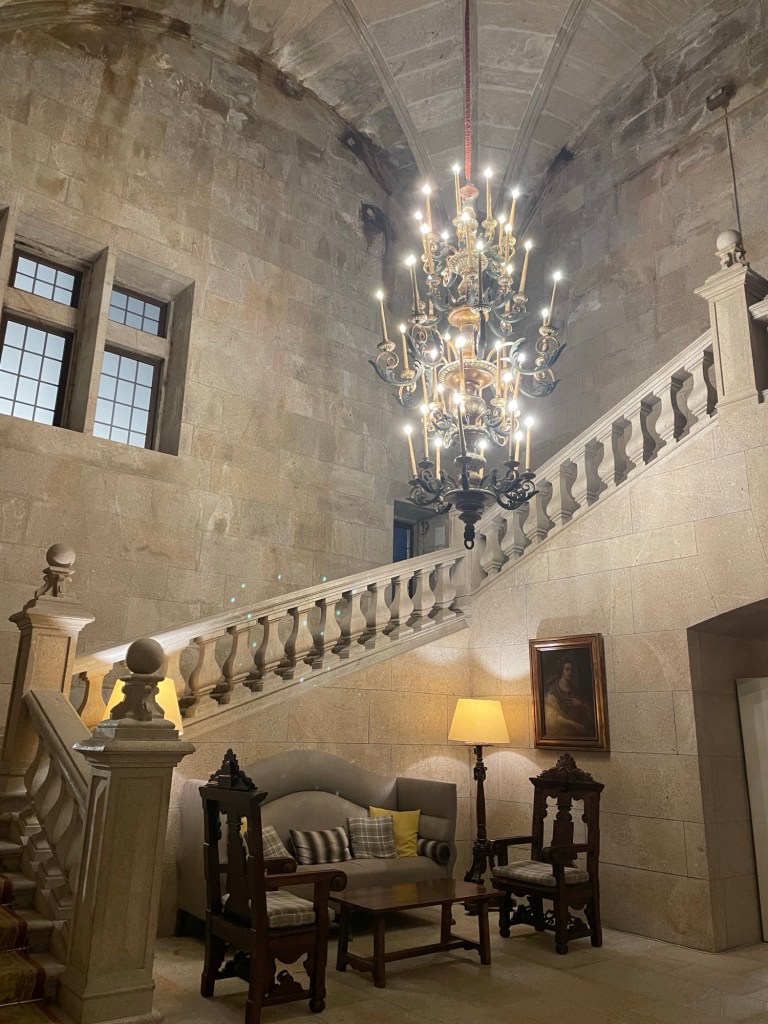
Even better was the news that day six was a rest day of sorts, with only a couple of hours into Baiona, where we’d be staying at the Parador. I may have bored you before about the joys of the Parador hotel – each one a national monument that just happens to be a hotel, and this one was as special as they get – we were literally staying in a restored fort – the outside wall of our room would have been the stone fort, the whole building covered the 18 hectare peninsula, and despite the fact that Francis Drake attacked it enthusiastically in 1585 it remains in amazing condition. And everything (this being a Parador) is just wonderful. We didn’t have time to explore all of the castle and the fort, opting to loaf around, make phone calls and recover properly, but if we had, we would have seen the prince’s tower, dating back to the 10th century, later holding the Hapsburg prince who was in an iron mask, the inspiration for the Dumas novel. And, for that matter, the slightly shorter Billy Bragg song.
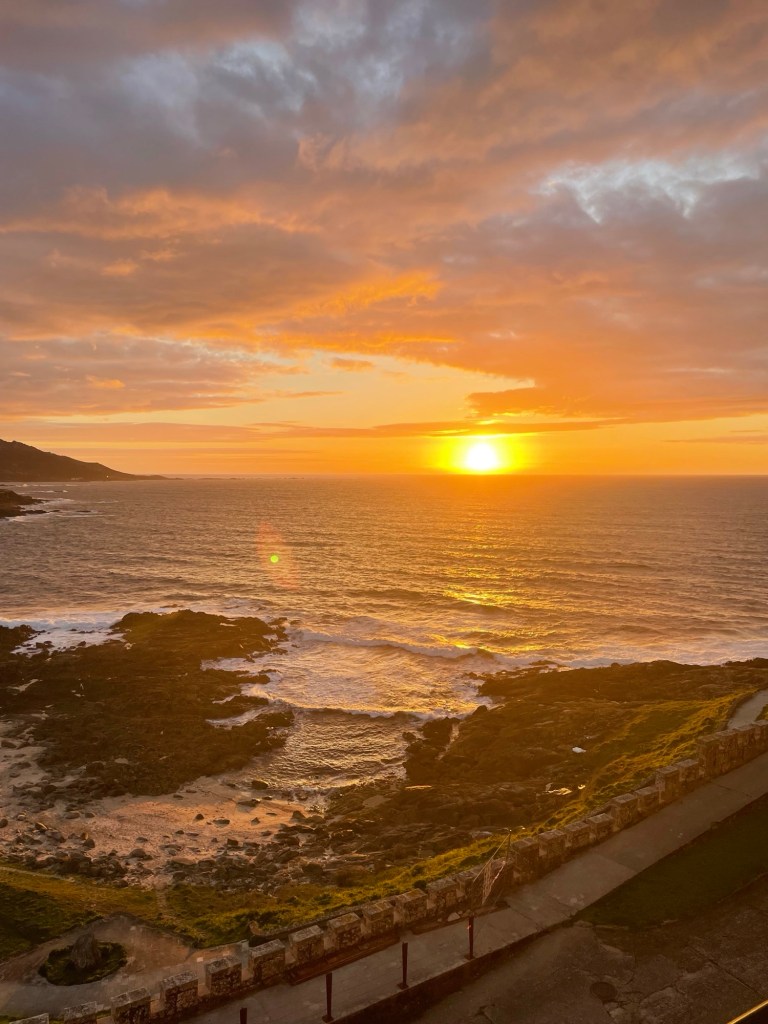
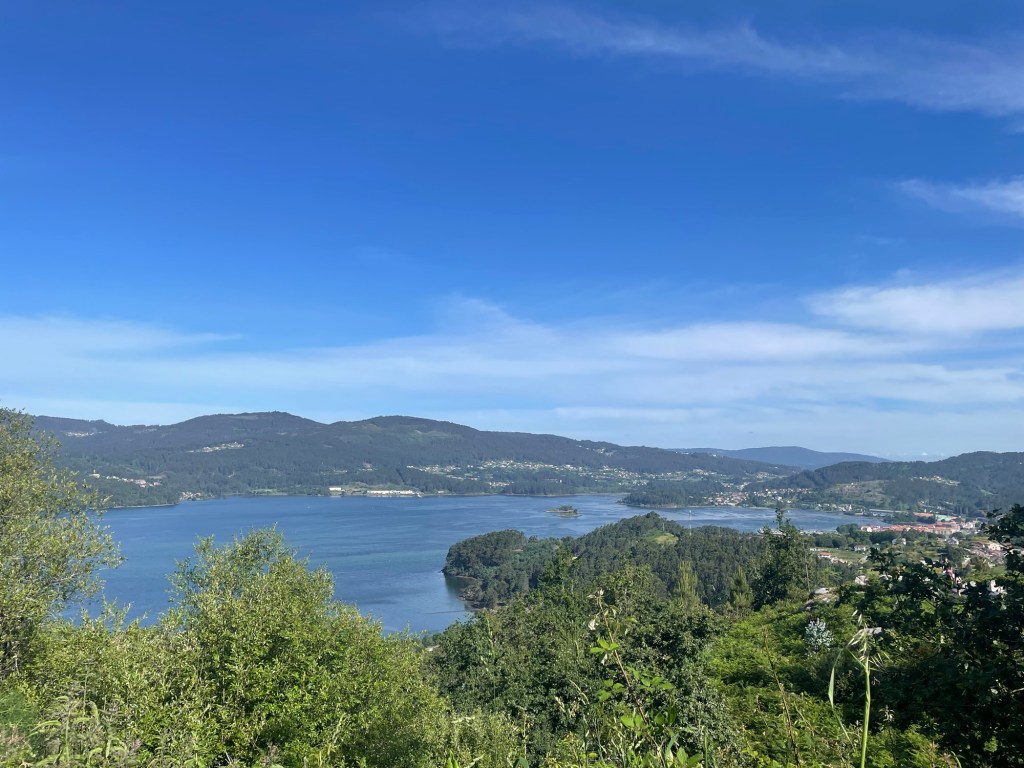
Day seven, and the first proper sunny day – our map suggested that we’d be hiking about 20km, but the caminho route said otherwise, and we ended up doing about 24km. A lot of this was off road, and a huge amount uphill, winding through forest tracks with terrific views of the ocean below, which for the first time showed a couple of spots that you might have been able to paddle in without being flattened by the big waves.

Mrs E found it hard going, and the last few kilometres were really taxing, very hot, very uphill, and by the time we got to our (very lovely) hotel, she was dragging her right foot a bit like Keyser Söze in The Usual Suspects.

That’s where part one of this blog was going to end. You could have read this and been excited for part two – we were halfway through the trip, the easiest walking was to come, and the celebrations in the square at Santiago were just six days away. I could have told you about the pilgrim’s service in the cathedral and maybe even the process of obtaining an indulgence. But there isn’t going to be a part two, because after Mrs E had limped to the hotel room, she made the mistake of removing her right sock. Despite a lot of Vaseline and a year’s supply of compeed, her blisters had got much worse and she was in lots of pain. Even worse, we could see the start of infection heading up from the foot.

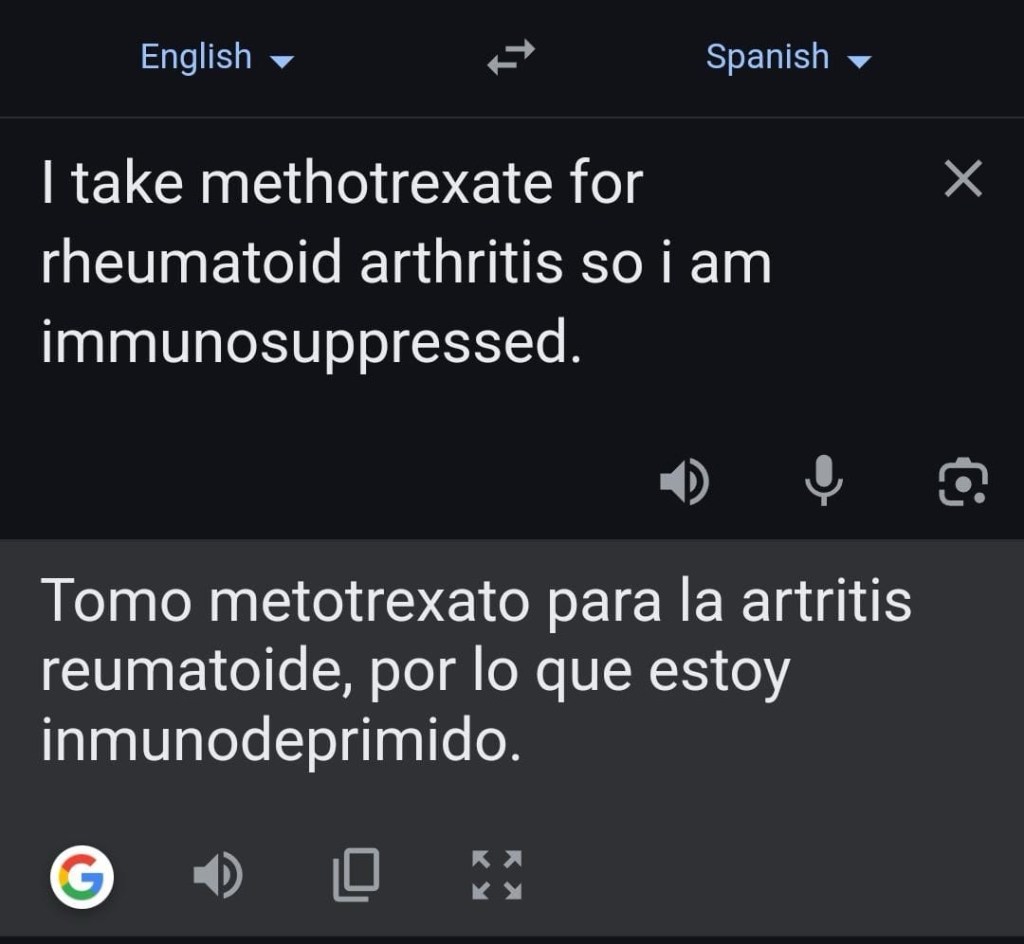
One of the many wonderful things about my wife is the way that she manages her health. She has a really nasty disease called rheumatoid arthritis – if you don’t know about this, it is unhelpfully labelled, being neither rheumatism nor arthritis – rather, it is an autoimmune disease that can seriously inflame and damage tissue and joints. She manages it brilliantly with some unpleasant drugs and a great deal of very cold water, and refuses to let it define her. But the side effect of the drugs means that she’s immuno-suppressed, meaning that her body is less able to fight infection. So this sign of infection was a bit of a red flag, and by about 8pm that night we were on our way to Vigo hospital for an evening with Spanish A&E.

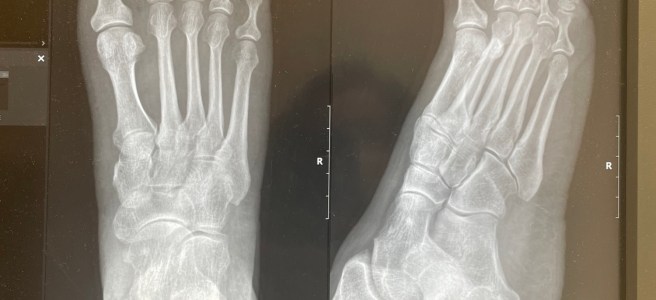
Emergency rooms are the same the world over. They’re full of people who (obviously) don’t want to be there, sometimes carrying injuries that must be incredibly painful, and everyone just desperate to be seen. Other than hanging around quite a bit, Mrs E was treated brilliantly – admitted really quickly, put into a wheelchair by the triage nurse, assessed by the doctor and put straight onto an IV drip with painkillers and antibiotics, bloods taken for tests, wounds dressed, X-rayed, and finally reassessed with the results, which showed the infection and a likely match with the antibiotics that would treat it. During all of this, we leaned heavily on Google Translate and WhatsApp support from Dr Jr Emu#1, who gave a varying quality of advice:
You might be eating your breakfast with this so I’ll not share the pictures of the wounds, but here’s a picture of the foot post-dressing.
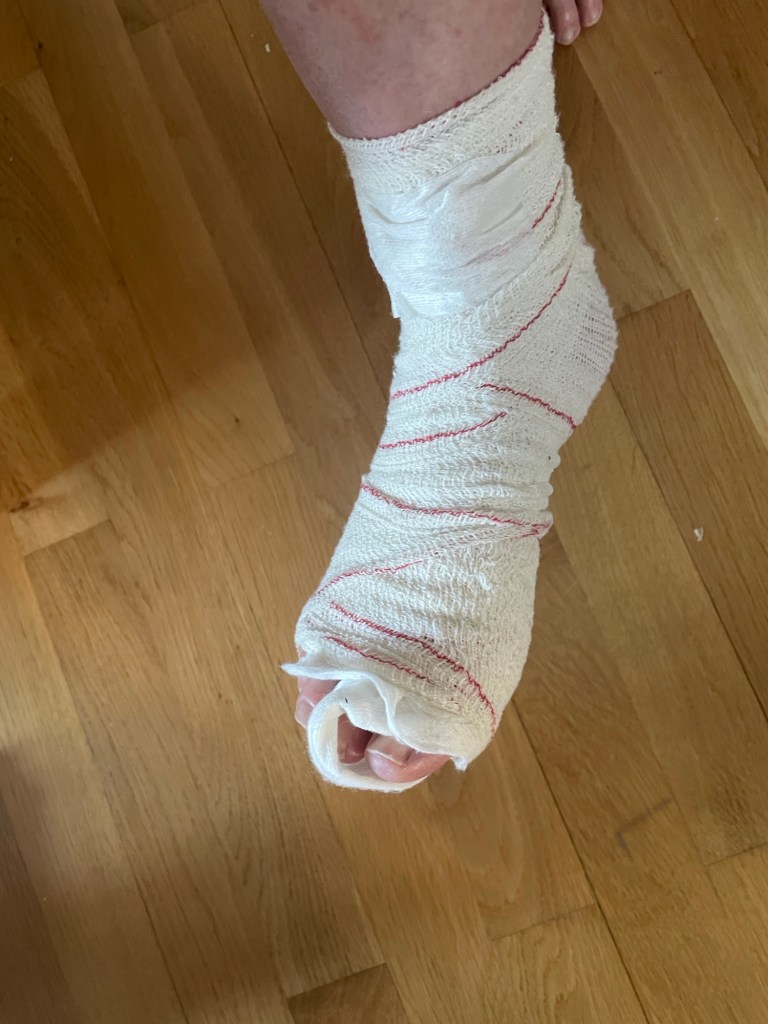
Eventually we got discharged, and headed back in the early hours with vague ideas about me continuing and Mrs E spending the next couple of days travelling by taxi and resting.

Woke up on day eight, and we both realised that those ideas were hopelessly optimistic, and the sensible thing to do would be to get home as soon as possible, so we spent most of the day cancelling hotels and flights, and booking stuff to get back the following day. And that’s where we are now, in Santiago de Compostela, sharing an airport bus with lots of happy pilgrims and their backpacks.
On day 4 we’d had an interesting conversation with our German friends, trying to understand why there’s no English equivalent word for schadenfreude, when the English probably needed the word far more than the Germans. I don’t know what the opposite word for being selfishly envious at other people’s happiness, but that’s what we felt now, when we heard the pilgrims chattering away. Well, a bit, anyway.

But we’d given it a go. If Mrs E could have put one more step in front of another with Beast 2 then she would have done. (My Garmin says we did 245,459 steps in the first seven days, so maybe that’s an achievement of sorts). And maybe we’ll come back next year to give it another try, if she can get hold of some waterproof socks.

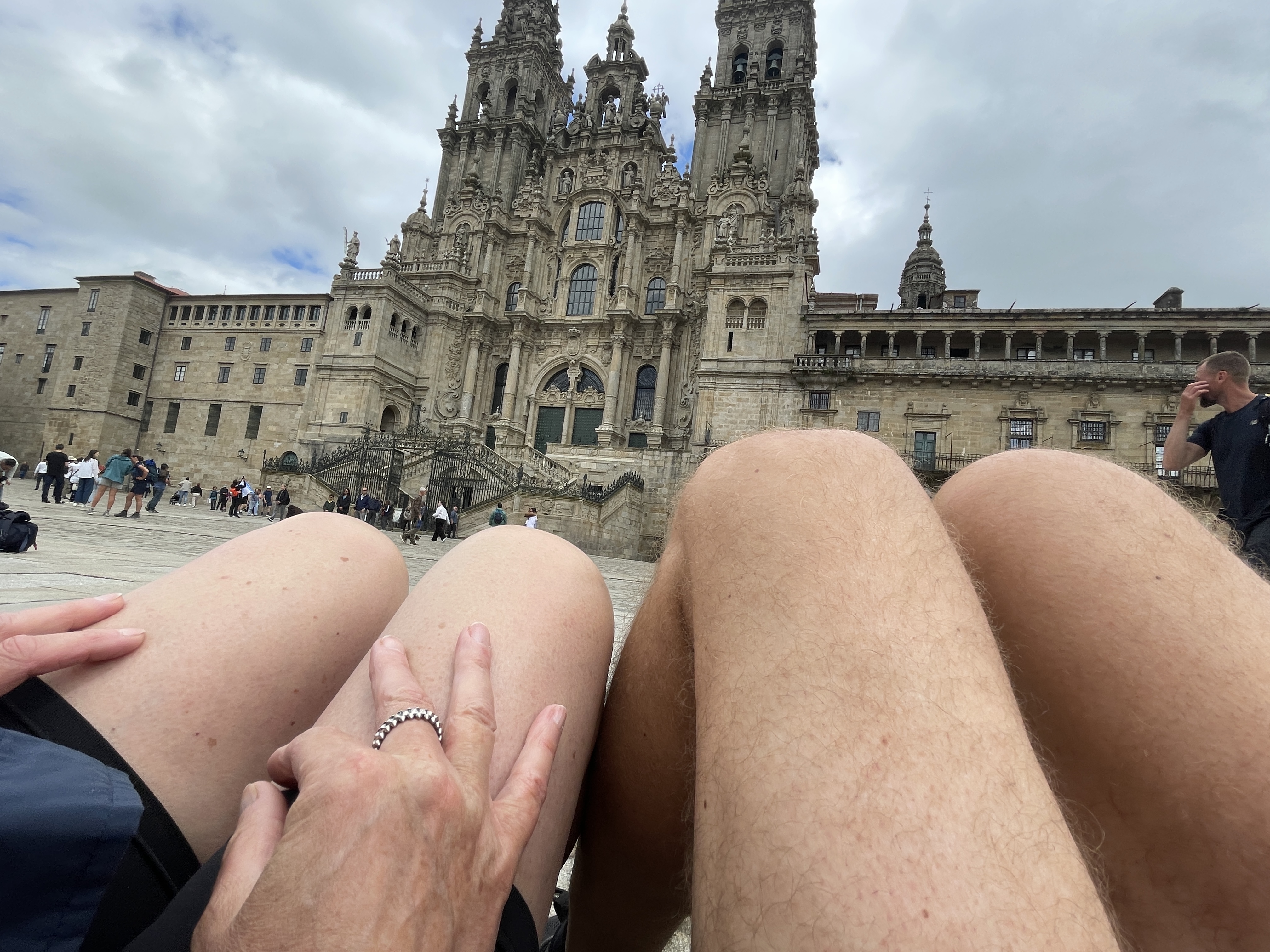
We didn’t have a particular religious or spiritual experience, and we didn’t get to experience the end bit. But we saw some beautiful parts of Portugal and Spain, met some fabulous people, and really looked after each other when we needed to. Which, when I think about it, is vaguely spiritual in itself. So that’s probably enough to stop being fed up.

Until the next time, Buen Camino!
Farewell, Don Hector

Me and Mrs E had cycled in the Netherlands a couple of times before – the last visit was in November, when the weather was so cold that we had to buy ski mitts for the way home, and shivered our way back to the Hook of Holland past completely frozen dykes. So, naturally, we were up for some more of that, as long as the weather was going to be kind to us, which of course it would be, in early May.

Well, not if the weather forecast was to be believed. With a few days to go, the weather across all of Europe was looking a bit bleak, and where we were heading looked like it was going to be raining all day, every day. And with one day to go (actually, on the day of departure (actually, with about three hours before we were due to leave for Harwich)), when Mrs E asked me to check her bike and I found that the hydraulic brake was completely knackered, it was beginning to look like a pretty crappy time was heading our way. 

Mrs E owns two bikes.  One is her lovely bike that she’s had for a few years, and which has transported her on a few tours before – a great bike, although, as we found out quite late on in our planning, not very good at stopping. And her new whizzy Dutch E-bike, which has enabled her to get back from a shift at work in record time, and which she’s terribly protective of. Unfortunately, the problem with the other bike meant she had to ride her pride and joy, which left us with a few dilemmas for the trip. 

Firstly, it being a nice shiny new bike that she was still working out how to use, she was very protective and didn’t entirely trust all its complex features to always work. But her biggest worry was the likelihood of being able to charge the battery every day – especially since one of the design ‘features’ of this bike is a non-removable battery, which means that the whole bike needs to be near a socket to charge. 

I had a different dilemma though. For years on our bike trips we’ve been reasonably well matched, I tend to ride ahead of her and if she needs me to slow down, the deal is that she’ll ring her bell to stop me sailing off into the distance. The first time we cycled in the Netherlands we were heading south through Zandwijk, through all manner of pedestrian traffic, and all I could hear was a regular pinging of her bell. It reminded me of Don Hector, just after Lalo tells him that he can’t find any evidence that Gus is at fault and he’s going back to plan A. Note that you need to have a working knowledge of Breaking Bad/Better Call Saul for that to make sense. If you don’t, just imagine a really impatient hotel guest hammering away at the reception bell. Anyway, Mrs E wasn’t going to be making any Don Hector impressions. Quite apart from the fact that her e-bike has an eerie echo-y bell as part of its gizmo collection, she was never, ever going to be left behind again. I knew this, because when cycling with her in the past, I’d worked incredibly hard to keep up with her, and just as I got alongside she’d press the little ‘boost’ button on the handlebars and disappeared off into the next county. 

With all of this potential fretting in mind, we got the bikes on the ferry on Saturday night, had a short sleep in a fabulous cabin, got up at 6, and by 7:30 were pushing the bikes off the ramp, in our full wet weather gear. The fww gear lasted us about 400 metres, as we realised that all the weather forecasts had been wrong – there was no rain to be seen (and there wouldn’t be any for the next 48 hours). 

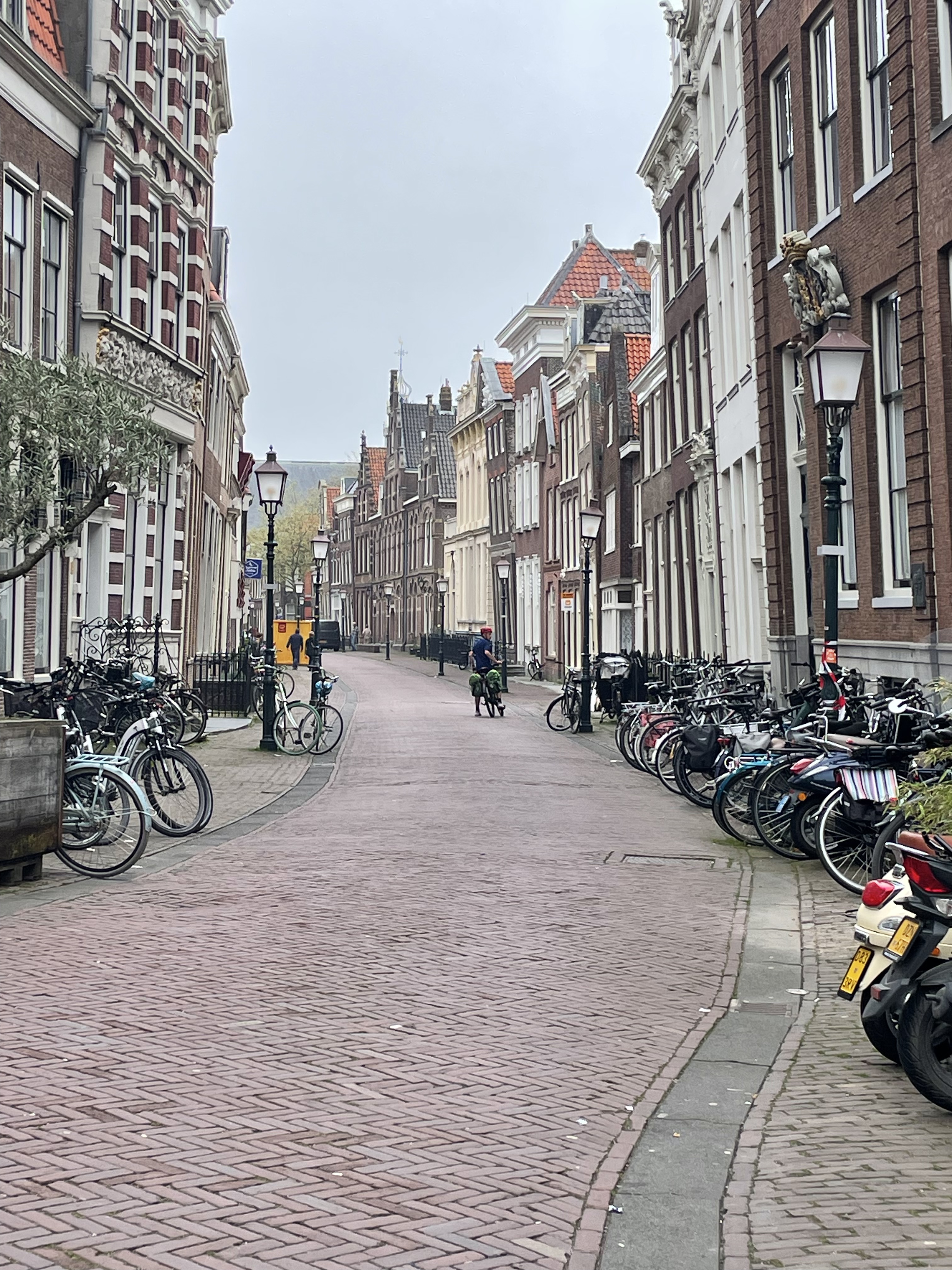
So we headed up the coast, a route we knew reasonably well, heading past Den Haag and Katwijk and Noordwijk, where we had the tour’s first appletaart, and on into Haarlem, where we sat down with some impossibly beautiful people and ate a very trendy Sunday brunch. Because we were off the ferry early, we’d travelled most of the trip by lunchtime, so pootled leisurely along to Zaandijk, where we were staying that night. The route through to Zaandijk has many things to love – fabulous cycle lanes, lovely villages, lots of wildlife, no litter, and not really much in the way of people. Those that you do see seem pretty happy to see you, although the ones that we spoke to seemed a bit nonplussed when we told them that we were here to cycle across the Maarkerwaarddijk. 

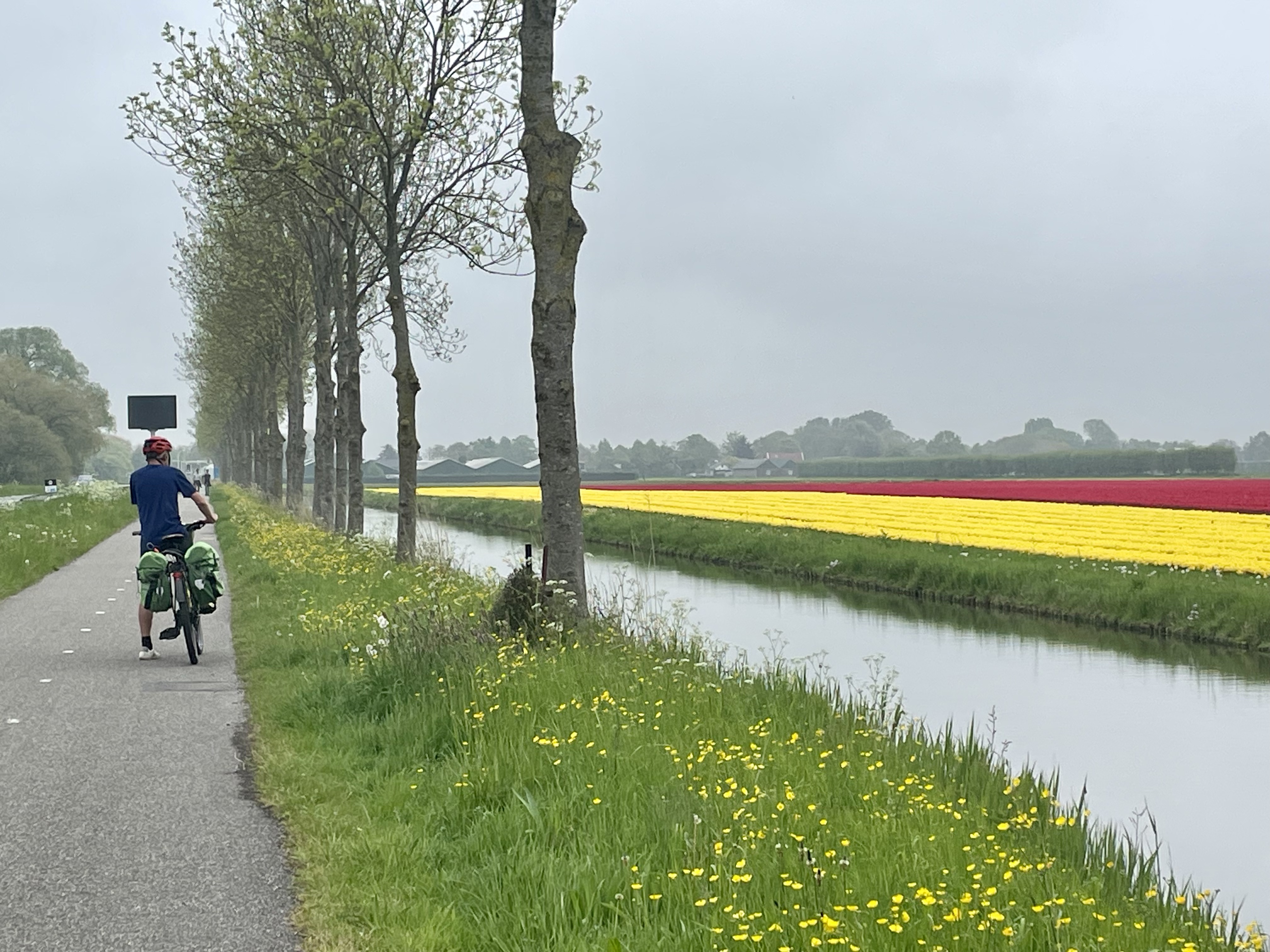
A word about those cycle lanes. I’ve waxed lyrical in this blog before about the wonders of cycling in the Netherlands. And if you’re bored with that then you can skip this next bit. But the network of cycleways in this country defies belief if you’ve spent your life mixing it with traffic in the UK. In the 1960s, it could easily have gone in a different direction – the Dutch car manufacturing lobby hired an American designer, David Jokinen, to help redesign the streets of Amsterdam and The Hague to make them more car friendly. One of his plans involved concreting over one of the main  Amsterdam canals to build a six lane highway.  Fortunately, a combination of finances and pressure groups stopped this happening. Key to these groups were the Provos, semi-anarchists who were represented on the Amsterdam city council, and the members of Stop de Kindermoord (Stop Childmurder), which was set up following the death of the daughter, by a speeding motorist, of an Eindhoven journalist.  By 1975 there was a standard design manual for road and street development which not only prioritised cycle usage, but complemented it with the concept of living streets and reduced traffic speed. Fast forward to today, and cycling has just become the norm across the Netherlands.  Very rarely do you have to have any contact with car drivers, but if you do, you normally have the right of way, it’s very clear whenever you don’t, and car drivers are, to a fault, polite and courteous. As are the cyclists. It’s almost as if there’s a respect for people riding bikes, which may be a surprise to you if you’ve been used to riding a bike in, say, the UK. The paths that we went on had fantastic smooth surfaces, were often well away from the roads in beautiful countryside, had no potholes, no litter, were clearly signed and just wonderful to spend time on.

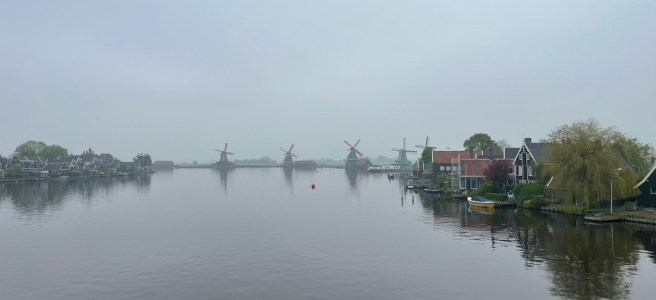
Back to Zaandijk, which was great for a walk in the evening past all the working windmills and the sort of houses that you see here and almost take no notice of, but which if they were  anywhere else in the world, would have a preservation order and a turnstile in front of them immediately. My kids, when they were young, used to play with playmobil, and I never really understood the appeal of the buildings, but I think I do now, having spent a bit of time with the real thing – the buildings are cute but functional, and look like they’ve been designed by architects who are incredibly proficient but who never let go of their sense of fun. Huge windows, over-pitched roofs, shiny doors, intricate brickwork, immaculate gardens – like a set of childs’ toys increased to adult size without gaining any of the full sized mess. 

To bed then, and up for breakfast looking over the mist, to just about make out the windmills on the other side of the river:

We were headed for Enkhuizen this morning, via Hoorn, and planned to cycle over the Maarkerwaarddijk in the afternoon, ending up in Lelystad for the evening. On the way we saw yet more fabulous cycle paths, borders of grass and cowslips and elderflower along uninterrupted and unpopulated paths, and pastoral scenes of springtime that made Mrs E go aah in all the right places. We saw ducklings, goslings, lambs and foals in quick succession, so much so that Mrs E titled the road ‘post-natal avenue’ – she was a woman very much in her element. 

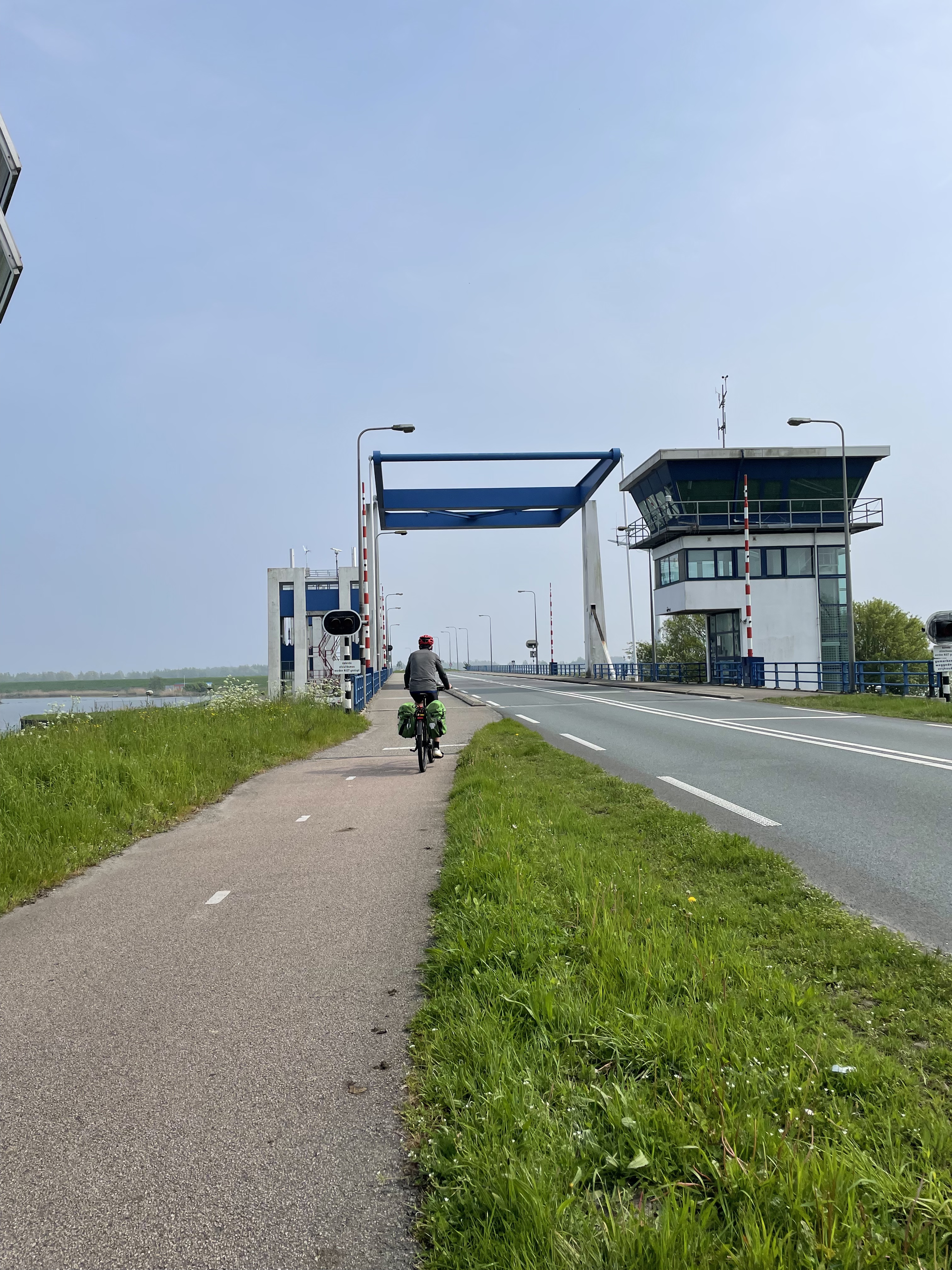
The Maarkerwaarddijk was a big deal for us, and almost the whole point of the trip. Mrs E has a thing about bridges – a few years ago we took a trip to Malmö, just so that we could go across the bridge that  connects Denmark to Sweden, which we did, four times in total. We’d originally planned to cross the Afsluitdijk to the north of here, but the mileages didn’t quite work out. There’s not much in it – the Afsluitdijk is 32 km long, and the Maarkerwaarddijk is 30km, so they’re both pretty sizeable pieces of engineering. 

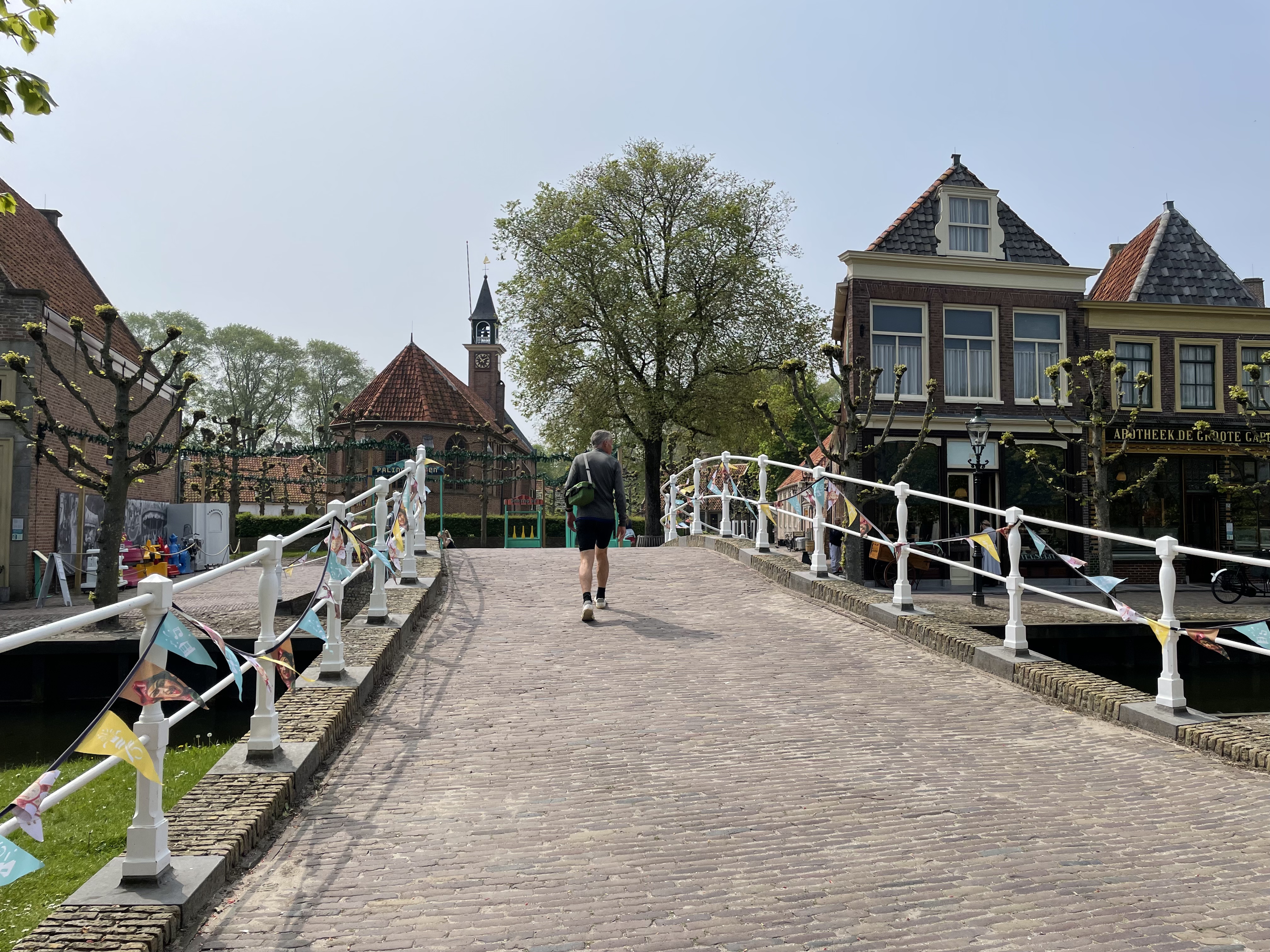
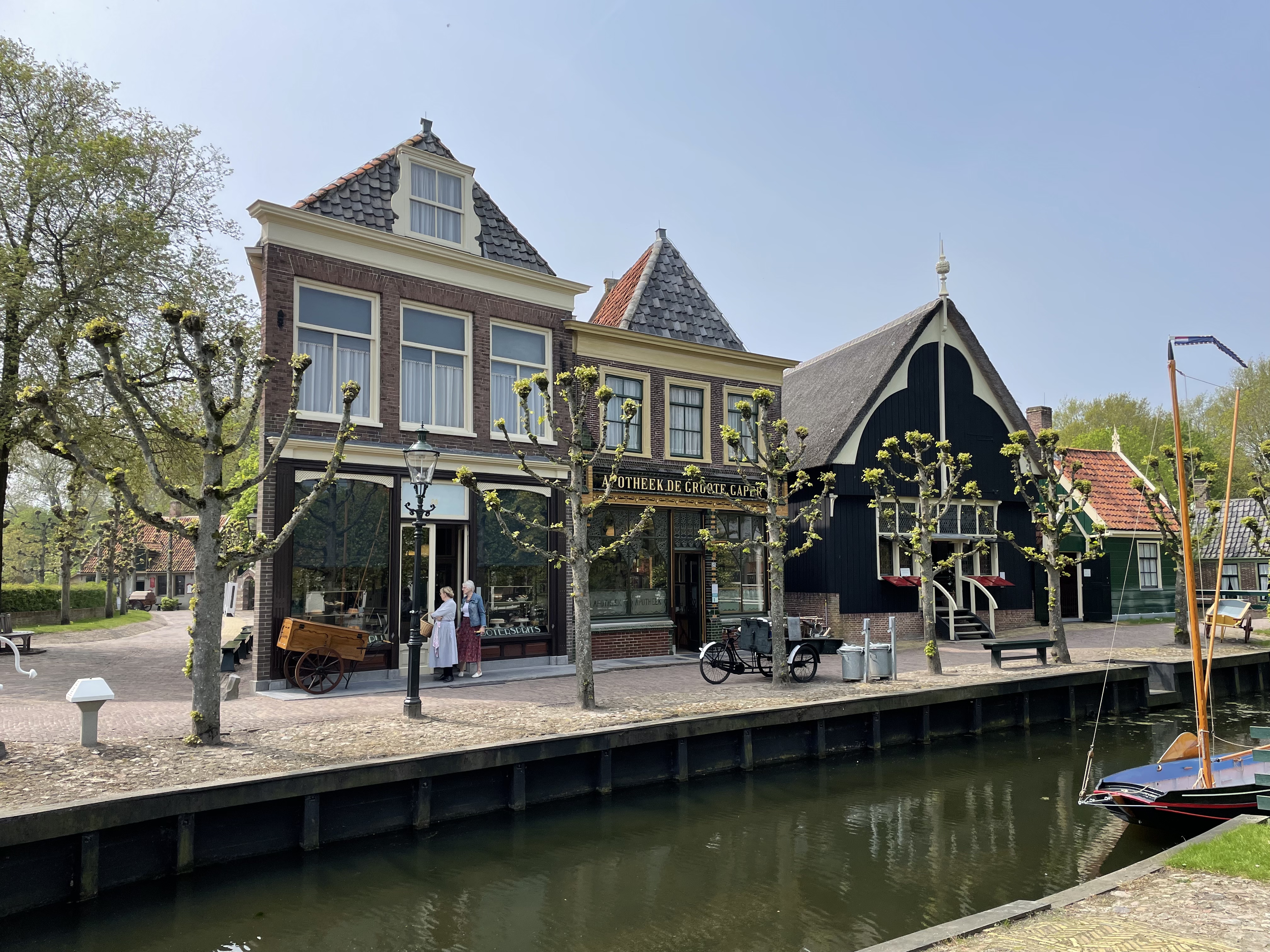
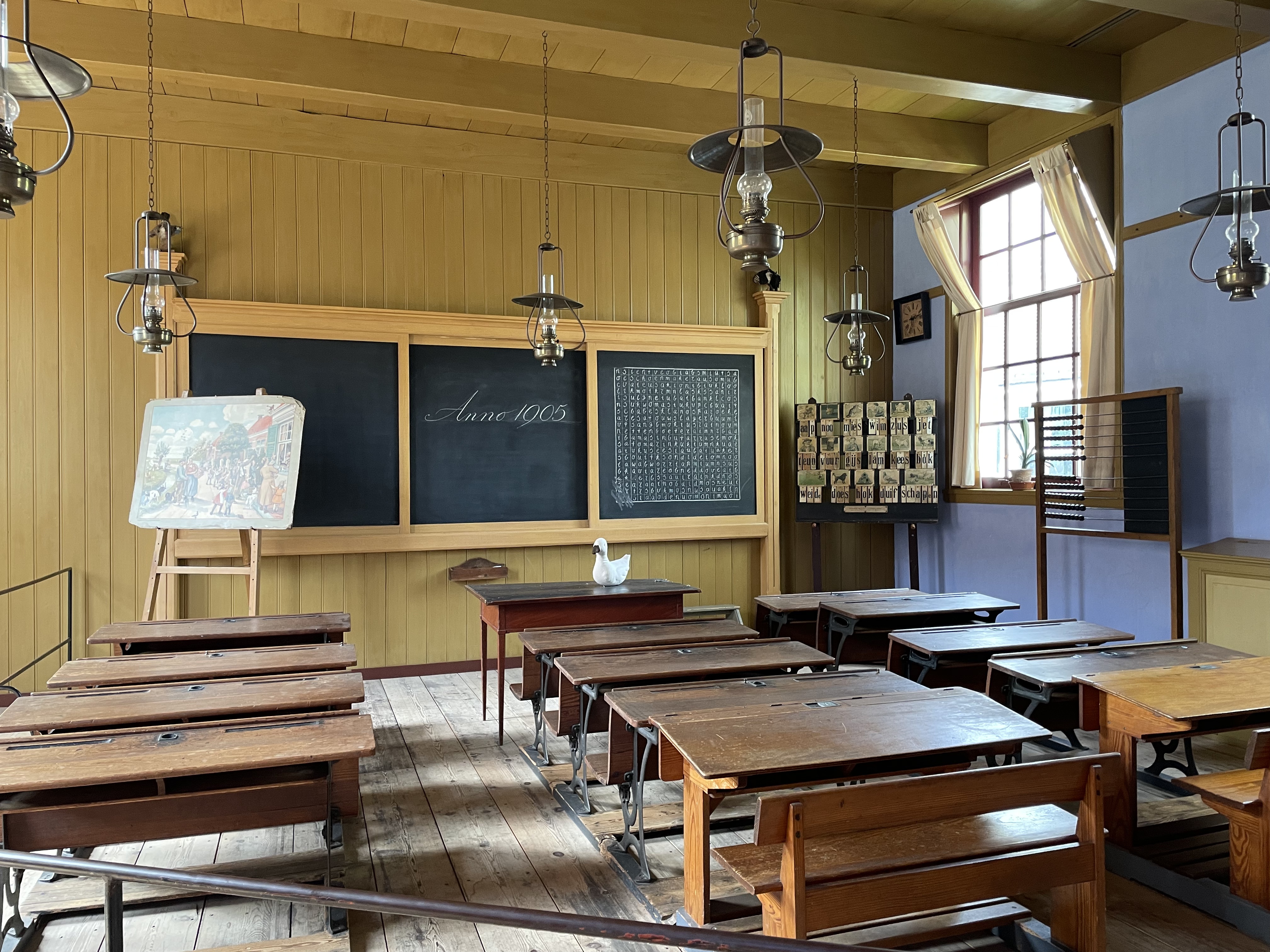
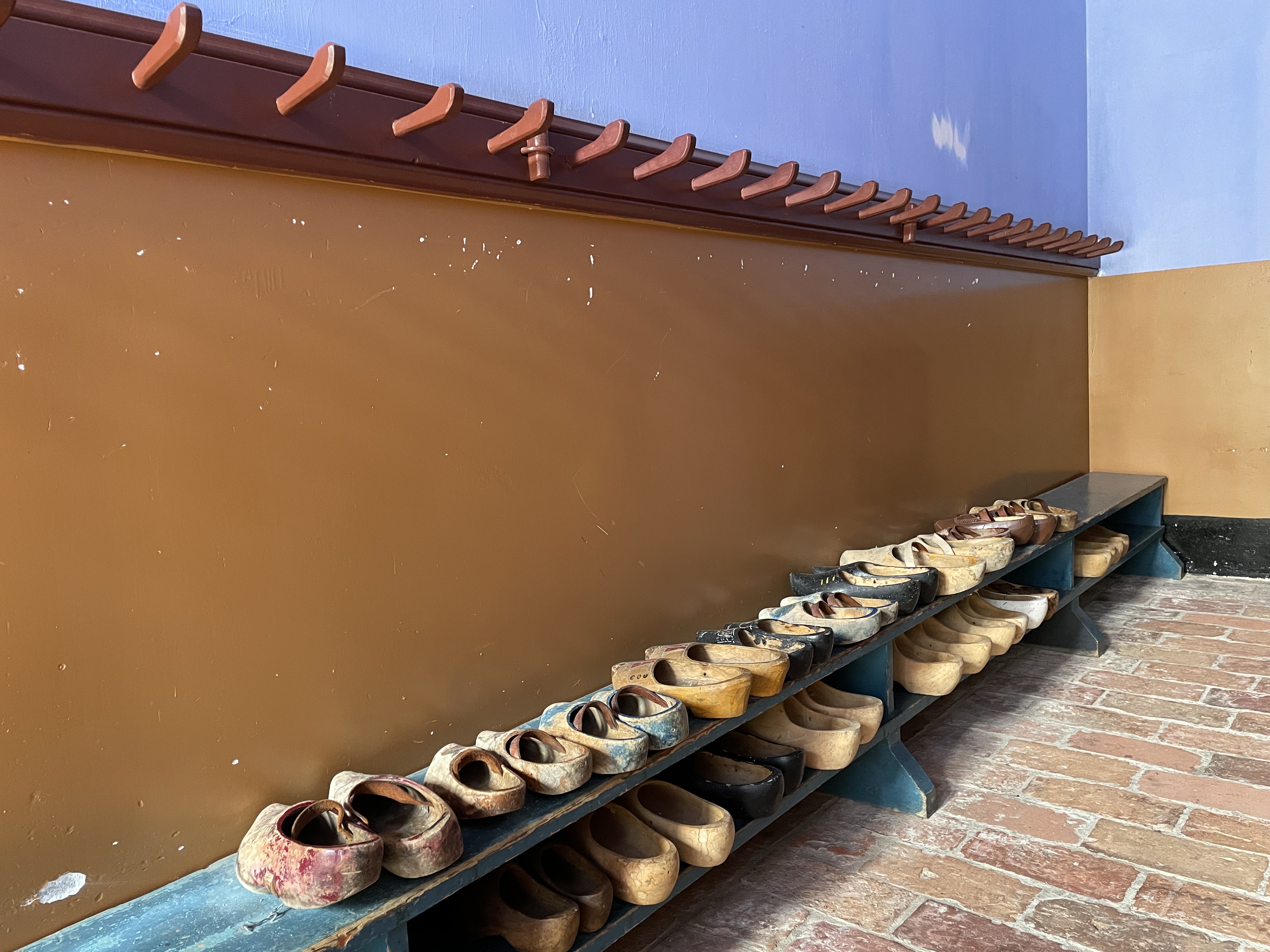
Both dams were designed and built  by Cornelius Lely, who figured that the Zuiderzee would be a safer place for all concerned if it was closed in. This had a massive impact on geography, ecology, fishing and farming, made the resulting massive lakes into fresh water (I’ve no idea how), and massively reduced risks of flooding. The only reason I know any of this is because we’d made good time across to Einkhuizen, so decided to grab a coffee in the Zuiderzee museum, which has its entrance just before the Maarkerwaarddijk. Before we knew it, we’d bought tickets to go and look round the museum, and were told that it was just a 20 minute boat trip away. A little bit unsure about delaying our ride, not to mention leaving all our gear unlocked on the bikes, we still went over, and on the on the other side of the boat trip found a living museum, full of Dutch artisans in aprons and clogs, a full blown wedding in progress, loads of buildings restored to the 1900s, and an indoor museum which told us everything that we ever needed to know about the Zuiderzee. Just fabulous. 

And just a quick boat trip back to find our belongings still attached to our bikes, and to start the two hour journey over the dam   

Which was, of course, also fabulous. Huge sea lakes on each side of the road, great crested grebes that seemed to be located at exactly 50m intervals, and heads down for 30km. Unfortunately, heads down was about right, as we also had the company of about 5 million sand mites who were constantly swarming into our path, and mouths and eyes and ears. Horrible. They eased off after about 90 minutes though, and we had the last few miles of the road sweeping away from the dam and round into Lelystad, to ourselves. 

Into Lelystad, named after Cornelius Lely, and, in keeping, seemed to be full of big buildings made out of concrete. It was a bit of a shock after the nature trail we’d been on for the previous 50 miles, but very friendly, and we soon found ourselves sat down at a slightly bizarre all you can eat sushi techno-buffet, where we knocked back about half our body weights in won ton soup, sushi, fried seafood, noodles, and anything else that looked good on the menu. As a result, we both felt pretty sick for the next 24 hours, but we were on holiday and determined to get our moneys worth.

Up in the morning for a short ride to Amsterdam, which was just as well, as it chucked it down with rain all day. The sort of thing that would make a cycling holiday really hard work, unless of course you had an electric bike, which at least one of us did.  No shortage of water in general – as well as tipping it down from above, we had the Markermeer on our right for most of the journey, and sometimes to our left as well. Into Amsterdam then, and able to mix with lots of other cyclists, and to the Social Hub hotel, ostensibly a student hotel but with fabulous rooms, great food, really lovely staff and great facilities. The sort of place that no student deserves, of course. 

We’d got to Amsterdam early because we had a booked slot to visit Anne Frank’s house, which was suitably sobering, and made our way back out into the rain feeling a mixture of depression and inspiration. 

Wandered around Amsterdam in the evening, still marvelling at the architecture and having the sort of discussion that you have when you’re in a  city that you love (how would we manage if we lived here, could we afford to, what would we do with the dogs, would anyone ever come and visit etc etc) then back to the Social Hub, where lots of happy young people were chatting and working and playing fussball, despite it being way past their bedtimes. 

We expected rain the next day but again got lucky and headed out of Amsterdam to Katwijk, and down through the dunes towards  the Hook. We happened across an Ernest Hemingway themed cafe (as you do) on the side of a lake, where we recharged ourselves and Mrs E’s bike, then diverted into The Hague for some light retail therapy. The route out of The Hague took us past all of the embassy and ambassador buildings, which made us feel like we were cycling in Beverly Hills, and soon we were back on the coast, buying up a load of food in Lidl and then hauling it, our bikes and luggage onto the boat. A very civilised picnic in the cabin, a catch up on Teemu Pukki’s emotional farewell to Norwich City (me) and the German occupation of the Netherlands (Mrs E), a brief sleep, positioned so that when we woke up in the night we could see the stars out of the porthole, and a 0530 wake-up, and we were ready to head home. 

I’m writing this, having got back this morning to a lively reception from the dogs, and the day before I drive up to Scotland for #1’s stag weekend. This will, apparently, involve some drinking, some hi-jinks and some cycling. But it’s really going to have to go some to match the last few days. Proost!

Organised Grime

I’d been to Sicily once before, when I was young, naive and, for the duration of the entire trip, drunk. It was a university hockey tour, and probably not the best way to explore Sicily’s culture, geography and people. I look back on the trip with a bit of a shudder, but try to remind myself that everyone does stupid and reckless things when they’re young.

This time was going to be very different. Me & Mrs E wanted to walk the Magna via Francigena, which is a pilgrimage path running from Palermo through the centre of Sicily to Agrigento, and we were promised that we’d (and I rather obviously quote…):

  • Roam the pure natural landscape of Sicily’s rural backcountry
  • Stay in villages full of history, such as Sutera, with its Arabic maze of alleys
  • Experience the enthusiasm, hospitality and pride of the Sicilian people
  • Try traditional Cannoli pie filled with ricotta, pistachios and candied orange

That sounded like exactly the sort of things that we should be doing in March, so off we went.

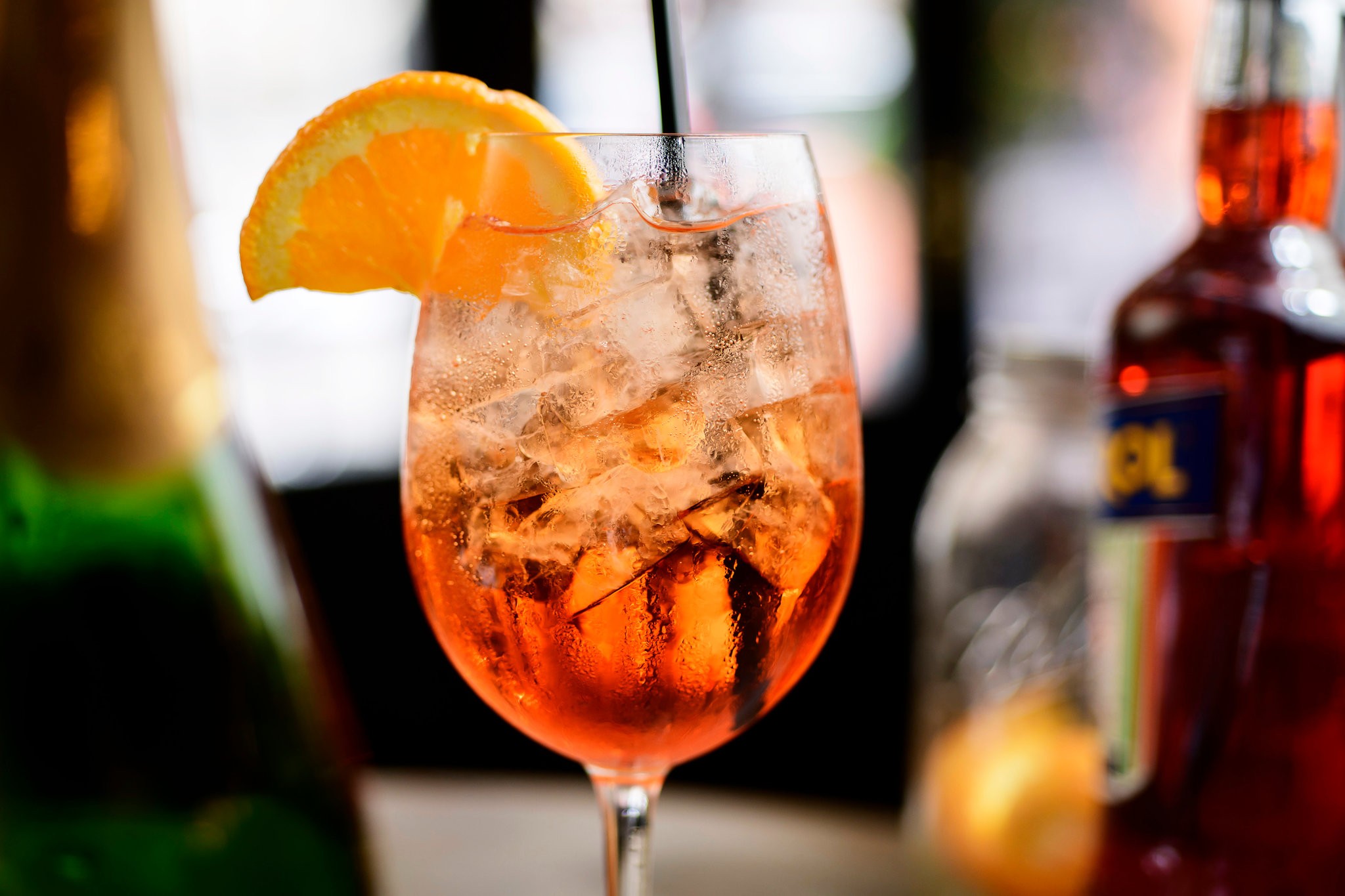
Our arrival in Palermo was a bit less idyllic – it’s a big city, and the airport train took us to the centre through some fairly ropey areas, depositing us outside the central station, with Google maps assuring us that we had a 10 minute walk across to our hotel. Half an hour later, having wheeled our cases through cobbles, kerbs and lots of litter, we found the hotel, checked in, and wandered around Palermo looking for our dream candlelit trattoria. One brightly lit vegan burger later, we found a bar that served Mrs E some weapons grade Aperol spritzers , together with huge plates of bruschetta and chips, which were, apparently, a gift from our host, who must have thought that we looked hungry. Our Italian is very limited, so our conversation was a bit stilted, but it did allow him to say “Hello Baby” a number of times at various volumes, and to establish that Paul McCartney and Mick Jagger were both still alive, and that he’d like to visit us in Liverpool at some point. We made arrangements to come back after the walk for further entertainment.

We had a taxi pick us up in the morning to deliver us to Santa Cristina Gela to start the walk. Again, a challenging conversation but we did establish two important things. Firstly we should always follow the red and white path markings. And secondly that GPS was a very good thing indeed. There was some other stuff that may or may not have been about Mussolini and railways, but that was much harder to follow and probably best ignored.

Our walk to Corleone started gently on undulating, soft green grass tracks, shortly giving way to a bit of mud. The first 10km was fine, but then the mud started getting wetter and wetter and turned from mud to clay, and before too long was adding a couple of pounds to our boots.

We heard a couple of days later that Sicilians call people from Corleone ‘Men with feet of clay’, which I don’t think is intended as a compliment, but maybe we were acting like natives with our stupidly heavy boots. We discovered that many of the paths that we took doubled as streams, and quite enthusiastic streams as well, as it had started raining just as we’d started the walk. This meant going down was really scary, and going up was even worse. At one point, we went down a steep muddy path/river bed for about 2km, all the time looking at a river below which our notes said should be crossed carefully, and a grass/mud climb the other side that looked almost vertical. We managed to get across the river, with very fast water coming up to our thighs, and just about got to the top of the other side, despite picking up clay on our boots with every step. I tried to reassure Mrs E that not every day would be like this. I had absolutely no reference point to be able to say this, other than my sunny optimism, which was getting a bit of a soaking of its own. Mrs E was also less excited than me on the result of the Norwich game (a 3-2 win away at Millwall) which came through about half way up the climb.

Finally made it into Corleone, which most people will associate with The Godfather. Don Corleone is fictional of course, but there’s quite a lot of early mafia history which emanates from Corleone, and if we’d not been covered in mud and arriving two hours after it closed then we would have had a wander around the mafia/anti-mafia museum.

Instead, we trudged to the hotel, where we were greeted by power cuts and some firm instructions that we should be taking off our boots, after which we were directed, freezing, barefoot and outside, to the room furthest away from the main building, presumably because we offered a health hazard to other residents. Between our room and the main hotel there were an astonishing number of lights on every tree and every wall, and possibly giving a clue as to the source of all the power cuts.

Washed most of the mud off and opted to eat in the hotel, partly as it was still chucking it down and partly as it was the only place open in the town. An interesting experience, and again not quite the rustic candlelit trattoria that we’d hoped for – I don’t think I’ve ever been in somewhere so brightly lit, except when the power went off. We were ushered into the main eating area, and took a seat near the middle, and just as we sat down Mrs E asked if we could move – there was a smell coming from the middle of the room that was going to impact her dining experience. The smell came from the centre table, where a man in dungarees had sat, and Mrs E was absolutely right – he absolutely stank of urine, which appeared to have made its way onto the yellowing hoody that he wore under the dungarees. Feeling a bit more charitable than Mrs E (Norwich’s away win was still making me very upbeat), I suggested that he might be a local farmer, and that we shouldn’t judge, because it “might not even be his own piss”. This reasoning wasn’t really appreciated, and we noticed that the many other diners were also moving tables, so that we created a kind of neutral doughnut around the poor smelly bloke.

A succession of waitresses came to see us, our attempts to point at things on the menu and ask for them didn’t seem to work at all, and eventually the third waitress agreed that the point and say “Si” approach was acceptable, despite her attempt to upsell us the risotto. All of the staff looked as if they would much rather be somewhere else, but it may be that they were undergoing some sensory deprivation testing. In addition to the assault on their noses and the blinding lights, there was a sound system that would have done justice to one of the larger Ibizan clubs. It was mainly tuned into a local radio station, but at one point managed to mash up the radio with the football commentary from the huge TV screen in the bar, together with some romantic ballads on the restaurant speakers. A special mention for the only male member of staff, for whom the name ‘Lurch’ might well have been invented. Wordlessly and aimlessly he wandered between tables, occasionally picking something off one table to put it down somewhere else. His bow tie, which presumably had begun the evening at a steady East-West setting, had begun moving around of its own accord, a bit like a revolving tie with a very flat battery. Halfway through our meal it had gone from ESE-WNW to a jaunty SE-NE, and by the time we left it was creeping gently towards true north. Maybe that’s how you wear a bow tie in Corleone. But it’s Corleone so maybe best not to ask.

Up early the next day for the next leg, a 21km trek into Prizzi, which would have been stunning if it hadn’t been tipping it down with rain again. We’d had a hasty breakfast, sped up by the surprise arrival of Urine Man, who popped into the restaurant for a coffee and left behind a distinct reminder of the night before.

Walking up and out of Corleone past olive groves and broken down farms, an idyllic walk spoilt only by the amount of fly tipping on the side of the paths. Fly tipping feels like it’s something of a national pursuit round here – whole bathroom suites and tiles at one point, collections of kitchen contents next, clothes thrown onto the road, a bin liner which was split open and was spilling out human hair, and loads of plastic bottles and cigarette packets, often with branding that I’d not seen for years at home. I mentioned to Mrs E that there were loads of Chesterfields on the road, and she told me about an hour later that she’d been impressed that I could tell the type of sofa that had been dumped, just from a few springs and cushions. Alarmingly, there were lots of disposable gloves on the side of the road as well – now why would that cause any concern?

We saw no one else walking, but a couple of drivers took a bit of interest in us. The first one stopped his car so that he could shout a long and enthusiastic message of support, complete with lots of positive hand action. We decided that, as this was clearly a great place to waste enemies, that he was using us as potential alibis. He might well have been responsible for some of the disposable gloves. A few km later, a jeep overtook is up a hill and the driver jumped out, asking if he could take our photo, as his web site publicised the Magna Via Francigena pilgrimage. Or at least, that’s what we thought he said. There was definitely something about his web site in there, but it would have to be really specialist for a picture of two muddy tourists in walking gear for us to be the March calendar picture.

We saw a bit of wildlife, in the form of giant frogs, most of which had been flattened on the road, and vaguely domesticated dogs, many of which decided that we were deserving of a lot of attention.

Sicily has a number of dog breeds, but we mainly drew the attention of the Maremmano-Abruzzese sheepdog. These dogs, which look like oversized white labradors, are bred to protect sheep, and to bark if they see anything out if the ordinary, which definitely included us.

Apparently they’ll also attack, if provoked, and will only stop once the shepherd calls them off. Frustratingly, we saw a great many dogs, and no shepherds. Mrs E read up about the dogs later and found articles suggesting they weren’t recommended for keeping as pets in towns and cities, as all they did was bark all the time. Which led, naturally, to a conversation about Solomon, a dog who we will always miss when we go away, but will wish he could shut up within minutes of getting home.

Finally started the long climb into Prizzi, and with about 1km to go a car pulled up and the driver jumped out, addressing us by name, which was a bit unnerving, until it turned out that it was Salvatore, who owned the Airbnb that we were staying at that night. He’d noticed it was raining and asked if we wanted a lift for the last bit, but we took a look at the state of each other and the cleanliness of his car and thought better of it.

We met up with him later when we’d arrived and it turned out that he’d been a driving force behind the Magna via Francigena route – he assured us that the worst of the mud climbing was behind us, and pointed us to the only restaurant open in Prizzi that night, a very brightly lit Pizzeria which turned out to be staffed and frequented entirely with cast lookalikes from The Sopranos. At one point, Christopher’s double came in for a takeaway, while Uncle Junior held court with dozen of his family. Truly bizarre.

Prizzi is one of the towns that had offered houses for sale for €1, to anyone prepared to live in them for a couple of years. In some areas you’d also get a grant of up to €30k to spend on the property, again if you committed to live there. Cammarata, where we were walking to next, had made headlines a couple of years ago by waiving the €1 fee. You get the dilemma when you go through the towns – these are idyllic places to live but there’s no work about, and an aging population. There’s some indication that the incentives might have drawn some younger people back home, but from what we saw, probably 90% of the houses were shuttered up, and of the few people we did see, they were even older than us.

Not that we actually saw any people on that day’s walk. We did 25km on a very hilly path, mainly through the Carcaci nature reserve – more beautiful views over the mountains and deserted forest roads as we climbed up to just under 1000m. All was well until the rain kicked in again, this time with some added wind, which soon turned ridiculously strong. By this time we were descending along a cliff road, with vehicle detours in place because of falling rocks. It was probably the only really scary part of the trip, and we arrived in Castronova, making quite the bedraggled entrance into the only bar in town, and immediately being ushered into a side room for the sake of the public good, where the barman brought us hot chocolate and cannola, and suddenly all was right with the world.

We were half way through the walk now, and were in fairly good shape other than Mrs E’s blisters, which hadn’t been helped by having the previous three days walking in soaking wet socks and boots. The next day was to Sutera, another impossibly pretty town surrounding the Monte San Paolina, and it was only 15.5km, so we thought we were in for an easy hike. In reality, it was another tough one, the initial climb up to Aquaviva Platini was a challenge, then followed by a long and very muddy ridge walk to the long road up to Sutera.

Worth it for the views alone though, and we were sustained by a long round of ‘Finding The Band In The Hardware Shop’, with winning entries including Sister Sledgehammer, Sheryl Crowbar, Paint Guns and Hoses, Barbecue Streisand, U Bend 40 and Earth Wind and Firelighters.

We stayed a couple of hundred metres downhill from Sutera, and again, there was only one restaurant open, which was a little way away. Our B&B host was appalled at the idea that we might want to walk to it in the dark, so she called the owner, Franco, and arranged for him to give us a lift. Don’t think we’d get that sort of service at home. Anyway, we got picked up in a knackered Fiat with no suspension left, and we’re despatched at breakneck pace to Franco’s restaurant, where we had the best antipasti we’d had all week, then the best pasta we’d had all week. We both almost fell asleep at the table, as we had to wait for Franco to finish his pizza deliveries and lock the restaurant up, but well worth it nonetheless, and to get us home at a reasonable hour, Franco went for a PB on the way back.

From Sutera to Racalmuto then – another long day punctuated by stunning views, and very lively dog interactions, the scariest one being with six loud and lively sheepdogs at once who seemed to be keen on herding us toward their sheep, then immediately away from them. More stunning valley views and with the bonus of decent weather, the walk took around 7.5 hours – Mrs E concluded that her cut off point, for future reference, was six hours, which I look forward to forgetting when we plan future trips. Todays best game was ‘Famous People In Hospital’ and winning entries included Urinary Tract Geller, Cancer Ian McKellen, Jennifer Canestan, Rib Separatori Amos, Gina Lolladentalbridgeida, The Monty Burns Unit, and my personal favourite, The Brighouse and Gastric Band.

As ever, it was another climb into Racalmuto to end the day’s walk, but this time into a town centre with loads of pedestrians and cars. We managed to find somewhere to sit and watch what was going on, as we’d not seen so many people in one place since Palermo. It turned out to be a funeral at the church in the town square – we were assured later that it was normally much quieter, and sure enough, when we sought out the only restaurant open a couple of hours later, there was nobody around. There was a bit of confusion at the Airbnb that we’d booked before then though – we assumed that when we’d been let in, that we had the whole flat to ourselves, and so set up camp in the kitchen. I offered to get our boots cleaned, as the next day was the last day of walking and was mainly on the road – we didn’t want to trudge a load of mud into our last hotel in Agrigento. So I set to, cleaning hopefully the last bits of clay in the kitchen sink, which took a lot more time than I thought. Just as I was getting to the end, there was a loud Ciao Ciao downstairs, and into the kitchen stomped a vision in leather trousers, leather waistcoat and a very stern expression, which turned pretty thunderous when she saw what I’d been doing in her kitchen sink. Going ballistic is an overused expression, but completely valid in this case, and for the first time since we’d landed in Sicily, I was very glad that I couldn’t understand Italian. I did, however, get the gist, and apologised as much as I could, and also established that there were two other parties taking rooms in the apartment and that the kitchen was only to be used for breakfast. Cruella, who Mrs E had named within seconds of meeting her, was in charge of breakfast, which unsurprisingly the next morning turned out to be a rather spartan affair. But completely served us right.

And so to the final day, a short (11.5km) hike up to Grotte and then largely downhill on roads into Caldare, where we got a train into Agrigento. Still beautiful, particularly the start, but more houses, (mainly) chained dogs and litter as we headed towards the coast, so we were pleased to be able to get the train. We got into Agrigento and walked what Google maps had told us was 20 minutes to the hotel, and which ended up as 45. We really wanted to see the Valley of The Temples and were told at reception that it was a 15 minute walk, so Mrs R bandaged up her blisters and off we set for the last trek of the holiday. Unfortunately we took a wrong turning, ending up 45 minutes later at the wrong entrance, but that mattered a lot less as soon as we started to hike up the hill to see the temples. It would be worth going to Sicily just to see this archaeological site – it’s over 2,000 acres in size and is brilliantly preserved – The Temple of Concordia is the most stunning, and the one that you’ll see on the tourist sites – built in the 5th century BC and still looking pretty good:

We were knackered and ideally would have got in a bus back to the hotel, but there weren’t any buses or taxis, so we trudged up the hill back to the hotel, packed away our walking boots, popped Mrs E’s blisters, showered, and went into the restaurant to celebrate. It ended up being a bit of a muted affair, as we were both so knackered, but we still had a couple of days ahead in Palermo where we could get the right side of an Aperol spritzer or two, so we looked forward to that instead.

Next day, to the station and the train back to Palermo. Slightly demoralising to take 2.5 hours to cover slightly more distance than we’d taken six days to walk, but I guess the train had a lot less mud to contend with. And Palermo in the sunshine was lovely – really stylish and as effortlessly cool as many of the other Italian cities we’d been lucky enough to visit. An afternoon at the No Mafia Memorial was suitably sobering, but the Aperol was calling, and it was only a short walk away…

Adventures on less than two legs

Apologies for the radio silence from the Emu blog. Like most people, I’ve had a rubbish 2020, followed by a rubbish 2021 and I’m not sure that sharing any of that is going to be of any help to anyone.

However, what I have noticed over the last 18 months or so, is that everyone has been able to derive some sort of enjoyment from other people’s misfortunes. So here’s a blog about misfortune, disaster, stupidity, weird cows and stagnant water for you all to enjoy. Here goes:

Like many other people with time on their hands during lockdown, I decided that I was going to do something exciting once I was allowed to be properly outside again. What I had in mind was a really long run over quite a few days. I’d been talking about this for a while with Mrs E, who approved of the project on condition that a) I didn’t do anything stupid or injuring and b) it didn’t cost too much money. So b) put the idea of running between luxurious B&Bs across the country into the long grass, and I started planning a more spartan event, involving a small tent. I started training properly, and planning routes between campsites, which were beginning to open up in May. And, most excitingly, started ordering all manner of ultra lightweight equipment. As each piece of lightweight gear arrived, I unpacked it, held it gently in my hand, and marvelled at its delicate being. It didn’t strike me until much later that combining lots of lightweight gear in one place would make for something that was actually quite heavy, and that may well count as my first school boy error.

I planned a route over six days, which roughly covered the perimeter of Norfolk, on long distant paths. By the start of July I had all of the routes downloaded, all of the kit bought and paid for and all of the campsites booked. By the start of July I was ready to go – I tried out the tent, albeit in the living room with unwilling volunteers pretending to be tent pegs, because it was raining, and it seemed to work. I could even just about sit up in it. On the 2nd July it had just about stopped raining, and at first light I was ready to go, just managing the time so that I could bring Mrs E her morning cup of tea. Rubbing the sleep out of her eyes, she looked me up and down; the first time she’d seen me in my new lightweight gear.

“Those trousers are ridiculous”, she said, instantly putting me at my ease before my big expedition.
“They look like the sort of thing that Lionel Blair would wear. And they woke me up.”

To be fair, they were a bit ridiculous. Alongside an elasticated waistband that was straight out of the Damart catalogue, they also boasted a roomy nylon fit with long side zips to allow for speedy changing without shoe removal. This was the first time they’d been worn, and she was right, they really did make quite a noise, a sort of shushing, swishing noise that I could only avoid if I walked like John Wayne. I wasn’t really sure about the Lionel Blair reference. Somewhere on the internet there is video evidence of our band playing on TV with Lionel Blair introducing us, and dancing along as we played. I suspect it was more memorable to us than to him, but I have no recollection of him wearing noisy lightweight running trousers. Anyway, armed with this peculiar insight into my wife’s waking thoughts, off I went.

I hopped noisily onto a train to Cromer about half an hour later, with my lightweight/heavyweight bag on my back. Got to Cromer, walked down to the sea, removed the Lionels and started to run, keeping the sea on my left. The plan was to get nearly to Caister-on-Sea, then turn inland to Martham, and then on to Clippesby, where a pitch with my name on it would give me a well earned night’s rest.

Day One was relatively uneventful. Even by keeping the sea on my left I managed to get slightly lost, and had to circumnavigate Bacton power station, which I can report is a good size bigger than it looks on the map. And as I was on the the Norfolk coastal path, unsurprisingly a lot of the running was on sand, so quite a bit of this soon turned to walking. No matter though, and 29 miles later I jogged into the campsite, bought an ice cream from the reception area, found my pitch and (you’ll have to forgive me here, cos I’m new to this camping parlance) ‘set camp’. The campsite even had its own bar, where they were showing Spain vs Switzerland on the TV and serving food. So, one veggie burger, a caramel slice, three pints of Guinness and one penalty shoot out later, I staggered back to my very small tent, and negotiated with my sleeping bag and inflatable mat. The three pints of Guinness were probably my second schoolboy error, as exiting your way out of sleeping bag and very small tent several times during the night is not to be recommended, particularly if your legs are complaining about a long run the day before.

Refreshingly though, I found that I could move fairly freely in the morning, and I’d (apparently) ‘broken camp’ well before my fellow campers had changed out of their jim-jams.

Day Two involved getting onto the Wherryman’s Way, which runs between Great Yarmouth and Norwich – I was going to follow this to Loddon, then pick up the Angles Way, which by the end of day three would land me somewhere around Thetford. I’d decided that today was going to be more walk than run, so had slipped into my Lionels, and made my way noisily out of the campsite, no doubt waking many of the other campers as I shuffled past.

“Did you hear that noise, Brian? Fair woke me up. Any idea what it was?”

“No idea. But it sounded strangely like….well, Lionel Blair, going for a walk”

Off I set along the route, when a voice in my headphones advised me to turn left onto the hiking path. I mentally made a note to write a charming letter to the navigation software company when I finished, as without their help I’d have completely missed the small gap in the hedge which led onto a narrow path.

A few minutes later, and I’d redrafted my note a couple of times, as the path gave way to a jungle of nettles, thistles and reeds which I had to negotiate like an Amazon explorer. Each time I got to a clearing I checked my tedious progress on my phone, and I was still on track – river to my left, field to the right, so there was nothing for it but to press on. In actual fact there was a very clear alternative, which was to turn round, go back to the road and to stop entrusting my well-being with a silly black line on my phone, but for some reason I wasn’t thinking of that as an option. And while I wasn’t thinking of that, a very loud bark was barked from across the field. The weeds and grass were up to my shoulders at this point, so I wasn’t able to see anything that was in there. I’m not by nature a fatalist, but I have read the legend of the Bungay Black Shuck, and I was headed in that general direction. I hoped that me shouting ‘Sod Off!’ very loudly would do the trick. It didn’t, and I was replied with a louder, more menacing, and worryingly closer bark. So I stood as still as I could, like a meerkat, popping my head above the nettles and swivelling around to survey my impending doom….

,oOo.

Meanwhile, about twenty yards away, a frustrated deer put his head above a similar set of nettles, looked in my general direction, barked again, and wandered off. Relieved, I just tried to remember whether deer got particularly aggressive during rutting season, and for that matter, when rutting season actually was. Tentatively I carried on, and finally was rewarded up a climb to a jungle free bank of a field. Checking on my trusty map, I saw that I was still on the hiking path, and off I jogged, with not a care in the world, other than the thought of lunch that no doubt awaited me at some Broadland inn en route.

Crossing the field, I came to a drainage ditch. It was about 3 metres across, and thankfully some kind soul had put a couple of logs across it, and I balanced like a tightrope walker with a bad case of DTs. As I lumped across to the other side, I looked behind me, and saw the log disappear into the stagnant ditch. ‘Ah well’, I thought, ‘no going back now’. It was amongst my more stupid thoughts of the morning.

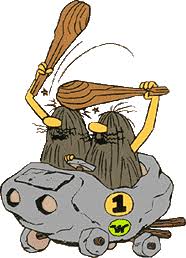
Along the next field, still no noticeable path anywhere but on my phone, and I got to another drainage ditch. No kind souls placing logs in advance here, and a couple of metres across – too far to jump, even without a ridiculously lightweight/heavyweight pack on my back. What I really needed was some sort of pole, so I could reenact one of those village sports days where they vault across a river. I should confess at this point that I never, for one moment, considered that a ridiculous idea. I found a tree nearby that looked like it had been struck by lightning, and managed to pull off a branch that, to all intents and purposes, looked like something that the Slag brothers from the Wacky Races would carry:

I’m not entirely sure how I managed it, but with a bit of fancy footwork and the help of a muddy island and my caveman club, I managed to get across to the other side without getting my feet wet. Again, the familiar ‘no going back now’ thought rattled around in my head, almost as if it was a good thing.

I strode on purposefully across the next field, still on the path, with a drainage ditch to my left, and still holding my trusty club. I was about halfway across the field when I noticed a cow to my right. And another, and another, and another. In fact, quite a few cows were headed in my direction. I don’t like cows. Never have and never will. They’re gormless, dangerous and the wrong size for their brains. By rights they should be British political leaders, haha. Anyway, several of them were headed in my direction. I tried the tactic that had worked so well with the deer/Black Shuck situation.

“Sod Off!”, I shouted. And to my surprise, they did.

I felt quite pleased with myself, but this was quite a short-lived experience, because as I looked up, I saw many more cattle, all headed in my direction. Clearly the first lot had found my ‘Sod Off!’ so amusing that they’d been to get all of their mates. They were all headed in my direction, and by the time they were a few yards away, I was beginning to panic. I tried ‘Sod Off! and a number of variations on that theme. I tried waving my trusty caveman club around, and over my head. They inched forward, and started to pin me in. Finally I tried.a line that had only previously worked outside a chip shop in Edinburgh, around midnight, about forty years ago, to a drunken charmer who was offering to beat me up.

“I’M NOT FROM ROUND HERE!”

Maybe it was the volume of the voice, the anxious tone, or the combination with the caveman club wave. Or maybe they understood every word, and decided, as did my Edinburgh opponent all those years ago, that if those were the best words that I could offer, then I really was a pathetic specimen that deserved to be left well alone. Whatever it was, they turned on their ridiculously tiny heels and stampeded off in the other direction.

I wandered on towards the edge of the field, still holding onto the club, just in case. Gently stepping on to some reeds, I lost my footing and fell directly into a drainage ditch. By the time the water hit my waist, I’d managed to use up almost all of the swear words I knew, and was cursing on repeat as I threw myself across the reeds to the other side. The bottom half of me was covered in a sludgey mess from the ditch that absolutely stank. As I scrambled up the side of the bank, still cursing, I thought again that at least today’s hike couldn’t get any worse than this point. On reflection, this was a hopelessly optimistic thought. By now, the route had mysteriously disappeared from my phone, as had any mobile signal. So even if I’d wanted to call my wife I’m not entirely sure what I could have asked her to do. My cheery optimism started to peter out.

Seeing an abandoned windmill a few fields away, I decided to head for it, on the logic that there still ought to be some sort of path to it that didn’t necessitate diving gear. I navigated a couple of further ditches semi-successfully, although by now I wasn’t overly worried about getting a bit wet.

.oOo.

I can’t remember the sequence of events that led to the next disaster. One minute I was finding my way towards the edge of a field, looking for a way across the widest ditch I’d seen so far. The next minute, I was in it – I’d fallen through the reeds, I was literally up to my neck in drainage, and my feet weren’t touching anything other than water. The lightweight/heavyweight rucksack was pulling me down, and I wasn’t able to turn around, so I kicked as hard as I could against the reedy bank and launched myself across to the other side. Fortunately I managed to keep my head above the sludge, grabbed onto the reeds on the other side, and hauled myself out. It doesn’t sound too bad written down like that, and it was over very quickly, but I was as scared as I think I’ve ever been in my life. A couple of other thoughts struck me. Firstly, that I’d exhibited astonishing levels of stupidity – if any of my children had been half as idiotic on an adventure as I had in the last couple of hours, then I’d have sounded off at them for being ridiculously irresponsible. And secondly, that if I were to have any say over when I got to meet my maker, then it definitely would not be in a Broadland drainage ditch, dragged out goodness knows when and in goodness knows what condition.

Away from the ditch, I did my best to assess the situation. Mentally, I was now, by a country mile, the most stupid object within a five mile radius. Including the cows. Physically I was tired, and I’d managed to knock my back and left knee so that neither was very keen on any further movement. Stylishly, I had rather lost the edge. My lionels had lost their jaunty swish, and, like all of my clothing was now clinging to me unhelpfully, under a carpet of slime and small-leafed greenery that until recently had been laying peacefully on top of the stagnant ditch. And pungently…well , I was in another place altogether. If every farm animal in the county had shat on me from a great height for 24 hours, I think I would have smelt slightly fresher.

‘Ah well’, I thought, ‘I’m not sure it can get any worse’.

And naturally, it did, but fortunately only for a bit. After climbing up the bank, I found myself in a very large field, fairly close to the windmill. I wandered around the perimeter, peering into the drainage ditches that surrounded it on all four sides. Thankfully there were no cows, but that was probably because, other than airlifting them into position, there was no obvious way to get them onto the field. I considered the situation as best I could. Despite the submerging incident, the waterproof rucksack had lived up to its billing, and everything inside, which included a tent, sleeping bag, two chewy bars and a bottle of water, was all usable. My phone had been in an unzipped pocket but had miraculously not disappeared into the drain – it was complaining of being wet, and was still functional, but without any signal. So things weren’t exactly desperate, but there was still no obvious way to get out of this miserable field.

Walking back around the field again, I noticed that a corner had been fenced off with barbed wire. Behind the wire was lots of reed bedding, which I assumed led to the connection of two drainage ditches. I didn’t have much option but to try it, to see if there was a way of getting across, but I was very nervous about going into an area that was fenced off, given how precarious the unfenced area had been. I said a quick prayer before passing my bag across the barbed wire. Thankfully the bag didn’t sink, and neither did I, as I tiptoed through the reeds. After about twenty yards, I came across a brand new galvanised five bar gate, and beyond that dry land which seemed to lead up to a path. It suddenly struck me that the gate and the barbed wire were there to stop idiots like me going into the field, rather than stopping idiots from getting out, and I fair skipped up the slope, as well as my left leg and lower back would allow.

I realised that I’d managed to get myself onto the Wherryman’s Way. I realised this partly because I knew that the path follows the river Yare, and beyond the path was a huge river. And in the river were the sort of pleasure boats that you only ever see in summer in Norfolk. There were quite a few of them, many piloted by cheery souls in captain’s hats, and they merrily waved at their fellow nature lover standing on the footpath. I waved back, trying to forget that I looked like Stig of the dump, and hoping that they were upwind of me.

I couldn’t run any more because my knee was still complaining. I checked my phone and was delighted to see that I had a signal. So I phoned Mrs E, who was slightly put out to have her Saturday morning dog walk interrupted. I don’t think I’ve ever actually cried down the phone before, but the threat of this must have come through to her, and she said she’d come out to Acle to meet me. Optimistically I asked her to bring a change of clothes and some wet wipes so I could carry on.

I made my way to Acle, found somewhere that sold coffee, and even better let you drink it outside, and waited. Mrs E turned up in a cloud of dust in the car park. She said she had the clothes ready if I wanted to change and carry on, but by then, I was completely fed up and my left leg had given up the ghost. I asked if she could take me home so I could get a shower, lie down, and forget about the last few hours.

On the way home, I asked if she wanted the window open.
“That’s alright”, she said, “you don’t smell too bad. Those bloody trousers were a mistake though”.

50 ways to leave your lover. Really.

You might be reading this as a Paul Simon fan. In which case, feel free to step away now. Big fans of Rhyming’ Simon (or lil’ Pauly, which his diehard fans definitely don’t call him) tend to be a bit precious about his work – kicking back when phrases like ‘cultural appropriation’ or ‘oversized monitors for everyone in the band except Paul’ are used.

I’m fairly ambivalent, but I’ll confess to a bit of a black mood every time I hear the opening chords to ‘Fifty Ways To Leave Your Lover’. This always leaves me disappointed, insofar that Paul tends to leave the listener a little short changed on the learning front. Having had a look at the lyrics, short changed to the tune of 45 ways, so if we’re looking to the song as a list of ideas, we’re a good 90% down on our expectations. To be clear, the ‘ways’ which are outlined in the song are:

  1. Slip out the back, Jack
  2. Make a new plan, Stan
  3. You don’t need to be coy, Roy
  4. Hop on the bus, Gus
  5. Drop off the key, Lee

Even these five recommendations seem a little flimsy on closer inspection. If your name was Roy, for example, you might feel a little underwhelmed if you’d gone to Paul for your relationship-ending advice.

However, the Emu is very much here to ease the pain in these troubled times, and would respectfully suggest a further set of strategies to leave your lover, which Paul may want to incorporate into future versions of the song.

6. Bogart the spliff, Cliff 

7. Play her all your records by The Fall, Saul

8. Snip through his brake cable, Mabel 

9. Wait till he’s asleep then violently sever his nose, Rose

10. Go swimming and tie her legs to an anvil, Granville 

11. Mention ‘big boned and jolly’, Wally

12. Tell her you’ve been charged with Gross Moral Turpitude, Dude

13. Tell her the sea’s your mistress, Idris

14. Dig a shallow grave, Dave

15. Slip your head in a noose, Bruce

16. Give her a swerve, Merve

17. Show her your truss, Russ

18. Walk around in her skirt, Kurt

19. Shoot some amateur porn, Shaun

20. Tell her you’re a slave to your work, Dirk

21. Say you fancy her Gran, Stan (a bit more effective than ‘A New Plan’)

22. Say you play for the other team, Gene

23. Cop an inappropriate feel, Neil

24. Reveal you’re a cleric, Derek

25. Leave an unpleasant stain, Wayne

26. Tell her your real name is Doris, Maurice

27. Reveal yourself as a big fan of Boris, Horace

28. Forget the safety word, Edward

29. Establish that behind your back she calls you Just In, Justin

30. Tell her you’re married already, Eddie

31. Reveal your prosthetic leg, Greg

32. Tell her you have the virus, Sirus

33. Mention your chlamydia, Lydia

34. Call him Mr Floppy, Poppy

35. Test his olfactory gland, Fran

36. Lower his sleeping hand into a blender, Glenda

37. Stab him in the hand if he tries to feel ya, Ophelia.

38. Play him some folk songs on your concertina, Katrina

39. Elaborately fake your own suicide, Clyde

40. Use the trusty ‘it’s not you, it’s me’ line, Clementine

41. Impale him on your fender, Brenda

42. Pretend it’s a vaccine, Maxine

43. Resign from (or, possibly, join) his quiz team, Christine

44. Tell him that’s not what you meant by a mouth organ, Morgan

45. Tell her you need to set the bar higher, Isiah 

46. ‘Forget’ to feed the cat, Pat

47. Give her a bath in something corrosive, Joseph

48. Hop on your cycle, Michael

49. Carelessly leave laying around the elaborate plans for her mausoleum, Ian

50. Tell her you’ve modelled your emotional development on the personality of Hannibal Lecter, Hector 

As I write, Bob Dylan has just released a seventeen minute version of a song documenting his thoughts on JFK and the American dream. So it’s probably not too much to ask for Mr Simon to go in the same direction. (I can guarantee that the rhymes above are no more contrived than the one’s you’ll find on the lyric sheet of ‘Murder Most Foul’).

Stay safe (Faith) x

Through a glass, darkly

Well, during these strange times, I’ve been looking to find ways of wasting time productively, or filling the gap between a) proper work and b) my vegetative state between the fridge and the TV. You may have a similar challenge in your life – some people seem to have the energy to do interesting things in their gardens, or setting quizzes, or spending time with Joe Wicks; I’ve decided to spend a bit of time researching my family tree. This involves taking the contents of boxes of stuff that I’ve accumulated over the years, and plugging this in to the rather wonderful ancestry.co.uk site, which gives you not only a platform to land your ancestors onto, but also links to all the digitised census, birth marriage, death & criminal records from the past, and, if they let you, access to all the other family trees that might intersect with yours.

I’m aware that hearing about other people’s family trees can be desperately tedious – a bit like listening to, say, Matt Hancock spinning another yarn about government guidance. Things start off uninspiring, and go steadily downhill, until you start running calculations in your head around time off for good behaviour. This will happen at about the time you’re told about a second cousin who might well have had a grandparent on the Titanic, or, in Mr Hancock’s case, where he starts advising on your civic duty. But this blog isn’t really about a family tree as such, it’s about one person – not an exceptional person by the sort of standard you might set today, but someone with a telling story nonetheless.

Below is a picture of my grandmother, Dorothy Kerridge. She’s on the right – from the left of the picture are her brother Reuben and her elder sister Dora, then her mother, Mary.

Grandma was born in 1909, and this picture was taken around 1916. By this time, her other elder brother Sidney had been called up and was fighting in the Great War. He came back unscathed, and came out of the army at the end of the war, but millions of others didn’t. There’s a war memorial in the village where Grandma lived; it has 60 names on it, which at the time would have been about a loss for around every fourth household – she would have known most of the families as she grew up. One of the names is P Kerridge – this was Grandma’s cousin Percy, a sailor who lost his life in the Indian Ocean somewhere near Bombay – a long long way from Suffolk.

And just at the end of the war, the Spanish flu epidemic claimed 50 million lives – 500 million were infected, which was about a third of the world population. I’ve never seen memorial to Spanish Flu, but this would have dominated thinking in East Anglia several years after the war ended:

(note very Suffolk subheading!)

Having survived those early years, Grandma attended school in Wickham Market and in 1922, aged 13, was enrolled on the ‘Rural Teacher’ training course, she completed aged 19, at which point she was appointed as an assistant mistress.

She met my Grandpa at a fair in Suffolk when they were both 16. He had to move to Bournemouth shortly afterwards, but would visit her every month until they were married in 1933. By then they’d both seen the Great Depression and the tough times of the 1920’s – one of the reasons they were apart was because he was following his father around the country finding work as a journeyman butcher.

They had two children, my father and his brother, in the 1930’s, and life was beginning to settle down until the Second World War broke out, when, again, they found themselves travelling about after Grandpa was called up. They were never separated during the war, despite him being posted all over the country, often to the sort of location where a young family would be in danger.

Some sort of stability came after the war – Grandpa was back in the butcher business with his name above the shop, my father and his brother left home, and they became grandparents just about the time that his heart problems meant he had to give up work – they moved into a static caravan on a park near Bournemouth. I was their second grandchild, born just before the Cuban missile crisis, when the world held its breath and waited anxiously for the big bang.

My Grandma died in 2005, aged 96. Between my arrival and her passing away, she’d seen multiple recessions; world famine; the Cold War; cholera, flu and measles pandemics. She saw all three of her siblings and her husband pass away between 1987 and 1995.

I’m writing this down because I’m keen for some perspective at a time when so much talk seems to be of the end of all things. I’m not diluting today’s crisis in any sense, but the nature of all crises is that they do, eventually, come to an end. And also because, at this time, I can remember my Grandma very clearly indeed. Any one of those world events could have hardened and depressed her, and they didn’t. She lived a very, very happy life, never seemed to stop smiling, and took delight in simple pleasures. She would have got through the current challenges by waiting it out, and being sensible and caring for those around her. Being a very British person, she’d have raised her eyebrows a little at some of the pictures in the paper:

And being a very kind, generous person, she would never say anything rash like ‘they don’t know they’re born’. But you really wouldn’t have blamed her if she’d thought it.

Stay safe x

Into the great wide open

To celebrate her birthday year (see previous blog, and pretty much every conversation in the Emu household for the last twelve months), Mrs E decided that she needed to do something special. Specifically, her requests/demands were a) a big hike, b) access to a great deal of cold water for swimming purposes and c) a remote location that defined ‘getting away from it all’.

After a certain amount of digging about, we settled on the Kungsleden trail in Swedish Lapland. The Kungsleden (King’s trail) runs for 440km, almost all above the Arctic Circle, from Abisko to Hemaven. You can start the hike in Abisko and, over seven days, go 107km south to Nikkaluokta. If you look at these points on a map, these are the two places on the first part of the trail that feature a road – the only access between the two points is on foot, helicopter or in the winter months, by snowmobile. I mentioned this to someone before we set off, and he asked if we were planning to hike all the way. I said that we’d actually decided to travel by helicopter, which I thought was a brilliant joke, but he just looked at me like I was a complete prat. Perhaps both things were true.

Anyway, you can camp along the trail or stay in one of the Swedish Tourist Federation (STF) huts, all of which are about a day’s hike apart. There’s no electricity, no running water and no mobile phone coverage, but the huts have beds, cooking facilities and, if you’re lucky, a wood fired sauna, which, together with nearby fjords or rivers, is how you keep clean. So far, so idyllic, although one of the drawbacks is that you do have to carry everything that you’ll need for a week on your backs. You do have access to water at the huts, you can drink from the rivers and fjords, so that’s something, but you’re still looking to carry 42 dried meals between you, which you’ll be unsurprised to hear, is quite a weight. By the time the food had been packed into Beasts One and Three (see previous blog) there was little room for anything else. Mrs E had read that the maximum carrying weight of a backpack should be no more than 10% of your body weight, so the first weigh in of about 12kg meant that we were going to have to put on some serious timber in order to cope. We managed to trim the pack weight back down a bit by losing any non-essentials, like a change of clothing, and I decided to sacrifice my razor, a marginal weight gain, perhaps, but one that would allow me to cultivate my first ever ‘rugged outdoorsman’ look.  I’ve never really seen the attraction of beards, being one of those people who has ready access to a mirror, but maybe here was an opportunity to see why people choose to look like serial killers. If you’re reading this and are currently in possession of a beard, apologies – I’m sure you have your reasons, I just don’t know what they are.

Anyway, back to the trip. We organised ourselves through the wonderful Alpine Exploratory agency in Edinburgh; they’d asked us to ensure that a) we were able to read and navigate with a map and compass in bad weather, b) we were adequately insured including helicopter rescue cover and c) we were carrying a GPS device to call for help where necessary. We addressed all of these points by a) asking our friend A to show us the ropes, and after a quick lesson, could quite easily navigate from one side of a football pitch to another in broad daylight b) asking our travel insurance company if we were covered, receiving the breezy reply that people with this cover got rescued by helicopter ‘all the time’, and c) went on a Swedish tech rental website (who knew?) and arranged to hire a Garmin beacon device for a knockdown price. In the event of course, none of this was necessary – we followed well worn paths in reasonable weather; saw a few helicopters, none of which were for us; and found no use for the very tempting SOS button on the side of the Garmin.

So other than putting the bins out, gaining a large amount of weight and cancelling the milk and papers we were ready to go.

And on the 4th of July, we set off, by taxi/train/train/plane/bus to Stockholm, and then the next day by bus/plane/bus up to Abisko where the Abiskoturistation marks the start of the Kungsleden. We were expecting the tourist station to be a mountain hut but it turned out to be fairly up market with very Swedish restaurant. Abisko is next to a road so allows people to travel to the start of the route, and I guess also allowed for fresh food to be delivered; not a situation we were likely to see for the next few days so we loaded up on as much decent food as we could, easing seamlessly into breakfast the next day.

We set off on day one, walking south from Abisko to Abiskojaure. It had been raining, so the rocky path was hard to navigate with slippery and muddy bits and an unfamiliar 10kg of extra weight on our backs. We soon got into a rhythm though, and started to enjoy the amazing hills and mountains as we came out of the forest and headed towards our first proper hut. The hut could sleep up to 62 people and most of them decided to use the kitchen at the same time, but we managed to rehydrate some unappetising dahl, which frankly could’ve done with a bit of mango chutney which we’ve forgotten to bring. Cleaned up, and then headed to the 8 to 9 pm mixed Sauna shift, with a variety of shape, sizes and optional swimwear. I decided to embrace the whole Swedish sauna ethos and before long I’d not only got naked and sweaty in front of a whole load of disinterested strangers, but was bounding down the lake for a cool/freezing dip. In my mind I was looking like a still from Health and Efficiency magazine– of course in reality I probably looked more like an old git covered in mosquito bites who needed to shave. And then have another shave. Speaking of which, the beard was beginning to look like a big mistake and there was no going back until I was to be reunited with my razor in Stockholm. There are no bathrooms on the Kungsleden and no mirrors, so I was reliant on Mrs E’s views on how well it was taking shape. I asked what I looked like unshaven and without missing a beat, she said ‘a nonce’.

Second day of hiking took us from Abiskojaure to Alesjaure, a distance of 22km – that doesn’t sound very much, but it took us around eight hours excluding stops. It was forecast to rain for most of the day, and the forecast turned about to be correct, making progress over the rocks a bit tricky. We’d bought capes that covered us and our backpacks, so these went on for most of the day, making us look like orange and black plastic hunchbacks trudging across the valley floor. But we kept dry, which was the main thing, we just had a bit of kit envy at our fellow hikers who had kit that made them look a bit less cumbersome. In later days we’d get quite nostalgic for the rain as it did at least send the mosquitoes away; they were literally a big irritation throughout the hike, we were bitten while we were walking, and in the dormitories when we slept, and even through our clothing. We had some deterrent spray that was pretty useless – we’d bought it on a previous trip abroad and couldn’t translate the label properly, so for all I know it may have been a mosquito encouragement spray. I also had some mosquito treatment cream that I’d bought in Japan, but again, I was unable to read the label, so for all I know I may have been rubbing itching cream onto the bites – that’s certainly what it felt like. Ridiculous climbs on really rocky paths, perilous board walks across marshland, a bit of wading across rivers, and some more climbing. Very grateful for the poles, and because the ground was so unpredictable, the tendency was to be looking down as the time, so we had to force ourselves to stop and look around. Mrs E summed it up nicely – every review we saw was like the front of an atlas – beautiful still lakes, waterfalls cascading down from the snowcapped mountains, it was absolutely stunning all day long, even in the rain. We dragged ourselves up the climb to the Alesjaure hut at about 5 pm, completely knackered and complaining about Beast related injuries in our legs and shoulders. However, the combination of rest, rehydrated food, ibuprofen, and a sauna/nude skip down to a freezing lake had us nicely sorted out in fairly short order.

Day three, and another testing hike, this time to the basic mountain hut at Tjäktja – no sauna, no shop, so everyone on the hike was looking forward to smelling especially ripe for the next 24 hours. It stopped raining, giving the mosquitoes a chance to get involved, but that was almost worth it – the views over the mountain passes were amazing again. The last climb seemed to last forever, but was really only about 3 km, hiking above the snow line and into more rockiness, then finally dropping down to the scariest suspension bridge so far, spanning a little canyon complete with waterfall and glacier, and leading to the hut.

Being without the Internet, we played a game which we will call ‘impossible fact checking’, in which we tested our memories with no option for fact checking, and no penalty for being wrong. Recommended for the next time you’re without internet access. Today’s topics included trying to remember :

  • The lyrics of the second verse of “Two Little Boys” by Rolf Harris
  • Whether Rolf Harris was still alive
  • The names of all the places we stayed on previous hikes
  • The chronology of all Belle & Sebastian/Beatles albums
  • The name of that town that my sister really likes, in the borders, where we stopped on a bike ride last year

Day four took us to the highest part of the Tjäktjapasset pass – a sharp climb of about 4 km to the peak at 1141m, where we found the rescue hut and some other tired hikers, before descending through more atlas-cover-worthy wilderness to the maze of rivers and lakes and onto Sälka, across another wobbly suspension bridge and into the little array of huts, these ones including a sauna, with adjoining river. We were sharing a hut with a wonderful family of hikers, three adults and four kids, the youngest of which was nine, putting us to shame on endurance. The 13-year-old boy was super keen on the wood burner, so we ended up in a very hot hut keeping us nice and warm after the dip in the nearby pool, where the waterfall delivered freezing cold water straight off the glacier. There’s plenty of wood about at the hats, which is odd initially as there are no trees for miles – we’re above the tree line and partway above the area where snow and ice were permanently on the mountain side. The wood and everything else that the huts need for the summer gets delivered by snowmobile every spring. They also take away all the recycling (hikers are expected to take their non-recyclable rubbish away so my rucksack was full of empty packets of freeze-dried rations by the end of the trip). But if you look at the logistics of this it’s amazing – in addition to delivering several tons of firewood, they also deliver all the hut construction materials (there was a new toilet block at every camp which looked amazing but smelt like four day old Glastonbury) plus gas canisters, and for huts with shops, enough supplies for hundreds of hikers.

Meanwhile, the beard continued to develop. Still no access to a mirror, so was checking in with the very non-beard-friendly Mrs E. Day 4 update was a severe eye roll and ‘It just makes you look old’. Apparently it’s extremely grey, so I was hoping to return home with a bit of a Gandalf look about me. Seriously considered a cloak and a staff for the Gatwick leg.

Day 5, and the hiking was beginning to feel a little easier – the route was still full of boulders so it was very slow going, but the packs were getting a little lighter with each meal we’d eaten, and it was a very pleasant 14 km mainly downhill to the huts at Singi. We were coming out of the Tjäktjapasset now, with its super-wide valley floor and huge lakes reflecting the mountain ranges. The Kungsleden carries on south for about another 300 km, but we were going to head east to Kebnekaise the next day. We got to Singi by about 1430 and spent a very relaxed few hours hanging out with some new Swedish/Finnish friends, learning a bit about this and that and breaking off occasionally to head for a dip in the river. We had a useful discussion about Scandinavian stereotypes, these are of course mixed depending on which part of Scandinavia you’re from, but there does seem to be a common grudging respect for the Finns, who seem to be harder in spirit than all the others. They talked about the sauna world championships as an example. The last of these was in 2010 after the final between a Russian and a Finn was called off after six minutes – both finalists were taken to hospital with severe burns and the Russian, who was later found to have been using banned painkillers, died.

Taking the left turn to Kebnekaise the next day, we headed out of the main valley and into the Laddjuvagge valley. It takes quite a while to climb the numerous false peaks as you get to the top of the pass, scrambling over yet more rocks as you do but once you get to the top, the rewards are so worth it.

As you drop down to the Laddjuvagge you notice that the sides of the valley are much more severe, with less space around the rivers, but walking next to the river is fun – it’s fast flowing which reduces the mosquito population and, of course crystal clear. Before we left, we were given differing advice about water purification but took our lead from a couple of Swedes, who told us that (of course) you could drink straight from all the rivers. So like all the other hikers, we did, and the cold water tasted exactly as cold water should, ie of nothing. Climbing over a couple of bluffs, we went past a Sami encampment – there are a few of these on the route but no one and no reindeer to be seen – the reindeer go high up in the mountains to get away from the mosquitoes, and the Sami spend this time of year rounding them up in order to manage the reindeer count later in the summer. Eventually we went round a bluff and saw the scattered buildings of Kebnekaise. Kebnekaise, like Abisko Turiststation, is a few pegs above where we stayed for most of the walk. The dining room, for example, featured proper meals that weren’t just made by pouring hot water onto freeze dried soya mince. There were hot showers. There was power. Oh, and drainage. And where there is hot and cold running water there will also be a mirror, so the beard was seen for the first time in a week. I think it’s safe to say that it was not a strong look. There was a reasonable amount of it, but it was almost all grey and the overall effect was less rugged outdoorsman and more ‘helping police with their enquiries’. Part of the problem was that it was a bit patchy on the cheeks, so I suppose I could have shaved the sides and go for the hipster jazz cat look, but what would be the point in that? I’d still have that ‘helping police’ look but with added rhythm. So it needed to go, but with a few days left before returning to Stockholm/my razor, there were still likely to be a few parents escorting their children away as I shuffled towards them, and I wouldn’t have blamed them in the least.

The other great thing about reaching Kebnekaise was that there was mobile reception, England were playing in the World Cup quarter final against Norway that night – it kicked off at 2300, so it was going to be a challenge with a 0630 start the next morning but it felt like a must-see opportunity. Despite significant technical preparation involving VPNs and network permission, I couldn’t get a stream to work, so asked a group of Danes if I could join them – they were crowded around an iPad and very much rooting for Norway but were really welcoming and we had the sort of conversation that people in bars always have when they’re watching football matches. The game went to extra time, at which point we were joined by a German guy, who, for some reason was determined to talk about fishing with one of the Danes. Just as my Dad would be able to recall in great detail Geoff Hurst’s third goal in the 1966 World Cup final, I will always remember Bellingham’s winner in extra time, as, just as it went in, the German passed his iPhone across to one of the Danes, to show a picture of a fish he’d caught. And because the head of the fish was pointing towards the Dane, it looked very much as if there was an enormous arctic char swimming across the pitch to celebrate the goal. Day seven, and the last hike, along to the lake at Láddjujávri where we cut the hike to Nikkaluokta down to about 14km by taking the boat, which drops you off next to the Enok restaurant, ‘famous’ for its reindeer burgers.

When you get to Nikkaluokta there are a couple of huts, a visitors centre, and a car park, and most importantly a road, where you patiently wait for one of the two daily buses that can take you to Kiruna.

Kiruna is one of those towns which is probably more interesting to read about than to stay in. It’s a mining town, and the mining has been so enthusiastic that it has opened up all sorts of cracks and fissures underneath the town centre. Subsequently, the entire town has had to be relocated 3-5km away, starting with the church, which was moved over two days in 2025. We stayed in a fairly nondescript Holiday Inn, with a room overlooking the car park, which was a bit of a come down from the previous week. But during our brief stay we each had multiple showers, pizza, beer and a breakfast that wasn’t porridge and dried milk. Also, a chance to reflect a bit on what was a stunning hike in the wilderness. Thoroughly recommend it for lots of reasons, there was a bit of a detox about it, the landscapes were stunning, everyone we met was super nice, and Mrs E got everything she wanted out of her holiday. Except for the beard, for which I can only apologise.

Il fait chaud, et J’entends une souris

This is turning out to be quite the year for Mrs E. Although her birthday falls in May, the fact that it’s (whisper it gently) a milestone birthday means that she’s demanded a treat each month, to make the most of what has become her ‘special year’. 

There is a pattern to the months already. Each one has been marked by a trip to an airport, where she can be whisked away to some exotic location, ideally one that has a good supply of cold water and ideally bottles of cider. If we were still the generation that took phrasebooks on holiday then we’d have marked very specific pages in our books. As it is, we now know how to ask for wild swimming directions and cider in five different languages. if only we could understand the answers. 

Anyway, this being May, the demands were amplified, with the actual birthday specified in some detail as follows:

A)  a trip to Hatton Garden to buy the ‘ultimate bracelet’ 

B) a couple of celebratory ciders to admire said bracelet in the sunshine, with an occasional dip in mood because that she loved it so much that it seemed a shame that she’d only get another twenty years of wear from it

C) a trip across London for a further cider with BFF

D) a further pre-Theatre cider ahead of…

E) …a truly awful production of David Hare’s Teeth and Smiles, only really rescued by the appearance of Rebecca Lucy Taylor. Mrs E is something of a RLT superfan, she’s seen her twice this year already as Self Esteem and is coming to Camp Bestival for the first time this year, specifically so she can ignore the band I’m in, as we play (on a very small stage) while SE plays at the same time (on a very big stage). 

F) a quick curry at the wonderful Dishoom in Covent Garden, complete with sparkling birthday cake 

G) a race across town for the best ever (and eye wateringly expensive) G&T at the Cafe Royal

Quite the day, really, and it really wouldn’t be a celebration for us if we didn’t try to balance that light debauchery with a little hard work. And May’s hard work came in the form of a little trek in Provence. The plan was to take the train to Paris and then on to Avignon, while still nursing the birthday hangovers, then head out from Avignon and make our way towards Arles over the next four days. There’d be a bit of hiking, using the bags we were planning to use for July’s big trip to Sweden, maybe a bit of river swimming on the way, some nice places to stay, and ending up doing some cultural stuff in Arles. 

In the event, our hiking plans were limited as temperatures in Provence started to knock on the door of 40 degrees. Our first warning of this came on the TGV to Avignon, which broke down about 20 minutes outside Paris with an electrical fault that knocked out the air conditioning. Three hours later, the train was on the move again, unfortunately this time in the opposite direction back to Paris, where we’d have to board another train, which seemed to have everything working, and we headed south again. We reflected on the passenger reaction to the whole episode, in which several hundred people were sweating like pigs in a hot tin can but in which there was no over-reaction, no outward annoyance; no swearing; just a few Gallic shrugs at the time and a nice orderly and polite transfer once we got to Paris. I’d like to have had the same experience at home to compare  (obvs ‘I’d like’ is a figure of speech). 

Anyway, we got to Avignon, where it was very hot, and started walking the next day, when it was even hotter. Apart from the challenges of hiking with heavy bags in +36 degree heat, we had another particular issue. Regular readers* will recall that our rucksacks were last used for the Portuguese Camino, and were christened Beast One and Beast Two, on account of their weight. You know when you were a kid and you saw a beetle on its back, legs flailing away because it didn’t have the strength to turn itself over? Well, if either of us had fallen backwards while strapped to B1 or B2, that would have been us. B2 has the added disadvantage of having a squeak, and the added added disadvantage of being strapped to Mrs E. Mrs E is intolerant of many things, often things that to you and me might be quite innocuous. Examples include anyone who whistles, people who think they’ve invented cold water swimming, children with pretentious names and insufficient wiping down of kitchen surfaces. And to that list, we can now add Things That Squeak. To be fair to her, it was quite annoying, although at least regular, even and relatively quiet. So it didn’t really interfere with the quiet reverie of  the beautiful Provence countryside. But the irregular outbursts of ‘For f***’s sake’ coming from Mrs E did. These shouts cut through the reverie like an air attack warning, and always managed to take me by complete surprise. We tried repacking the bag, adjusting straps, bending the plastic frame and anything else we could think of, but to no avail. Eventually after about three hours in the heat we gave up, sweltering, and decided to get a bus to our next hotel. 

The same pattern for the next couple of days – set off in beautiful sunlight, get overheated, react violently to the squeakiness, then find a way to get to our destination before Mrs E kicked B2 over a cliff. 

I’m hoping that I’ve not given you the impression that hiking in Provence is anything but glorious fun – challenging and astonishingly beautiful countryside, excellent footpaths, not much traffic from cars or hikers. Just ridiculously hot,with a constant squeak, and occasional Tourette’s outbursts from Mrs E. 

On our return home, Mrs E had a final shout at Beast 2 as it was kicked into the spare room. I researched ‘ways to fix a squeaky Osprey rucksack’ and the internet was as helpful as ever, suggesting a variety of silicon oils and restitching patches, but in the end I asked Osprey for help. Well, who knew that every one of their rucksacks had a lifetime guarantee? Send it off to us, they said, we’ll fix it or recycle it and we’ll hurry a repair or replacement back to you. After a couple of days, where I like to imagine that the Osprey trainee technician was sent out on a long hike with a tape recorder and a profanity dictionary, they just sent back a replacement. Just like that. And it arrived. And (so far) it doesn’t squeak. Quite frankly, the best birthday present ever. 

As I write, we’re just embarking on yet another hike with Beast One and Beast Three. We’re going to the arctic circle, but if B3 starts squeaking and the wind is in the right direction, you should be able to hear Mrs E’s reaction wherever you are in the world. Wish all four of us luck x

*Hi, how are you doing? We should go for a drink some time. How about the smallest pub in Norwich? We won’t need much space. 

East Is East (again)

If me & Mrs E had a thing called a bucket list, then it’d be quite a long one. Incidentally, why is it called a bucket list? Well, fact fans, it’s because a screenwriter wrote a film based on his own list, which he’d originally titled ‘Things to do before I kick the bucket’, which then got abbreviated to ‘The Bucket List’. What you learn on the net, eh? But the reason our bucket list would be quite long is that there are so many things that we’ve not done that we’d like to do, so many places we’d like to see, so many hills we want to climb, so many bodies of water that we want to swim in, that it would be exhausting just making the list. And then we’d have to look at the list, and try to ‘achieve’ it, so we’d always feel like we were competing with ourselves. So, two things – we don’t have a list, and we don’t tend to go back to places, unless there’s really good reason. And our reason for going back to Japan (see here for the first time around) was very much in the shape of #3, and we both miss him more than words can say. Having said which, I’ll give those words a go, very possibly in the next couple of paragraphs.

Actually, saying ‘we’re back in Japan’ isn’t strictly true. We’ve just had a fantastic visit, and we’re currently two hours into a 14 hour flight to Amsterdam, which should allow a bit of time for reflection. We’re currently a couple of hundred miles to the east of Russia, heading towards Alaska and Greenland. Mrs E is watching a film to my left, and the Spanish guy to my right has just started snoring after a reading a chapter of Jordan Peterson’s latest book. So he’ll be good for a cheery conversation about populism and the death of late stage western capitalism a bit later on. If only I knew the Spanish for ‘my pronouns are…’  

And I’m listening to Abbey Road on some brilliant noise cancelling headphones that I bought for the equivalent of £30 in a Japanese shop where I was bowed to around a dozen times by four different shop workers. And I’m listening to that particular album because I downloaded it after our last conversation with #3, in a basement music bar where they not only allowed smoking, but actively encouraged it, where most of the drinkers there seemed to know #3 by name, and where there was a full PA and drum kit set up just waiting to be used, and where, according to #3, ‘they’re always playing the Beatles whenever I come in’. And as we made our way down the stairs, there were the first few chords of ‘Come Together’, and it felt like Abbey Road had been cued up for our arrival. 

And because none of us can ever say how much we’re going to miss each other, and how much we mean to each other, even though it’s our last night together,  we end up having a conversation about the Beatles. And it’s not one of those awful blokey factual conversations about how George Martin positioned the microphones just so, to pick up the guitar feedback; or Mal Evans’s contributions to ‘Maxwell’s Silver Hammer’; or the meaning of the numberplate on the front cover; no, this one is about the music, and the point at which the segues work, and the way that the album showcases four different talents in a way that none of the other Beatles albums really do. It’s a lovely conversation that lasts as long as the one beer that we’d promised each other, and I find myself looking at him, not for the first time, just in awe of how perceptive and funny he is, and how that funniness masks a deeper thinking that must be really hard to articulate in a different culture. And then, just as ‘Her Majesty’ fades out and the barman puts on a Weezer album,, which couldn’t be a better cue to leave.

And then it’s time to say goodbye, thankfully only until Christmas, and as we’re saying slightly rushed goodbyes at the subway station, an ambulance speeds past, and Mrs E has a bit of a wobble, about what would happen if he was ever taken ill. And somewhere in all of that is the reason for missing him; we’ve actually spent more time with him over a concentrated period that with any of his brothers in the last couple of years; they’re all living their own lives and there’s a few hundred miles between us all in the UK. But with this one there’s the fear of how he’s able to manage his own happiness in a world where he can’t really share his emotional thinking. Does that make sense? I guess what I’m saying is that there were little bits that evening where the three of us just tuned into the same wonderfulness of shared music, like on ‘Carry That Weight’ when it cuts into ‘The End’, or the bit where the gap between ‘Polythene Pam’ links to ‘Bathroom Window’ by Lennon shouting ‘Oh Look Out!’, where we can all agree that it’s genius, but it’s hard to encapsulate why, and it’s hard to imagine how he’ll tune into that with other people – even if his Japanese was perfect, that lack of a shared cultural reference might lead to a dissatisfaction. And then he might not be able to live his best life, whatever that is. And that, in a very roundabout way, is at the heart of why we’ll miss him.

But let’s get back to Japan – there’s some stuff we saw and did that was amazing, and some observations that might be old hat…but who cares – you can always skip past them if you’re bored.

What we did…

Get to Osaka, and like the old hands that we are, jump on the Haruka ‘Hello Kitty’ themed train to Kyoto – spotlessly clean and on time, of course, head across to Kyoto to meet #3, and he looks so tall and healthy, he’s been looking after himself and he can’t stop grinning and neither can we, and it’s all rather wonderful. We stay in a hotel next to his flat so we can store our bags at his while the three of us fly to Sapporo, which is about as far North as you can go without ending up in Russia, and where we get to meet #2, who is 3 weeks into a month-long trip in Japan, so we get to hang out with the four of us, hiking, sightseeing, running, and just being in each other’s company for a few days. A day trip to Otaru, which is a bit like a mini Disneyland in the middle of an industrial town. We wandered off the beaten track a couple of times and found ourselves in about the least Disneyland place you could imagine. But #3 found an Anpanman character for his rucksack, so well worth the expedition. 

There seems to be a fascination in Japan for old music boxes; especially the ones that play big metal disks against a strung mechanism. There are a couple of museums/shops in Otaru that have lots of these on display, often with very creepy Pierrot figures rotating to plinky sounds – Mrs E declared the shop we went to as possibly the creepiest place she’d ever been to: 

A strange last night in Sapporo, where we find ourselves at a fabulous frantic restaurant being run by one elderly woman who was doing everything, then spilled out to find ourselves outside the Atomic Cock Tattoo Parlour, which, fortunately was closed, and then escorted by a complete stranger, who’d taken a shine to #3 (and to me, once #3 had lied to her that his dad was a personal friend of Harry Styles) to the beautifully named ‘Bar Foul’, where we were the only punters, and the only non-Japanese sign asked patrons not to throw up in the bathroom.

Back to Kyoto, and a goodbye to #2, so he can start his new job, which is going to be a bit of a contrast to how he’s spent the last four weeks, hiking in rural Japan with only a couple of words of Japanese and his winning smile to get him through.

A few days in Kyoto where all of my Duolingo Japanese deserts me, and the only thing I can remember is (Watashi wa nihonjin desu) (I am Japanese) which got a few polite laughs but didn’t really help beyond that.

A visit to a football match, Kyoto Sanga at home to Kawasaki. Now, I go to Carrow Road to see Norwich play every home game – a penance that no-one really deserves, but there’s a comfort in football that I might have tried to describe on these pages before. Carrow Road holds just over 27,000 people, and on a good day, will be a noisy, shouty, exciting and chaotic place to be. Kyoto’s home ground holds 5,000 less fans, and has an atmosphere that you’d expect from a stadium twice its size. Twice the noise of Carrow Road, and probably ten times the effort put into making this an exciting place. Every seat sold out, home fans pretending to be ultras at one end, and at the other end, fully a third of the total seats filled by travelling Kawasaki fans. (Note at this point that these two cities are about 5 hours apart by car – that would be like Norwich Fans taking about 10,000 to Middlesbrough on a Friday night, which has never, and will never happen). The game itself was not overly exciting, but the fans at each end didn’t stop jumping and singing (all in perfect unison) for the whole game. At the end of which, all the players went around the pitch applauding the fans, before lining themselves up in front of the directors’ box, and bowing in unison. And afterwards, everyone filed out without pushing fans from each side shoulder to shoulder, and all carrying their own litter, which everyone queued up to give to the stewards holding bin bags on the way out. Norwich are at home to Bristol City on Saturday, and, although I’m looking forward to getting back to that dirty, grubby untidy match day experience, I can’t help feeling that I’ve recently experienced how it could be done – maybe any British football club exec who claims that it’s all about the fans should whisk themselves off to the Japanese leagues for a view on how fans actually like to be treated.

A couple of day trips to Kobe (wonderful, calm, non-touristy) and Osaka (manic, and crashing a party for one of #3 friends, at least one too many drinks for us all), then, having spent a fair chunk of change on the Shinkansen, south to Nagasaki, where we found ourselves in the middle of a three day festival of dragons and quarter size ships being paraded by enthusiastic monks through the busy streets. Tried not to look too hard at the food stalls, which seemed to specialise in sea creatures on skewers. We later learnt that we’d missed the real festival food favourite, which involved cramming as many quails eggs as possible into the inside of an octopus. Wandered around the Peace Park and the Peace Museum, which was quite sobering, and hiked up to the top of Mount Anasa to see the views over the city; we could see where the bomb had dropped and the destruction it must have caused – although Nagasaki was the secondary target for the second bomb (the drop on Kokura had been abandoned due to cloud cover and smoke) – it was effective in the same way as Hiroshima had been – both cities are surrounded by mountains, so the radiation was contained.

Nagasaki was really important as a manufacturing city as well, and that had partly come about through the semi-colonialisation of the city in the late 1800s, by shipping and manufacturing entrepreneurs like Thomas Glover. It’s worth wandering around the Glover estate if you get the chance – it overlooks the city from the other side to Mount Anasa, and is presented with quite a bit of affection and respect for the families that came over and made a bundle from Japanese trading. And when you’ve done looking at colonial style homes built by Japanese carpenters, and tropical gardens on the Glover estate, then you can head to the waterfront and visit Dejima, an artificial island which has now been absorbed into the port area, that was set up as a trading post, initially for the Portuguese , until the mid 1600s, and then the Dutch, who ran it until 1858. Again, colonialism presented with some affection, which felt a bit odd, as those words don’t normally go together but there’s (I think) a genuinely positive feeling about how Nagasaki managed to assert itself through western links as Japan developed into the twentieth century.

Back to Takeo-Onsen on the Shinkansen – we’d decided to stop for the night, based on the promise of a wood panelled hotel, and after a certain amount of searching, found it, just outside what the roadsigns called the ‘Hotel Town’. Wood panelled it was, and featured a number of items that would have fitted well into Mrs E’s ‘creepiest place’

It was, by any definition, a strange hotel. And made even stranger the next morning when I popped down to reception to get a coffee, to be accosted by a Japanese lady, well into her 90’s by any stretch, offering to DJ on one of the decks for me. Again, my Japanese failed me, and I must have given the impression that I thought that it was a good idea, and a full music box orchestration of ‘Rule Britannia’ was soon filling the ground floor at no small volume. If I could have ‘made my excuses and left’, as the Sunday papers used to say, I would have done. Instead, I just left. But even now, I can still hear that tune…

Back to Kyoto then, a couple of days decompressing from the Japanese Mrs Overall and her peculiar brand of morning entertainment, and then a last night with #3, which brings us back to the start of the blog.

So, if that’s what we did, what about the pithy observations?

  1. Americana is still writ large, but it feels like it might be fading…

Every city has a collection of secondhand/vintage shops where you can mix and match your eclectic wardrobe from a selection of tatty American castoffs. There’s an awful lot of western tourists in these shops, which makes a bit of sense when you look round and see Japanese people wearing much plainer or neater fashions. There are a few gothy and punky types wandering about, but American fashion is far from mainstream. As with most things, there’s a value in authenticity, and you don’t get the bargains that you might have found in the past – I saw a pair of brand new shrink to fit 501’s in a glass case in a shop in Nagasaki, prices at a cool ¥149,900 (about £750). Not my size, unfortunately. And for all the falling out of love with Americana, there was queuing round the block for Onitsuka Tiger trainers, which were more expensive than in the UK…

  • The way of the Onsen

We returned to onsen life like we’d never been away, public baths in Kyoto, hotel onsens in Nagasaki and in Takeo-Onsen. Towards the end of the holiday, we were averaging a couple of onsens a day, alternating between hot and cold baths, saunas and sit down showers. We reached a state of cleanliness that I suspect we’ll never get again. If you’d rubbed your thumb against our arms or legs, it would have made a squeaking sound. Once you get used to the idea that this is Japan, so you have to avoid eye contact and still not look in the wrong place in a room of naked people, you’re fine. And don’t have a tattoo. And if you have to carry a modesty towel, don’t let it touch the water. And use a mat to sit on in the sauna. And wash yourself with cold water from a bowl before going in the cold pool. And wash down the sit down shower area before and after use. And don’t speak unless you’re spoken to. Honestly, it’s fine. 

  • Litter

There’s still no litter. I thought this was amazing first time round, and got to observe it a bit more this time. It’s not that litter doesn’t get produced – if you eat food from the combini convenience stores, for example, there’s loads of packaging – but there are very few bins and in the parks on the cities, so if you end up with some rubbish, you just put it in your bag and take it home to recycle. 

  • Trains

The four of us were travelling on the subway on #2’s last night, one of us made a joke that made all of us laugh, and an elderly Japanese lady shook her finger at us, and pointed to the sign that said no talking. Really embarrassing stuff, so much bowing and quiet apologising, but the point was well made. You don’t travel in Japan to make a noise and potentially annoy other people. You just get on with the journey in your own world. Apart from the Shinkansen, there’s no eating or drinking on the trains. And of course, no litter. Once you’re on the big trains, it’s like getting into a business class plane seat, and of course, they’re really comfortable, and spotless. We got a connection between Shinkansens on the way back from Nagasaki to Kyoto, so got to see the train being prepared. One cleaner per carriage, every tray table taken down, cleaned and dried then put back, then vacuumed everywhere – each carriage got the same treatment and it probably took about twenty minutes, just for the one hour shuttle to Hakata. And let’s face it, you’re not going to litter something that’s been looked after that well anyway, are you?

  • About the language. 

I made a commitment to learn a bit of Japanese so that I could at least try to say something other than thank you. I’m rubbish with languages so at least I didn’t disappoint myself – I am nearing the vocabulary of a toddler but have no idea how sentences fit together and my comprehension is still non existent. But there’s something straightforward about sounds with meaning that make up a language, even if they don’t always obviously fit to any of the three indecipherable alphabets. Kyoto (Kee yo to), for example, means big city, as it was the original capital of Japan. Tokyo (to kee yo), means city that’s big; it took over from Kyoto as capital in 1868. So there’s a logic there – getting to grips with it so far has been impossible, but I can’t help feeling it’s worth persevering.  

  • Toilets

It was a truly sad moment when, a few minutes before boarding our plane home, that I had my last sit down on a Toto Washlet. This was just for old times sake really, I didn’t need to use it, but I just wanted that nice warm feeling on the tops of my legs, and to hear the wand come out to give me a little colonic irrigation with some delightfully warm water. Honestly, if I lived in a house that had a Toto installed, I can’t see that I’d get anything else done. 

That wasn’t the paragraph I wanted to end on, so here is a bit of final thinking – we will definitely head back to Japan, not just because #3 has extended his contract for a further year, but because we’re developing a real taste for even a light improvement on our understanding. And as you get a bit more knowledge, you begin to realise what you don’t know – I know next to nothing, for example, about history, politics, nationalism, language or literature from Japan. No ambitions at all to become an expert, but I know that getting to have just a little more understanding might be a lot of fun. So…back to the duolingo then. Shitsurei shimasu (possibly) x

The eyes have it

When I was a callow youth, I settled my ambitions on becoming a musician. I use the word musician in a very loose sense, as I had no talent and no intention of ever learning an instrument, but I thought (incorrectly) that I could front things out by writing the lyrics for songs, pretending to be able to sing, and, most importantly, hanging out with proper musicians. A blog for another time, but the process of starting, and being in a band is a bizarre experience of creativity, relationship building and chance events. And one key factor in forming a band is the Selection Of A Name. It’s a weird process because you’re trying to choose something interesting, that’s going to tell people something about you, in a few words that are likely to bear no relationship to your creative output. But such is rock and roll. 

I prepared for my musician/non-musician future throughout my youth, largely by focussing on the ideal name for a band. So much so that by the time I actually joined one, I had a list of 20 or 30 names, which in the event, were beyond embarrassing and never shared with anyone. By the time I joined my third band (by now a bit less callow and youthful), I was back to square one on the naming front, so resorted to the time honoured tradition of flicking through random books and hoping to settle on something new. I’d decided to start a band with a friend who had a guitar and a good working knowledge of early Buffalo Springfield, and before we knew it, had a few country infused indie songs and were ready for a recruitment drive. That was a process that didn’t really have an agreed end point, and we kept inviting people to join the band until we reached eight of us, and were limited only to the size of a rehearsal room. But that’s another blog. Anyway, just ahead of recruitment, we needed a name, which needed to be sourced from the books owned by me or my friend. 

At which point, we’re edging precariously close to the point of this blog. Because one evening, we were flicking through some old books, and my friend showed me an old medical reference book from the 50’s.  In it was a description of a procedure called ‘Killian’s Eye’, together with a line drawing of how a particular incision on the eye took place. Just looking at the drawing made me feel quite ill. Thinking about it 40 years later still makes me a bit queasy. So, given that it could have that effect, ‘Killian’s Eye’ was the new name for the band. We changed our name about two weeks later, but again, that’s another blog. 

And I mention that whole ‘feeling queasy at the memory of a line drawing of an eye operation’ thing, because almost everyone I know turns an unpleasant shade of green when you mention eye surgery. And, funnily enough, it was exactly that feeling that I had a few weeks ago after a visit to the optician. I’d noticed a. bit of blurring when I tried to use a computer, then found that if I completely closed my left eye then the world just turned into a set of vague shapes. It was quite disturbing really, so I headed off to the opticians a worried man. And after an hour of testing and talking, I worried for a different reason. Firstly, I had cataracts, which would require the 2025 version of some sort of Killian op, but also because it was cataracts. I knew that they were relatively straightforward to resolve, but weren’t they what old people get? My 91 year old mother, for example, was (and is) currently waiting for a cataract op. I asked about that at the opticians. Óh no, we get really quite young people in with cataracts’. Remarkably unconvincing.

And so the process of getting my eyes back on track began. Part of the point of this blog is to shout about what a fantastic process it was, and let’s start by showing some stupendous NHS efficiency. I’m going to do this based on working days:

  • Day 1 – eye test at optician
  • Day 2 – checked that GP had received referral and got an appointment for the next day
  • Day 3 – saw the GP, who referred me to eye clinic
  • Day 5 – received a letter for eye clinic for assessment on day 7
  • Day 7 – cataract assessment from optometrist (both eyes) and appointment booked for:
  • Day 9 – cataract removed from right eye
  • Day 20 – cataract removed from right eye

So, that’s six days from GP to surgery. And an enforced two weeks between right eye and left eye. The conversation with the optometrist went a bit like this:

  • You’ve got a fast growing cataract in your right eye and another in your left. So we’ll need to take them both out, starting with the right one.
  • Yikes, that sounds nasty, how long will I have to wait to have them removed?
  • I’m sorry, but the soonest we can fit you in is the day after tomorrow

Amazing stuff, and with the huge advantage that I didn’t have time to worry about the actual op at all. And to avoid getting cold feet, I studiously avoided any information on how cataracts were removed until the day of the procedure, thinking that the less I knew, the better it would be. And in the event, I really shouldn’t have worried. I had to put some dilation drops in to my eye before I walked to the surgery, met a nurse who put some anaesthetic drops in, and made sure they had the correct eye, before taking me to meet the surgeon, who measured my eye so that the right sized lens would be put in place, then met the nurse who explained that she’d be holding my hand, and that if I at any time felt that I was going to cough or sneeze, to squeeze immediately. Something about that being bad news if it happened when the scalpel was making an incision. Then taken into the operating room, to meet more nurses and the surgeon again, a clamp put on the eye to stop blinking, a cover over the rest of my face, some drops that made sure all I could see were outline lights, then ten minutes of trying not to think what was going on and not squeezing my new friend’s hand, just noticing the odd sensation of touch, rather than pain, and watching the lights move, then the surgeon saying ‘all done’, clamps and cover removed, a clear plastic patch over the eye, which I could see perfectly through, back to the first nurse for some dos and don’ts for the next few weeks, then home. The whole thing took about forty minutes from arrival to leaving, and of that, there was about fifteen minutes in the operating room. And just in case any of us thought that was a lucky break, back two weeks later for the other eye, which took almost the same amount of time, and if anything, caused a bit less discomfort. It’s just staggering.

Now all of this has been done, I’ve allowed myself to have a look at what actually happened. The queasy feeling is still there when you read up on it, but it’s as nothing if you look at what used to happen before a process called phacoemulsification came in around in the 1990s. Before then, cataract surgery would leave you in hospital for about 10 days; the op would need a general anaesthetic, and there’d be months of convalescence afterwards. And we have Charles Kelman to thanks for phacoemulsification – he developed the process of blasting away the cataract through a small incision using a laser after talking to a dentist about a tool being used for laser dental treatment. That was in the mid-1960s, so fairly soon afterwards, everything literally started looking a bit rosier for people with cataracts.

About that rosier stuff. Having a cataract is a bit like seeing the world through a glass of milk, or a grubby net curtain, but it happens quite gradually, so you don’t really notice the deterioration. But when it’s taken away, everything comes back immediately. For me, it wasn’t just the blurring that went, but my sight over distance was much better, I could see the computer properly, and I saw certain colours, blues and greens particularly, really vividly.

There is, of course, always a downside. In this case, it’s about what you have to do and not do after the op. Lots of steroid eyedrops for the following four weeks, which aren’t really a problem once you get used to the technique and a bit of stinging. But then there’s quite a few things that you can’t do – mainly any exercise that would elevate the pulse, and increase pressure in the eye, as that could put the recovery/repair back. So that’s bending over, lifting anything and any active exercise. Definitely no swimming, and no running or cycling or any other sport. This is quite a big deal for me, because I had both eyes done, so that’s no exercise for six weeks, and I’m counting the days before I can go back. I’ve never had that much time away from exercise before, and I’d be climbing the walls if that was allowed, tee hee. The list of do’s and don’ts confirmed some of my initial ‘aren’t cataracts something that much older people have done?’ thoughts. For example, it talks about active sports, but then specifically says that this includes bowls and golf. It then says that patients should avoid sex for two weeks, which must presuppose that a gentle game of bowls is twice active as having sex. Now, I’ve only played bowls twice in my life, but…

You can finish that last sentence off for yourself. As I write, I’m two weeks and three days away from being able to go for a run, so at least that’s over half way. And I suppose only three days before making myself available for, well, a bit of biblical knowledge. As long as it’s no more enthusiastic than half a game of bowls.

Unfinished business

Well, the last Emu blog received quite a bit of attention. Thanks for that, although I’d hope that the rise in stats wasn’t entirely due to a morbid interest in the infection levels of Mrs E’s feet. If it was, for you, then I suggest you take yourself off to onlyfans, where there are specialist subscriptions for the likes of you.

If you have a more healthy interest in the follow up to the last blog, however, do read on. Because minutes after getting home on one foot, Mrs E decided that there was some unfinished business on the Camino Portugués, and that that business was to be finished just as soon as she had two workable legs. Optimistically, she decided that should be within six weeks, so I was set to work rebooking hotels (tick), rerouting routes (tick) and claiming on travel insurance (no tick, another story, unfortunately).

And so, around six weeks after our shameful exit, we were heading off again to Santiago de Compostela, this time jammed in to a Ryanair flight along with about two hundred Spurs supporters, all headed to Bilbao for the Europa League final the following day. ‘But Bilbao is nowhere near Santiago de Compostela’, I hear you cry. Well, apparently any flights and hotels for Bilbao were stupidly expensive, so, according to the Spurs supporter that I spoke to, it made much more sense to get a plane in the right general direction, then hire a car and drive the 6 hours to stay in Santander, then get a train to Bilbao for the game, then do the whole thing in reverse the next day. Luckily for him, they won the game, otherwise that would have been a really long trip back. Our hearts go out to the long suffering Man United supporters of course, one of whom I heard in the passport queue, worrying that he didn’t know what he’d do if they didn’t get a win out of the final, because ‘we need to get something from this season’. Poor lamb.

Anyway, back to the walk. Despite Mrs E’s enthusiastic atheism, she’d had her doubts when getting injured, thinking that she may have been struck down by the spirit of St Isabel. This thinking went back to around 7am on the morning when we crossed from Portugal into Spain, where we’d settled into a conversation with a particularly stern American man and his son. The conversation ended at the point where Mrs E said that she had no truck with this religious nonsense, and was only really doing the walk so she could get to the end. It turned out that the Americans very much did have truck, and were absolutely on the route to get whatever spiritual lift (and possible guidance through purgatory) from the hike. We spent the subsequent boat journey avoiding eye contact and conversation, and grunted our goodbyes on the Spanish pier, at which point they shot off like rabbits in a completely different direction to the route markers, and we never saw them again. And only an hour later, the heavens opened, Mrs E’s feet got soaked, blisters were formed, infections were developed, and before too long she was in Vigo hospital on a drip, wondering if St Isabel was working in a very mysterious way. I mention this now, because on part two of the walk, Mrs E was a bit more open about the chance of getting a spiritual lift. After all, part of the point of the pilgrimage was to suffer in the name of something that you believed in, and it would be a shame if you couldn’t have that something to help the suffering along. And towards the end of the walk I saw a side to her that is normally very well hidden, offering factor 50 to women who looked a little red round the shoulders, stopping to offer Nok cream to people with sore feet, and generally putting herself about like she was the living embodiment of Saint Isabel.

To day one then, and we strapped ourselves into Beast 1 & Beast 2. I appreciate that this will mean more to you if you’ve read part one of this blog, but if you haven’t, this might be time to use your imagination and possibly remind yourself of what a terribly sordid mind you have. Anyway, an easy four hours in the sunshine, out of Vigo and north east along the coast to Redondela. Lots more people on the route than in March (unsurprisingly) and already sorting themselves into a hierarchy. At the top of the hierarchy are the pilgrims who are carrying their own gear in big rucksacks and staying in albergues, which are the hostels on the route. Next level down are those, like us, who are carrying their own gear but have opted to stay in cheap hotel rooms, primarily to avoid sleeping and snoring in noisy dormitories. These two levels can also be separated by the use of wooden staffs for balance, as opposed to walking poles, which mark out the seniority of pilgrims, as well as Tolkien characters. Next level down are the hikers who’ve arranged to have their luggage transported between stages. This is a very good idea if, say, you can’t function without hair straighteners and a travelling library of an evening, and it’s something that we’ve done in the past on other walks, but it kind of minimises the suffering. There really is nothing like the feeling of 10kg on your back to make you lean forward onto your stick and at least form the silhouette of a medieval pilgrim:

Anyway, the hikers with day packs can be spotted by their excellent posture and practiced overtaking manoeuvres. A little further down the list are the cyclists, who have a varied approach to overtaking notification, and still seem to be doing the same distances as the hikers. And finally the guys who have hired electric bikes for a couple of weeks, and freewheel cheerily by on the uphills, occasionally smoking a fag. Somewhere in this hierarchy are the horse riders, who can also receive certificates for completing the Camino; we didn’t see any of them though, I suspect they’d go out early to avoid the crowds and the heat.

A bit of reflection on the spiritual journey as we wandered along. This pilgrimage lark obviously means lots of things to lots of people, and we spent a bit of time talking about what those things might be, concluding largely that they were to make sense of and manage mortality, something that I’m obsessed with, and of which Mrs E has a much more mature and nonchalant view. So, a few happy miles chatting about death, during which we planned each others funerals – I can’t give you the detail of the conversation for reasons of sensitivity, but I can tell you that a) I’d really like to be around for my dry run, including the wide variety of guest speakers that Mrs E plans to invite and b) Mrs E, after her last walking adventure, has opted to be cremated in an open toed coffin.

Day one ended fairly early at Redondela, a really lovely town where it would be rude not to sit in the town centre with a cold glass of Estrella and a couple of plates of tapas. So we did.

Redondela to Pontevedra the next day was a bit further, and took around six hours, with a couple of fairly gnarly climbs in the sun, but eased by some really great tracks in the forests, sometimes allowing us to look left and down to the inland sea of Enseada de San Simon. All a bit too much for Mrs E, who was missing cold water even more than spiritual awakening.

Pontevedra is another lovely town, the sort of place that you could happily retire to and write that novel that you’ve always promised the world. Although in reality, your days would be just as fulfilling if you were watching the world go by with a coffee in the morning and a beer in the evening, separated by a serious siesta in the daytime. Really must get round to that one of these days. On the subject of books, Mrs E decided that a good use of our time would be to get me started on some productive and rewarding work for a change. She’s been saying for some time that I ought to write a book, so suggested that we spend the several hours from Pontevedra to Caldas des Reis working out the main character and plot lines from a number of lucrative novels. Figuring that Richard Osman is all the rage at the moment with a series about unusual detecting, we agreed that we should create a new character called Santiago Jones, who solves a number of crimes on Camino routes, mainly by interviewing fellow hikers. Santiago Jones will have some detective skills, but we couldn’t agree on the specific traits that would set him aside from other gumshoes. On the understanding that no idea is a bad idea, we agreed that he should be something of a modern polymath. He can play any musical instrument, speak and understand any language, and make any animals do his bidding. He has a good understanding of martial arts, and will normally carry an axe, along with a staff carved from a tree branch from the garden of his late lamented mentor. He is also proficient in gymnastics, archery, boules and imitating birdsong. The first few mysteries that Santiago Jones will solve (copy these at your peril, Osman) are provisionally titled Murder on the Camino Portugués, the Mystery of the Masked Pilgrim and The Compostela Massacre.

Pontevedra to Caldas de Reis next, and another six hours, very hot walking, but with a gentle breeze. And the mildest camembert, tee hee.* There was a big bump in the middle of the route, where we stopped at a very strategically placed van, serving food and drink. I mentioned in the first blog about getting your Compostela card stamped en route, which would mean that you would get a certificate at the end, and Mrs E was delighted to get by far the most elaborate stamp yet, finished in black wax with silver detailing. Also explained the length of the queue at the van.

At the end of the stage, Mrs E had unfortunately developed a problem with her right eye. ‘It’s not affecting my walking’, she declared, tripping over her walking pole for the 15th time, ‘I just need some chloramphenicol’. We went to the chemist, and were directed to the doctor around the corner, where we google translated ourselves into a waiting room. This was beginning to feel familiar from our last saga, but we were seen really quickly by a doctor who did a full assessment involving fluorescein, lots of torch work and folding Mrs E’s eyelid back with a fairly chunky retractor. Mrs E remained cheery throughout the process, testing out her new Duolingo vocabulary (already an impressive 500 words) with a doctor who disappointingly spoke perfect English. She was also chuffed with a prescription for chloramphenicol, sagely agreeing with the doctor that this was a very wise diagnosis. As the prescription was being stamped, she reached into her bag and brought out the Compostela documents, asking the doctor to stamp these as well. I’m still not sure that she was joking. Anyway, back to the chemist, paid the massive prescription charge of €4, and reflected on the wonders of the Spanish healthcare system. As I write this, Mrs E has just returned to work to a criminally understaffed hospital where all nurses and doctors are being offered voluntary redundancy to meet cost challenges…

Caldas de Reis to Padron the next day, and a slightly shorter five hours, but with another bump half way. With only two days to go, and the merger of the coastal and the mainland Portuguese camino routes behind us, it was getting to be a bit busier. Good in lots of ways, and we met some lovely people, and exchanged ‘Buen Camino’s with loads of other pilgrims, but the solitude of the previous walks became something that we began to miss. And certain voices managed to cut through the countryside like knives. I wished I’d had the ability (like Santiago Jones) to speak lots of languages, cos some of the conversations were so animated and so long – sentences that seemed to last for ten rapid fire minutes without drawing breath – it really made you wonder what they were about. It’s quite difficult to put a lot of distance between you and other hikers, unless you stop to take a picture, at which point you inevitably find that they stop as well. It’s like being in a very polite marathon but at a much slower pace. Similarly to marathons, the technique for overtaking is quite challenging. It might take you twenty minutes to make up fifty metres on someone, because you’re walking at such a similar pace. So if you go past them, you have to speed up a bit, otherwise you’ll end up getting under their feet. Obviously you’ll give them a cheery ‘Hola, Buen Camino’, but what then? Sometimes you might fall into an easy conversation and spend the next few hours chatting away, and maybe swapping addresses and making promises to holiday together some time (this has genuinely happened to people I know), but more often you’ll have a brief chat, then remember that you need to complete your overtaking manoeuvre. Timing is crucial here, as there is a danger that you end up continuing to chat over your shoulder, which is uncomfortable at best. Anyway, it’s a bit like being one of those lorries overtaking uphill on a motorway. It takes for ever, and you do wonder once it’s done what the point actually was.

Padron is another lovely town, tiny steep streets and beautiful stone buildings , and it would be really peaceful were it not for the endless procession of pilgrims enthusiastically trooping through. Still, I guess if you’re going to have a tourist trade, peaceful religious pilgrims who want to be tucked up in bed by ten and who eat like horses are the ones you’d want.

We were tucked up in bed a little later than ten and by the time we got to the 0730 breakfast, the locusts, or, as we will call them, mountain bikers, had already filled their capacious lycra clad stomachs and back pockets with pretty much everything that the buffet had to offer. Consequently we left for the longest leg with fairly empty stomachs, reminding ourselves that breakfast is a much overrated meal anyway. But this did mean that we managed a reasonably early start, and it was overcast until about 2pm, so perfect weather for the parade into Santiago at around 3. By the time we got to the outskirts of the city, we didn’t need signs any more, we just followed the snaking trail of pilgrims all the way to the cathedral, where we did all the things that you’re supposed to do at this point – sighed a bit, took pictures, posed for more pictures, sent messages home, took our shoes off, and lay in the sun with our heads facing up to the top of the cathedral.

Santiago de Compostela is a gorgeous city, and completely dominated by the cathedral, which in itself is astonishing. We’d been in it before on another adventure, but didn’t feel that we could justify seeing the relics of St James or touching the back of his statue above the altar until we’d finished the Camino. But we had now, so we did, and felt fairly good about it. Not quite a conversion, but maybe a bit more respect for people who have a belief system that means that a bit of suffering goes a long way. And if that long way means that there’s a bit less time spent in purgatory, well that’s just peachy. Mind you, we had an interesting conversation with a couple of hardcore pilgrims at the airport, where we considered whether taking a coach to all the key points, getting Compostela stamps and certificate for a couple of days travel was cheating. And having concluded that it was, then so was staying in hotels, sleeping in beds, not working your way from stage to stage to pay for your meals, wearing anything other than sandals and a robe, not carrying a staff and not walking home afterwards. So maybe we’re all cheating a bit, and maybe that’s the life lesson we need to learn about trying a bit harder next time.

So, until next time, Buen Camino!

  • This joke courtesy of ‘A Bit of Fry and Laurie’ c1986. In the same sketch, SF says ‘I stooped to pick a buttercup. Why people leave buttocks lying around I’ll never know’ ABOF&L made us very happy for a very long time.

Toto, I’ve a feeling we’re not in Norfolk anymore.

I don’t know if you’ve noticed, but it’s been a bit chilly in the UK over the last few months. We’ve allowed ourselves the heating on from 6 until 8 in the mornings, and from 4 until 8 at night, so spend much of the daytime shivering and waiting for 4pm, or going for walks in big coats. Still, it’s only another few years until we get our bus passes, so then we’ll be able to travel round all day in relative warmth.

So in a bid to go for a walk wearing something a little more flattering, we decided to head South to the Canary Islands, and specifically to La Gomera, an island thrown together by volcanic eruptions about two million years ago. It’s fairly small, about 20km from side to side, and has only 22,000 inhabitants, although that number is a lot more once you add in all the tourists. Like a lot of the Canary Islands, tourists are attracted by the opportunity to sit by the side of a pool and do sod all for a few days, but La Gomera also attracts hikers who, like us, had read about the sub-tropical paradise (over half of the island is a national park) criss-crossed by hiking trails with amazing views. Well, that’s what drew me in, anyway, along with the whistling.

The indigenous Canarians had been whistling to each other for a couple of thousand years before the Europeans popped along for a little light conquesting in the 15th century. Silbo Gomero, as it’s called, was a really useful language, as it could be used to communicate over valleys and ravines, up to about 3km away, so ideal if you were trying to get last minute instructions to a shepherd, or if you’d left your sandwiches at home. I can’t find anything to suggest that there was another language used indoors so I like to think that there wasn’t, because those noisy conversations around the indigenous dinner table would have been quite funny. The language had almost died out by the 1970’s so the government decided to act to ensure that every Gomeran school child would learn whistling as part of their primary and secondary education, which they’ve been doing since 1999. Consequently, every Gomeran born after 1990 knows how to whistle. On the second day of hiking, we climbed up to a viewing point, and I could hear whistling ahead of us. Immediately I thought of those shops that you’d go into in Wales, where they’d start talking in Welsh as soon as a tourist came in, and how I’d always wanted my superpower to be to speak any language just so I could tell them to sod off. Turned the corner expectantly hoping to have the same experience, but the bloke just stopped whistling to say ‘Hola’, which, as you might know, is what British people say when they’re in Spain, to avoid sounding like they’re British. Anyway, he was from Harlow and was whistling because he was being happy.

I digress. What I was really excited about on the Silbo Gomero front, was the reaction of Mrs E to the prospect of the valleys and ravines echoing with the screeched whistles, reminding people 3km away to get some milk on the way home. Because Mrs E has an aversion to whistling in the same way that others dislike nails on blackboards, or crying babies, or the entire works of Barry Manilow. She absolutely hates it, and there are numerous ways to exploit this, such as sneaking a couple of Roger Whittaker hits onto her playlist when she’s least expecting it. She loathes it to such a degree that she can’t stop herself from saying ‘shussh’ really loudly, sometimes to complete (and invariably happy) strangers. So I was really excited about the prospect of her shusshing loudly across valleys, trying in vain to quell the ancient language of the Gomerans.

In the event, none of this happened. The only whistling we heard while hiking was the bloke from Harlow, although we did get on a bus ride down to San Sebastian where quite a few schoolkids were whistling – that may or may not have been the Silbo Gomero, and it didn’t really matter, as Mrs E was far too busy being thrown about by the bus (standing room only for the last two passengers) to worry about shusshing. Although after ten minutes of death defying hairpins, she’d been shaken down into the stairwell of the emergency exit, so I may have missed something. By the bye, that was the worst part of the trip by a country mile. The rest was idyllic, and wonderful, and exhilarating, and exhausting, and generally pretty life affirming…

Well, except for the flight out. That was pretty rank. Last couple of plane journeys I’ve been sat next to passengers who have started off the journey very large, then seem to have got bigger during the trip, spilling out over the armrest and into, well, me. So initially I was quite pleased as a Polish family sat themselves strategically around us, placing their angelic son, who must have been no more than nine, and with a delicate frame that wasn’t going to go anywhere near my armrest, next to me. All was well until a few minutes into the flight, when he started shuffling about uncomfortably, and pretty soon the unmistakable scent of a nervous child with an uneasy stomach, came wafting across the seats. It’s been a while since I spent any time with smelly nine year olds, but I had a feeling that this would last quite a way into the four hour flight, and I wasn’t wrong. And the sight of his doting mother patiently feeding sausages into his upturned beak made me worried all the more. If you’ve spent any time in proximity to keen meat eaters, you’ll know that particular noxious scent that they can emit. And so it was that we landed, with me, Mrs E and several others trying to breathe through our shirts, while the young Polish boy on the Atkins diet slipped away, still quietly farting, probably unaware of the lasting damage that he’d caused.

But onward, and onto a ferry to La Gomera, into a taxi to Hermigua, and ready for the first days hike, to Vallehermoso. Within the first few hours we noticed a couple of things that we’d not accounted for. Firstly, the scenery was jaw-droppingly beautiful. Neither of us had spent any time in sub-tropical paradises before, so we didn’t have a great deal to compare it against, but it was stunning – massive climbs to the top of volcanoes, dramatic plugs from volcano blasts, laurel forests, palm trees and huge cacti everywhere. The second thing was that in order to take stock of all of this, in fact, in order to do anything, you had to go up. And up. And up. The first day we climbed around 1100m, including a diversion that looked before we started like it went straight up the side of a volcano:

And when we were part way through, the climb, we realised that’s exactly what it did. If you carried on the line of the lamppost in the picture to top, you’d be more or less following the path. It’s hard to describe how steep it was, but I’ll give it a go. Imagine you live in a terraced house, and you decide to remove every other stair from the staircase. then you pour down a load of boulders, stones and gravel to fill the gaps. Then you haul yourself up, navigating your way as best you can between the stairs that are still there, that ought to be there, and are underneath boulders. Then you repeat, say, fifty times. Well, that’s your warm up.

Then you have to do that until you get to something called a Mirador – you can see the viewing point of the Mirador in the centre of the picture with the lamppost- it has a glass floored viewing platform which is a challenging place to eat your sandwiches. Anyway, you turn round at the top of any of the Miradors and look at how far you’ve come, and it’s all very much worth it:

It took us seven hours to travel the ten miles that got us to Vallehermoso, skirting around the huge Roque Cano above the village, which translates, quite accurately as ‘Beautiful Valley’.

We thought we’d done the toughest day first, but it turned out that day two was billed as even harder – 1300m of ascent, and ending up in Chipude, the hotel full of beaming walkers, hobbling to and from their rooms ready for the next day’s challenge. The route map had some notes that said it started with ‘just enough undulation to remind you that you are exploring a volcanic island’, and it didn’t stop reminding us all day. At one point, Mrs E took a picture of her companion up ahead doing a passable impression of Old Father Time:

But we got to see the more stunning valleys and ravines; the sort of views that you hardly ever get when you’re walking in Norfolk:

And so to day three, which we were pleased to see was billed as medium-hard, a gentle step down from the previous two days. In reality, it didn’t feel like that at all; we were still climbing that bloody staircase for the first half of the hike, up to Alto Mt Garonajay, where you could look out in different directions to Mt Teide on Tenerife, El Hierro or La Palma. That was the highest point, and the middle of the day, so you’d expect the second half to be easier, but it was a challenging descent, and Mrs E’s happiness self-timer, which resets after six hours of any hike, was tested by a good couple of hours.

Eventually we got to the end-point, a bus stop at Degollada, where we could jump on the bus and have a truly disturbing thirty minutes in the company of several whistling teenagers, and the psychotic driver reliving a scene from The Italian Job.

We played a number of games, as we tend to do on these trips, especially on the uphill bits. Probably the best game was on day one : ‘Things you can say in the bedroom and when hiking’, to which there were a number of winners, my favourites being ‘have you tried adjusting that pole at all?’ ; ‘it’s all up and down with you, isn’t it?’ and ‘the problem with doing this in a large group is that there’s always some bloke at the front that wants to come first’.

Inevitably, this led to quite a bit of innuendo opportunity for the rest of the trip, and I’ll admit that I did manage to get a couple of German hikers that we met to admit that they found it harder going down. Childish, I know, but it kept us amused. If nothing else, the spirit of Finbarr Saunders lives on.

And having, in those last two paragraphs, scuppered my chances of winning any kind of travel writer award, I’ll sign off. Until the next time, gentle reader x

Jack Valentine – the man who must be stopped

If you were of a romantic nature, and you were around in the 1900’s, then Norfolk, and Norwich in particular, was the place for you. Norfolk people would make a lot of effort on Valentine’s Eve to swap presents. Valentine’s Eve was a bigger deal with Christmas Eve, you’d go to your sweetheart’s home, leave an extravagant present on the doorstep, knock on the door, and run away. With a bit of luck, by the time you got home you’d find presents on your own doorstep.

Children would set off before dawn to sing in exchange for sweets and pennies:

And the good folk of Norwich would shower them with little gifts, like a scene out of one of Dickens’ lighter chapters.

‘Old Mother Valentine

Draw up your window blind

You’ll be the giver

And I’ll be the taker’

But, inevitably, there was a Norfolk twist to all of this romantic malarkey. It came in the form of Jack Valentine, who would get involved in a bit of Valentine mischief. Sometimes Jack would wrap up presents with multiple layers of paper, for the recipient to spend ages unwrapping a big box which turned out to contain only a stone. Or he’d knock on the door and run off, leaving an expectant young soul disappointed that no presents had been left for them. Sometimes Jack would hang around nearby and laugh loudly and cruelly at the person who had open the door. Or he might be represented by a dawn scrooge, heating pennies up in the fire before dropping them down to the charming children singing in the street.

Reading about Jack Valentine reminded me of what my grandparent’s generation would tell me every now and again – ‘back when I was your age, we made our own entertainment’. It took me some years to realise that this could easily translate as ‘back when I was your age we were bored out of our wits too’, and, if they came from Norwich, ‘back when I was your age we were so bored that we ended up playing cruel practical jokes on desperately sad people’.

Just in case you’re in any doubt, here’s a sentence in its own special paragraph in this blog: the worst kind of joke ever is the practical joke.

I’m sure someone in Norwich is keen to revive this tradition – for all I know there might be a group of desperate individuals in one of the city’s select postcodes who plan tomorrow to make a real nuisance of themselves to unsuspecting star-crossed lovers. I really hope there isn’t – it’s so much easier to do it on Facebook.

In Search of the Perfect Boot

Our regular reader will be aware that the Emu’s past travel plans have featured, and occasionally been beset by, the hidden agenda of one of the participants. Last year’s excursion to Berlin, for example, necessitated a fairly unremarkable pilgrimage to a place where David Bowie had once drunk a cup of coffee, or the trip to Budapest in 2014 where I forgot to mention (or Mrs E wasn’t listening) that the Budapest marathon happened to be taking place the very weekend we were visiting. Or a trip to Venice where we spent an inordinate amount of time in search of the perfect boot. That particular mission was successful, and the perfect boot was found; Italian made, finishing just shy of the knee, inside zip and a heel perfect for both walking and, in an emergency, a stirrup.

But apparently, like so many things in our lives, the concept of the perfect boot changes, and these days, by all accounts,* TPB is made in Portugal, has a block heel, chunky sole, Chelsea boot style elasticated gusset and can progress upwards into either a short elastic sock or a finishing strap as required. A lot less horsey inspired, a lot more violent goth. It’s what every 58 year old woman is wearing this season.

And with this not very well hidden agenda in mind, we set off to Lisbon last week, leaving behind the sub-arctic conditions of the UK, hoping to catch a bit of January sunshine, some Portuguese culture, some gentle R&R, and, of course, to tour the many shoe shops that Lisbon has to offer.

If you’ve not been to Lisbon, see if you can correct that some time soon. It’s really relaxed, has some stunning architecture, the people are lovely and the food and drink is wonderful, particularly if you’re keen on sardines. And port. It has a tram system that crosses the town’s many hills, and which hasn’t been modernised since the 1930’s, and an underground and train system that makes sense, runs on time and takes you places for next to nothing. You wander from huge pristine squares onto cobbled alleys and into beautiful parks, up to fabulous monuments and into little bars which are more inviting than almost any pub I’ve ever been to. And it is host to a dazzling array of shoe shops, many of which we were lucky enough to spend time in.

We’d decided to make some inroads into the childrens’ inheritance by staying in a fabulous hotel in the centre of Baixa, which was great, as everything we wanted was on our doorstep, including trains out to Belem, metros in all directions, and a tram stop right outside. Plus dozens of decent restaurants and bars within stumbling distance, easy access to runs along the riverfront, and hundreds (probably) of shoe shops. The hotel was great, and offered a walking tour every day, so we spent our first morning getting our bearings around Baixa, which is beyond elegant – really wide streets and 5-6 storey blocks that lead into the squares, most of which have statues of kings on horses wearing big hats. (The kings, not the horses). The reason for the building uniformity is all due to the triple disaster of 1755, a story of bad luck that would have had the early Lisbon monarchy saying ‘Doh’ increasingly loudly. Firstly, the earthquake, on 1 November (All Saints’ Day), that opened up 5 metre wide fissures in the city centre. Naturally, the good people of Lisbon who had survived rushed towards the docks, as it was the only area of clear open ground, and witnessed the sea-river receding into the distance. Then, 40 minutes later (you may be ahead of me here), there was a massive tsunami which covered most of the city centre. Because of the earthquake, the candles that had been lit for All Saints’ Day fell and set fire to the parts of the city that hadn’t already been destroyed. Most of the central city was destroyed and almost a quarter of the population died. The recovery from this devastation was astonishing – the decision was made to completely clear the Baixa area and build new ‘Pombaline’ blocks, separated by 12m-wide roads and paths, and featuring anti-seismic devices based on flexible wooden structures. These were tested, apparently, by filling the squares with soldiers and getting them to march up and down to see if the buildings moved (or, presumably, fell down on top of the soldiers). And they’re the reason why there are major restrictions on changing any interior walls for shops or apartments. All of which means that it’s a pretty cool place to be, as it looks pristine, like it hasn’t been changed for 250 years.

It’s important on holiday to plan for how you aim to spend the week ahead, and I decided on the flight over that I should develop a taste for port. So, with an excited spring in my step, I led Mrs E into the hotel bar, and ordered a cider for her and a port for me. Mrs E had settled into a comfortable seat and was leafing quietly through the menu before jumping up and swearing fairly loudly. She’d found the page with port on, and objected that I might be spending €20 of her shoe budget on one drink. So the holiday plans were adjusted back to a much more reasonable €4.50 for a large Super Bock beer, and that set the standard for the rest of the break.

I could give you a day by day account of what we got up to for the next week, but I fear that would be even more tedious to read than normal. But we had a fabulous time and did a load of things…

We mooched about Alfama which meant a lot of hill climbing in the rain, looking enviously at the warm dry tourists in the trams, but loving the cobbles on the hairpin pavements. We went to the Resistance museum, which told us that the 1974 revolution that had overthrown Salazar’s regime was just one in a long line of revolts dating back to the 14th century. We drank beer and cider in the fruit and vegetable market by the river. We headed for the National Swimming club, which boasted on Google of its outdoor pool which turned out to have shut down five years ago, so we swam in a huge indoor pool instead. We walked up to Estrela park and wandered around inside a huge deserted basilica. We queued up with all the other tourists to take the 28 tram from Martim Moniz to Campo Ourique, stopping occasionally to avoid hitting wayward pedestrians or delivery drivers, and rattling through tiny streets that were so close to the tram that the doors and windows of the houses would have to be opened really carefully. We walked to the foot of the suspension bridge, 1 km long, that connects Lisbon to Almada, and snuck into the climbing wall site, where we drank coffee and looked up at the climbers, grabbing the odd picture that showed climbers, bridge and a plane passing overhead in one busy shot:

We went to the museum of Lisbon in the Pimenta palace, and learnt more about the early revolutions, and we headed up to the castle to see the fabulous views and stand where some of the pre-Salazar revolts had taken place:

We took the train out to Belem to see the Discovery monument and Belem tower, where the King would stand watching for returning boats.

We took the Elevador Santa Justa to the Bairro Alto, then wandered down the cobbles again. And we took the train out to Sintra, first to the Palicio de Pena, striking a bold red and yellow pose on top of a stupidly steep hill, and then to the mansion at Montserrate, which was restored by Francis Cook in the late nineteenth century as a homage to romanticism, so you can’t move for stunning windows, tiles everywhere, internal galleries and Greek statues.

And we took another train out, this time to Entroncamento, to visit our friend A, who had come out here eight years ago, ostensibly for 3 months, but had just forgotten to go home. A seems to have landed an idyllic lifestyle amongst the orange and lemon trees, surrounded by dogs and horses, in a beautiful house that she’s converted from a very basic shell. We went for a beer on the way home to her local bar, where we were quizzed by other people on when we were planning to move out here, and we were tempted to say ‘quite soon’.

And in amongst all of these adventures, the spectacle of returning home without TPB loomed large. There are many branches of Seaside shoeshop in Lisbon, and we visited each one, hoping that TPB would appear by magic, in the same way that I used to go into record shops and hope that by going to enough of them, eventually I’d find that The Bible had released a third album. We got stunningly close near to Rossio Square, where Mrs E tried on an almost PB, but was put off by a man gently hovering nearby, who wanted exactly that boot in that size for his daughter. So Mrs E gallantly gave them up, declaring that they weren’t quite the fully PB.

And so Mrs E returned empty handed, or possibly empty footed. She didn’t seem too disappointed, already making plans to return in a few months to visit A to ride horses and walk dogs. Although I’m sure she’ll take in a few shoe shops on the way.

*note, when I say ‘all accounts’… that’s not necessarily what I mean

Why Football Is Important

Mrs E and I disagree about quite a few things. The acceptable price for a pair of shoes, for example, or the relevance of musical theatre. Or the God like genius of Roddy Frame. Or whether the best way to deal with running injuries is to run through them. Or the exact amount of punishment to be meted out to people that don’t indicate at roundabouts.

And, of course, we muddle along with these disagreements, both of us occasionally conceding that the other one might have  a point, but never really getting close to agreement. And probably the subject which will ever remain separate is Why Football Is Important. 

I’m very much of the view that  the beautiful game is something that gives us structure, tragedy and unparalleled elation. She, on the other hand, goes perilously close to that hackneyed old view of it being 22 idiots pointlessly chasing a piece of leather around a field. 

So it’s unlikely that this blog will bring our views closer together, but it might present a reasonable case for the defence.

By way of background, I follow Norwich City as my team, and have done since I moved to Norwich forty years ago. I have a second team in Arsenal, because for some weird reason, several of my children support them, and I have a nodding acquaintance with West Ham, as they were the club I supported as a kid. Being a Norwich supporter has a number of conditions, the most significant of which are a need to celebrate anything bad that happens to Ipswich Town, and the ability to either moan at an international level, or patiently tolerate those around you that do. Other than that, it’s a similar club to many others. There are ups and downs, seasons of astonishing delight and seasons of despair, players and managers that you want to have a beer with, and others that you firmly wish would take their wage bill elsewhere. We (note ‘We’) are self sustaining, which means that we don’t have dodgy untraceable money coming in to prop us up, and considering our location, have a lot of fans that travel away, and a full home ground for every game. We’ve spent around half of our time in our 122 year history in the top league and about half in the second tier, with an occasional foray into what used to be called the third division, and which, confusingly, is now called league one. Plenty of supporters would like to see us in the premiership again, and the journey there in the past has been fun, but you do tend to get knocked about a bit when you get there, and being beaten up every week does jar after a while, so people like me tend to rattle on about how much more enjoyable championship football is, where passion can override technique, where there’s less of a corporate feeling to the grounds, and where, importantly, there’s no VAR. For those of you not familiar with VAR, it’s the technology that is used to challenge refereeing decisions by playing back video evidence from multiple angles of goals, fouls and offside decisions, monitored in a remote office in Stockley Park, meaning that referees can no longer make mistakes, and that the crowd has to wait for several minutes after a goal has been scored to see it they’re able to celebrate.

Back to the case for the defence. Let me tell you about how structure works for the old bloke in the corner holding his yellow and green scarf. I measure years not necessarily by calendar, but by season. That means I can not only look forward to the start of Summer, but the end as well. You measure the days by how long you have to the next game. In Covid times, the weeks, which seemed to be endlessly tedious, could be mapped out: Monday – press conference, Tuesday or Wednesday game, Thursday press conference, Saturday or Sunday game. Repeat until Matt Hancock gets caught. That sort of structure helped lots of people get through – it helped in Norwich that the team (and the press conferences) were managed by Daniel Farke, a man whose management capability and very presence made all genders swoon. And it helped that we were promoted, because DF got us playing the best style of football that people had seen in years. It was just a pity that everything, including the celebrations, got played out only to club staff and a few cameramen in masks.

Then the structure of a game itself. I live about a 40 minute walk from the ground, so I set off from the house at about 2, stop at the co-op to buy the multipack of snicker bars, meet my friend P at the bridge over the link road, walk to the ground, reviewing the team which came through on both of our phones just after 2, catch up on other stuff, get into the ground, stand up for the teams coming out, belt out a rousing version of Ón The Ball City, and settle down for the first half. Usually Norwich will be defending the goal in front of us, which I prefer, as a second half goal at the Barclay end is a very special thing indeed. First half over, a quick analysis of the game and the scoring of our own Canary Bingo, which is where we have to tick off the phrases used by the miserable bloke in seat 4 (‘Wake Up, Norwich!’; ‘Play it Forward for once in your life!’; ‘How many more times?!’) Then it’s time to scoff the chocolate before the second half, which can be joyous – Hernandez hurtling towards us with the whole stadium (including himself) speculating as to what he’s going to do next, or Josh Sargent rising majestically to head the ball, then falling to the floor clutching one of his two glass ankles, hobbling off and looking forward to some more quality time with the club physio, or Marcelino Nunez or Borja Sainz curling a beautiful ball into the net, running to the corner with a knee slide for the last ten yards and kissing the badge just as the knees get separated by the corner flag. Or it might be a bit more tense, with all the action at the other end as we get battered back – a tougher watch, but saved partially by a second round of Canary Bingo.

Before the end of the game, various people will leave. Sometimes this is tp get a bus, sometimes to ‘beat the traffic’ and sometimes because they can’t ‘bear to watch any more of this rubbish’. I’ve never understood this – to me it’s the same as leaving the cinema or the theatre early – even if you think you know what’s going to happen, you should always check, right? Anyway, full time, have a look to see if anything interesting is going on/off on the pitch, make our way down the stairs and along the road, reflecting as we go, possibly a swift beer on the way back (different pubs chosen for the season depending on whether we won, lost or drew).

And that’s the structure. I’m doing some reading at the moment on ordinariness and how it doesn’t have to equate to being boring – this is a really good example – it’s structured and not necessarily positive all the time, but I absolutely love every aspect of it.

But what about the tragedy and the elation? If you’re not a football supporter, then you might think that tragedy is a bit of a stretch for what, as Mrs E might remind me now and again, is just a game. But it’s not. For my team, it’s 27,000 people shouting at the tops of their voices when something happens that goes against what they consider to be the right way. It’s building up your hopes so much when our current manager talks about his plans for the club, to bring in young players, to play technically good football, to play possession football with aggression, only to find that your 35 year old central defender has gifted the ball to the opposition then comically fallen over his own feet when trying to get it back. It’s listening to the opposition fans taunt you when they’re 0:1 up, singing ‘Can we play you very week’ or ‘You must be useless, we’re winning away’. There’s even civic pride in there – our recent forays into the premier league will always be greeted by the pundits with phrases like ‘out of their depth’ or ‘little yoyo club’ or ‘certainty for relegation’, which, of course, normally comes true. So away from the city, meeting people from other places, they’ll equate Norwich with this sense of being second rate. And given that Norwich people often have a bit of an inferiority complex anyway, it really doesn’t help. 

But it’s mainly tragedy because that feeling of losing, or even not playing well, is in sharp relief to what it’s like when everything suddenly goes right. Of course, it doesn’t happen suddenly in reality. The flashes of brilliance that make the whole crowd go loopy are fashioned years ago in training, in the previous months as the manager builds up the chemistry of the team and drills the tactics in, in previous weeks as they form the team and the options for an individual game, in the lead up on the day, the injuries and substitutions that reshape the game itself, driven by the countless permutations of whether 22 players are performing, who can adapt best to those permutations, and occasionally a bit of luck or bad luck that pushes the tiniest of margins one way or another. To some extent, you get a bit of euphoria every week. Recently players like Emi Buendia, Gabriel Sara, Nunez and Sainz have made thousands of people just gasp and shout and wonder ‘how did he do that’. And when that happens, there’s no place I’d rather be. 

Which brings me to last Saturday, and perhaps a message to Mrs E about relative importance. We’re playing Coventry City, and we go 0-1 down in the first half, making the Snickers bars taste a little stale. We very rarely lose to Coventry, they’re below us (just) in the league, and they’re managed by Frank Lampard. Norwich people have long memories – some of them have never really forgiven the foreign suppression of the Kett Rebellion in 1549 so we can easily remember when FL took his Derby County team off in 2018 after a floodlight failure, cos he was 3-2 down, hoping to abandon the game, then came back and won 3-4. And then gloated. The second half begins with Norwich attacking, and just not being able to get the ball in the net. Our manager, Johann Hoff Thorup, a man with as much charisma and charm and swoon-worthy goodness as Daniel Farke before him, tries tactical changes, swapping Crnac for Hernandez, Shwartau for Dobbin, dropping the talismanic Kenny McLean to form a back three, and putting on Forson and Gordon – two young players who’ve not played this season – as a last gasp attempt to score. Still we can’t get past the Coventry defence, and with about 5 minutes to go,  as Forson and Gordon come on, the moaners start leaving the ground. I barely notice this but as we go into 5 minutes of injury time, something wonderful happens – Sainz makes another horizontal mazy run, and plays the ball back to Forson on the edge of the box. He swings his left foot, time seems to stand still, and then the ball dips perfectly into the top corner of the goal. The crowd go ballistic, and I’m turning round to see a row of empty seats where the moaners were before, which makes me even happier. The Coventry fans go very quiet. The Norwich fans are roaring – the place is absolutely buzzing, and in the 95th minute Hernandez chases a ball that most people would think would be lost, shoulders a defender, runs it into the penalty area and plays it back outside the box to Forson, who places it this time just inside the far post. What we need here now is a word more powerful than ballistic. 27,000 people, minus the Coventry fans, minus the people who left the theatre before the end of act two, go more than ballistic. At the far end of the pitch, Forson is being held up in the air like a small toddler by the mighty Shane Duffy. Some of the players end up in the stands. Thorup is dancing a strange Danish jig on the touchline. The final whistle goes. A hearty chorus of ‘One nil, and you fucked it up’ is directed to the dejected Coventry supporters. The players are still grabbing and hugging each other. It feels like we’ve just won the World Cup. 

There’s moments of elation in everyone’s life that are worth remembering, worth celebrating, worth experiencing. But there’s not that many that you get to enjoy, in the moment, with twenty thousand people in a relatively enclosed space. It’s beyond joyful. And that, Mrs E, is Why Football Is Important.