Unfinished business

Well, the last Emu blog received quite a bit of attention. Thanks for that, although I’d hope that the rise in stats wasn’t entirely due to a morbid interest in the infection levels of Mrs E’s feet. If it was, for you, then I suggest you take yourself off to onlyfans, where there are specialist subscriptions for the likes of you.

If you have a more healthy interest in the follow up to the last blog, however, do read on. Because minutes after getting home on one foot, Mrs E decided that there was some unfinished business on the Camino Portugués, and that that business was to be finished just as soon as she had two workable legs. Optimistically, she decided that should be within six weeks, so I was set to work rebooking hotels (tick), rerouting routes (tick) and claiming on travel insurance (no tick, another story, unfortunately).

And so, around six weeks after our shameful exit, we were heading off again to Santiago de Compostela, this time jammed in to a Ryanair flight along with about two hundred Spurs supporters, all headed to Bilbao for the Europa League final the following day. ‘But Bilbao is nowhere near Santiago de Compostela’, I hear you cry. Well, apparently any flights and hotels for Bilbao were stupidly expensive, so, according to the Spurs supporter that I spoke to, it made much more sense to get a plane in the right general direction, then hire a car and drive the 6 hours to stay in Santander, then get a train to Bilbao for the game, then do the whole thing in reverse the next day. Luckily for him, they won the game, otherwise that would have been a really long trip back. Our hearts go out to the long suffering Man United supporters of course, one of whom I heard in the passport queue, worrying that he didn’t know what he’d do if they didn’t get a win out of the final, because ‘we need to get something from this season’. Poor lamb.

Anyway, back to the walk. Despite Mrs E’s enthusiastic atheism, she’d had her doubts when getting injured, thinking that she may have been struck down by the spirit of St Isabel. This thinking went back to around 7am on the morning when we crossed from Portugal into Spain, where we’d settled into a conversation with a particularly stern American man and his son. The conversation ended at the point where Mrs E said that she had no truck with this religious nonsense, and was only really doing the walk so she could get to the end. It turned out that the Americans very much did have truck, and were absolutely on the route to get whatever spiritual lift (and possible guidance through purgatory) from the hike. We spent the subsequent boat journey avoiding eye contact and conversation, and grunted our goodbyes on the Spanish pier, at which point they shot off like rabbits in a completely different direction to the route markers, and we never saw them again. And only an hour later, the heavens opened, Mrs E’s feet got soaked, blisters were formed, infections were developed, and before too long she was in Vigo hospital on a drip, wondering if St Isabel was working in a very mysterious way. I mention this now, because on part two of the walk, Mrs E was a bit more open about the chance of getting a spiritual lift. After all, part of the point of the pilgrimage was to suffer in the name of something that you believed in, and it would be a shame if you couldn’t have that something to help the suffering along. And towards the end of the walk I saw a side to her that is normally very well hidden, offering factor 50 to women who looked a little red round the shoulders, stopping to offer Nok cream to people with sore feet, and generally putting herself about like she was the living embodiment of Saint Isabel.

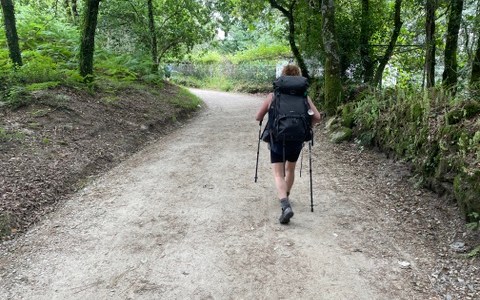
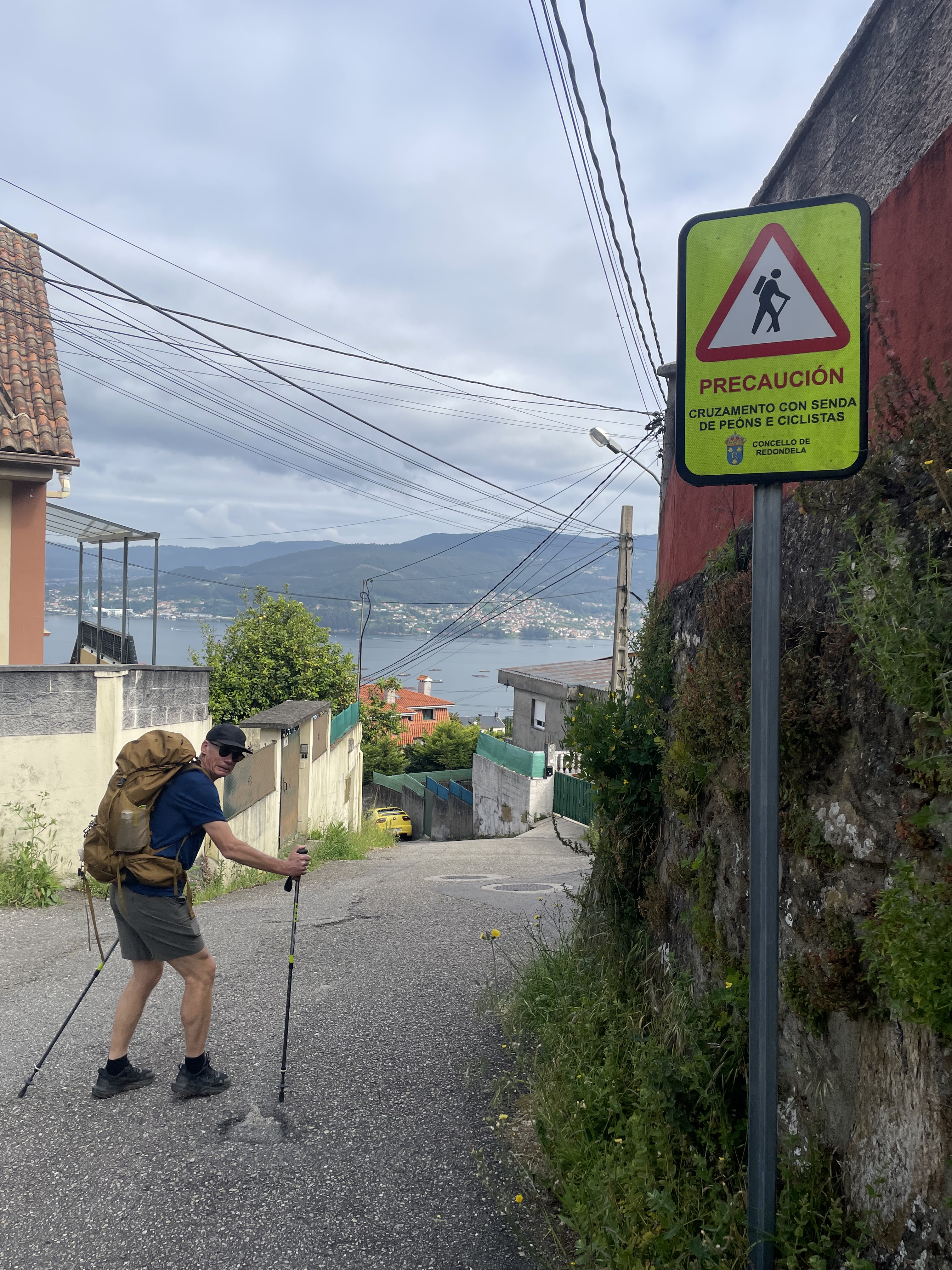
To day one then, and we strapped ourselves into Beast 1 & Beast 2. I appreciate that this will mean more to you if you’ve read part one of this blog, but if you haven’t, this might be time to use your imagination and possibly remind yourself of what a terribly sordid mind you have. Anyway, an easy four hours in the sunshine, out of Vigo and north east along the coast to Redondela. Lots more people on the route than in March (unsurprisingly) and already sorting themselves into a hierarchy. At the top of the hierarchy are the pilgrims who are carrying their own gear in big rucksacks and staying in albergues, which are the hostels on the route. Next level down are those, like us, who are carrying their own gear but have opted to stay in cheap hotel rooms, primarily to avoid sleeping and snoring in noisy dormitories. These two levels can also be separated by the use of wooden staffs for balance, as opposed to walking poles, which mark out the seniority of pilgrims, as well as Tolkien characters. Next level down are the hikers who’ve arranged to have their luggage transported between stages. This is a very good idea if, say, you can’t function without hair straighteners and a travelling library of an evening, and it’s something that we’ve done in the past on other walks, but it kind of minimises the suffering. There really is nothing like the feeling of 10kg on your back to make you lean forward onto your stick and at least form the silhouette of a medieval pilgrim:
Anyway, the hikers with day packs can be spotted by their excellent posture and practiced overtaking manoeuvres. A little further down the list are the cyclists, who have a varied approach to overtaking notification, and still seem to be doing the same distances as the hikers. And finally the guys who have hired electric bikes for a couple of weeks, and freewheel cheerily by on the uphills, occasionally smoking a fag. Somewhere in this hierarchy are the horse riders, who can also receive certificates for completing the Camino; we didn’t see any of them though, I suspect they’d go out early to avoid the crowds and the heat.

A bit of reflection on the spiritual journey as we wandered along. This pilgrimage lark obviously means lots of things to lots of people, and we spent a bit of time talking about what those things might be, concluding largely that they were to make sense of and manage mortality, something that I’m obsessed with, and of which Mrs E has a much more mature and nonchalant view. So, a few happy miles chatting about death, during which we planned each others funerals – I can’t give you the detail of the conversation for reasons of sensitivity, but I can tell you that a) I’d really like to be around for my dry run, including the wide variety of guest speakers that Mrs E plans to invite and b) Mrs E, after her last walking adventure, has opted to be cremated in an open toed coffin.

Day one ended fairly early at Redondela, a really lovely town where it would be rude not to sit in the town centre with a cold glass of Estrella and a couple of plates of tapas. So we did.

Redondela to Pontevedra the next day was a bit further, and took around six hours, with a couple of fairly gnarly climbs in the sun, but eased by some really great tracks in the forests, sometimes allowing us to look left and down to the inland sea of Enseada de San Simon. All a bit too much for Mrs E, who was missing cold water even more than spiritual awakening.
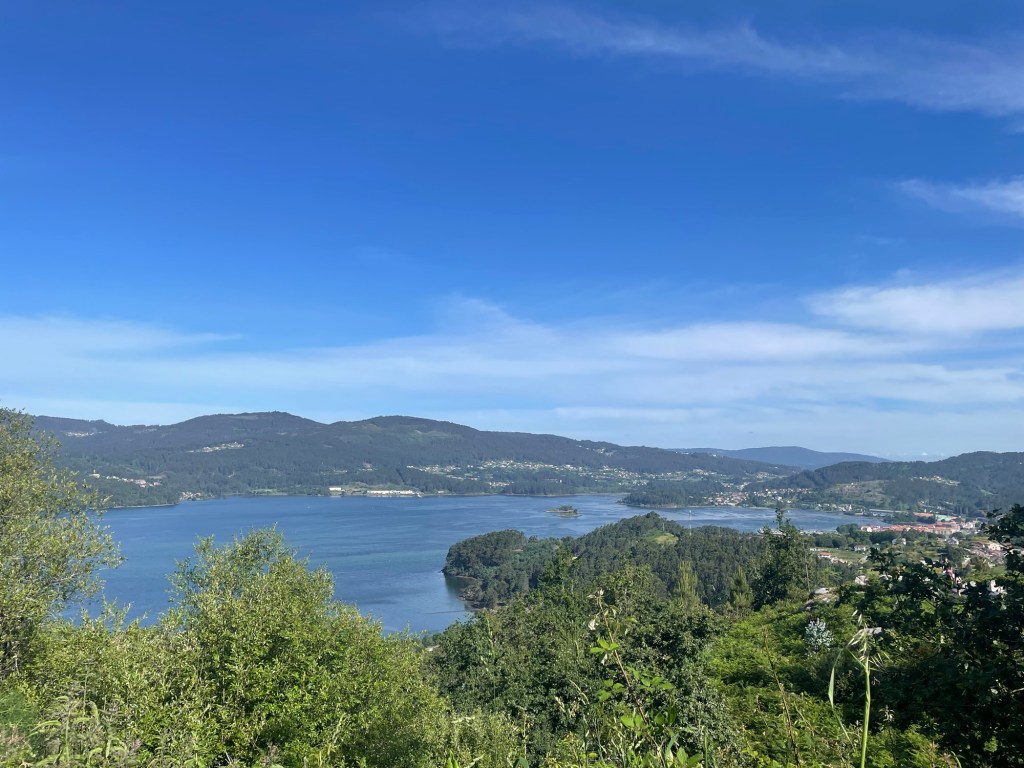
Pontevedra is another lovely town, the sort of place that you could happily retire to and write that novel that you’ve always promised the world. Although in reality, your days would be just as fulfilling if you were watching the world go by with a coffee in the morning and a beer in the evening, separated by a serious siesta in the daytime. Really must get round to that one of these days. On the subject of books, Mrs E decided that a good use of our time would be to get me started on some productive and rewarding work for a change. She’s been saying for some time that I ought to write a book, so suggested that we spend the several hours from Pontevedra to Caldas des Reis working out the main character and plot lines from a number of lucrative novels. Figuring that Richard Osman is all the rage at the moment with a series about unusual detecting, we agreed that we should create a new character called Santiago Jones, who solves a number of crimes on Camino routes, mainly by interviewing fellow hikers. Santiago Jones will have some detective skills, but we couldn’t agree on the specific traits that would set him aside from other gumshoes. On the understanding that no idea is a bad idea, we agreed that he should be something of a modern polymath. He can play any musical instrument, speak and understand any language, and make any animals do his bidding. He has a good understanding of martial arts, and will normally carry an axe, along with a staff carved from a tree branch from the garden of his late lamented mentor. He is also proficient in gymnastics, archery, boules and imitating birdsong. The first few mysteries that Santiago Jones will solve (copy these at your peril, Osman) are provisionally titled Murder on the Camino Portugués, the Mystery of the Masked Pilgrim and The Compostela Massacre.

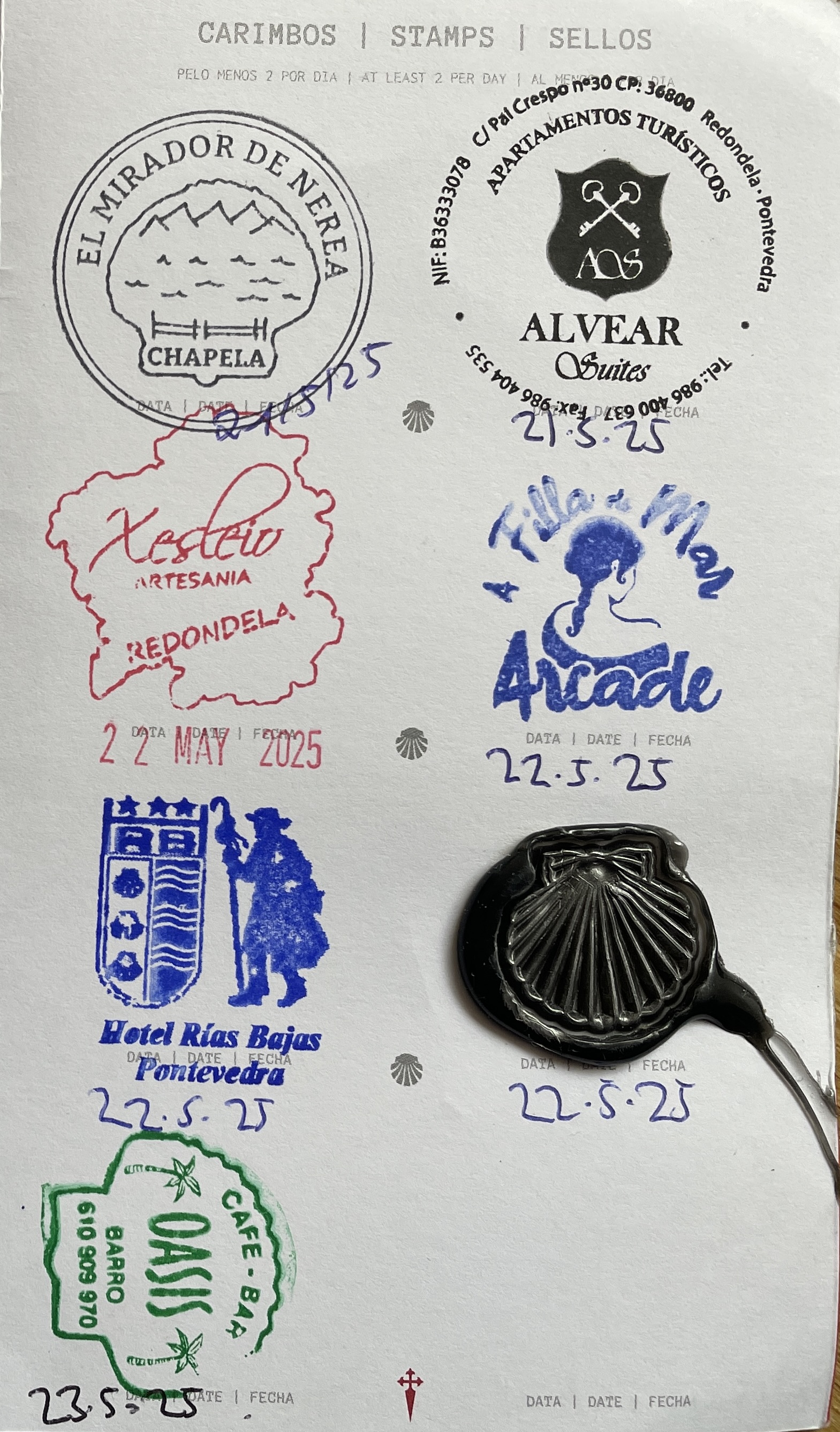
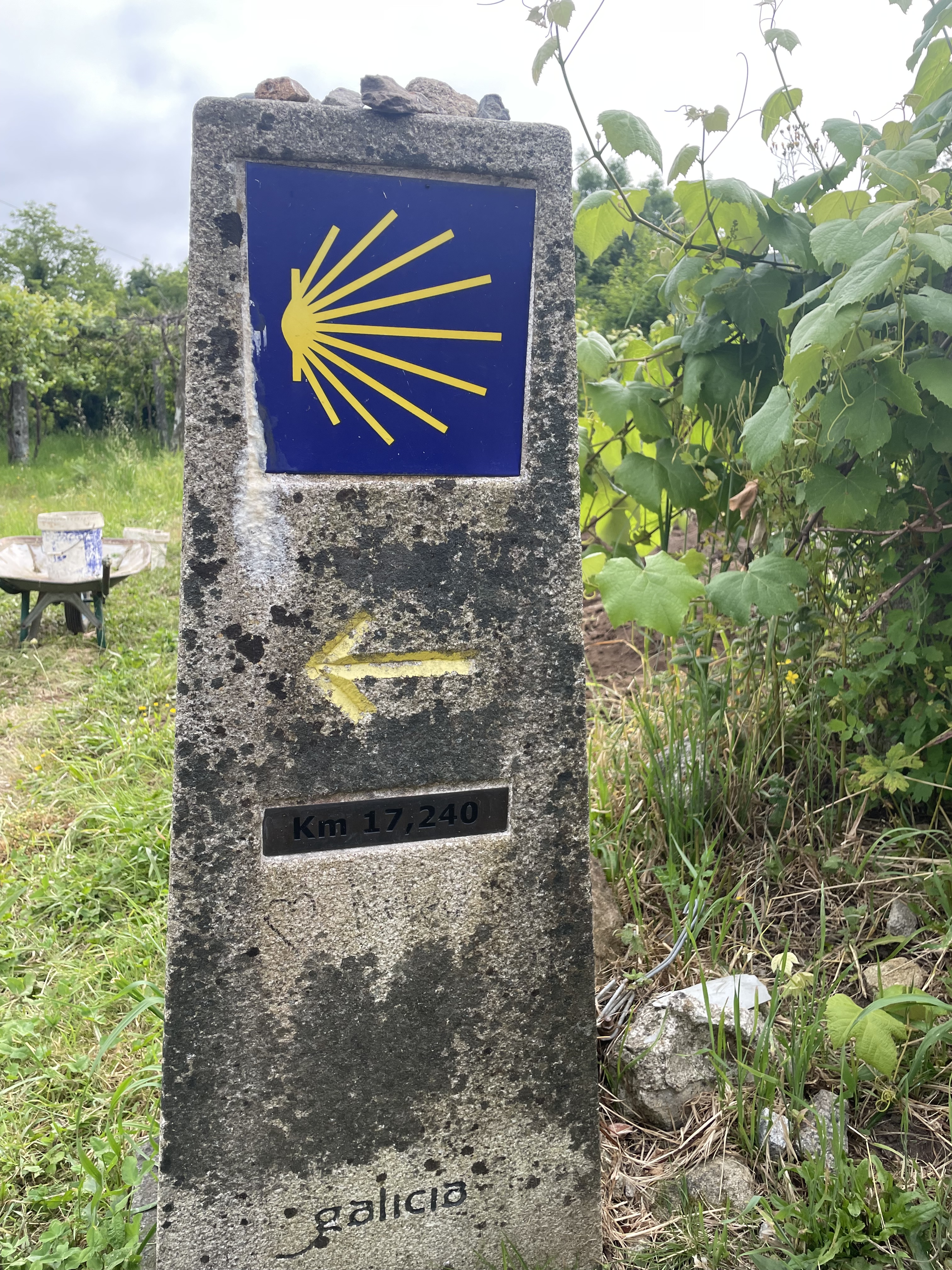
Pontevedra to Caldas de Reis next, and another six hours, very hot walking, but with a gentle breeze. And the mildest camembert, tee hee.* There was a big bump in the middle of the route, where we stopped at a very strategically placed van, serving food and drink. I mentioned in the first blog about getting your Compostela card stamped en route, which would mean that you would get a certificate at the end, and Mrs E was delighted to get by far the most elaborate stamp yet, finished in black wax with silver detailing. Also explained the length of the queue at the van.
At the end of the stage, Mrs E had unfortunately developed a problem with her right eye. ‘It’s not affecting my walking’, she declared, tripping over her walking pole for the 15th time, ‘I just need some chloramphenicol’. We went to the chemist, and were directed to the doctor around the corner, where we google translated ourselves into a waiting room. This was beginning to feel familiar from our last saga, but we were seen really quickly by a doctor who did a full assessment involving fluorescein, lots of torch work and folding Mrs E’s eyelid back with a fairly chunky retractor. Mrs E remained cheery throughout the process, testing out her new Duolingo vocabulary (already an impressive 500 words) with a doctor who disappointingly spoke perfect English. She was also chuffed with a prescription for chloramphenicol, sagely agreeing with the doctor that this was a very wise diagnosis. As the prescription was being stamped, she reached into her bag and brought out the Compostela documents, asking the doctor to stamp these as well. I’m still not sure that she was joking. Anyway, back to the chemist, paid the massive prescription charge of €4, and reflected on the wonders of the Spanish healthcare system. As I write this, Mrs E has just returned to work to a criminally understaffed hospital where all nurses and doctors are being offered voluntary redundancy to meet cost challenges…

Caldas de Reis to Padron the next day, and a slightly shorter five hours, but with another bump half way. With only two days to go, and the merger of the coastal and the mainland Portuguese camino routes behind us, it was getting to be a bit busier. Good in lots of ways, and we met some lovely people, and exchanged ‘Buen Camino’s with loads of other pilgrims, but the solitude of the previous walks became something that we began to miss. And certain voices managed to cut through the countryside like knives. I wished I’d had the ability (like Santiago Jones) to speak lots of languages, cos some of the conversations were so animated and so long – sentences that seemed to last for ten rapid fire minutes without drawing breath – it really made you wonder what they were about. It’s quite difficult to put a lot of distance between you and other hikers, unless you stop to take a picture, at which point you inevitably find that they stop as well. It’s like being in a very polite marathon but at a much slower pace. Similarly to marathons, the technique for overtaking is quite challenging. It might take you twenty minutes to make up fifty metres on someone, because you’re walking at such a similar pace. So if you go past them, you have to speed up a bit, otherwise you’ll end up getting under their feet. Obviously you’ll give them a cheery ‘Hola, Buen Camino’, but what then? Sometimes you might fall into an easy conversation and spend the next few hours chatting away, and maybe swapping addresses and making promises to holiday together some time (this has genuinely happened to people I know), but more often you’ll have a brief chat, then remember that you need to complete your overtaking manoeuvre. Timing is crucial here, as there is a danger that you end up continuing to chat over your shoulder, which is uncomfortable at best. Anyway, it’s a bit like being one of those lorries overtaking uphill on a motorway. It takes for ever, and you do wonder once it’s done what the point actually was.

Padron is another lovely town, tiny steep streets and beautiful stone buildings , and it would be really peaceful were it not for the endless procession of pilgrims enthusiastically trooping through. Still, I guess if you’re going to have a tourist trade, peaceful religious pilgrims who want to be tucked up in bed by ten and who eat like horses are the ones you’d want.

We were tucked up in bed a little later than ten and by the time we got to the 0730 breakfast, the locusts, or, as we will call them, mountain bikers, had already filled their capacious lycra clad stomachs and back pockets with pretty much everything that the buffet had to offer. Consequently we left for the longest leg with fairly empty stomachs, reminding ourselves that breakfast is a much overrated meal anyway. But this did mean that we managed a reasonably early start, and it was overcast until about 2pm, so perfect weather for the parade into Santiago at around 3. By the time we got to the outskirts of the city, we didn’t need signs any more, we just followed the snaking trail of pilgrims all the way to the cathedral, where we did all the things that you’re supposed to do at this point – sighed a bit, took pictures, posed for more pictures, sent messages home, took our shoes off, and lay in the sun with our heads facing up to the top of the cathedral.
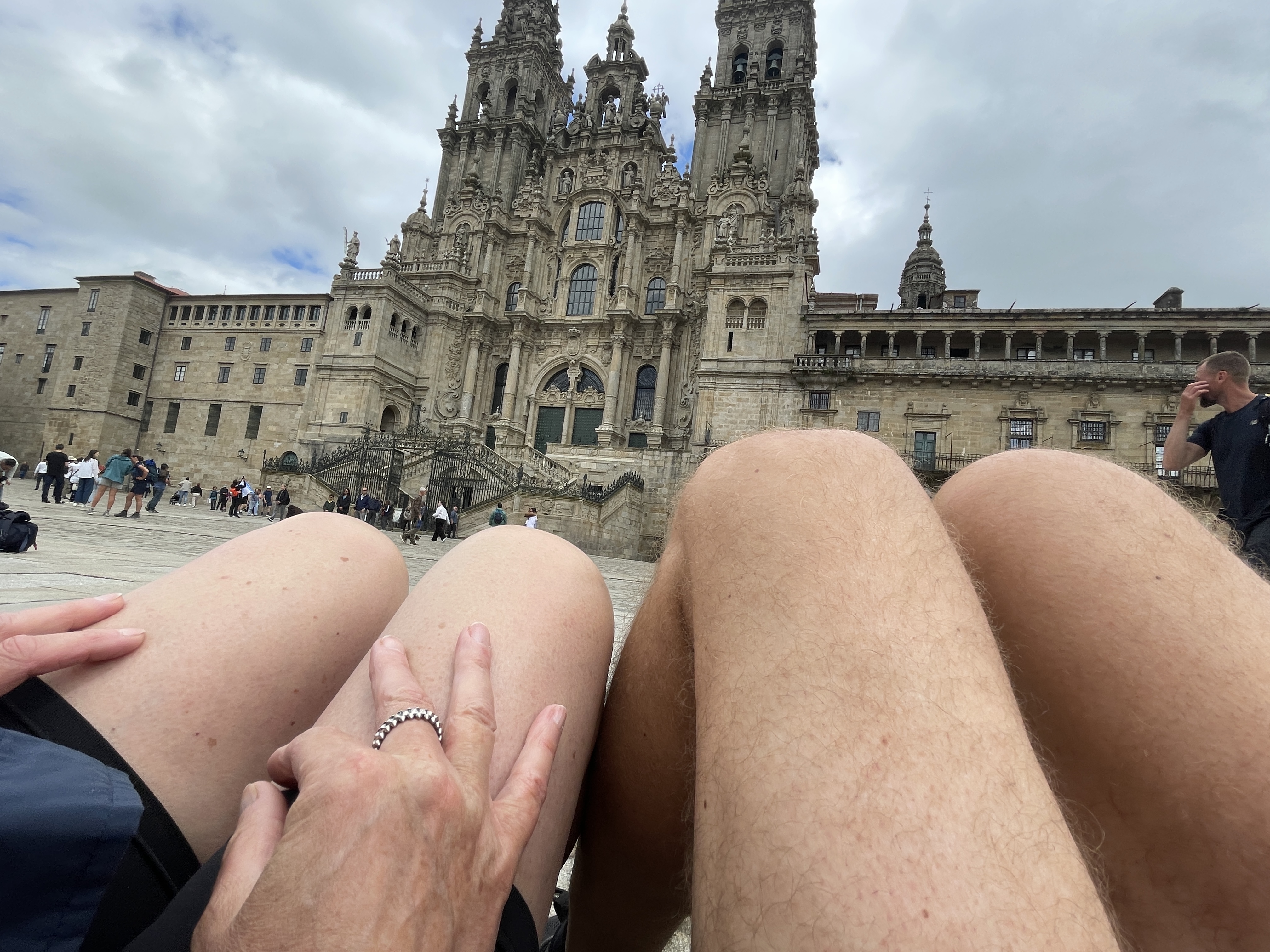
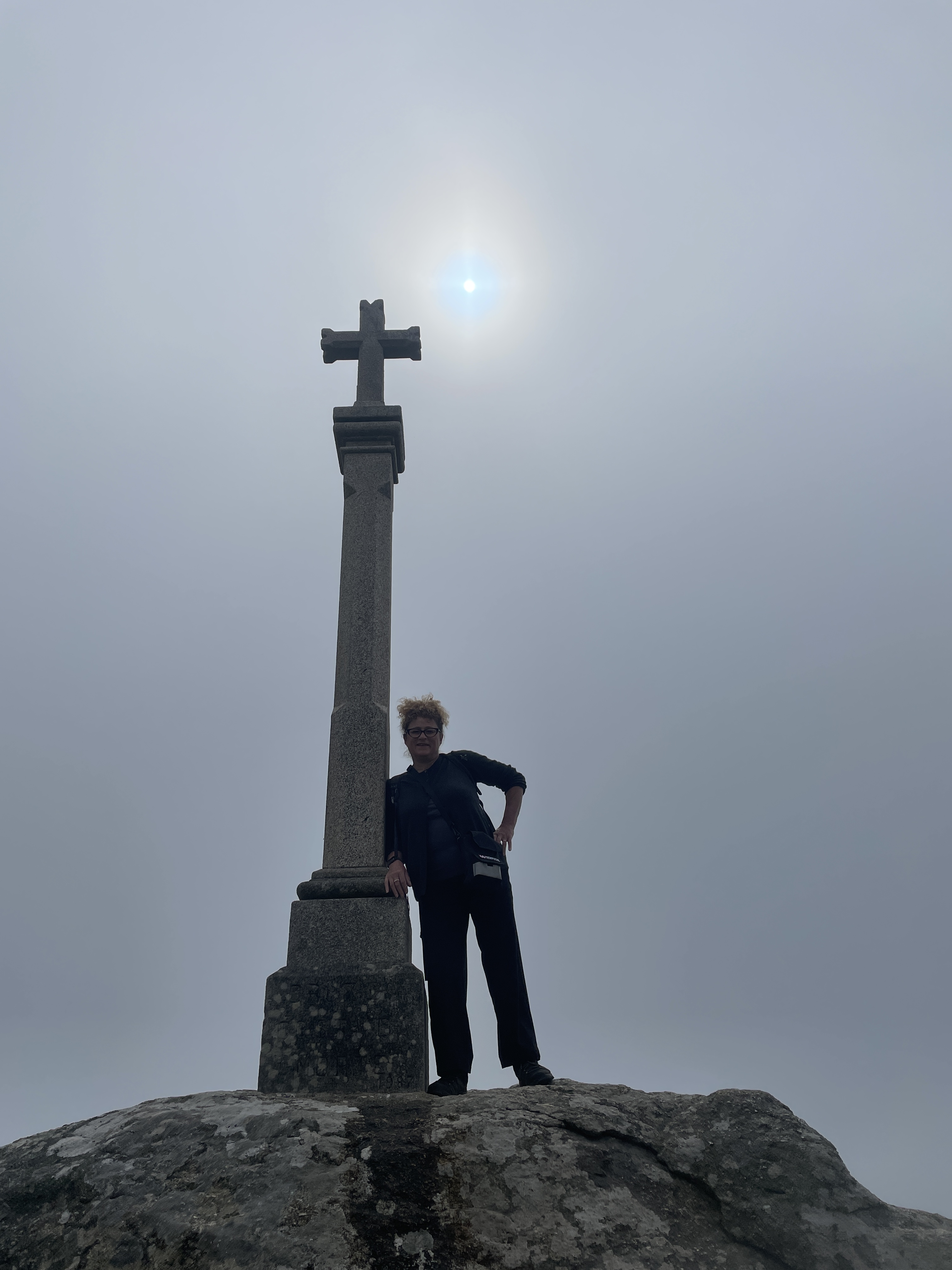
Santiago de Compostela is a gorgeous city, and completely dominated by the cathedral, which in itself is astonishing. We’d been in it before on another adventure, but didn’t feel that we could justify seeing the relics of St James or touching the back of his statue above the altar until we’d finished the Camino. But we had now, so we did, and felt fairly good about it. Not quite a conversion, but maybe a bit more respect for people who have a belief system that means that a bit of suffering goes a long way. And if that long way means that there’s a bit less time spent in purgatory, well that’s just peachy. Mind you, we had an interesting conversation with a couple of hardcore pilgrims at the airport, where we considered whether taking a coach to all the key points, getting Compostela stamps and certificate for a couple of days travel was cheating. And having concluded that it was, then so was staying in hotels, sleeping in beds, not working your way from stage to stage to pay for your meals, wearing anything other than sandals and a robe, not carrying a staff and not walking home afterwards. So maybe we’re all cheating a bit, and maybe that’s the life lesson we need to learn about trying a bit harder next time.

So, until next time, Buen Camino!
  • This joke courtesy of ‘A Bit of Fry and Laurie’ c1986. In the same sketch, SF says ‘I stooped to pick a buttercup. Why people leave buttocks lying around I’ll never know’ ABOF&L made us very happy for a very long time.
It’s The End Of The World As We Know It

So we escaped the hullabaloo of a collapsing government, an increasing volume of vociferous gammon, and an overexcitable media to head for the relative calm of the Galician coast. Fairly skipped out of the country, we did, in the hope for simple hiking adventures in the bright June sunshine of the Spanish countryside.

And it’s not like we didn’t have the odd warning on the way. Our first warning was a phone call next to the Ryanair gate at Stansted. I’d had an MRI scan a couple of weeks before, after going to my doctor and telling her that I was struggling to stand up if I’d sat down for any length of time. This phone call was from the triage doctor, following up on the scan, and asking if I’d had any further issues. Not really, I said, it’s just really painful and I look like I’m about ninety when I stand up. Incidentally, my mother, who has just actually turned 90, can easily beat me in the getting out of a chair without complaining stakes, particularly if it’s 6pm and time for a drink. Anyway, the lovely doctor said that he’d refer me to someone who could see me and the scan in the same place,, at the musculoskeletal (MSK) clinic and recommend some sort of intervention, which sounded ominous. Incidentally (again) – I saw my GP in May, had an MRI scan later that month, had this phone call mid June, and now have an appointment at the MSK clinic at the end of June. I absolutely bloody love the NHS. Anyway, at the end of the phone call, the lovely doctor told me that I’d better not do any walking between now and the MSK appointment. Ooops.

Second warning was the actual booking. We were due to walk the ‘Wild Atlantic Coast’. I didn’t really worry about what actually made it wild until we started. Maybe it was going to be the wild flowers, or the wild sense of abandon you felt as you skipped along it’s banks. Or maybe it was wild like a wilderness, a leafy green expanse of rolling green that we’d skip along as we held hands along manicured footpaths. Wild in a Kate Bush style, if you like. Well none of that. The Wild Atlantic Coast really should have the Wild Atlantic bit in bold. and underlined. When the Atlantic gets enthusiastic around these parts, it really makes itself known. Wild in more of a Keith Moon/Oliver Reed style then. We were walking the lighthouse way, from Laxe to Finisterre, and it’s known as that because you can’t walk for more than a couple of hours without tripping over yet another lighthouse. And you need them here because otherwise there’d be even more shipwrecks. Did I mention the shipwrecks? Well, one of the first things we did, when opening the map of the route, was to ask what Costa da Morte meant. Our Spanish isn’t that great, but our French is ok, and surely no-one would ever name a touristy destination the Coast Of Death. Well, they did, and it’s because there’s a long history of shipwrecks along the coast – galleons, fishing boats, german submarines, oil tankers – they’ve all misjudged the waves and the winds and the rocks and understood a bit too late what the Wild Atlantic is all about. We stayed in a hotel that showed all the shipwrecks on a series of maps along a corridor. They were very big maps, it was a long corridor, and the writing was very small – there have been over 600 shipwrecks since the 14th century, hence the need for lighthouses, although with that sort of record, you might want to have put a few slightly brighter bulbs in.

We set off from Santiago de Compostela, a beautiful city best known as the destination for the pilgrimage Camino walks that start all over southern France, Spain, and Portugal. Santiago is named for St James, whose relics are held underneath the cathedral, hence the pilgrimage destination, and there’s a long queue of pilgrims in the cathedral every day, queuing up to touch the shoulders of the statue of St James behind the altar, to mark the end of their journey, which may have been a six week hike. It’s quite emotional watching people get to the cathedral with their backpacks and walking poles, and quietly filing around the altar to get to this moment. We felt as if we’d be cheating if we joined in, so we went outside to the sunny square behind the cathedral, where pilgrims were arriving after their journeys, looking exhausted but elated, lying down on the cobbles, hugging each other, taking selfies and generally feeling very pleased with themselves. We spent half an hour here, soaking up the sun and atmosphere, and also managing to drop one of our passports on the floor, which we didn’t notice until a couple of hours and a 50km taxi ride later, when we tried to check in to our first hotel. Key travel tip – if you are going to lose your passport, make sure you do so in a crowded square full of elated and repentant Christian pilgrims, as they’re more than likely to hand it in to the police station. So, 100km of taxi rides later, we were back in Laxe, very relieved, and having a quick dip in the Atlantic before dinner and the start of the walk.

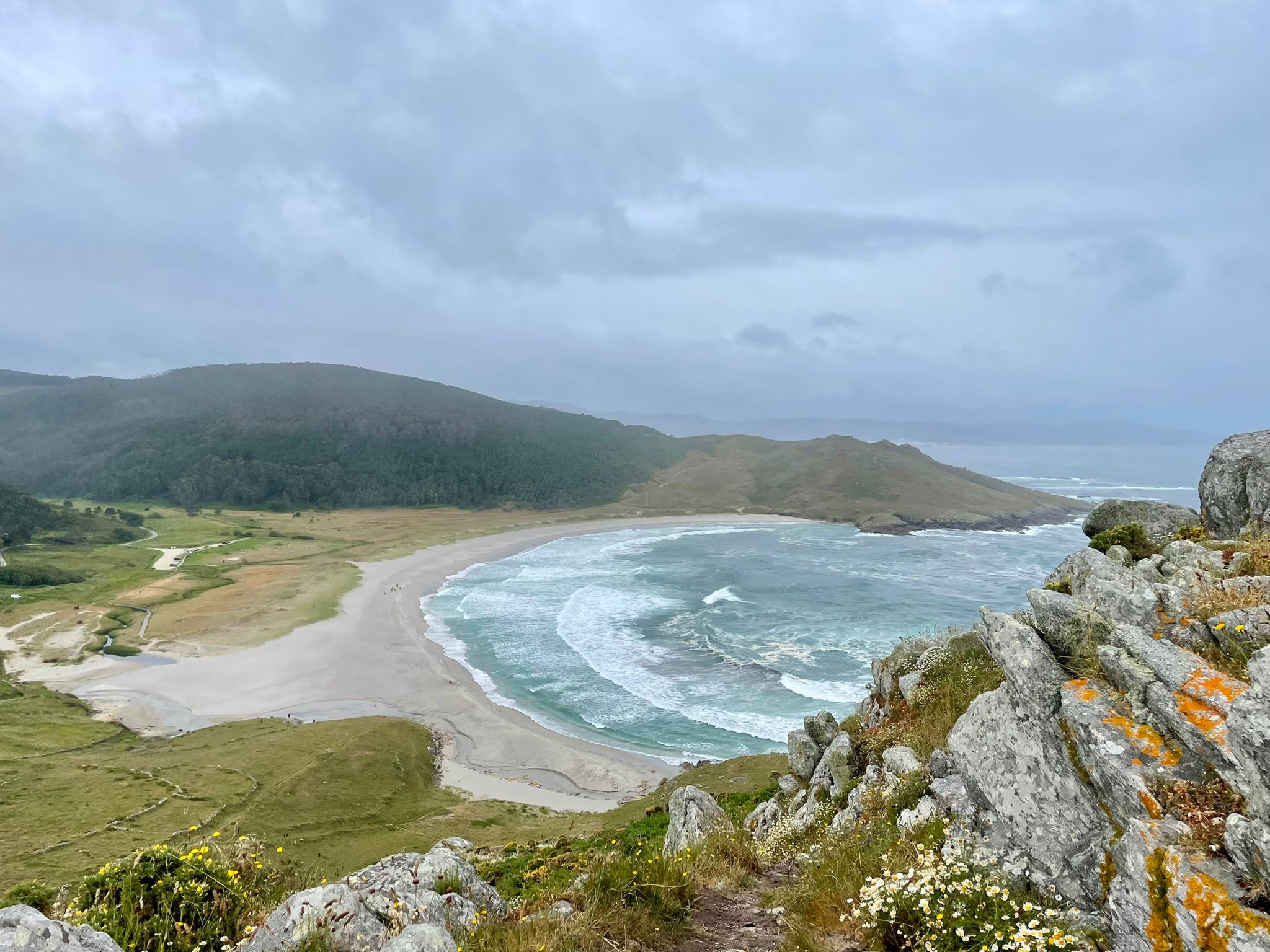
Laxe is a small fishing town and the start of the lighthouse walk which travels all the way around the Costa da Morte to Finisterre. Quite a few restaurants, all of which seemed very keen on local seafood, including pulpo feira, which is a kind of cold cake made of sliced octopus. Tastes a lot better than it sounds. Fortunately we both like seafood, as this was pretty much all we’d be eating for the next week. Started the walk the next morning, from Laxe to Arou. Quite a bit of up and down stuff, up to the top points to lookout to sea; down to the boardwalks and the beaches, with waters that looked fairly lively:

All was well and sunny, until it wasn’t, and when we hit a bit of rain, the walking suddenly got quite a bit harder. No slipping about on the rocks, thankfully, but the rain just kept coming, and managed to make its way inside our coats and boots so that when we finally arrived in Arou, we were fairly bedraggled. Whenever we do one of these walks, we tend to exhaust the conversations about the kids and politics fairly early on, so we’ll play games to keep our spirits up – the game today was alphabetically naming places we’d travelled to together; exclusions for Q, U, V, X and Z, with nominations for place we’d never return to (Sequoia, it’s a long story), and places we’d go back to like a shot (Kathmandu). Did our best to find places to dry boots and coats, then headed into town, trying to dodge the rain, Found the only restaurant in town, where Mrs E decided to indulge me by pretending to like beer (which she did, in a 1:10 mix with Sprite), and be interested in the football, although England’s uninspiring 1:0 win over Serbia really wasn’t a great introduction to the beautiful game.

We were hoping for better weather the next day, but we’d been warned about likely storms, which were confirmed in the morning. The advice was to skip the walking altogether, which, looking at the forecast, we agreed to, so we jumped in the taxi with our bags and headed to Camarinas. Part of both of us wanted to be walking, and the rain held off until about 10am, but after that it absolutely hammered down, so we made the best of things – me knocking out 5,000 words on the history of cigarette marketing, and Mrs E brushing up on her Galician history and language. As I mentioned, we can get by ok in French, but our Spanish is dreadful, and our Galician non-existent. They’re similar languages in many ways, but Galician has many more Xs, which are a bit confusing until you realise that they largely make a ‘sh’ sound, and lots of squiggly lines above the N letters. But the main challenge is in pronunciation. I’m all for rolling my Rs, but Galician takes it to a new level, so that any word beginning with an R starts off like a Formula One car, and there are plenty of other words that seem to involve coughing up about 10ml of mucus at the start of the word for the correct sound. And there’s a certain amount of pride in how fast you can talk as well, so we’re lost in a muddle of hawking and industrial purring and machine gun sentences before we ever get a chance to try to tune in to one word, just one word that we might be able to connect with. One of our sons is in Japan at the moment, where he’s gone to teach English, and assumed he could just wing it speaking Japanese with no prior knowledge. He’s taught himself a few useful phrases, including one that roughly translates as ‘oh really, how interesting’, which allows the conversation to rattle along while his brain shuts down. Incidentally, he also learnt the phrase ‘please, do sit down’, so that he could be polite to old people on buses and trains, before being told that his pronunciation was slightly off, and that what he was saying was ‘please, can you touch me?’. He also made the mistake of clinking glasses with someone in a bar and saying ‘chin chin’, which apparently translates in Japanese as the must depraved thing you can possibly say about a penis. More of this in a short while. Anyway, while writing my stuff (an absorbing project that I expect will have a voluntary readership of less than two people when it reaches a final draft next year), I found myself listening to the Galician equivalent of Smooth FM, which had a variety of show tunes and easy listening pieces on repeat. It was on the third rendition of My Way that I realised just what an appalling song it is. Actually, the third one wasn’t too bad in that respect, as it had a throaty saxophone over a lilting orchestra, but the previous versions were truly dreadful. And it wasn’t the versions themselves (one Tony Bennett soundalike, one slightly bossanova version with a impassioned Spanish tenor). It was the lyrics. And with that song, it’s all about the bloody lyrics. The version we all know was written by Paul Anka, whose pedigree ought to have put him above the tenuous rhymes that make their way onto My Way. It’s almost as if he came up with the title, then scuttled off to the rhyming dictionary and scribbled down the first things he found….highway/byway/shy way, then thought, crikey, I’m on a roll here, I’ll have a go at curtain/certain; mention/exemption; knew/chew; losing/amusing, and then I’ll plug them into a song about a self-entitled twit whose claim to fame appears to be that he’s rattled through a life where his top ten priorities are all about himself. And then, all being well, a whole load of people will line it up without any sense of irony to be played as their funeral anthem, Anyway, that’s what I thought when I was listening to it. And don’t get me started on Magic Moments..

Next day from Caramarinas to Cereixo, reasonably dry, and up and down again, onto tracks that looked as if they’d not been trodden for years, so that we dragged through soaking bracken and gorse to get to the top of some of the passes, then plunged down to beaches that looked like they were in the Seychelles.

Mrs E was very keen for a swim, and, having dramatically misread the map, I advised we’d be able to stop at a beach nearer the end, at which point we headed inland and it started to rain. We’d been walking for seven hours by the time we got to Ceriexo, where we were staying in a B&B out of town . Had a good meal there, with both cooking and entertaining from our genial Galician host, Julio, a man who by rights should have been sponsored by both the Galician tourist board and Grecian 2000. His after dinner presentation, which may well have been in either Spanish or Galician, was about the health benefits of a home distillery, At one point, with all parties being lost on where the conversation was going, we turned to the Galician to English setting on Google Translate. The very next sentence translated as ‘you will have no further fears for the mis-use of a penis’, which we all found a little baffling. But we stuck with the whole presentation and were rewarded by sampling his ‘digestifs’, one of which was fabulous (coffee) and the other one, which brought up memories of an unfortunate time when I tried to siphon petrol out of a mini clubman. Today’s walking game: alphabetic rounds of people we both knew, managed about six rounds of this with exclusions for X and Z, but the game fell into disarray when Mrs E denied ever meeting my last two Y’s.

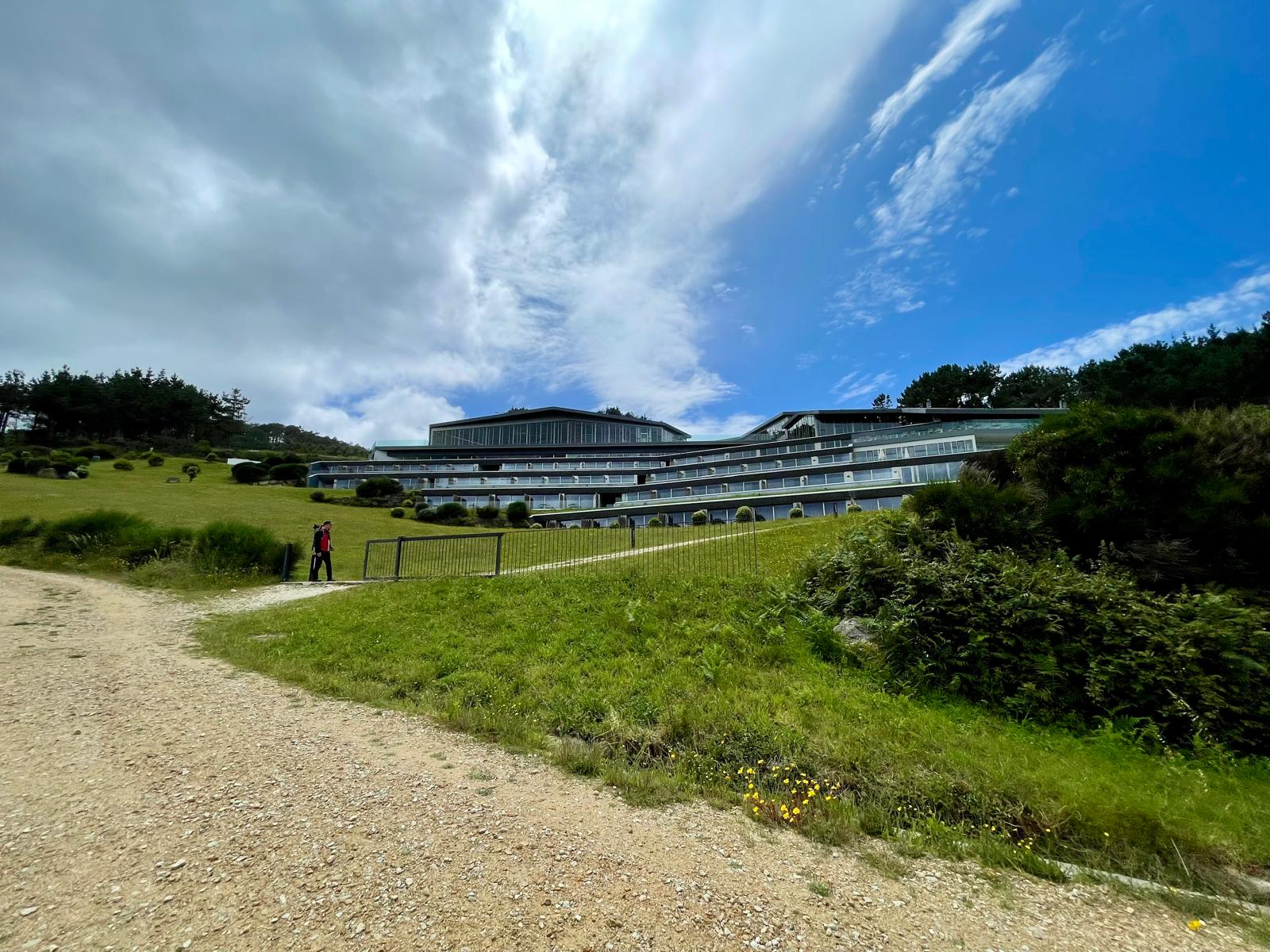
And so to Muxia, another challenging one with wet footpaths getting much wetter as it tipped it down for the duration – when it wasn’t raining, we always seemed to be in the jungle-y bits of the route, so our feet got wetter and wetter, and on the few bits of tarmac we both made a squelchy sound as we walked. Some lovely beaches, but all a bit wet and windy for swimming, and we had an appointment to keep at the Paradores hotel. This was a bit beyond Muxia, but we’d been drawn to it because it looked like a really lovely place to stop mid-hike. It’s new, huge, very modern, and looks a bit like Tracey Island, cut into the side of the hill, and up a long track from a sandy beach.

And very lovely it was inside too, it was on five floors, which were connected by a cross between a lift and a funicular railway. I think it must also be a place to stay for a pampering sunny weekend as well, the other guests all looked a bit fed up with the weather, and we stood out like sore thumbs with our hiking boots and poles (although we did leave them in the room when we went to the bar). Anyway, we did manage a swim, in the ‘seasonal’ hotel pool, which was lovely, albeit under the disapproving gaze of everyone in the cafeteria, looking on in disbelief as we swam in the cold drizzle. Today’s walking game: name one hundred famous Scottish people: we managed this fairly comfortably, but I was denied both Rod Stewart and Alistair Campbell (on the no accent rule, which Mrs E introduced mid-game), although I did score extra points for BA Robertson, and we had a happy twenty minutes not being able to remember any of his ‘hits’. I’m just writing this up, and Mrs E has gone into a tragic fit, as she’s just remembered that neither of us included Jeanette Krankie.

Another diversion in the morning, as we’d had a warning about a loose and large dog that had bitten a walker a couple of weeks previously. So we hopped in a taxi with a very nice man from Luton, who dropped us off beyond the range of the Alsatian which was, apparently, as big as a pony. We started near the Monte de Buitra, which we walked around first to give us a bit more mileage. It was (of course) wet, and fairly desolate, and reminded both of us of Craggy Island. A couple of mysterious farm buildings, a lighthouse (of course) and we only came across one other road user, also striding purposefully along:

Then south through more rain, up a couple of challenging climbs, and down into Lires, a tiny village which fortunately had a fabulous restaurant where we ate cake when we arrived, dinner much later, and even bought our lunch from them the next morning – hands down the best food that we’d had all week. By now, there was no likelihood of drying out our wet socks or boots, so the socks headed straight for the washing bag, and the boots stayed outside the front door, thereby leaving an unpleasant smell at some distance. The views were amazing on the walk though, we saw hardly any other people this or on any of the previous days, and the footpaths, although marked with green dots, in the most green countryside we’d ever seen, were fairly easy to spot. There were some paths that were described as vertiginous, which were actually ok, and some that weren’t, which were fairly scary. There were definitely places that would have been described as dangerous at home, with sheer drops onto cliffs a hundred metres below, but we were ok sticking to the path, and of course hoping that nobody in their right mind would be walking towards us. Today’s walking game: Musicians as Animals. Mrs E’s winner – Llama del Ray. Mine – Elephants Gerald. Honestly, the miles flew past.

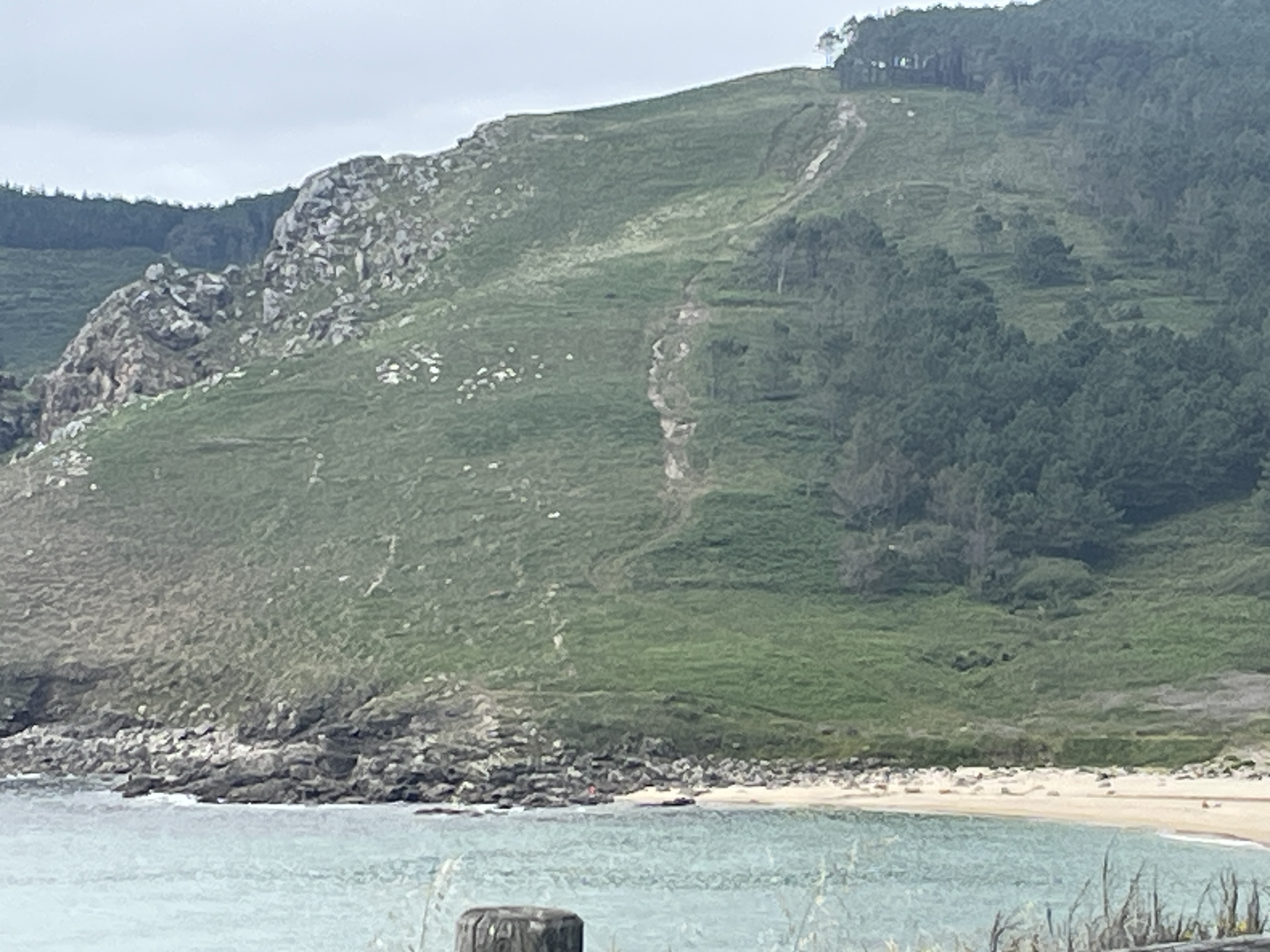
And then, the final leg, from Lires to Finisterre. We were told that we should allow ten hours to do this leg, which was fairly daunting, but in the end it took us just over eight. And probably the hardest walk in terms of climbing (some proper hands over your head stuff) and descending – the drop into Finisterre felt like it was near vertical, and looked like it facing back from the beach (it’s the worn bit in the centre of this this picture):

Finisterre means end of the earth, and it ought to be continental Europe’s most westerly point, given that it’s got the name and everything. But the cape at Touriñán, which we’d walked around the day before,, is further west, as is Cabo da Roca, in Portugal, but, as they say, why let the facts get in the way of a good story? What Finisterre has got, is the most western lighthouse, which pleasantly lit up our hotel room every 30 seconds or so, as we drifted off to sleep that night. Just beyond the lighthouse is a little strip of rock, where pilgrims complete the ‘extra bit’ after they reach Santiago de Compostela. They’re suppose to burn their capes and boots at this point, to formally end their pilgrimage, but apparently that’s now been outlawed – probably just as well, as flaming goretex wouldn’t be a good environmental look. Instead, they have photographs taken, which is better for everyone.

Headed across to the other side of Fisterra for the final night, where we at last managed a swim in the (according to Mrs E) warm Atlantic. Mrs E’s warm is anything over 8 degrees. Mine is above 65, and ideally in a sauna, so we are ill-matched on that front, but she tells me that cold water will be good for my back, and I believe her because she’s a nurse, and because believing her has served me very well for quite a long time now. And so when she says it’ll be a good idea to do one of the full camino pilgrimages next year, I’ll be there like a shot, even if I’m not allowed to burn my cape at the end.