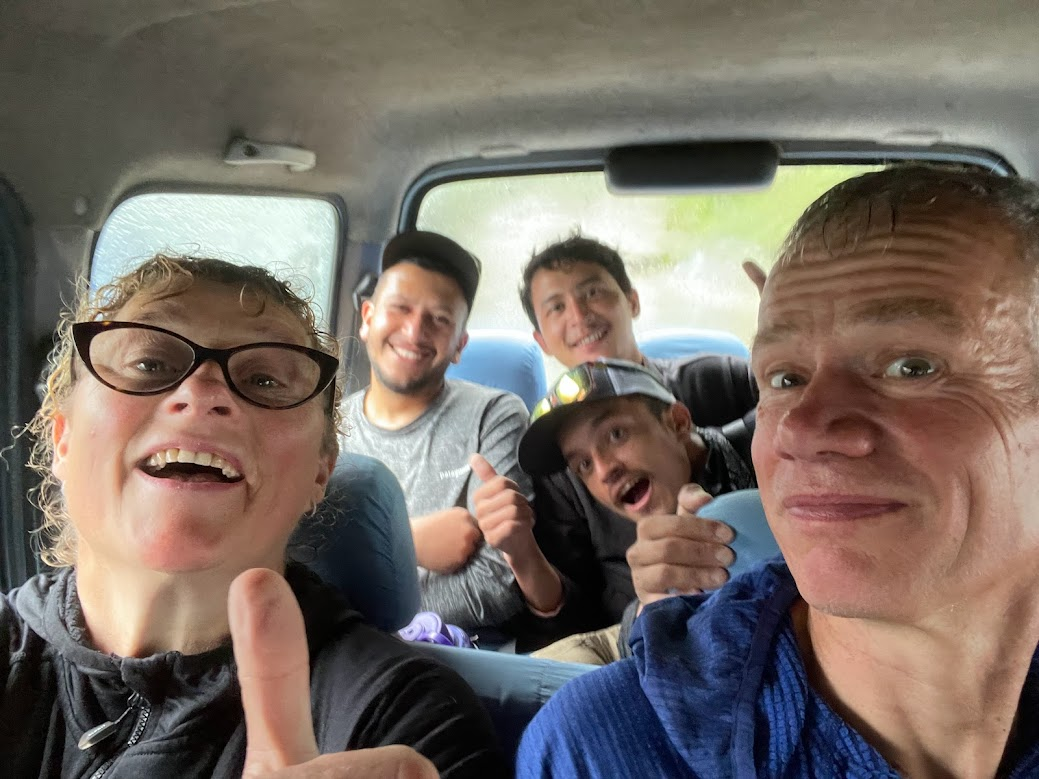
Unfinished business

Well, the last Emu blog received quite a bit of attention. Thanks for that, although I’d hope that the rise in stats wasn’t entirely due to a morbid interest in the infection levels of Mrs E’s feet. If it was, for you, then I suggest you take yourself off to onlyfans, where there are specialist subscriptions for the likes of you.

If you have a more healthy interest in the follow up to the last blog, however, do read on. Because minutes after getting home on one foot, Mrs E decided that there was some unfinished business on the Camino Portugués, and that that business was to be finished just as soon as she had two workable legs. Optimistically, she decided that should be within six weeks, so I was set to work rebooking hotels (tick), rerouting routes (tick) and claiming on travel insurance (no tick, another story, unfortunately).

And so, around six weeks after our shameful exit, we were heading off again to Santiago de Compostela, this time jammed in to a Ryanair flight along with about two hundred Spurs supporters, all headed to Bilbao for the Europa League final the following day. ‘But Bilbao is nowhere near Santiago de Compostela’, I hear you cry. Well, apparently any flights and hotels for Bilbao were stupidly expensive, so, according to the Spurs supporter that I spoke to, it made much more sense to get a plane in the right general direction, then hire a car and drive the 6 hours to stay in Santander, then get a train to Bilbao for the game, then do the whole thing in reverse the next day. Luckily for him, they won the game, otherwise that would have been a really long trip back. Our hearts go out to the long suffering Man United supporters of course, one of whom I heard in the passport queue, worrying that he didn’t know what he’d do if they didn’t get a win out of the final, because ‘we need to get something from this season’. Poor lamb.

Anyway, back to the walk. Despite Mrs E’s enthusiastic atheism, she’d had her doubts when getting injured, thinking that she may have been struck down by the spirit of St Isabel. This thinking went back to around 7am on the morning when we crossed from Portugal into Spain, where we’d settled into a conversation with a particularly stern American man and his son. The conversation ended at the point where Mrs E said that she had no truck with this religious nonsense, and was only really doing the walk so she could get to the end. It turned out that the Americans very much did have truck, and were absolutely on the route to get whatever spiritual lift (and possible guidance through purgatory) from the hike. We spent the subsequent boat journey avoiding eye contact and conversation, and grunted our goodbyes on the Spanish pier, at which point they shot off like rabbits in a completely different direction to the route markers, and we never saw them again. And only an hour later, the heavens opened, Mrs E’s feet got soaked, blisters were formed, infections were developed, and before too long she was in Vigo hospital on a drip, wondering if St Isabel was working in a very mysterious way. I mention this now, because on part two of the walk, Mrs E was a bit more open about the chance of getting a spiritual lift. After all, part of the point of the pilgrimage was to suffer in the name of something that you believed in, and it would be a shame if you couldn’t have that something to help the suffering along. And towards the end of the walk I saw a side to her that is normally very well hidden, offering factor 50 to women who looked a little red round the shoulders, stopping to offer Nok cream to people with sore feet, and generally putting herself about like she was the living embodiment of Saint Isabel.

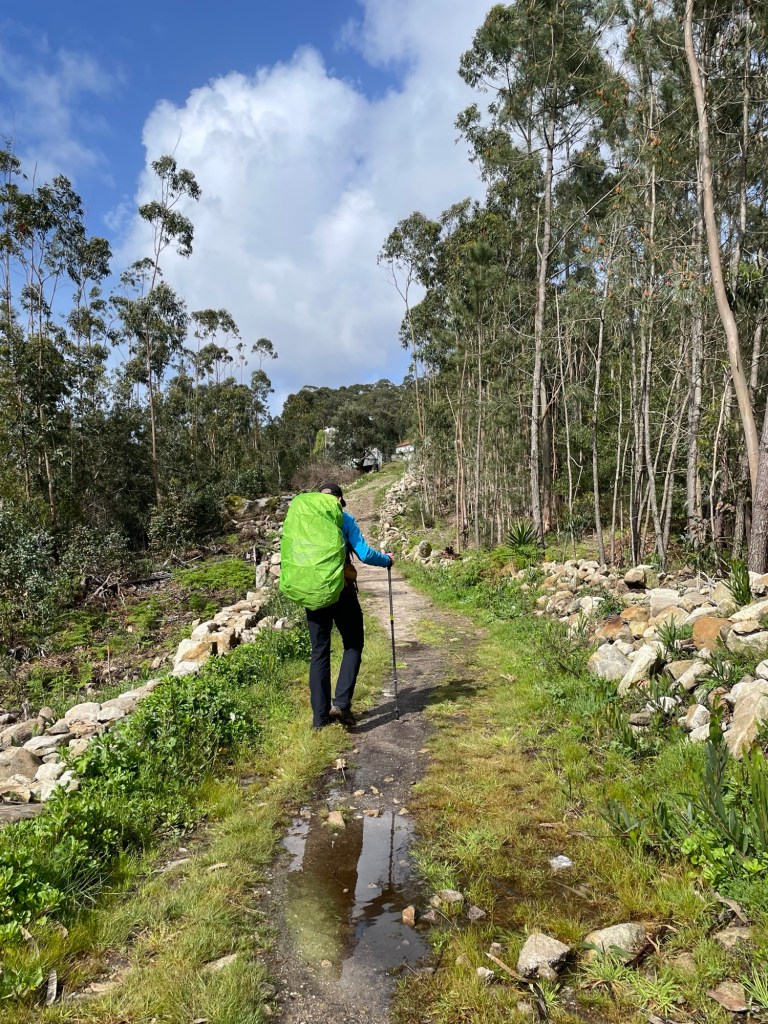
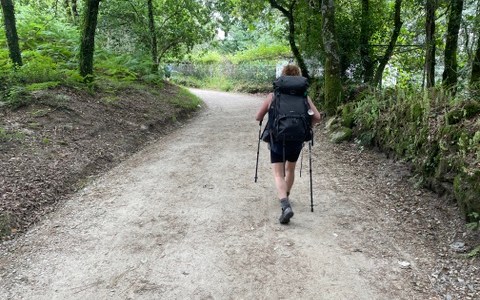
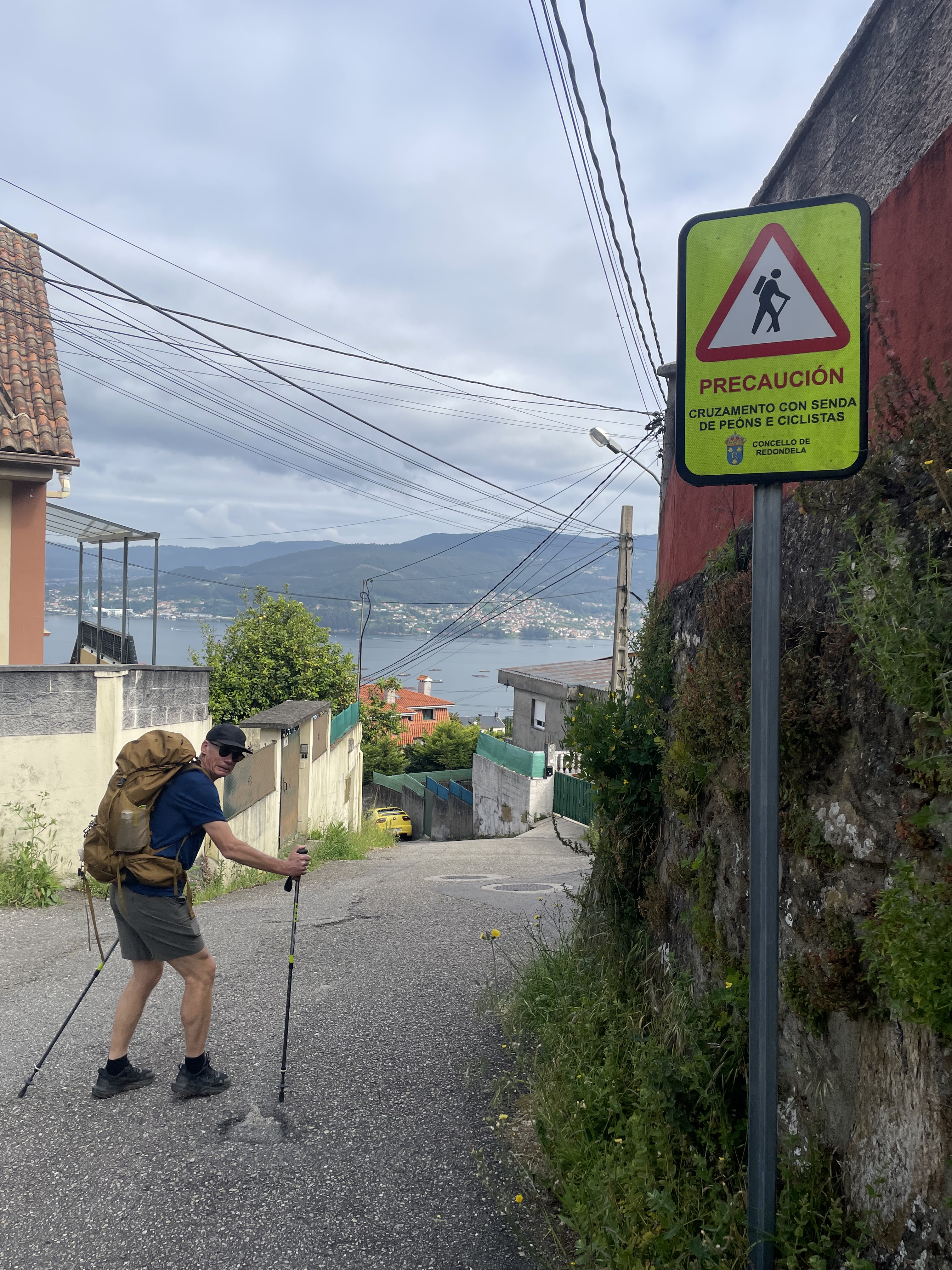
To day one then, and we strapped ourselves into Beast 1 & Beast 2. I appreciate that this will mean more to you if you’ve read part one of this blog, but if you haven’t, this might be time to use your imagination and possibly remind yourself of what a terribly sordid mind you have. Anyway, an easy four hours in the sunshine, out of Vigo and north east along the coast to Redondela. Lots more people on the route than in March (unsurprisingly) and already sorting themselves into a hierarchy. At the top of the hierarchy are the pilgrims who are carrying their own gear in big rucksacks and staying in albergues, which are the hostels on the route. Next level down are those, like us, who are carrying their own gear but have opted to stay in cheap hotel rooms, primarily to avoid sleeping and snoring in noisy dormitories. These two levels can also be separated by the use of wooden staffs for balance, as opposed to walking poles, which mark out the seniority of pilgrims, as well as Tolkien characters. Next level down are the hikers who’ve arranged to have their luggage transported between stages. This is a very good idea if, say, you can’t function without hair straighteners and a travelling library of an evening, and it’s something that we’ve done in the past on other walks, but it kind of minimises the suffering. There really is nothing like the feeling of 10kg on your back to make you lean forward onto your stick and at least form the silhouette of a medieval pilgrim:
Anyway, the hikers with day packs can be spotted by their excellent posture and practiced overtaking manoeuvres. A little further down the list are the cyclists, who have a varied approach to overtaking notification, and still seem to be doing the same distances as the hikers. And finally the guys who have hired electric bikes for a couple of weeks, and freewheel cheerily by on the uphills, occasionally smoking a fag. Somewhere in this hierarchy are the horse riders, who can also receive certificates for completing the Camino; we didn’t see any of them though, I suspect they’d go out early to avoid the crowds and the heat.

A bit of reflection on the spiritual journey as we wandered along. This pilgrimage lark obviously means lots of things to lots of people, and we spent a bit of time talking about what those things might be, concluding largely that they were to make sense of and manage mortality, something that I’m obsessed with, and of which Mrs E has a much more mature and nonchalant view. So, a few happy miles chatting about death, during which we planned each others funerals – I can’t give you the detail of the conversation for reasons of sensitivity, but I can tell you that a) I’d really like to be around for my dry run, including the wide variety of guest speakers that Mrs E plans to invite and b) Mrs E, after her last walking adventure, has opted to be cremated in an open toed coffin.

Day one ended fairly early at Redondela, a really lovely town where it would be rude not to sit in the town centre with a cold glass of Estrella and a couple of plates of tapas. So we did.

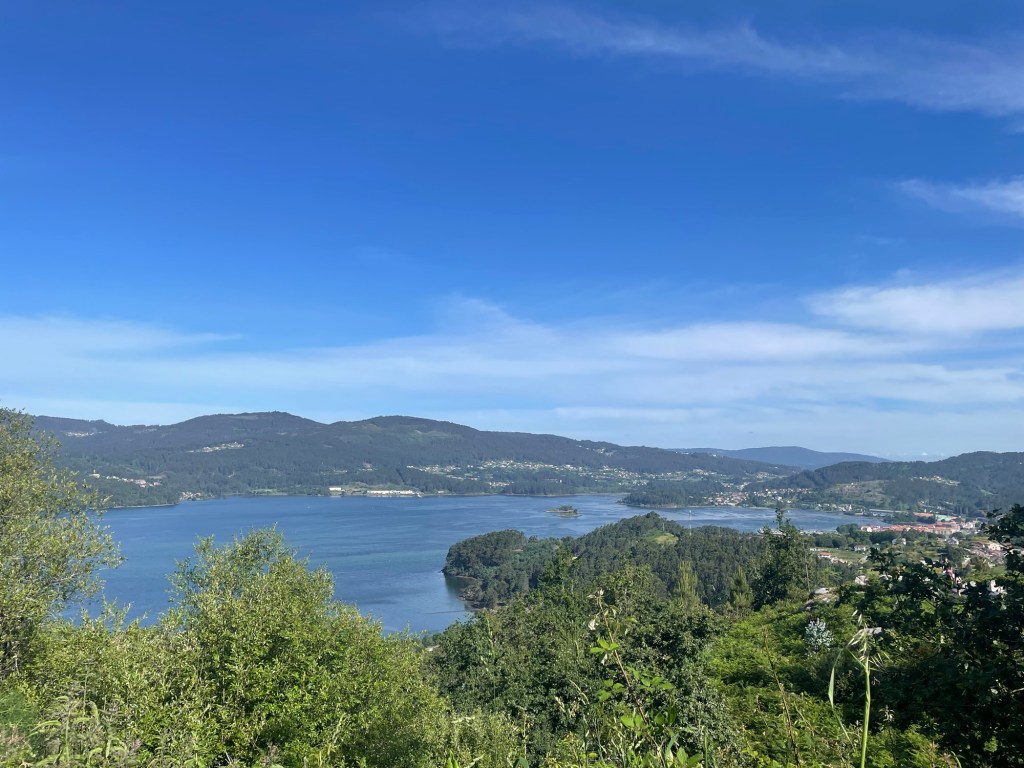
Redondela to Pontevedra the next day was a bit further, and took around six hours, with a couple of fairly gnarly climbs in the sun, but eased by some really great tracks in the forests, sometimes allowing us to look left and down to the inland sea of Enseada de San Simon. All a bit too much for Mrs E, who was missing cold water even more than spiritual awakening.
Pontevedra is another lovely town, the sort of place that you could happily retire to and write that novel that you’ve always promised the world. Although in reality, your days would be just as fulfilling if you were watching the world go by with a coffee in the morning and a beer in the evening, separated by a serious siesta in the daytime. Really must get round to that one of these days. On the subject of books, Mrs E decided that a good use of our time would be to get me started on some productive and rewarding work for a change. She’s been saying for some time that I ought to write a book, so suggested that we spend the several hours from Pontevedra to Caldas des Reis working out the main character and plot lines from a number of lucrative novels. Figuring that Richard Osman is all the rage at the moment with a series about unusual detecting, we agreed that we should create a new character called Santiago Jones, who solves a number of crimes on Camino routes, mainly by interviewing fellow hikers. Santiago Jones will have some detective skills, but we couldn’t agree on the specific traits that would set him aside from other gumshoes. On the understanding that no idea is a bad idea, we agreed that he should be something of a modern polymath. He can play any musical instrument, speak and understand any language, and make any animals do his bidding. He has a good understanding of martial arts, and will normally carry an axe, along with a staff carved from a tree branch from the garden of his late lamented mentor. He is also proficient in gymnastics, archery, boules and imitating birdsong. The first few mysteries that Santiago Jones will solve (copy these at your peril, Osman) are provisionally titled Murder on the Camino Portugués, the Mystery of the Masked Pilgrim and The Compostela Massacre.

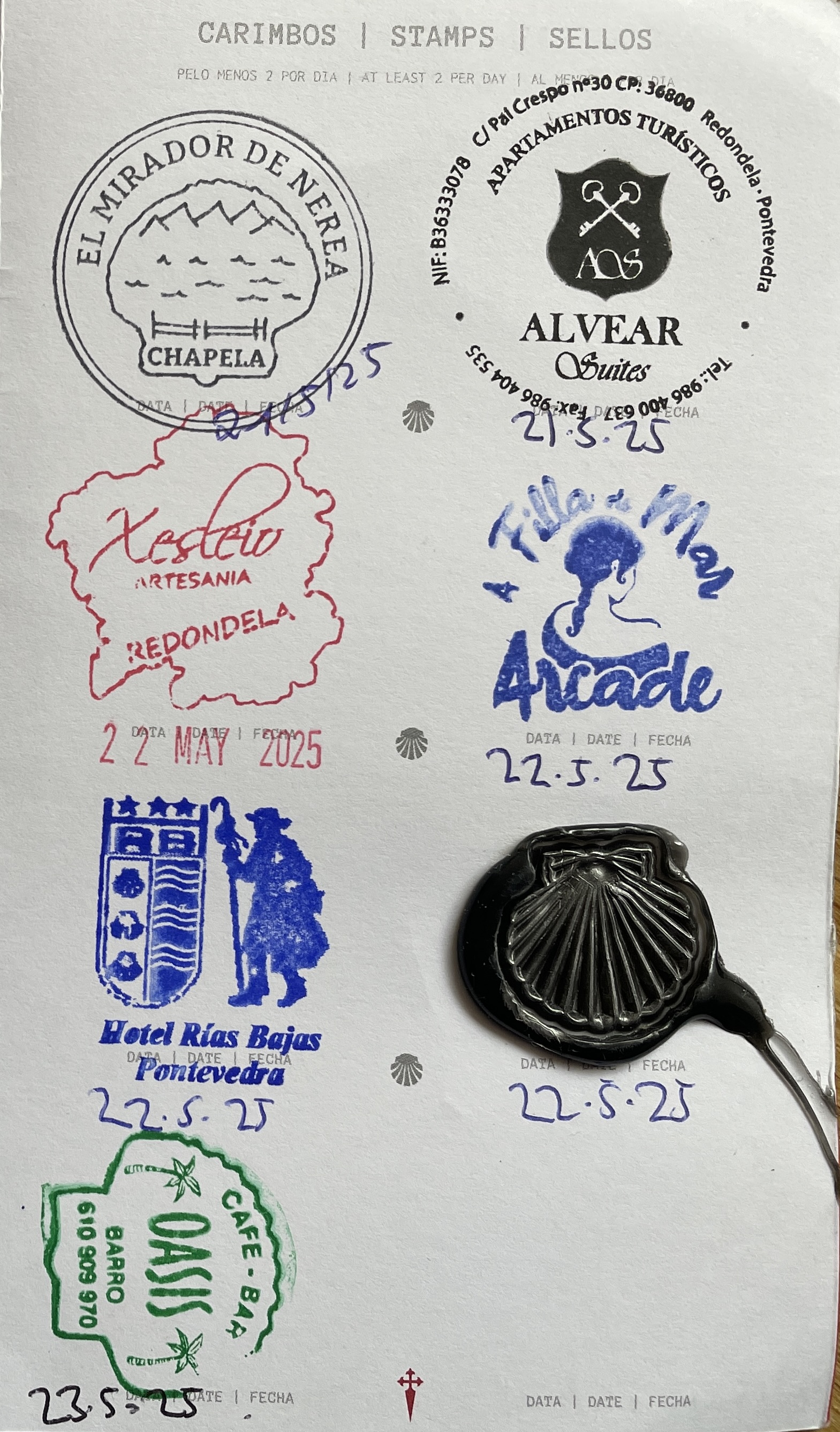
Pontevedra to Caldas de Reis next, and another six hours, very hot walking, but with a gentle breeze. And the mildest camembert, tee hee.* There was a big bump in the middle of the route, where we stopped at a very strategically placed van, serving food and drink. I mentioned in the first blog about getting your Compostela card stamped en route, which would mean that you would get a certificate at the end, and Mrs E was delighted to get by far the most elaborate stamp yet, finished in black wax with silver detailing. Also explained the length of the queue at the van.
At the end of the stage, Mrs E had unfortunately developed a problem with her right eye. ‘It’s not affecting my walking’, she declared, tripping over her walking pole for the 15th time, ‘I just need some chloramphenicol’. We went to the chemist, and were directed to the doctor around the corner, where we google translated ourselves into a waiting room. This was beginning to feel familiar from our last saga, but we were seen really quickly by a doctor who did a full assessment involving fluorescein, lots of torch work and folding Mrs E’s eyelid back with a fairly chunky retractor. Mrs E remained cheery throughout the process, testing out her new Duolingo vocabulary (already an impressive 500 words) with a doctor who disappointingly spoke perfect English. She was also chuffed with a prescription for chloramphenicol, sagely agreeing with the doctor that this was a very wise diagnosis. As the prescription was being stamped, she reached into her bag and brought out the Compostela documents, asking the doctor to stamp these as well. I’m still not sure that she was joking. Anyway, back to the chemist, paid the massive prescription charge of €4, and reflected on the wonders of the Spanish healthcare system. As I write this, Mrs E has just returned to work to a criminally understaffed hospital where all nurses and doctors are being offered voluntary redundancy to meet cost challenges…

Caldas de Reis to Padron the next day, and a slightly shorter five hours, but with another bump half way. With only two days to go, and the merger of the coastal and the mainland Portuguese camino routes behind us, it was getting to be a bit busier. Good in lots of ways, and we met some lovely people, and exchanged ‘Buen Camino’s with loads of other pilgrims, but the solitude of the previous walks became something that we began to miss. And certain voices managed to cut through the countryside like knives. I wished I’d had the ability (like Santiago Jones) to speak lots of languages, cos some of the conversations were so animated and so long – sentences that seemed to last for ten rapid fire minutes without drawing breath – it really made you wonder what they were about. It’s quite difficult to put a lot of distance between you and other hikers, unless you stop to take a picture, at which point you inevitably find that they stop as well. It’s like being in a very polite marathon but at a much slower pace. Similarly to marathons, the technique for overtaking is quite challenging. It might take you twenty minutes to make up fifty metres on someone, because you’re walking at such a similar pace. So if you go past them, you have to speed up a bit, otherwise you’ll end up getting under their feet. Obviously you’ll give them a cheery ‘Hola, Buen Camino’, but what then? Sometimes you might fall into an easy conversation and spend the next few hours chatting away, and maybe swapping addresses and making promises to holiday together some time (this has genuinely happened to people I know), but more often you’ll have a brief chat, then remember that you need to complete your overtaking manoeuvre. Timing is crucial here, as there is a danger that you end up continuing to chat over your shoulder, which is uncomfortable at best. Anyway, it’s a bit like being one of those lorries overtaking uphill on a motorway. It takes for ever, and you do wonder once it’s done what the point actually was.

Padron is another lovely town, tiny steep streets and beautiful stone buildings , and it would be really peaceful were it not for the endless procession of pilgrims enthusiastically trooping through. Still, I guess if you’re going to have a tourist trade, peaceful religious pilgrims who want to be tucked up in bed by ten and who eat like horses are the ones you’d want.

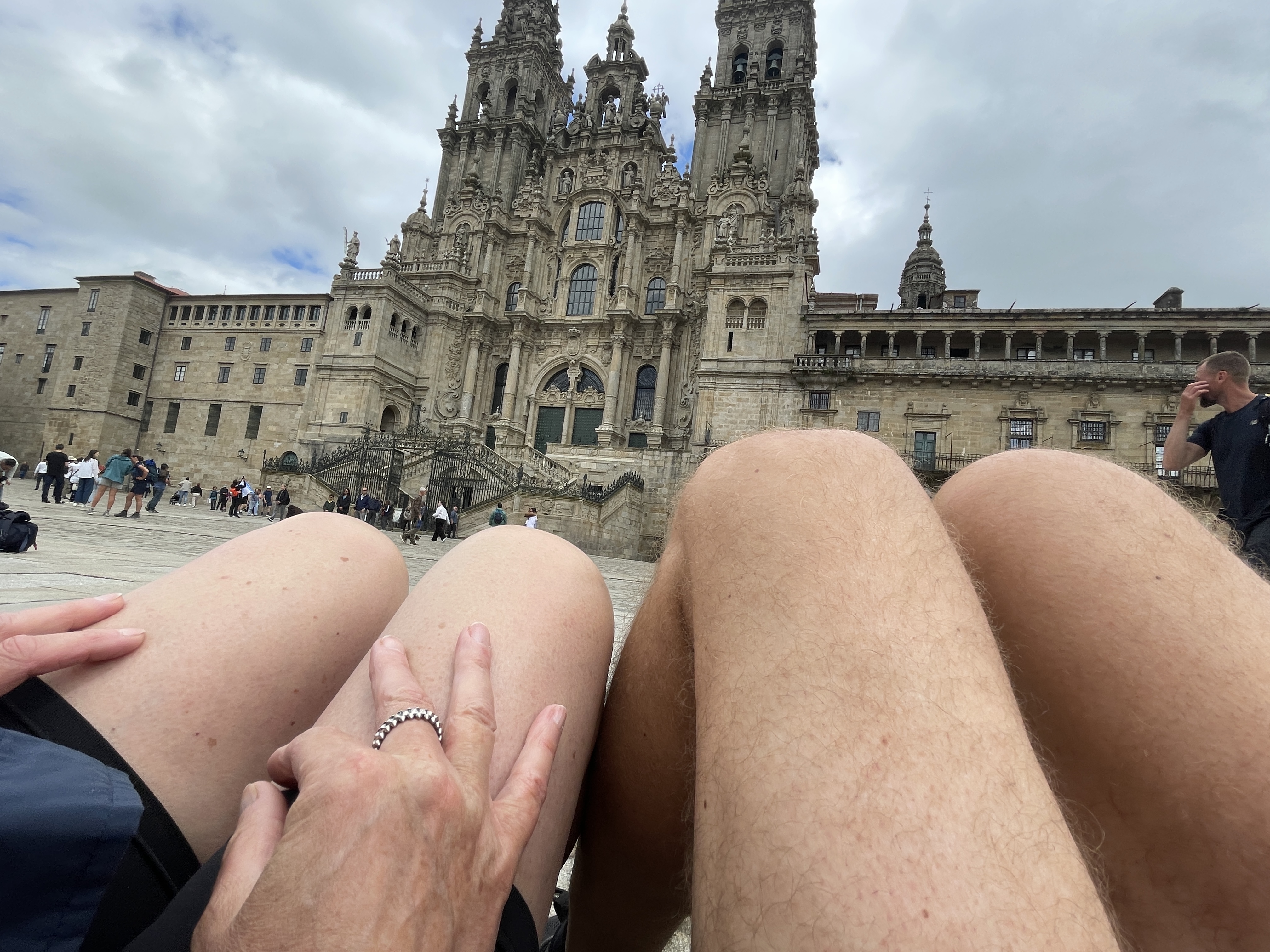
We were tucked up in bed a little later than ten and by the time we got to the 0730 breakfast, the locusts, or, as we will call them, mountain bikers, had already filled their capacious lycra clad stomachs and back pockets with pretty much everything that the buffet had to offer. Consequently we left for the longest leg with fairly empty stomachs, reminding ourselves that breakfast is a much overrated meal anyway. But this did mean that we managed a reasonably early start, and it was overcast until about 2pm, so perfect weather for the parade into Santiago at around 3. By the time we got to the outskirts of the city, we didn’t need signs any more, we just followed the snaking trail of pilgrims all the way to the cathedral, where we did all the things that you’re supposed to do at this point – sighed a bit, took pictures, posed for more pictures, sent messages home, took our shoes off, and lay in the sun with our heads facing up to the top of the cathedral.
Santiago de Compostela is a gorgeous city, and completely dominated by the cathedral, which in itself is astonishing. We’d been in it before on another adventure, but didn’t feel that we could justify seeing the relics of St James or touching the back of his statue above the altar until we’d finished the Camino. But we had now, so we did, and felt fairly good about it. Not quite a conversion, but maybe a bit more respect for people who have a belief system that means that a bit of suffering goes a long way. And if that long way means that there’s a bit less time spent in purgatory, well that’s just peachy. Mind you, we had an interesting conversation with a couple of hardcore pilgrims at the airport, where we considered whether taking a coach to all the key points, getting Compostela stamps and certificate for a couple of days travel was cheating. And having concluded that it was, then so was staying in hotels, sleeping in beds, not working your way from stage to stage to pay for your meals, wearing anything other than sandals and a robe, not carrying a staff and not walking home afterwards. So maybe we’re all cheating a bit, and maybe that’s the life lesson we need to learn about trying a bit harder next time.

So, until next time, Buen Camino!
  • This joke courtesy of ‘A Bit of Fry and Laurie’ c1986. In the same sketch, SF says ‘I stooped to pick a buttercup. Why people leave buttocks lying around I’ll never know’ ABOF&L made us very happy for a very long time.
First avowed intent

If you know about the pilgrim Camino network in Europe, then skip this bit. If you don’t, then buckle up, because, even if you don’t fancy yourself as a modern pilgrim, it’s still fairly special.

The legend of St James is that his remains were brought to Galicia for burial where they were lost, and only found after a hermit followed a bright star (I know you think you’ve heard this before, but carry on) to the burial spot in what is now Santiago de Compostela. Word got back to King Alfonzo, who ordered the cathedral to be built on the burial site. The relics are still there, and have been verified by various popes, so they’re definitely the genuine article…

So, after the cathedral was constructed, it became a place of pilgrimage, as part of the general ‘suffer on the way to see the relics of St James and you’ll buy yourself an indulgence which will speed your way through purgatory’ process. 2025 is a special year, as indulgences are actually available to modern pilgrims (although you need to be catholic, take confession and jump through a couple of other hoops before you get a certificate).

Queen Isabel made the pilgrimage twice in the 14th century and she later became a saint, which we both saw as a strong incentive for the walk. Well, you’ve got to have dreams, haven’t you?

The Camino network starts from many places in Europe, but most notably Spain, France and Portugal. People do the pilgrimage walks for lots of reasons, and there are, understandably, lots of enthusiastic Christians that look on it as a spiritual adventure. I reflected on this quite a bit over the days we were walking/hobbling/sheltering from the elements, wondering how much the positive and negative parts would be magnified if we’d have been travelling with St Isabel, for example. Btw, let’s abbreviate her to SI now. I’ve a feeling she’ll be featuring quite a bit as we travel toward Santiago. In fact, let’s see what happens by telling the story of the walk…

Day one, and we headed out of Porto. I should have mentioned that there were four of us on this trip. Me, Mrs E, and two unpleasantly large rucksacks, which we will call Beast 1 and Beast 2. We’d packed lightly, taking whatever we thought we could get away with, but even so, the packs seemed to weigh a ton. We’d managed a 15 mile walk with full packs the previous weekend, and all had been well, but we’d not taken more than a few steps before Mrs E and Beast 2 were struggling to get on.

‘I’m not going to get on with you for two weeks’, she said, probably addressing the pack.
‘Let’s just get out of Porto’, I helpfully suggested.

If you’re planning to do this trip, please note that it takes about four hours to get out of Porto. By now, packs had been adjusted and there was just a bit of back pain to put up with. Unfortunately, Beast 2 was still complaining, with a squeaking noise that no adjustment could shift.

‘I really can’t put up with this any more’, Mrs E announced, again, probably addressing the rucksack.

By now we were skirting around Porto airport, and the squeaking was still audible over the sound of the planes taking off and landing. Mrs E was getting even more frustrated with Beast 2.
‘Why doesn’t yours squeak?’ she demanded.
Then I may have told a slight untruth, which even SI might have forgiven.
‘Oh, mine squeaks all the time’, I fibbed.
That seemed to settle things nicely. As long as Beast 2 wasn’t making it personal, and as long as Beast 1 was also being annoying, all was right with the world, and even though the squeaking continued for another three days, it was never mentioned again.

Eight hours and 30km later, we got to our hotel, just outside Vila de Conde. Many pilgrims choose to stay in Auberges, which are hostels along the route, where you pay about €15 a night for the opportunity to sleep in a dormitory along with other pilgrims. We’d decided, in a Christian-like spirit, not to impose our snoring on others, and to stay in rooms with comfortable beds and bathrooms, and decent breakfasts. Not sure this was quite the pilgrim spirit, and I think SI would have preferred a more spartan arrangement, but who knows? We’d prebooked the hotels and it would be a shame to not use the rooms, after all.

A fitful night’s sleep for Mrs E – I’d dropped off nicely as usual but she was kept awake initially by the floorboards creaking (‘Just imagine you’re on a boat, and it’s the sound of the timbers’, I helpfully said, going to sleep myself on the second syllable of timbers). This kept her awake for an hour or so, before a rowdy group assembled at the bar just below our room. This was the final straw, so, wearing a fetching ensemble of nightdress, walking trousers, fleece and sandals, she marched down to reception and asked for another room. Apparently (this was, after all, during my REM phase), she did so between tears, only managing to blurt out


‘I’m very tired and tomorrow I have to walk the caminho!’
over and over again.


Unsurprisingly, the group was moved to another part of the hotel. A few hours later, fully refreshed, I asked her how she’d slept. I received what Paddington fans might remember as a ‘hard stare’.

Day two, and a recovery from that tetchy start, with a walk along the coastline to Esposende. We’d seen some horrendous news from Southern Portugal about storm Martinho, which had caused loads of damage through storm rain, floods and gales in mainland Portugal. It hadn’t spread too far north yet, but it was expected to make an appearance in the next couple of days, so we enjoyed a really good hike across boardwalks and forest tracks, met a few more pilgrims on the way, and started to hear a few ‘Bom Caminho’s’ as we went along. We even managed a few of our own – there were hikers going in the opposite direction, towards the Fatima shrine, between Porto and Lisbon.

Beasts 1&2 were being slightly better behaved, although at least one of them was still squeaking away.
We saw a lot of the sea – we’d hiked in Galicia before so we knew it could be a bit lively – it would have been great for surfing, had it not been for the coastline, which was very very rocky. Frustrating for Mrs E, whose idea of a perfect morning includes a sea or river swim, ideally at around 5°C – we’d even packed towels just in case we wanted to interrupt eight hours of walking with a bracing dip – but it was not to be.
Anyway, 26km later we were in a comparatively crappy hotel, grabbing food at the only veggie restaurant in town, and back for a thankfully undisturbed sleep.

Which brings us to day three. When me and the two chuckle brothers (see previous two wheeled adventures) reminisce about our bike touring trips, we often mention the ‘day from hell’, an 80 mile ride in the Netherlands, where it started pouring as soon as we set off, where we were all soaked to the bone within 30 minutes, and where the rain just kept on giving and giving, only relenting with about one mile left to go. You may be ahead of me here, but day three was our day from hell. Storm Martinho had decided to take a trip North, and although it didn’t bring the destructive winds from a few days before, it definitely tried hard with the rain. We lasted ok for the first hour, with our ‘waterproof’ coats keeping us fairly snug, but apparently there is a limit to how waterproof a coat actually is, and our limits were both about an hour, with at least another six to go. And our feet were soon sitting on top of a layer of puddle, sock, puddle and shoe.

Absolutely everything was soaked. I suggested to Mrs E that if we looked on this as a true pilgrimage then we might want to think of these conditions as a test of our faith. (She didn’t agree). At times it felt a bit like that scene in Forrest Gump, when Lieutenant Dan ties himself to the mast and shouts to God ‘Is this all you’ve got?’ in the storm. But the rain eased off a little after four hours, and we began to count down the distance to Viano do Castelo. But Martinho hadn’t done with us yet, and as we crossed the bridge from Cabadelo, it decided to pick up with renewed enthusiasm.


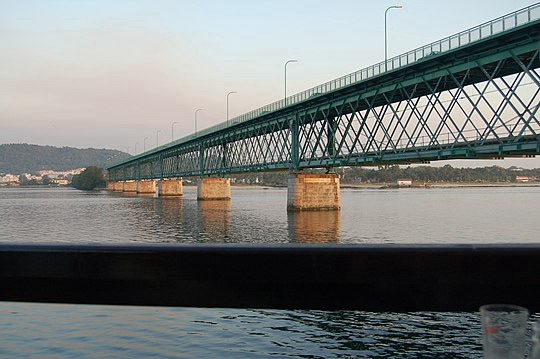
A word about the bridge. It’s called the Ponte Eiffel, (designed by yer man Gustav), it’s made of steel, it’s 645m long, and the top floor, where the traffic and pedestrians go, is completely open, except for a guard rail on each edge. I don’t know how high it is off the water, but definitely high enough that you don’t want to look down. There was no way that we were going to take a picture in that weather, so here’s one that someone took in drier times :

I suppose looking down wasn’t really an option anyway. The rain was so bad that you just had to concentrate on looking ahead. The wind was incredibly strong, and blowing from the sea, threatening to throw us into the traffic at any point. I decided that the best approach was to put my left arm over the guard rail to hold on there when the wind really gusted. Every now and then I’d turn round, and I remember being quite surprised to see that Mrs E was still on the path. Anyway, it took about 10 minutes to cross, one of the scariest things we’d ever done, and at the end, completely drenched and with no feeling left in our hands, we tried to find somewhere to shelter to see where our hotel was. Unable to operate a wet phone with broken thumbs, we guessed, and fortunately headed in the right direction. We made something of an entrance to the very posh hotel, dripping water on their shiny wooden floor and refusing to sit down on their pristine seats. Recovered a bit to sign in, but only managed to do so by holding a pen in my fist and moving it randomly around the registration form.
We managed to get into our room without too much further embarrassment, and made a check of clothing that needed to dry. Because we’d packed very light, almost everything needed to be worn again the next day, so, dressed in dry shorts and T-shirts, we borrowed an umbrella and found the town laundrette. Not quite Nick Kamen, but not far off.

Day 4 brought further storms which would apparently be ‘over in a couple of days’. Most of our clothes were relatively dry and we were quite keen to keep them that way. We’d noticed other pilgrims on day three wearing huge capes that covered them and their rucksacks, and also wearing smug smiles as they eased past our shivering forms. Was it wrong to envy other pilgrims? SI wasn’t around to ask, so we decided not, and so I set off after breakfast, again in shorts and umbrella, to a tiny shop that we’d noticed the night before, that had a handwritten ‘ponchos’ sign in the window.
‘Don’t get yellow’, Mrs E helpfully called out, as I headed off into the monsoon.


As it happened, colour was the least of the issues. My Portuguese is beyond rusty, and the elderly lady at the shop was not only very Portuguese but also very deaf. Eventually we established that:
a) she did sell ponchos
b) that she only had one left (in blue)
c) they were €7
d) that she’d go and look out the back for another one
e) there wasn’t one out the back
f) the one hanging up could be for sale
g) but on closer inspection it had a number of rips and tears
h) so was neither use nor ornament (I’m paraphrasing the Portuguese here, of course)
i) that she could help me no more so here was the change from €10
j) that there wasn’t another poncho seller in the town
k) that our business was was concluded


Then, apparently as an afterthought, she held the torn (yellow) poncho out to me, presumably to dispose of as I saw fit.
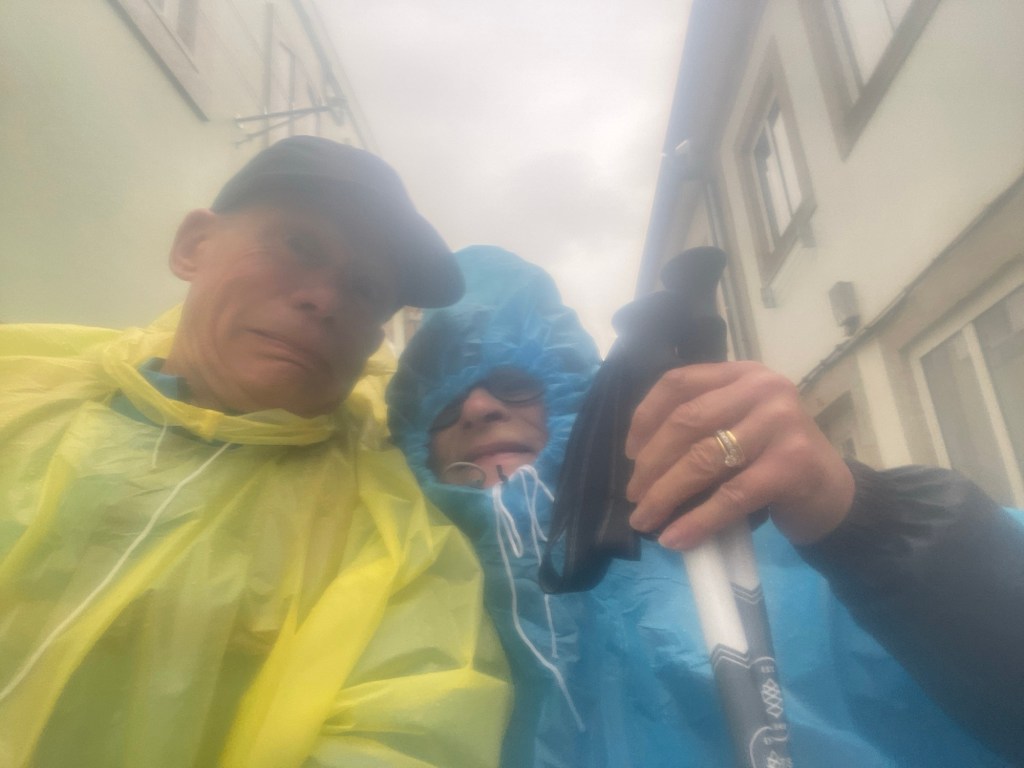
And so it was that we set off, with both of us and the two Beasts covered with the flimsiest of plastic covers, Mrs E in a fetching blue, and me in a less fetching yellow number, looking very much like I’d recently been attacked with a Stanley knife. This is the first picture we took. Possibly not our finest, but I’m very keen on the porthole look that my wife has gone for. I think it’ll catch on.

The rain kept up for hours, we were marginally drier than the day before, except where our legs and arms emerged from the cape (and for me, below the numerous slashes).
We hiked through some lovely forest and went up and down what would have been challenging rocky paths, but, because of the weather, were challenging river beds. At one point, we took shelter in a bus stop and both independently thought about checking the bus timetable. We had to cross a river on giant stepping stones, each about a meter apart, with precarious falls on each side, and only mentioned the bus option to each other afterwards, by which time of course, we couldn’t go back.


We’d agreed after day one that we’d try to drink water every hour, just to have a break, and this was a good tactic, or it would have been had it not been for the process of needing to go to the loo every hour as well. This is challenging on a walk at the best of times, but in pouring rain, with full packs, hiking gear, ponchos and hands so cold that fingers and thumbs were inoperable, it proved particularly challenging. Obviously the challenges took different forms. I managed with very little precision using some ungainly thumb work. Mrs E found a balancing point that looked oddly like an outtake from Teenage Mutant Ninja Turtles, quite elegant in her own way, but requiring a partner to lift Beast 2 off her back in order to reassemble her lower clothing.
We’d completed these manoeuvres, thankfully, when we met up with a couple of German women, who we walked with for a couple of hours, and the change of conversation and company meant that the miles went by much faster. Said goodbye to our German friends as we reached Amoroso, as they were staying there, but we still had another 10k to go, as we needed to get to Caminha, on the Portuguese border. This was hard work, as it started raining again, every now and again it would stop, there’d be a little bit of drying out, then it would start again.
‘I’ve really had enough of this’, said Mrs E, as we climbed yet another hill. And then a miracle happened. I might have mentioned in the past that Mrs E has a real aversion to whistling, and there, at the top of the hill, sheltering under a huge umbrella was a whistling man. A tunelessly gormless whistling man at that.
I turned to my long suffering wife who, incidentally, hadn’t been able to see anything out of her porthole since the morning as her glasses had been covered in rain.
‘What if there was something at the top of this hill that really annoyed you even more than the rain? But that you could just walk away from?’
‘Yeah, like that’s going to happen’
And so it was, at the top of a hill in northern Portugal, in pouring rain, a gormless man whistling a tuneless tune under a huge umbrella, miles away from anywhere, found the contents of a blue and a yellow cape, covering ridiculous hunchbacks, openly laughing at him. SI would not approve.
On the way downhill from the whistling twit, Mrs E managed some further good news. Beast 2 had stopped squeaking. Maybe the beast had been tamed.
Eventually we got to Caminha, and checked into a creepy hotel which was full of dark winding corridors with ‘staff only’ doors shutting just as we turned each corner. And, for some reason, a glade plugin on every available power outlet. Rarely wared, as they say in Norfolk.
We were on the Portugal/Spain border and needed to get across the Minho river. The hourly ferry wasn’t running, but we managed to book a water taxi, which was as billed as a ‘speedboat for six’, at 0830 in the morning.

So Day 5 started with a walk to the dock, and a chilly wait with other pilgrims for the speedboat for six.
Actually, it started a bit before then – Mrs E was determined not to have wet feet any more – she’d started to get some really nasty blisters from walking in wet socks and shoes. To her delight, she found that a plastic sanitary bag from the bathroom was just right to cover her sock. But only one sock, so the day started nice and early with her asking the night porter for another bag, a challenge that probably wasn’t helped by her miming that she wanted it, not for its original use, but for her foot. The night porter struggled with the challenge, especially when trying to enlist the help of the breakfast cook, but eventually returned with a couple of carrier bags, so Mrs E set off on day five with a sanitary bag on one foot and a large plastic bag on the other. Meanwhile, the speedboat turned up dead on time, and sped us across the river in under five minutes. This was a relief – if we’d not got the boat we would have had to wait until 1430, or take a 15km diversion via an inland bridge.

So we set off into Spain, where, thanks to Mrs E’s 30 day streak on duolingo, we felt much more relaxed with the language, seamlessly switching from ‘Bon Caminho’ to ‘Buen Camino’. Of course it started raining almost immediately, but it was soft and light and intermittent rain, so we were wearing our ridiculous capes for fun rather than function. It turned into a long day though; the stages so far had pretty well matched the suggested routes in our guidebook, but we wanted to stay in a hotel a bit further into the next stage, so we ended up walking for eight hours, and covering about 30km.

The last couple of hours were quite hard work – Mrs E had blisters from wet socks on the previous couple of days, so we trudged down the hill to what ended up as a fantastic hotel with its own hydrotherapy spa – unbelievable luxury – we looked and felt completely out of place in the posh reception with our rucksacks and muddy trousers, but this mattered a lot less by the time we got to the spa, where Mrs E found a freezing plunge pool and looked as happy as I’d seen her for several days.

Even better was the news that day six was a rest day of sorts, with only a couple of hours into Baiona, where we’d be staying at the Parador. I may have bored you before about the joys of the Parador hotel – each one a national monument that just happens to be a hotel, and this one was as special as they get – we were literally staying in a restored fort – the outside wall of our room would have been the stone fort, the whole building covered the 18 hectare peninsula, and despite the fact that Francis Drake attacked it enthusiastically in 1585 it remains in amazing condition. And everything (this being a Parador) is just wonderful. We didn’t have time to explore all of the castle and the fort, opting to loaf around, make phone calls and recover properly, but if we had, we would have seen the prince’s tower, dating back to the 10th century, later holding the Hapsburg prince who was in an iron mask, the inspiration for the Dumas novel. And, for that matter, the slightly shorter Billy Bragg song.

Day seven, and the first proper sunny day – our map suggested that we’d be hiking about 20km, but the caminho route said otherwise, and we ended up doing about 24km. A lot of this was off road, and a huge amount uphill, winding through forest tracks with terrific views of the ocean below, which for the first time showed a couple of spots that you might have been able to paddle in without being flattened by the big waves.

Mrs E found it hard going, and the last few kilometres were really taxing, very hot, very uphill, and by the time we got to our (very lovely) hotel, she was dragging her right foot a bit like Keyser Söze in The Usual Suspects.

That’s where part one of this blog was going to end. You could have read this and been excited for part two – we were halfway through the trip, the easiest walking was to come, and the celebrations in the square at Santiago were just six days away. I could have told you about the pilgrim’s service in the cathedral and maybe even the process of obtaining an indulgence. But there isn’t going to be a part two, because after Mrs E had limped to the hotel room, she made the mistake of removing her right sock. Despite a lot of Vaseline and a year’s supply of compeed, her blisters had got much worse and she was in lots of pain. Even worse, we could see the start of infection heading up from the foot.

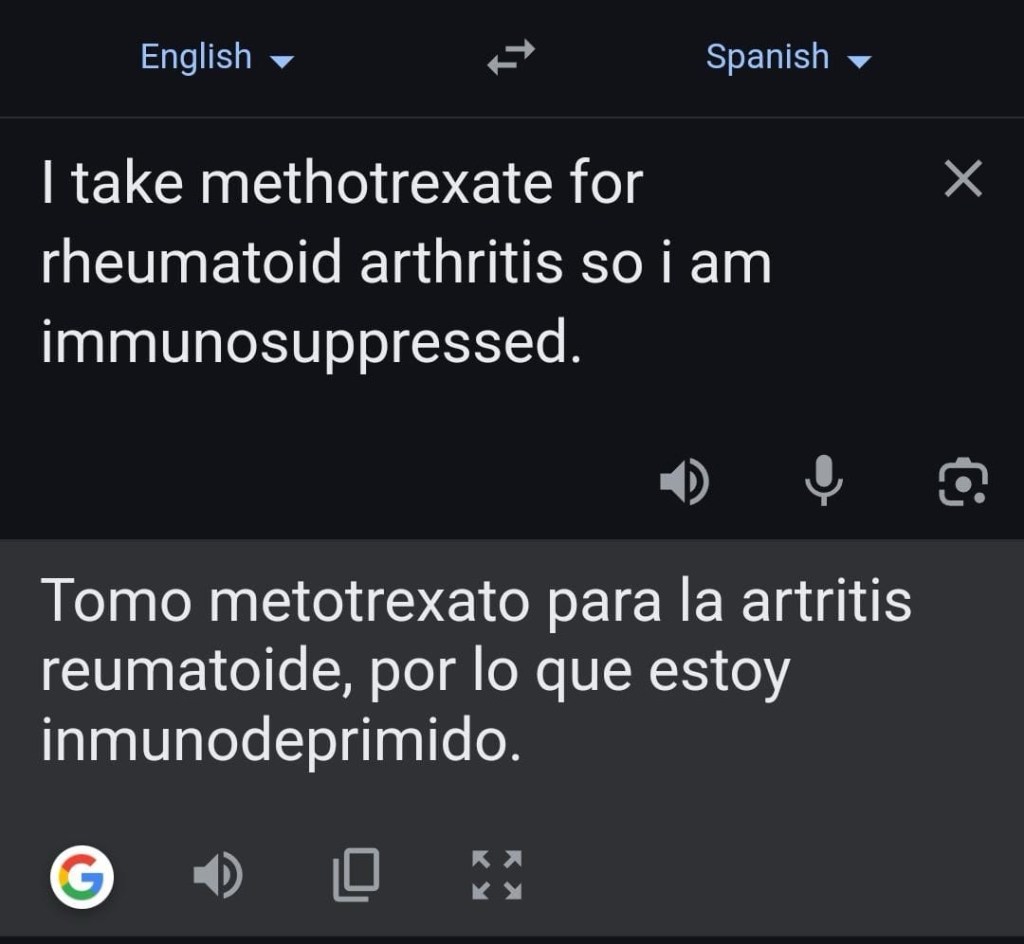
One of the many wonderful things about my wife is the way that she manages her health. She has a really nasty disease called rheumatoid arthritis – if you don’t know about this, it is unhelpfully labelled, being neither rheumatism nor arthritis – rather, it is an autoimmune disease that can seriously inflame and damage tissue and joints. She manages it brilliantly with some unpleasant drugs and a great deal of very cold water, and refuses to let it define her. But the side effect of the drugs means that she’s immuno-suppressed, meaning that her body is less able to fight infection. So this sign of infection was a bit of a red flag, and by about 8pm that night we were on our way to Vigo hospital for an evening with Spanish A&E.

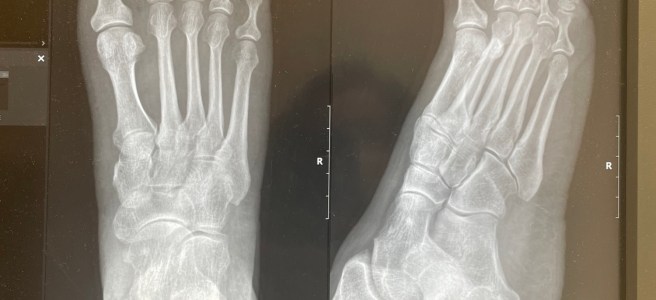
Emergency rooms are the same the world over. They’re full of people who (obviously) don’t want to be there, sometimes carrying injuries that must be incredibly painful, and everyone just desperate to be seen. Other than hanging around quite a bit, Mrs E was treated brilliantly – admitted really quickly, put into a wheelchair by the triage nurse, assessed by the doctor and put straight onto an IV drip with painkillers and antibiotics, bloods taken for tests, wounds dressed, X-rayed, and finally reassessed with the results, which showed the infection and a likely match with the antibiotics that would treat it. During all of this, we leaned heavily on Google Translate and WhatsApp support from Dr Jr Emu#1, who gave a varying quality of advice:

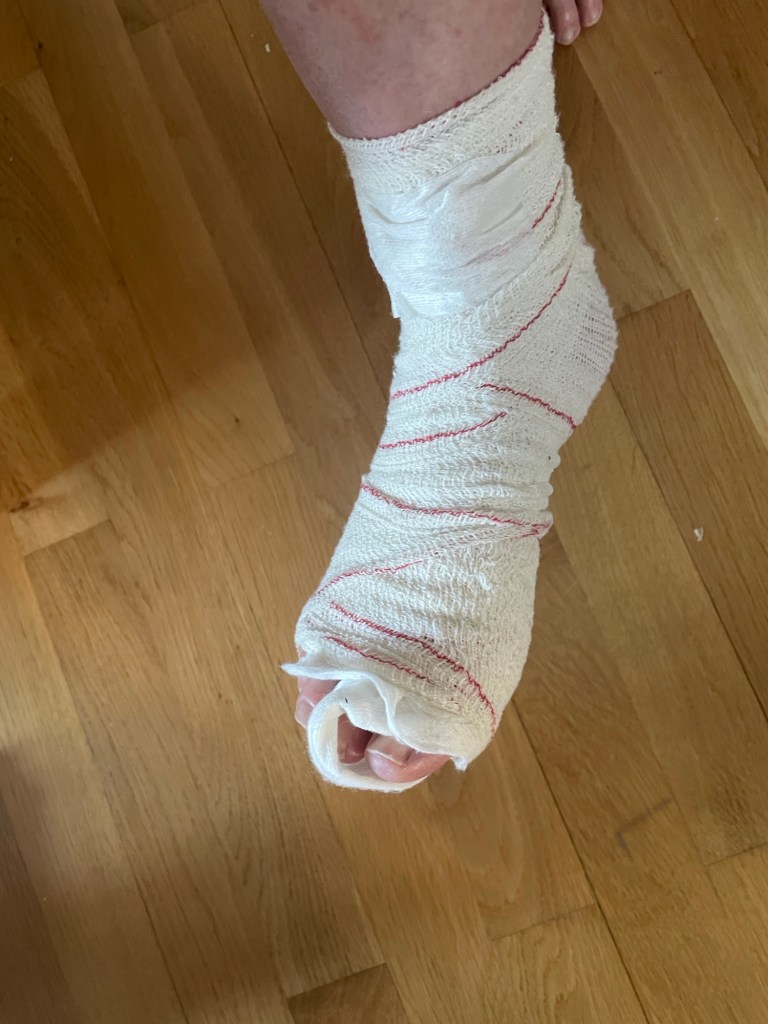
You might be eating your breakfast with this so I’ll not share the pictures of the wounds, but here’s a picture of the foot post-dressing.

Eventually we got discharged, and headed back in the early hours with vague ideas about me continuing and Mrs E spending the next couple of days travelling by taxi and resting.

Woke up on day eight, and we both realised that those ideas were hopelessly optimistic, and the sensible thing to do would be to get home as soon as possible, so we spent most of the day cancelling hotels and flights, and booking stuff to get back the following day. And that’s where we are now, in Santiago de Compostela, sharing an airport bus with lots of happy pilgrims and their backpacks.
On day 4 we’d had an interesting conversation with our German friends, trying to understand why there’s no English equivalent word for schadenfreude, when the English probably needed the word far more than the Germans. I don’t know what the opposite word for being selfishly envious at other people’s happiness, but that’s what we felt now, when we heard the pilgrims chattering away. Well, a bit, anyway.

But we’d given it a go. If Mrs E could have put one more step in front of another with Beast 2 then she would have done. (My Garmin says we did 245,459 steps in the first seven days, so maybe that’s an achievement of sorts). And maybe we’ll come back next year to give it another try, if she can get hold of some waterproof socks.

We didn’t have a particular religious or spiritual experience, and we didn’t get to experience the end bit. But we saw some beautiful parts of Portugal and Spain, met some fabulous people, and really looked after each other when we needed to. Which, when I think about it, is vaguely spiritual in itself. So that’s probably enough to stop being fed up.

Until the next time, Buen Camino!

It’s The End Of The World As We Know It

So we escaped the hullabaloo of a collapsing government, an increasing volume of vociferous gammon, and an overexcitable media to head for the relative calm of the Galician coast. Fairly skipped out of the country, we did, in the hope for simple hiking adventures in the bright June sunshine of the Spanish countryside.

And it’s not like we didn’t have the odd warning on the way. Our first warning was a phone call next to the Ryanair gate at Stansted. I’d had an MRI scan a couple of weeks before, after going to my doctor and telling her that I was struggling to stand up if I’d sat down for any length of time. This phone call was from the triage doctor, following up on the scan, and asking if I’d had any further issues. Not really, I said, it’s just really painful and I look like I’m about ninety when I stand up. Incidentally, my mother, who has just actually turned 90, can easily beat me in the getting out of a chair without complaining stakes, particularly if it’s 6pm and time for a drink. Anyway, the lovely doctor said that he’d refer me to someone who could see me and the scan in the same place,, at the musculoskeletal (MSK) clinic and recommend some sort of intervention, which sounded ominous. Incidentally (again) – I saw my GP in May, had an MRI scan later that month, had this phone call mid June, and now have an appointment at the MSK clinic at the end of June. I absolutely bloody love the NHS. Anyway, at the end of the phone call, the lovely doctor told me that I’d better not do any walking between now and the MSK appointment. Ooops.

Second warning was the actual booking. We were due to walk the ‘Wild Atlantic Coast’. I didn’t really worry about what actually made it wild until we started. Maybe it was going to be the wild flowers, or the wild sense of abandon you felt as you skipped along it’s banks. Or maybe it was wild like a wilderness, a leafy green expanse of rolling green that we’d skip along as we held hands along manicured footpaths. Wild in a Kate Bush style, if you like. Well none of that. The Wild Atlantic Coast really should have the Wild Atlantic bit in bold. and underlined. When the Atlantic gets enthusiastic around these parts, it really makes itself known. Wild in more of a Keith Moon/Oliver Reed style then. We were walking the lighthouse way, from Laxe to Finisterre, and it’s known as that because you can’t walk for more than a couple of hours without tripping over yet another lighthouse. And you need them here because otherwise there’d be even more shipwrecks. Did I mention the shipwrecks? Well, one of the first things we did, when opening the map of the route, was to ask what Costa da Morte meant. Our Spanish isn’t that great, but our French is ok, and surely no-one would ever name a touristy destination the Coast Of Death. Well, they did, and it’s because there’s a long history of shipwrecks along the coast – galleons, fishing boats, german submarines, oil tankers – they’ve all misjudged the waves and the winds and the rocks and understood a bit too late what the Wild Atlantic is all about. We stayed in a hotel that showed all the shipwrecks on a series of maps along a corridor. They were very big maps, it was a long corridor, and the writing was very small – there have been over 600 shipwrecks since the 14th century, hence the need for lighthouses, although with that sort of record, you might want to have put a few slightly brighter bulbs in.

We set off from Santiago de Compostela, a beautiful city best known as the destination for the pilgrimage Camino walks that start all over southern France, Spain, and Portugal. Santiago is named for St James, whose relics are held underneath the cathedral, hence the pilgrimage destination, and there’s a long queue of pilgrims in the cathedral every day, queuing up to touch the shoulders of the statue of St James behind the altar, to mark the end of their journey, which may have been a six week hike. It’s quite emotional watching people get to the cathedral with their backpacks and walking poles, and quietly filing around the altar to get to this moment. We felt as if we’d be cheating if we joined in, so we went outside to the sunny square behind the cathedral, where pilgrims were arriving after their journeys, looking exhausted but elated, lying down on the cobbles, hugging each other, taking selfies and generally feeling very pleased with themselves. We spent half an hour here, soaking up the sun and atmosphere, and also managing to drop one of our passports on the floor, which we didn’t notice until a couple of hours and a 50km taxi ride later, when we tried to check in to our first hotel. Key travel tip – if you are going to lose your passport, make sure you do so in a crowded square full of elated and repentant Christian pilgrims, as they’re more than likely to hand it in to the police station. So, 100km of taxi rides later, we were back in Laxe, very relieved, and having a quick dip in the Atlantic before dinner and the start of the walk.

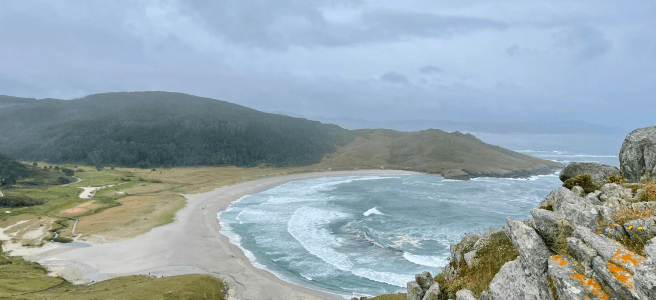
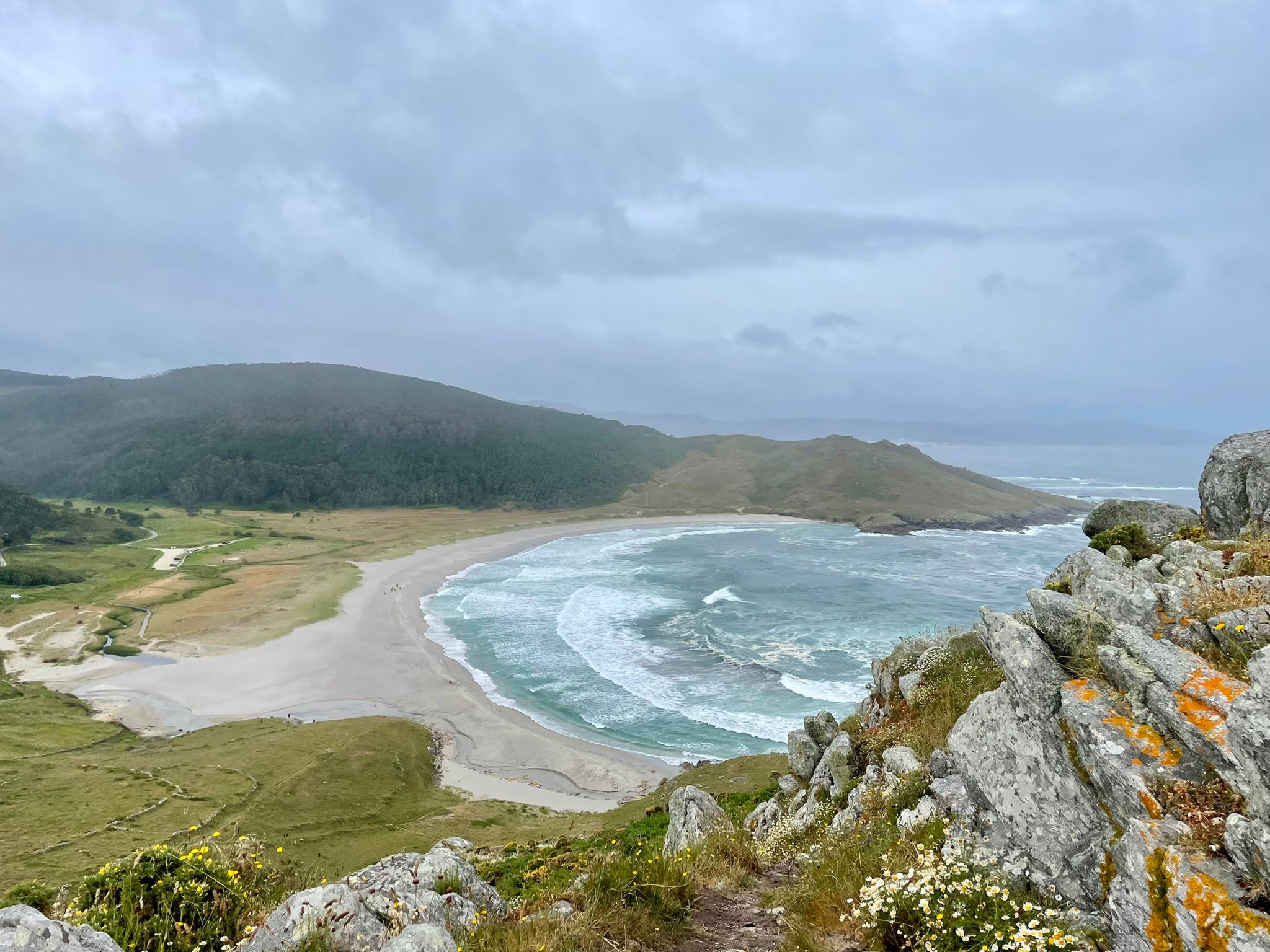
Laxe is a small fishing town and the start of the lighthouse walk which travels all the way around the Costa da Morte to Finisterre. Quite a few restaurants, all of which seemed very keen on local seafood, including pulpo feira, which is a kind of cold cake made of sliced octopus. Tastes a lot better than it sounds. Fortunately we both like seafood, as this was pretty much all we’d be eating for the next week. Started the walk the next morning, from Laxe to Arou. Quite a bit of up and down stuff, up to the top points to lookout to sea; down to the boardwalks and the beaches, with waters that looked fairly lively:

All was well and sunny, until it wasn’t, and when we hit a bit of rain, the walking suddenly got quite a bit harder. No slipping about on the rocks, thankfully, but the rain just kept coming, and managed to make its way inside our coats and boots so that when we finally arrived in Arou, we were fairly bedraggled. Whenever we do one of these walks, we tend to exhaust the conversations about the kids and politics fairly early on, so we’ll play games to keep our spirits up – the game today was alphabetically naming places we’d travelled to together; exclusions for Q, U, V, X and Z, with nominations for place we’d never return to (Sequoia, it’s a long story), and places we’d go back to like a shot (Kathmandu). Did our best to find places to dry boots and coats, then headed into town, trying to dodge the rain, Found the only restaurant in town, where Mrs E decided to indulge me by pretending to like beer (which she did, in a 1:10 mix with Sprite), and be interested in the football, although England’s uninspiring 1:0 win over Serbia really wasn’t a great introduction to the beautiful game.

We were hoping for better weather the next day, but we’d been warned about likely storms, which were confirmed in the morning. The advice was to skip the walking altogether, which, looking at the forecast, we agreed to, so we jumped in the taxi with our bags and headed to Camarinas. Part of both of us wanted to be walking, and the rain held off until about 10am, but after that it absolutely hammered down, so we made the best of things – me knocking out 5,000 words on the history of cigarette marketing, and Mrs E brushing up on her Galician history and language. As I mentioned, we can get by ok in French, but our Spanish is dreadful, and our Galician non-existent. They’re similar languages in many ways, but Galician has many more Xs, which are a bit confusing until you realise that they largely make a ‘sh’ sound, and lots of squiggly lines above the N letters. But the main challenge is in pronunciation. I’m all for rolling my Rs, but Galician takes it to a new level, so that any word beginning with an R starts off like a Formula One car, and there are plenty of other words that seem to involve coughing up about 10ml of mucus at the start of the word for the correct sound. And there’s a certain amount of pride in how fast you can talk as well, so we’re lost in a muddle of hawking and industrial purring and machine gun sentences before we ever get a chance to try to tune in to one word, just one word that we might be able to connect with. One of our sons is in Japan at the moment, where he’s gone to teach English, and assumed he could just wing it speaking Japanese with no prior knowledge. He’s taught himself a few useful phrases, including one that roughly translates as ‘oh really, how interesting’, which allows the conversation to rattle along while his brain shuts down. Incidentally, he also learnt the phrase ‘please, do sit down’, so that he could be polite to old people on buses and trains, before being told that his pronunciation was slightly off, and that what he was saying was ‘please, can you touch me?’. He also made the mistake of clinking glasses with someone in a bar and saying ‘chin chin’, which apparently translates in Japanese as the must depraved thing you can possibly say about a penis. More of this in a short while. Anyway, while writing my stuff (an absorbing project that I expect will have a voluntary readership of less than two people when it reaches a final draft next year), I found myself listening to the Galician equivalent of Smooth FM, which had a variety of show tunes and easy listening pieces on repeat. It was on the third rendition of My Way that I realised just what an appalling song it is. Actually, the third one wasn’t too bad in that respect, as it had a throaty saxophone over a lilting orchestra, but the previous versions were truly dreadful. And it wasn’t the versions themselves (one Tony Bennett soundalike, one slightly bossanova version with a impassioned Spanish tenor). It was the lyrics. And with that song, it’s all about the bloody lyrics. The version we all know was written by Paul Anka, whose pedigree ought to have put him above the tenuous rhymes that make their way onto My Way. It’s almost as if he came up with the title, then scuttled off to the rhyming dictionary and scribbled down the first things he found….highway/byway/shy way, then thought, crikey, I’m on a roll here, I’ll have a go at curtain/certain; mention/exemption; knew/chew; losing/amusing, and then I’ll plug them into a song about a self-entitled twit whose claim to fame appears to be that he’s rattled through a life where his top ten priorities are all about himself. And then, all being well, a whole load of people will line it up without any sense of irony to be played as their funeral anthem, Anyway, that’s what I thought when I was listening to it. And don’t get me started on Magic Moments..

Next day from Caramarinas to Cereixo, reasonably dry, and up and down again, onto tracks that looked as if they’d not been trodden for years, so that we dragged through soaking bracken and gorse to get to the top of some of the passes, then plunged down to beaches that looked like they were in the Seychelles.

Mrs E was very keen for a swim, and, having dramatically misread the map, I advised we’d be able to stop at a beach nearer the end, at which point we headed inland and it started to rain. We’d been walking for seven hours by the time we got to Ceriexo, where we were staying in a B&B out of town . Had a good meal there, with both cooking and entertaining from our genial Galician host, Julio, a man who by rights should have been sponsored by both the Galician tourist board and Grecian 2000. His after dinner presentation, which may well have been in either Spanish or Galician, was about the health benefits of a home distillery, At one point, with all parties being lost on where the conversation was going, we turned to the Galician to English setting on Google Translate. The very next sentence translated as ‘you will have no further fears for the mis-use of a penis’, which we all found a little baffling. But we stuck with the whole presentation and were rewarded by sampling his ‘digestifs’, one of which was fabulous (coffee) and the other one, which brought up memories of an unfortunate time when I tried to siphon petrol out of a mini clubman. Today’s walking game: alphabetic rounds of people we both knew, managed about six rounds of this with exclusions for X and Z, but the game fell into disarray when Mrs E denied ever meeting my last two Y’s.

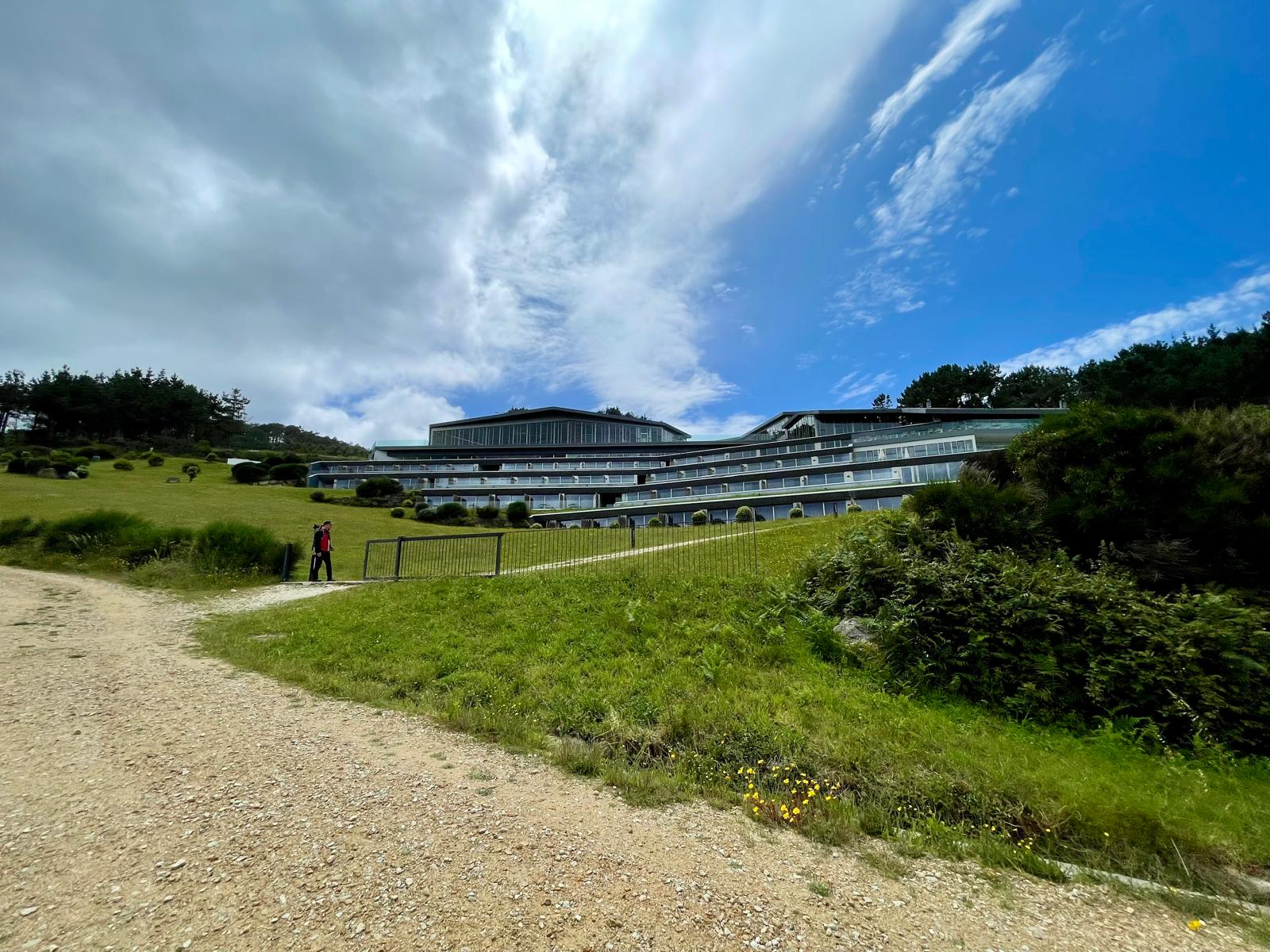
And so to Muxia, another challenging one with wet footpaths getting much wetter as it tipped it down for the duration – when it wasn’t raining, we always seemed to be in the jungle-y bits of the route, so our feet got wetter and wetter, and on the few bits of tarmac we both made a squelchy sound as we walked. Some lovely beaches, but all a bit wet and windy for swimming, and we had an appointment to keep at the Paradores hotel. This was a bit beyond Muxia, but we’d been drawn to it because it looked like a really lovely place to stop mid-hike. It’s new, huge, very modern, and looks a bit like Tracey Island, cut into the side of the hill, and up a long track from a sandy beach.

And very lovely it was inside too, it was on five floors, which were connected by a cross between a lift and a funicular railway. I think it must also be a place to stay for a pampering sunny weekend as well, the other guests all looked a bit fed up with the weather, and we stood out like sore thumbs with our hiking boots and poles (although we did leave them in the room when we went to the bar). Anyway, we did manage a swim, in the ‘seasonal’ hotel pool, which was lovely, albeit under the disapproving gaze of everyone in the cafeteria, looking on in disbelief as we swam in the cold drizzle. Today’s walking game: name one hundred famous Scottish people: we managed this fairly comfortably, but I was denied both Rod Stewart and Alistair Campbell (on the no accent rule, which Mrs E introduced mid-game), although I did score extra points for BA Robertson, and we had a happy twenty minutes not being able to remember any of his ‘hits’. I’m just writing this up, and Mrs E has gone into a tragic fit, as she’s just remembered that neither of us included Jeanette Krankie.

Another diversion in the morning, as we’d had a warning about a loose and large dog that had bitten a walker a couple of weeks previously. So we hopped in a taxi with a very nice man from Luton, who dropped us off beyond the range of the Alsatian which was, apparently, as big as a pony. We started near the Monte de Buitra, which we walked around first to give us a bit more mileage. It was (of course) wet, and fairly desolate, and reminded both of us of Craggy Island. A couple of mysterious farm buildings, a lighthouse (of course) and we only came across one other road user, also striding purposefully along:

Then south through more rain, up a couple of challenging climbs, and down into Lires, a tiny village which fortunately had a fabulous restaurant where we ate cake when we arrived, dinner much later, and even bought our lunch from them the next morning – hands down the best food that we’d had all week. By now, there was no likelihood of drying out our wet socks or boots, so the socks headed straight for the washing bag, and the boots stayed outside the front door, thereby leaving an unpleasant smell at some distance. The views were amazing on the walk though, we saw hardly any other people this or on any of the previous days, and the footpaths, although marked with green dots, in the most green countryside we’d ever seen, were fairly easy to spot. There were some paths that were described as vertiginous, which were actually ok, and some that weren’t, which were fairly scary. There were definitely places that would have been described as dangerous at home, with sheer drops onto cliffs a hundred metres below, but we were ok sticking to the path, and of course hoping that nobody in their right mind would be walking towards us. Today’s walking game: Musicians as Animals. Mrs E’s winner – Llama del Ray. Mine – Elephants Gerald. Honestly, the miles flew past.

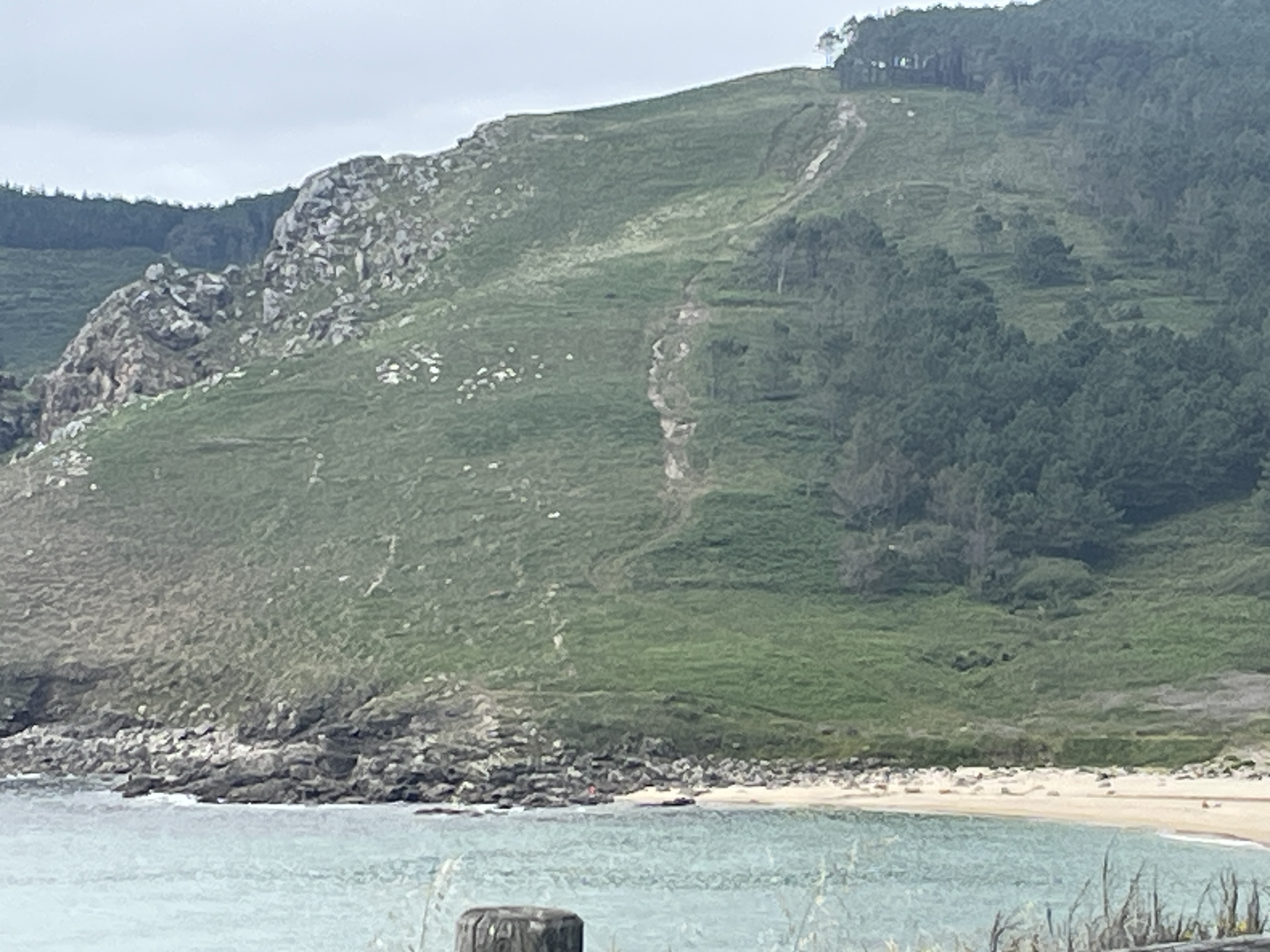
And then, the final leg, from Lires to Finisterre. We were told that we should allow ten hours to do this leg, which was fairly daunting, but in the end it took us just over eight. And probably the hardest walk in terms of climbing (some proper hands over your head stuff) and descending – the drop into Finisterre felt like it was near vertical, and looked like it facing back from the beach (it’s the worn bit in the centre of this this picture):

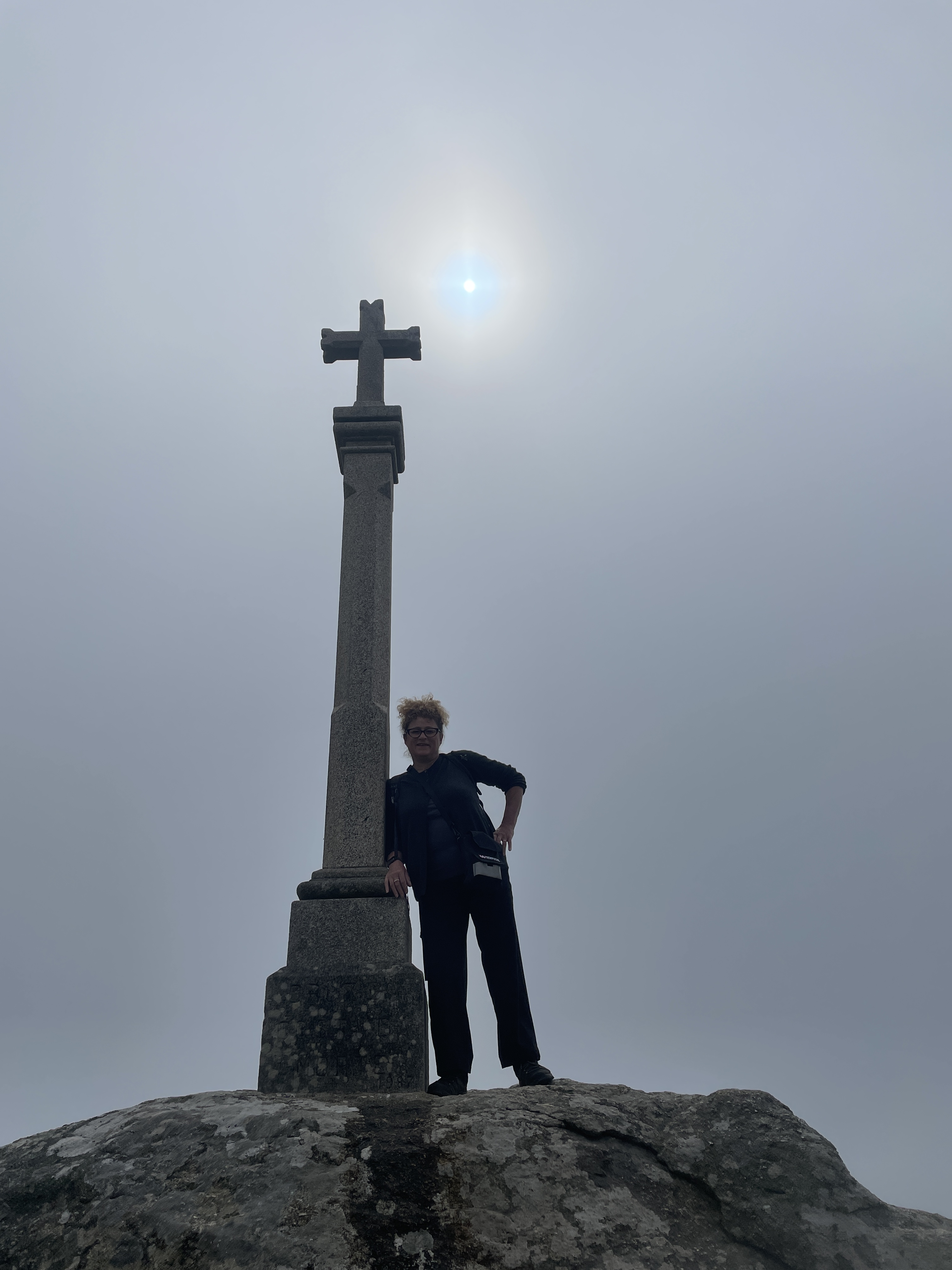
Finisterre means end of the earth, and it ought to be continental Europe’s most westerly point, given that it’s got the name and everything. But the cape at Touriñán, which we’d walked around the day before,, is further west, as is Cabo da Roca, in Portugal, but, as they say, why let the facts get in the way of a good story? What Finisterre has got, is the most western lighthouse, which pleasantly lit up our hotel room every 30 seconds or so, as we drifted off to sleep that night. Just beyond the lighthouse is a little strip of rock, where pilgrims complete the ‘extra bit’ after they reach Santiago de Compostela. They’re suppose to burn their capes and boots at this point, to formally end their pilgrimage, but apparently that’s now been outlawed – probably just as well, as flaming goretex wouldn’t be a good environmental look. Instead, they have photographs taken, which is better for everyone.

Headed across to the other side of Fisterra for the final night, where we at last managed a swim in the (according to Mrs E) warm Atlantic. Mrs E’s warm is anything over 8 degrees. Mine is above 65, and ideally in a sauna, so we are ill-matched on that front, but she tells me that cold water will be good for my back, and I believe her because she’s a nurse, and because believing her has served me very well for quite a long time now. And so when she says it’ll be a good idea to do one of the full camino pilgrimages next year, I’ll be there like a shot, even if I’m not allowed to burn my cape at the end.

This Is Water

We’d been talking about going to Nepal for about a year, off the back of some fantastic European hikes that we’d done previously. Nepal felt like the next adventurous and ambitious journey so we did tons of research, found a recommended trekking company and agreed a route that seemed to fit our needs. We described ourselves as experienced hikers, which we are, but it would seem that’s different to being an experienced Himalayan hiker, as we were to find out. But we did prepare, (as much as walking in Norfolk can prepare you for ridiculous elevation increases), and counted down the days excitedly. 

And so we left home on a cloudy September afternoon and found ourselves about 18 hours later stepping out blinking into the sunshine of the Kathmandu airport exit, and witnessing for the first time the absolute chaos of a Nepalese city. We managed to find a taxi driver in the throng of people near the exit, threw our bags in the boot and ourselves in the back, and went on the first of many bum clenching rides that we were to have in the next couple of weeks. Heading into Kathmandu meant more and bigger potholes that we’d ever seen, it meant near misses with other cars and scooters that seemed to be heading at us like a weird video game. It meant car and bike horns constantly sounding as vehicles overtook on both sides, and it meant that every right turn was preceded by a small prayer and a brush of the lucky Buddha tassels hanging from the rear view mirror. We had quite a few of these journeys to remember, many with our Italian friend Alberto in the front seat, regularly crossing himself. On a later bus journey from Pokhara to Kathmandu he told me that his watch had recorded 10,000 steps in four hours simply from sitting in the seat and going over the bumps. I’ll not describe every journey in detail, as it might trigger some latent PTSD, but you’re just going to have to take my word that, in the most peaceful and serene country that we’ve ever been to, travelling as a passenger in any motor vehicle is like watching Grand Theft Auto at double speed while someone holds a gun to the side of your head. And no accidents, or at least none that we saw – just as you think that you’re bound to be sandwiched by two other cars, or the pillion rider in the motorbike will fly off at the next pothole, time slows down slightly and order is briefly restored, just in time for you to open your eyes to see the next near-miss.

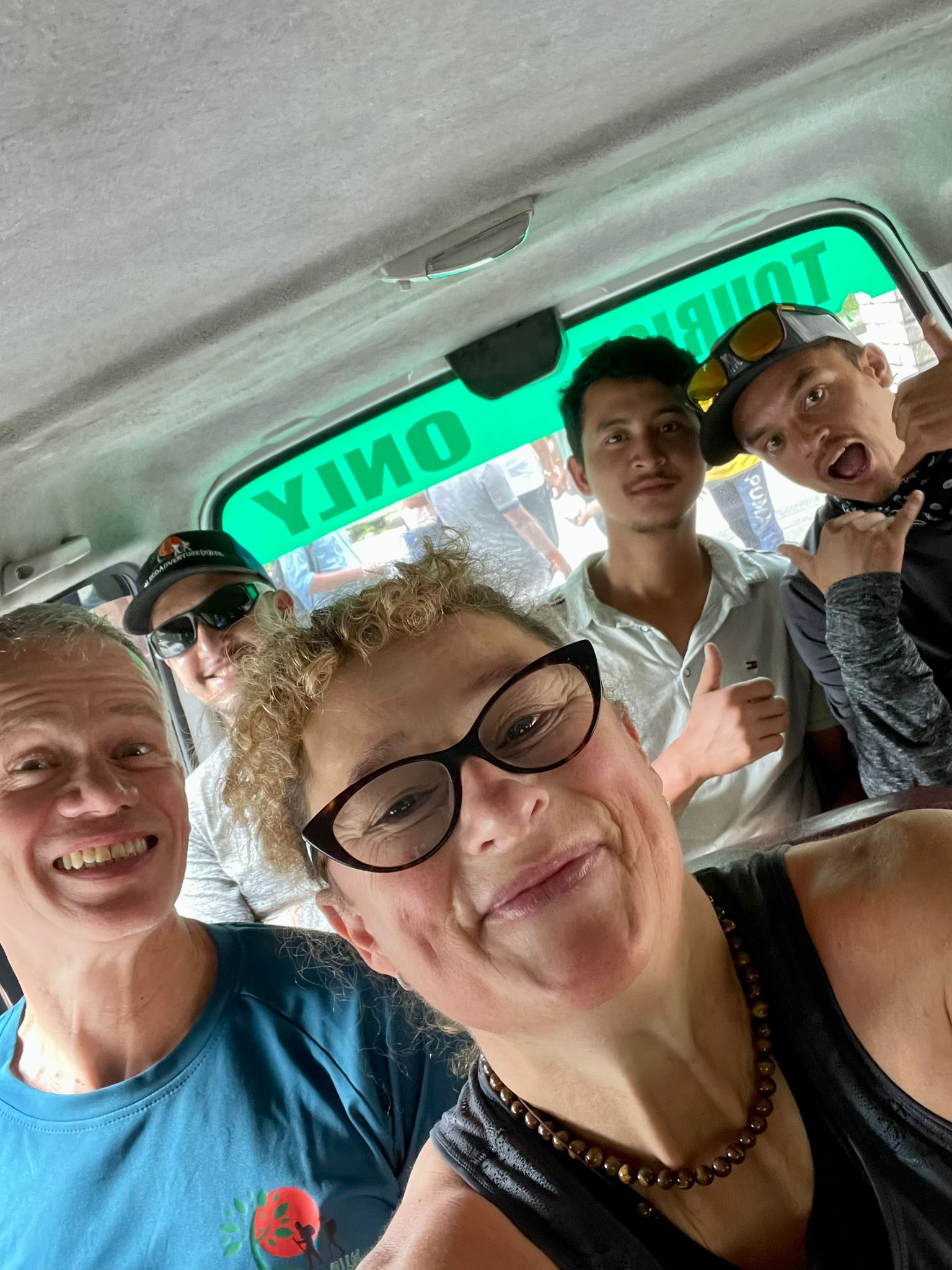
But trekking was what we were here to do, so let’s return to that. We met up with the trekking company the day after we got to Kathmandu, borrowing poles, sleeping bags and duffel bags for the journey, and, one curry, two beers and a sleep later, met up again at 0630 to take the bus to Pokhara.  We weren’t entirely sure even then who was going to be o the trip, but we were soon joined by our guide (Sandeep), porters (Anish and Nara) and another trekker, Alberto. We were incredibly lucky to spend the next couple of weeks in their company. Sandeep is funny, considerate and knowledgeable. Both porters astonished us by carrying about 25kg from a strap resting across their foreheads and marching across climbs and descents that we could barely manage with poles. And Alberto appeared to be immediately in tune with both of us – about halfway through the trek one of us mentioned David Foster Wallace and we had about 20 minutes on Infinite Jest while going uphill, completely forgetting that Mrs E had been left behind at the start of the conversation. He had quite a lot to share with Mrs E as well – they both had concerns about blisters, stomach issues and altitude sickness, with Mrs E falling to two out of three of these – Alberto was a trained pharmacist and appeared to have a bottomless rucksack containing a chemist’s solution to every ailment. 

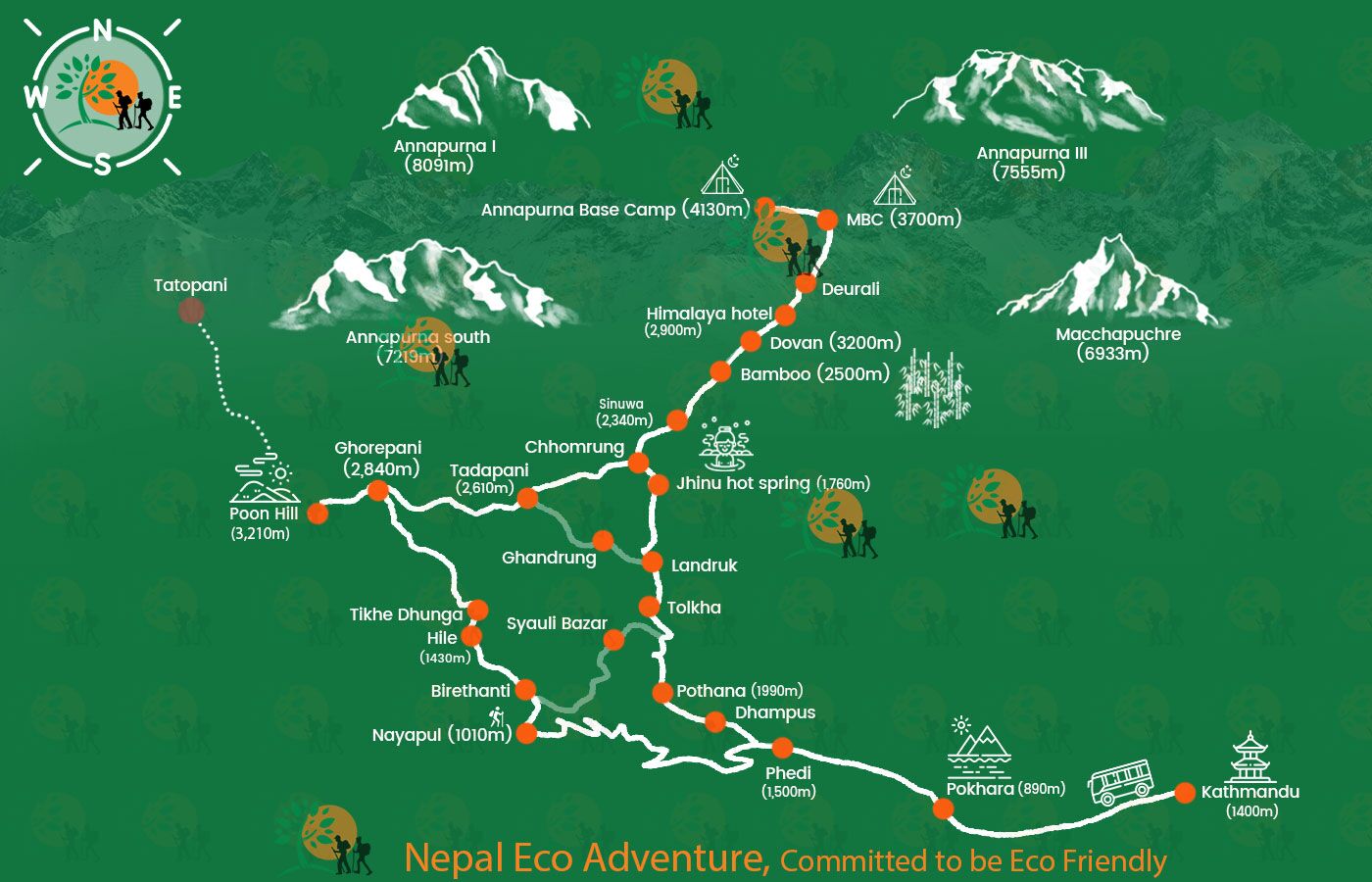
So that was the crew that set off – first on the bumpy bus ride to Pokhara, then in a car to Nayapul, then our first trek to Hile. This was a relatively straightforward 10k hike, mainly uphill, but all done in a few hours and readying us for the experience of tea houses and longer days to come. 

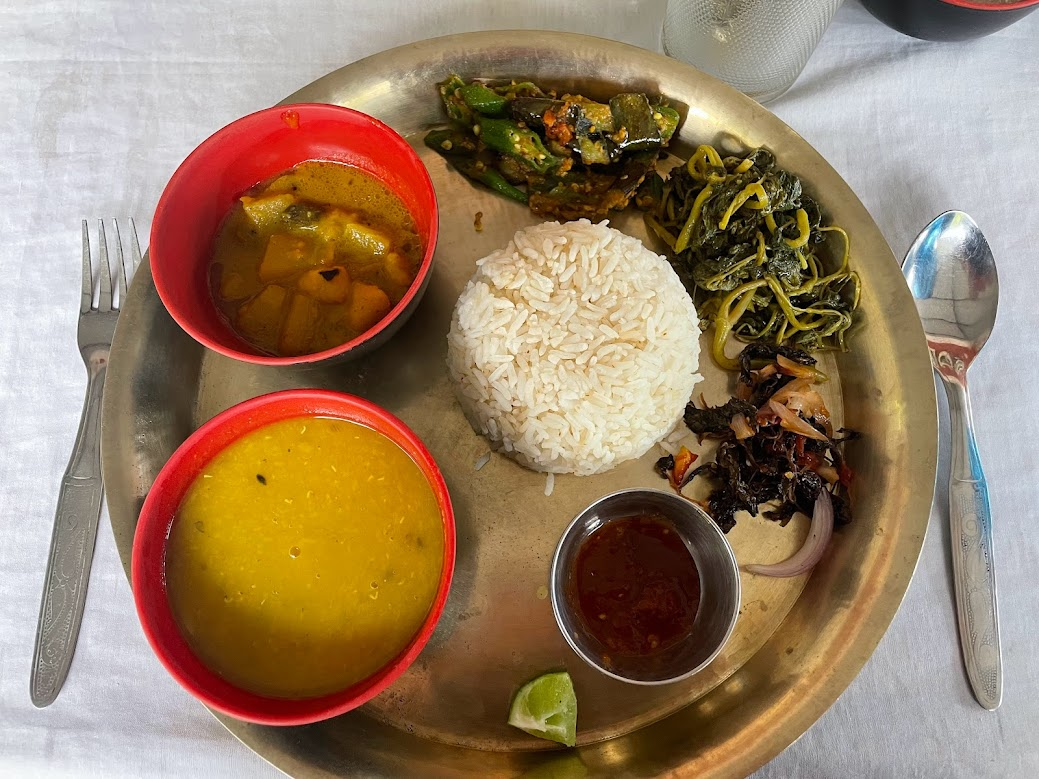
We made eight tea-house stops on our trek, and they were all pretty similar – very basic rooms separated by plywood walls, occasional warm water, and communal eating areas where there was a standard menu set by the Nepalese authorities. A bit of variation in this as you get further away from the road, as everything has to be carried by mule or porter (and only by porter once you cross past the sanctuary border), so by the time you get to the base camps, everything that you’re eating, living in and using for power (eg huge LPG bottles) has been carried there by hand for at least two days. While tea houses aren’t necessarily the most sophisticated holdings by western standards, they still use plenty of aluminium doors, steel beams, corrugated iron, cement and timber – all lugged there on the backs of porters negotiating ludicrously steep steps and paths. The standard tea-house menu is fairly limited, but it doesn’t really matter as long as you like Dal Bhat – the Nepalese national dish that always has a bowl of dhal, a mound of rice and a vegetable curry, together with whatever relishes are available where you are. Most Nepalese that we met ate Dal Bhat twice a day if they can – usually with their hands, mixing curry and rice together on the plate and making little mouth sized balls. The portions are really generous, and there’s always an offering of more just when you think you might still be hungry. And they’re totally what you need to power your hiking. 

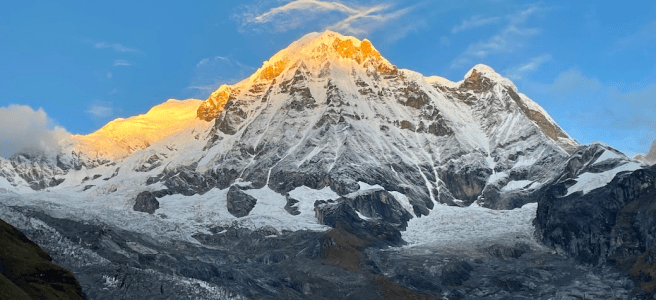
We were at almost 3,000m by the second day, and on the third morning hiked by head torch at 0430 to the top of Poon Hill, to watch the sunrise onto Annapurna, Dhaulagiri, Fishtail and Himchuli mountains. Mrs E gave up the 800m ascent at about half way, and lay down on a bench with Nara looking after her, but after we’d been at the top for about 20 minutes waiting for the sunrise, she emerged from the final steps with Nara grinning beside her. Apparently her main motivation for her Lazarus-like performance was a concern that I might be left on my own to describe the experience in the future. Proper FOMO! And she was right, as it happens. There wasn’t much cloud about, and it seemed to be clearing just before the sun emerged. I don’t really believe in God but if I did I’d be thinking that he had the biggest ever SAD light – the mountains changed colour completely, lit up in a deep yellow light. 

Three long days of hiking (and dragging up and down huge climbs and stony descents around 3,000m), and we were ready for the climb to Annapurna Base Camp at 4,130m. This would be the first time we’d gone over 3,200m, and we were both nervous about altitude sickness, which every other trekker we’d previously met before appeared to have had. In the event, it wasn’t too bad, although we both had a bit of difficulty catching our breath as we climbed, and Mrs E struggled over the final hour – we got to the Namaste sign below base camp and she burst into tears – she described it in the same way that she’d used when  finishing a marathon in 2006. 

Sunrise the next morning and a shorter amble to see God’s alarm clock light up. This time, however, there were mountains on all sides –  we’d trekked north since we left, then at Machhapuchhre Base Camp, headed west into the base of a crown of mountains. It was simply (& literally) wonder-full. 

Heading back along the trail was always going to be a bit anti-climactic, but we made the best if it, walking through forests with langur monkeys, past stunning waterfalls and over perilous rope bridges, and covering more ground than we’d planned originally, so we could spend an extra night in Pokhara. The final day of hiking was all downhill and largely on road, which was just as well, as the weather reminded us that we weren’t yet out of the monsoon season, and it tipped down all day. After finally getting down to Nayapol, we ate celebratory snicker bars (that had definitely seen better days), shook hands, hugged, put the bags on the roof rack of the taxi, then squeezed our six sodden bodies inside for the bumpy ride (this time with the added challenge of faulty windscreen wipers and opaque screen), to get back to Pokhara. 

A few goodbye beers for Sandeep, Nara and Anish, a great meal at the Little Windows restaurant (recommended, should you ever find yourself in Pokhara), a sleep, an attempt at a run in the rain, a visit to the international mountain museum (recommended as above…), a good curry and a couple of beers, another sleep, then time to head back to Kathmandu. We flew back and Alberto took the bus, which in the end took him 12 hours (it’s only 200km, but the roads are horrendous). We had the best part of the day in Kathmandu, had a couple of drinks with a very tired Alberto in the New Orleans bar (recommended if you find yourself thirsty in Kathmandu…), a quick nightcap overlooking the city, with the top of the Swayambhunath temple lit up (we’d visited a couple of weeks before and it was great, so if you ever find yourself in Kathmandu…), and then another sleep.

We’d arranged to visit the Pashupatinath Temple in the morning. This is one of the oldest and the largest Hindu temples in the world, and sits on the banks of the Holy Bagmati river, so it’s used for funerals, on one side of the river and annual celebrations of the passing of loved ones on the other. As we wandered into the temple complex, we were met by an ambulance which stopped and despatched a body covered in an orange sheet and decorated with flowers, onto a metal stretcher, to be carried round to the riverside. Keeping our distance, we saw the procession heading to the river side, the washing of the feet in the river, the anointing of the body and finally the procession to the pyre, which we were told would burn for 2-3 hours. A real privilege to be able to witness this – we were on the other side of the river for most of the time, so slightly bizarre amongst the celebratory nature of the other river bank. Finally said goodbye to Alberto, whose plan to have a ‘This Is Water’ tattoo in reference to David Foster Wallace was beginning to make a lot of sense (if you don’t know the quote, have a listen here – if only every graduation speech was like this!), then a taxi ride through the bumpy and teeming streets to sort out our flight back home.

In reading this back, I’m concerned that I might have underplayed the astonishingly poor state of the country. Like most tourists, we saw the bits that tourists see a lot of the time, but it’s impossible to ignore the desperate poverty in both the rural and urban areas. Nepal exports about $1.25 billion in goods every year (there are over 30 companies in the USA that make that each year in revenue), and it’s reliant on India and China for buying most of that, but also for providing almost everything that the country needs. The one exception is electricity, which Nepal has lots of, thanks to its network of hydro-electric dams. But it’s still a nation of subsistence farmers and hugely growing urban areas that seem to serve only to concentrate the poverty. 

Fifty years ago, my parents drove me to Heathrow airport and put me on a plane to Karachi, where I was to meet my cousins, aunt, and uncle, who were living and working near Rawalpindi. I was there for only six weeks, and a good deal of that was inside a US/Italian ex-pat compound, but we did manage to travel outside sometimes, and witnessing the poverty juxtaposed with the most astonishing sights of the Hindu Kush and the Kyber Pass was very similar to how the last couple of weeks have felt in Nepal. Pakistan has moved on a little since then, but it’s far from a success story in development terms, and if it takes another 50 years for Nepal to get to where Pakistan is today, then it won’t really say much for civilisation, will it?

Of course it’s wrong to think about this through a western lens and make judgements about how happy people are and what you’d throw away in order to bring whole populations into what we’d consider a better place, but it’s still worth thinking about. And if you think about it and consider it a worthwhile use of money that you don’t really need, here’s a link …

County lines

The plan was pretty simple. I wanted to run/walk around the perimeter of Norfolk, with the minimum of support, and knock out around 170 odd miles in six days. Me and this route have had quite a bit of previous – I tried to run/walk it a couple of years ago, with disastrous results, and for many years I’ve been involved with the Round Norfolk Relay, a great event that follows a similar route, but with 60 teams over 17 stages of a continuous (and thereby, overnight) relay. The Round Norfolk Relay probably deserves a much better write-up than that, so I’ll crack on with that when I’m not wandering around with a stupidly heavy bag on my own.

As with most of these undertakings, I prioritised the playlist over any silly logistics like the best route or the right shoes. And so I set off, literally, with a song in my heart, courtesy of twenty of my favourite albums, a bunch of podcasts and, rather optimistically, a 54 hour audio book of David Foster Wallace’s ‘Infinite Jest’. If you’ve not come across IJ before, I’d recommend a bit of caution when approaching. It’s sometimes referred to as the last great American novel – mainly by fans of post modernist literature who rave on about its meta-fiction leanings and use of tennis as a metaphysical trope. I’m reading IJ as part of a 10 week course where we’re being asked to read 120 pages a week, and so far I’ve managed 120 pages in four weeks, finding bits of it impenetrable, so thought someone else reading it to me might help. Which it has, thus far, but there will get to a point, about 6 hours in where the audio overtakes what I’ve actually read and stops making sense. Which is a delightful segue to the first album to listen to, starting on the early morning train to Cromer, in a bid to decide my favourite live album ever by listening to them really closely. And by the time I’d held both semi finals (Talking Heads/Stop Making Sense vs Johnny Cash/Folsom Prison and the all-R&B battle of Dr Feelgood/Stupidity vs Nine Below Zero/Live at the Marquee), and then held a very close final between Talking Heads and Dr Feelgood, and then allowing THs to clinch the final, partly because of the quality of suits worn by Messrs Byrne & Brilleaux – well, by then I was a good 8 miles into the walk and somewhere between Bacton and Mundesley.

I’d gone wrong at Bacton before by staying on the coast path and not being able to get past the power station without making a 3 mile detour, so I stayed on the beach from Mundesley, hoping to beat the incoming tide, which I just about did. Bacton has put in what I assume are sea defences to protect the cliffs next to the power station – about 3 meters of banked sand which sits above the beach, but which seems to be being blown away by the wind that comes down from the north. So I was lightly sandblasted for a mile or so before heading for Happisburgh, and its postcard lighthouse and church, both sitting perilously close to the cliff edge.

Up along the dunes as far as Horsey, where I took a quick detour to look at the seals. There was a blackboard where the seal people (I assume) had noted that the current seal count was 1,920, although I can’t help feeling that can’t be a particularly precise science.

Stayed on the sand up to Hemsby, where I climbed the steps up to the town, hoping to get something to eat. But Hemsby was shut, as far as I could see. If I’d wanted to fill up at Jack’s Seafood, the Veggie Hut, or Benny’s Beach Kiosk, I was out of luck. And no joy at the Beach Shop or even the RNLI Shop, let alone the giant fibreglass caveman crazy golf course. If you’re from this neck of the woods, you’ll know that Hemsby has been in the news of late, as quite a bit of the town has been condemned to fall off the cliff tops as the sea has washed away what limited defences it has had. And because people can be quite snobbish and cruel, there’s been a fair amount of ‘who cares?’ comment – Hemsby is seen by quite a few people as a poor cousin of Great Yarmouth. But as you walk away from the sad attractions and past/under the town, you realise that that attitude is, well, snobbish and cruel. You can look up at the edge of the cliff, where only last year there were front gardens and the row of telegraph poles that marked the footpath, and now you see the edges of buildings and the poles toppled onto the beach below and it’s really very sad. People lived their lives in those houses, looked after their gardens, tolerated the constant pedestrian traffic in front of them, had kids, moved in, moved out, grew up, lived and died, and now everyone’s being kicked out for their own safety. There are a few disparate concrete and rock defences that have been put on the beach recently to slow down the erosion, but slowing down is probably the best that places like Hemsby can hope for.

On, then, to the hopelessly optimistically named California Sands, then along to Caister, by which time the novelty of the walking /jogging on sand was beginning to wear off (or wear out) , so up to the road again and walked the last bit along the promenade into Great Yarmouth.

My friend P raves about Yarmouth and its history, and I need to go on a visit with him sometime to understand the town a bit more, as up to now I’ve not found that much to love about it. And today was no exception – the quickest way to get to the railway station was through some nondescript streets, an underpass that allowed me sight of the station, and access if I was prepared to cross a few lanes of traffic and a steel mesh bridge. Which I was, cos I had only a couple of minutes before the train left. So I ran as fast as I could, which was an excellent way to get mile 32 on the board.

Day 1 summary – 32 miles, 8hrs 5mins, 66,135 steps, powered by Talking Heads, Dr Feelgood, Nine Below Zero, Johnny Cash, 5 hours of Infinite Jest, and a 3 bean chilli with rice & chips in Winterton.

.oOo.

I’d gone back to Norwich to see Mrs E, sleep in my own bed, and get the heavy bag with all the camping gear. I really wasn’t taking that much stuff but it’s amazing how heavy all this lightweight equipment can be once it’s all packed together and on your back. Everything was in my lovely and cavernous rucksack which I’d bought online purely because it weighed very little, without realising that it was exactly the same material and colour as one of those Ikea bags that you used to get. Cue hilarious jibes from Mrs E as I got everything ready.

I left early, almost managing to avoid waking Mrs E and the dogs, and got the first bus to the station, almost the first train to Yarmouth, and was on my way at exactly 8:08. Which reminds me that I need to write a blog about the number 808… The idea today was to walk, rather than try running, with the Ikea bag, as I only had 20 miles to go to the first campsite. Decided to change plans after the first few miles – the route went inland and I managed to get lost fairly early on, and perilously close to some drainage ditches in finding my way. As it was, with the grass so high and so wet, by the time I was back on decent footpaths my running shoes and socks were completely soaked, and there didn’t seem to be much prospect of getting dry. The walk itself was lovely though, and I made really good progress across fields with no distractions, other than lots of horses, one of which bore an uncanny resemblance to Joey Ramone.

Anyway, after about 6 hours I was nearly at the campsite and it was still only 1430, so I decided to push on to Harleston, get into a hotel which would have a radiator, and cancel the campsite. So this made a nice easy 20 mile walk into a 31 mile route march in soaking feet. Grabbed some food at the Wherry Inn in Beccles and pressed on, through some lovely south Norfolk villages and got to Harleston at about 1900. On the plus side, the room had a bath. On the minus, no radiator, so tried to dry out my shoes in the bar (‘Can I put my shoes by the fire?’ ‘I’m afraid not sir, that fire is just for decoration and produces no heat’) so optimistically put them on the bedroom windowsill and hoped they’d air dry. Which they didn’t.

Day 2 summary – 31 miles, 9 hours 39 minutes, 68,177 steps. Powered by Stevie Wonder/Hotter Than July, Camera Obscura/Let’s Get Out of this Country, 3x Stewart/Campbell leadership podcasts, none of which said anything about leadership, 3 hours of Infinite Jest, and a sweet potato curry & chips.

.oOo.

Woke up in Harleston to sunny skies and the sort of positive feeling that a planned 22 miles, as opposed to the original 34, could bring. And soon I was skipping away from the hotel, literally full of beans and with a another song in my heart (Oliver’s Army, seeing as you asked). Of course, it wasn’t long before I got lost again, and the feet were reassuringly wet before I’d gone more than a few miles. Back on track, I wandered west along the southern county boundary, hopping between Angles Way and Boudicca Way, fields all around for miles, and the solitude only broken by hares and deer running off the path as I approached them. Bliss.

Stopped for lunch in Kenninghall, which also had a Co-op, so I popped in and bought some plasters, as by then I’d had that tell-tale message from my right foot that I was about to lose a toenail. I wasn’t sure what the campsite might have to offer so I also bought some dates and, ever with an eye for a bargain, a half price cheese slice. 

This being Saturday on a bank holiday weekend, there were inevitably some other walkers, who seemed very happy to be alive, and a few large groups of teenagers, who didn’t. I met three of these groups, walking the paths with rucksacks even bigger than mine, and looking quite downbeat. You may be familiar with these groups, or even been in one yourself, if someone ever convinced you that you should do your Duke of Edinburgh’s award scheme at school. I’ve not got a lot of time for the royal family, but I do have a sneaking regard for the Duke’s legacy, as he seems to have managed to take perfectly happy teenagers and subject them to abject misery for entire weekends in the name of service. I saw the last group in the distance towards the end of the day, and they all had marching orange rucksack covers, so they looked like they were transporting radioactive waste across the border. I caught up with the group eventually, and cheerily asked the girl at the back if she was having fun yet. ‘No, not really’ she replied, looking pretty fed up with her lot, and for a moment I thought she was going to burst into tears. Thankfully she didn’t, and I walked along the rest of the group trying to be pleasant and positive, asking the lad in front, how much further they had to go. ‘Only another 4 miles’ he replied, in the sort of tone that he might have used to announce that he has double maths next, followed by geography with the creepy supply teacher.

Soon after the DoE encounter, I got to the campsite, which was ideally positioned at the bottom of Peddar’s Way, a path that follows an old Roman road North right to Hunstanton and the sea. It’s a great route and it’s amazing to trek along it, reminding yourself that there were groups of legionnaires putting their backs into making another perfectly straight road across the country. Although you can’t help wondering whether they all got together a few years later and compared notes on their legacy:

‘Well, my crew finished Ermine Street in record time, and I reckon they’l be using that for years to come, possibly renaming parts of it something like the A10’

‘Well, my lot built the Military Way, as a means to support Hadrian’s Wall, and I reckon people will still be admiring its breathtaking engineering for a couple of thousand years’

‘That’s nothing, my team built a road from just outside Thetford to Hunstanton, and I wouldn’t be at all surprised if it got turned into a barely used footpath in the future.’

Day 3 Summary – 22 miles, 6hrs 30mins, 48,833 steps, powered by Elvis Costello/Armed Forces, Gram Parsons/Grievous Angel, Best of Elmore James, 99% invisible podcast, and a few hours of Infinite Jest. And a veggie burger & chips.

.oOo.

Anyway, I got to the campsite, checked in and got pointed to a field and chose a pitch between a couple of motorhomes. Set up camp, and then went to check out the campsite facilities. The on-site pub would not be providing food, I was told, but they had a few things to eat at the reception. Unfortunately, the only thing that wouldn’t need heating up was a tin of beans. So, cheese slice, cold baked beans and dates for dinner then. Spent a very demoralising couple of hours watching Norwich get taken apart (again) by a fairly average West Bromwich Albion, and, there being very little else to do, decided to go to bed. Had I mentioned how cold it was? It was really cold. So, going to bed was a challenge in itself. I just about had enough clothes to keep warm inside my not-overly-warm sleeping bag. And by enough clothes, I mean socks, pants, tights, trousers, 2 t-shirts, two long sleeve shirts, a down coat, hat and gloves. I convinced myself that I could keep warm like this, if I kept my face inside the zipped up bit of the bag, and tried to sleep.

Sleep did not come particularly easily, and I was conscious at about 0100 that the motorhome next door had decided to play some irritating dance music. This was just about audible enough to be annoying, and annoying is what it was. I managed to drift off, but the music kept up, and it woke me up fairly regularly through the night until about 0400, when I decided that I needed to make some sort of protest. I knew that I should have extricated myself from my sleeping bag to do this, but I was fairly well wedged in, and really didn’t fancy getting cold and knocking on the door of the motorhome, so I took the action that any right thinking Briton and Monty Python fan would take, and decided to fart in their general direction. Now, I’m not one of those amazing people that can summon up tumultuous trumpets at will, but I’m not bad, and I knew the tin of beans would work very much in my favour, so summoned up all my effort into producing something truly reverberating. Despite the racket I’d managed to produce, there was simply no effect on the music, so all was in vain, and I realised all too late, that I’d failed to properly think through my plan. Because farting inside a sleeping bag under multiple layers of clothing, inside a tent, when the only way of keeping warm is to keep your face well inside the sleeping bag, is not to be recommended. The noxious coughing fit that followed the fart also had little effect on the music, so all I’d really achieved was to add toxic fumes to the giddy cocktail of cold, discomfort and noise that had stopped me from sleeping in the first place.

By 0630 and with very little sleep, I decided to get up, pack up, and go, making sure that I knocked on the motorhome door on the way out. Surprisingly, as I emerged from the tent onto the long and inevitably very wet grass, I noticed that the noise wasn’t coming from the motorhome at all, but from somewhere in the distance – it was still going on, and (very obviously now) was some rave event going on a mile or so away in the forest. Obviously, I was a little embarrassed, and I think I noticed the curtain twitch in the motorhome as I stole away in my wet running shoes:

‘I see that idiot camping next door is off early then’

‘Yes, did you hear him last night?’

‘Hear him? Couldn’t not hear him, a bloody sight louder than that rave’

‘Still it’s not surprising – have you seen what he has to eat at night?’

‘Yes, no wonder he’s on his own’

etc etc

Well, at least the early start would allow the long day (32 miles) to be achievable, and there was little chance of getting lost – where the Peddars Way isn’t completely straight, it’s pretty well marked, so I tuned into IJ for a few hours in the bright cold morning. This was the best bit of walking so far, although the silent forest was punctuated a fair bit by the Sunday morning trials bike riders who also seem quite keen on the soft sandy paths. And IJ was a lovely accompaniment. I wasn’t sure if I was really understanding it as deeply as I needed to (although it seemed to make a good deal more sense once I’d gone into that near-hallucinatory state that you get after about 7 hours of exercise), but I think that’s a feature of the whole post-modernistic schtick – if you don’t understand something, you can always tell yourself that the author never intended you to understand it anyway. I got a bit lost listening to a Thomas Pynchon novel once, and was half way through before I realised that the audio app was set on shuffle. So I started again, listening to the chapters in the right order, and it added absolutely nothing to my level of understanding.

Anyway, I was enjoying the whole experience, and decided after 10 miles to try to run for a bit – I was meeting Mrs E later that night and didn’t want to be late. I’d already sent her a series of ‘can you just bring’ messages (Walking boots! Ibuprofen! Nail clippers! Your warm sleeping bag! – it was almost as if I hadn’t planned this very well). I gave her a call and told her about the night’s events, and she convinced me to knock the camping on the head and get accommodation for the last couple of nights. I protested for a bit (my lovely lightweight tent was currently working out at about £50/sleep and I was quite keen to get a bit more use out of it), but I relented, not least as I know that my tent was wet and would be even less inviting next time I put it up. She later told me that, after hearing about the previous night, she was actually driven by the thought of me never, ever going anywhere near her sleeping bag in the future.

Stopped for lunch at a community pub that had just been renamed the King Charles III, and which was sporting a huge England flag outside. Inside, the small dog in the table next to me was trying to look fierce in a Union Jack collar. Almost managed to avoid conversation about the up-coming coronation. Away and a bit more run/walking, past the wind farm around Swaffham and soon got to Castle Rising, which I really wanted to stop at, but didn’t have time. And finally into Great Massingham, where the lovely people at The Dabbling Duck kindly ignored the smell (mainly my shoes) and pointed me upstairs to a room with a bath. Bliss.

Met up with Mrs E and took on clean clothes and walking boots in exchange for very dirty clothes and running shoes. She asked if I’d put the running shoes inside a couple of bags in the boot of the car, as they absolutely stank, and told me the next morning that even so, she’d had to drive home with all the windows open.

Day 4 summary – 32.3 miles, 8hrs 49mins, 67,421 steps, powered by Otis Redding/Soul Manifesto, Sturgill Simpson/Metamodern Sounds, 3 hours of Infinite Jest, and a nut roast & chocolate milk & chocolate drink (not all at once).

.oOo.

The days were going to get even better from here, the Ikea bag was much lighter without the camping gear, and I didn’t have the option of running, as I was in my boots. And the route was into North Norfolk, full of impossibly beautiful villages between great swathes of fields. More and more horse parsley on the road verges and the paths, which seems to be a coastal thing, and which smells of vanilla and celery. And a hill, which I got to after about 9 miles. So I’d been going for about 125 miles at this point, and this was the first hill, which tells you all you need to know about the landscape of Norfolk. Anyway, it’s called Bloodgate hill, and when you get to the top there’s the site of an iron age fort, and you can stand there, and because Norfolk is as flat as it is, see right over the the woods before the sea at the Burnhams, and out to properly shaped fields on all sides, today almost all dark brown and freshly ploughed, with an occasional flashes of early rape seed yellow. I could have stayed there for ages, but I was getting hungry, and headed north to Burnham Market.

Burnham Market has a couple of claims to fame – it was Nelson’s birthplace (although I passed a sign for Nelson’s birth a good two miles before I got to the village), and it’s known by people in Norfolk as Chelsea-on-Sea, for all the second homes and ridiculous cars that descend on it at weekends, spilling out Jessicas and Marmadukes and designer dogs and bemused young nannies. The village centre has a dozen or so shops, one of which is a Joules – hard to imagine that the local population (724 in 2021) can keep that one going. But there’s also a cafe (or, more likely a café) called Tilly’s that made me a sandwich and a coffee without pretending that we were in South Kensington, and I headed out shortly afterwards, narrowly avoiding a collision with a couple wearing matching Breton tops and non-matching but complementary gilets. They were hurrying to miss the rain – when I’d gone onto the cafe the sky had been a glorious blue but now it was really grey. (If you’re from Burnham Market and you’re reading this, it had gone from Lulworth Blue to Elephant’s Breath.) Dodging rain, and more Boden coordinated families, and soon I was heading for the sea.

There’s something wonderful about seeing the sea for the first time. It doesn’t matter if you’re 6 years old and competing for space to look over your Dad’s shoulder to be the first to say “I can see the sea”, or if you’re a 60 year old bloke on his own, climbing over a stile into a field with only half a mile between you and the water. And if you’ve got something wonderful in your headphones at the same time, well it just feels…right. And that’s why, if you’d been travelling on the road from Burnham Overy Staithe to Wells at about four o’clock on the first of May, you might have looked out of your window to see an old man standing on top of a stile, silently and enthusiastically dancing to ‘Life During Wartime’.

This part of the coast has lots of flats and marshes before you see too much water, but it’s beautiful nonetheless. I thought I was on my own when I turned on to the coastal path, but realised, sometimes quite late on, that I was sharing the path with quite a few fully camouflaged bird watchers, lying, sitting or standing perfectly still. They were friendly enough, but I sensed that they were a bit disappointed by their cover being blown by some twit with a big Ikea bag on his back strolling along and wishing them a good afternoon.

The grey sky now just a memory, I headed for Holkham. The beach at Holkham must be a good couple of miles across, and has enormous sandy beaches that wouldn’t look out of place in a brochure for the Seychelles:

After Holkham, across some dunes and woods and into Wells, which was selling Bank Holiday ice creams to familes on the front, and further back into the town, lots of beer to happy people with red faces. Found my bed for the night, left the Ikea bag in the room, and headed to join them.

Day 5 summary – 24.8 miles, 8hrs 08mins (there it is again), 54,881 steps, powered by Long Ryders/Final Wild Songs, Nick Cave/Abbatoir Blues, several hours of Infinite Jest, a demoralising Norwich City podcast, and a prawn sandwich and slice of Billionaire’s (I know, but it was Burnham Market) shortbread.

.oOo.

And so to the last day, the shortest leg, and the delights of the Norfolk coast path for the whole day. The sun was shining, my feet were dry and had the same number of toenails attached as when I’d started, and all was right with the world. And typically, this is where you’d find a ‘however’ thrown in to darken the mood. But there isn’t one, really. I didn’t want to rush this leg, so I just followed the long and winding sandy path past Stiffkey and Morston, passing the sort of harbour that ought to be in a Famous Five book:

Then on to Blakeney, and looking out to Blakeney point, still on the path, before turning back into Cley, crossing over the river and through the village and out again to the beach where, for the first time, I could wander down to the water edge. I say wander, but it was more like moonwalking, as the beach at Cley is gravel, and lots of it, and really difficult to walk on without sinking. And by lots of it, I mean miles and miles, all the way up to Weybourne, where at last you can get on to a cliff path again. The route from Cley through to Cromer is stage 5 of the Round Norfolk Relay, and I made a mental note as I waded through the shingle not to offer to run that leg in this, or any other year. Just before the end of the leg, there’s a climb up the ‘Beeston Bump’, which is one of those hills that is so steep that you have to use your hands to run up. I ran this leg a few years ago and can vividly remember panting my way to the top of the hill, and finding myself at eye level with the shoes of a couple of the running club’s supporters, who’d positioned themselves on the top bench with the express aim of watching their fellow runners go through agony after 10 miles of really hard slog. As I finally got to the top of the path, they both shouted out ‘Well done!’, and Great Running’, which are exactly the things that you shout at runners at any race, but this time I think they really meant it.

After the Bump, it’s a fairly easy stretch down to Cromer, with West and East Runton on the right, and the crashing sea a few yards to the left and lots of yards below. Eventually you get to the bit where you re-join the beach, and with only about half a mile to go, my fairly slow walk turned into a bit of a sulky saunter, as I realised that I didn’t really want this bit to end. It was 1630 and I’d not eaten since breakfast, so I was really hungry, and if I just walked to the steps and went up to the promenade, I could have my fill of anything that Cromer had to offer. Ok, this was basically chips or ice cream, but both sounded quite good. So I climbed the steps. I decided I couldn’t be bothered with chips or ice cream, so I sat on a bench, fished around in the Ikea bag and found a manky protein bar. And then I stopped my watch.

Day 6 summary – 22.3 miles, 7hrs 31mins, 52,465 steps. Powered by The Kinks, Hamish Hawk, Teenage Fanclub, Aztec Camera, T Rex, Velvet Underground, The Bluebells and The Staple Singers. And another 4 hours of Infinite Jest. And one manky protein bar.

.oOo.

Overall – 167.2 miles, 357,952 steps. I listened to almost 19 hours of Infinite Jest, which means I have a mere 37 hrs and 48 mins left. Oh, and 870 pages. Wish me luck x

Organised Grime

I’d been to Sicily once before, when I was young, naive and, for the duration of the entire trip, drunk. It was a university hockey tour, and probably not the best way to explore Sicily’s culture, geography and people. I look back on the trip with a bit of a shudder, but try to remind myself that everyone does stupid and reckless things when they’re young.

This time was going to be very different. Me & Mrs E wanted to walk the Magna via Francigena, which is a pilgrimage path running from Palermo through the centre of Sicily to Agrigento, and we were promised that we’d (and I rather obviously quote…):

  • Roam the pure natural landscape of Sicily’s rural backcountry
  • Stay in villages full of history, such as Sutera, with its Arabic maze of alleys
  • Experience the enthusiasm, hospitality and pride of the Sicilian people
  • Try traditional Cannoli pie filled with ricotta, pistachios and candied orange

That sounded like exactly the sort of things that we should be doing in March, so off we went.

Our arrival in Palermo was a bit less idyllic – it’s a big city, and the airport train took us to the centre through some fairly ropey areas, depositing us outside the central station, with Google maps assuring us that we had a 10 minute walk across to our hotel. Half an hour later, having wheeled our cases through cobbles, kerbs and lots of litter, we found the hotel, checked in, and wandered around Palermo looking for our dream candlelit trattoria. One brightly lit vegan burger later, we found a bar that served Mrs E some weapons grade Aperol spritzers , together with huge plates of bruschetta and chips, which were, apparently, a gift from our host, who must have thought that we looked hungry. Our Italian is very limited, so our conversation was a bit stilted, but it did allow him to say “Hello Baby” a number of times at various volumes, and to establish that Paul McCartney and Mick Jagger were both still alive, and that he’d like to visit us in Liverpool at some point. We made arrangements to come back after the walk for further entertainment.

We had a taxi pick us up in the morning to deliver us to Santa Cristina Gela to start the walk. Again, a challenging conversation but we did establish two important things. Firstly we should always follow the red and white path markings. And secondly that GPS was a very good thing indeed. There was some other stuff that may or may not have been about Mussolini and railways, but that was much harder to follow and probably best ignored.

Our walk to Corleone started gently on undulating, soft green grass tracks, shortly giving way to a bit of mud. The first 10km was fine, but then the mud started getting wetter and wetter and turned from mud to clay, and before too long was adding a couple of pounds to our boots.

We heard a couple of days later that Sicilians call people from Corleone ‘Men with feet of clay’, which I don’t think is intended as a compliment, but maybe we were acting like natives with our stupidly heavy boots. We discovered that many of the paths that we took doubled as streams, and quite enthusiastic streams as well, as it had started raining just as we’d started the walk. This meant going down was really scary, and going up was even worse. At one point, we went down a steep muddy path/river bed for about 2km, all the time looking at a river below which our notes said should be crossed carefully, and a grass/mud climb the other side that looked almost vertical. We managed to get across the river, with very fast water coming up to our thighs, and just about got to the top of the other side, despite picking up clay on our boots with every step. I tried to reassure Mrs E that not every day would be like this. I had absolutely no reference point to be able to say this, other than my sunny optimism, which was getting a bit of a soaking of its own. Mrs E was also less excited than me on the result of the Norwich game (a 3-2 win away at Millwall) which came through about half way up the climb.

Finally made it into Corleone, which most people will associate with The Godfather. Don Corleone is fictional of course, but there’s quite a lot of early mafia history which emanates from Corleone, and if we’d not been covered in mud and arriving two hours after it closed then we would have had a wander around the mafia/anti-mafia museum.

Instead, we trudged to the hotel, where we were greeted by power cuts and some firm instructions that we should be taking off our boots, after which we were directed, freezing, barefoot and outside, to the room furthest away from the main building, presumably because we offered a health hazard to other residents. Between our room and the main hotel there were an astonishing number of lights on every tree and every wall, and possibly giving a clue as to the source of all the power cuts.

Washed most of the mud off and opted to eat in the hotel, partly as it was still chucking it down and partly as it was the only place open in the town. An interesting experience, and again not quite the rustic candlelit trattoria that we’d hoped for – I don’t think I’ve ever been in somewhere so brightly lit, except when the power went off. We were ushered into the main eating area, and took a seat near the middle, and just as we sat down Mrs E asked if we could move – there was a smell coming from the middle of the room that was going to impact her dining experience. The smell came from the centre table, where a man in dungarees had sat, and Mrs E was absolutely right – he absolutely stank of urine, which appeared to have made its way onto the yellowing hoody that he wore under the dungarees. Feeling a bit more charitable than Mrs E (Norwich’s away win was still making me very upbeat), I suggested that he might be a local farmer, and that we shouldn’t judge, because it “might not even be his own piss”. This reasoning wasn’t really appreciated, and we noticed that the many other diners were also moving tables, so that we created a kind of neutral doughnut around the poor smelly bloke.

A succession of waitresses came to see us, our attempts to point at things on the menu and ask for them didn’t seem to work at all, and eventually the third waitress agreed that the point and say “Si” approach was acceptable, despite her attempt to upsell us the risotto. All of the staff looked as if they would much rather be somewhere else, but it may be that they were undergoing some sensory deprivation testing. In addition to the assault on their noses and the blinding lights, there was a sound system that would have done justice to one of the larger Ibizan clubs. It was mainly tuned into a local radio station, but at one point managed to mash up the radio with the football commentary from the huge TV screen in the bar, together with some romantic ballads on the restaurant speakers. A special mention for the only male member of staff, for whom the name ‘Lurch’ might well have been invented. Wordlessly and aimlessly he wandered between tables, occasionally picking something off one table to put it down somewhere else. His bow tie, which presumably had begun the evening at a steady East-West setting, had begun moving around of its own accord, a bit like a revolving tie with a very flat battery. Halfway through our meal it had gone from ESE-WNW to a jaunty SE-NE, and by the time we left it was creeping gently towards true north. Maybe that’s how you wear a bow tie in Corleone. But it’s Corleone so maybe best not to ask.

Up early the next day for the next leg, a 21km trek into Prizzi, which would have been stunning if it hadn’t been tipping it down with rain again. We’d had a hasty breakfast, sped up by the surprise arrival of Urine Man, who popped into the restaurant for a coffee and left behind a distinct reminder of the night before.

Walking up and out of Corleone past olive groves and broken down farms, an idyllic walk spoilt only by the amount of fly tipping on the side of the paths. Fly tipping feels like it’s something of a national pursuit round here – whole bathroom suites and tiles at one point, collections of kitchen contents next, clothes thrown onto the road, a bin liner which was split open and was spilling out human hair, and loads of plastic bottles and cigarette packets, often with branding that I’d not seen for years at home. I mentioned to Mrs E that there were loads of Chesterfields on the road, and she told me about an hour later that she’d been impressed that I could tell the type of sofa that had been dumped, just from a few springs and cushions. Alarmingly, there were lots of disposable gloves on the side of the road as well – now why would that cause any concern?
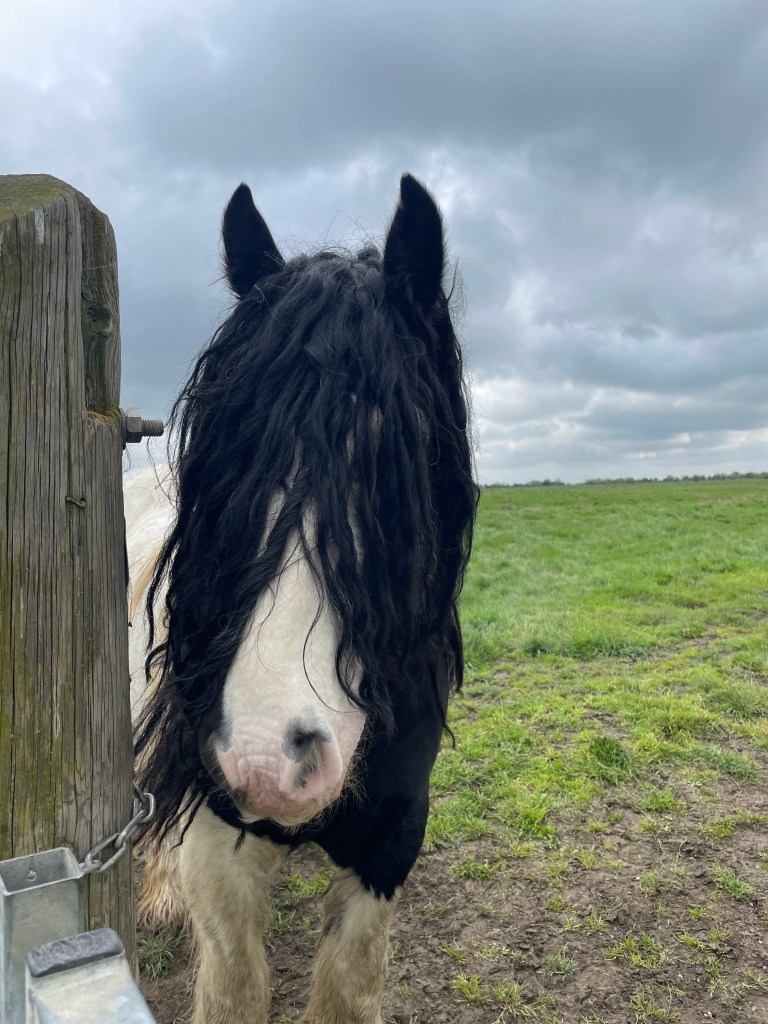
We saw no one else walking, but a couple of drivers took a bit of interest in us. The first one stopped his car so that he could shout a long and enthusiastic message of support, complete with lots of positive hand action. We decided that, as this was clearly a great place to waste enemies, that he was using us as potential alibis. He might well have been responsible for some of the disposable gloves. A few km later, a jeep overtook is up a hill and the driver jumped out, asking if he could take our photo, as his web site publicised the Magna Via Francigena pilgrimage. Or at least, that’s what we thought he said. There was definitely something about his web site in there, but it would have to be really specialist for a picture of two muddy tourists in walking gear for us to be the March calendar picture.
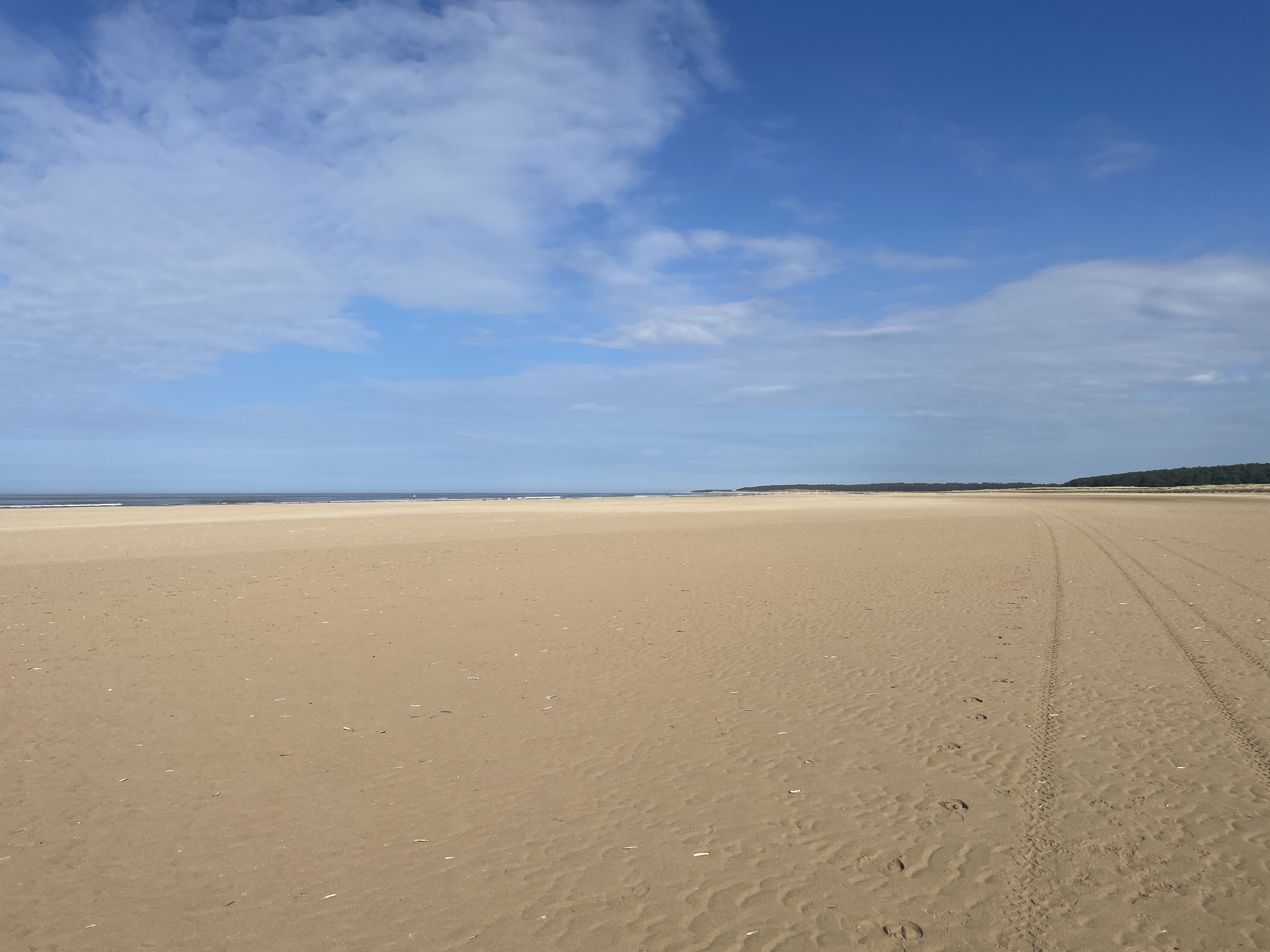
We saw a bit of wildlife, in the form of giant frogs, most of which had been flattened on the road, and vaguely domesticated dogs, many of which decided that we were deserving of a lot of attention.

Sicily has a number of dog breeds, but we mainly drew the attention of the Maremmano-Abruzzese sheepdog. These dogs, which look like oversized white labradors, are bred to protect sheep, and to bark if they see anything out if the ordinary, which definitely included us.

Apparently they’ll also attack, if provoked, and will only stop once the shepherd calls them off. Frustratingly, we saw a great many dogs, and no shepherds. Mrs E read up about the dogs later and found articles suggesting they weren’t recommended for keeping as pets in towns and cities, as all they did was bark all the time. Which led, naturally, to a conversation about Solomon, a dog who we will always miss when we go away, but will wish he could shut up within minutes of getting home.

Finally started the long climb into Prizzi, and with about 1km to go a car pulled up and the driver jumped out, addressing us by name, which was a bit unnerving, until it turned out that it was Salvatore, who owned the Airbnb that we were staying at that night. He’d noticed it was raining and asked if we wanted a lift for the last bit, but we took a look at the state of each other and the cleanliness of his car and thought better of it.

We met up with him later when we’d arrived and it turned out that he’d been a driving force behind the Magna via Francigena route – he assured us that the worst of the mud climbing was behind us, and pointed us to the only restaurant open in Prizzi that night, a very brightly lit Pizzeria which turned out to be staffed and frequented entirely with cast lookalikes from The Sopranos. At one point, Christopher’s double came in for a takeaway, while Uncle Junior held court with dozen of his family. Truly bizarre.

Prizzi is one of the towns that had offered houses for sale for €1, to anyone prepared to live in them for a couple of years. In some areas you’d also get a grant of up to €30k to spend on the property, again if you committed to live there. Cammarata, where we were walking to next, had made headlines a couple of years ago by waiving the €1 fee. You get the dilemma when you go through the towns – these are idyllic places to live but there’s no work about, and an aging population. There’s some indication that the incentives might have drawn some younger people back home, but from what we saw, probably 90% of the houses were shuttered up, and of the few people we did see, they were even older than us.

Not that we actually saw any people on that day’s walk. We did 25km on a very hilly path, mainly through the Carcaci nature reserve – more beautiful views over the mountains and deserted forest roads as we climbed up to just under 1000m. All was well until the rain kicked in again, this time with some added wind, which soon turned ridiculously strong. By this time we were descending along a cliff road, with vehicle detours in place because of falling rocks. It was probably the only really scary part of the trip, and we arrived in Castronova, making quite the bedraggled entrance into the only bar in town, and immediately being ushered into a side room for the sake of the public good, where the barman brought us hot chocolate and cannola, and suddenly all was right with the world.

We were half way through the walk now, and were in fairly good shape other than Mrs E’s blisters, which hadn’t been helped by having the previous three days walking in soaking wet socks and boots. The next day was to Sutera, another impossibly pretty town surrounding the Monte San Paolina, and it was only 15.5km, so we thought we were in for an easy hike. In reality, it was another tough one, the initial climb up to Aquaviva Platini was a challenge, then followed by a long and very muddy ridge walk to the long road up to Sutera.

Worth it for the views alone though, and we were sustained by a long round of ‘Finding The Band In The Hardware Shop’, with winning entries including Sister Sledgehammer, Sheryl Crowbar, Paint Guns and Hoses, Barbecue Streisand, U Bend 40 and Earth Wind and Firelighters.

We stayed a couple of hundred metres downhill from Sutera, and again, there was only one restaurant open, which was a little way away. Our B&B host was appalled at the idea that we might want to walk to it in the dark, so she called the owner, Franco, and arranged for him to give us a lift. Don’t think we’d get that sort of service at home. Anyway, we got picked up in a knackered Fiat with no suspension left, and we’re despatched at breakneck pace to Franco’s restaurant, where we had the best antipasti we’d had all week, then the best pasta we’d had all week. We both almost fell asleep at the table, as we had to wait for Franco to finish his pizza deliveries and lock the restaurant up, but well worth it nonetheless, and to get us home at a reasonable hour, Franco went for a PB on the way back.

From Sutera to Racalmuto then – another long day punctuated by stunning views, and very lively dog interactions, the scariest one being with six loud and lively sheepdogs at once who seemed to be keen on herding us toward their sheep, then immediately away from them. More stunning valley views and with the bonus of decent weather, the walk took around 7.5 hours – Mrs E concluded that her cut off point, for future reference, was six hours, which I look forward to forgetting when we plan future trips. Todays best game was ‘Famous People In Hospital’ and winning entries included Urinary Tract Geller, Cancer Ian McKellen, Jennifer Canestan, Rib Separatori Amos, Gina Lolladentalbridgeida, The Monty Burns Unit, and my personal favourite, The Brighouse and Gastric Band.

As ever, it was another climb into Racalmuto to end the day’s walk, but this time into a town centre with loads of pedestrians and cars. We managed to find somewhere to sit and watch what was going on, as we’d not seen so many people in one place since Palermo. It turned out to be a funeral at the church in the town square – we were assured later that it was normally much quieter, and sure enough, when we sought out the only restaurant open a couple of hours later, there was nobody around. There was a bit of confusion at the Airbnb that we’d booked before then though – we assumed that when we’d been let in, that we had the whole flat to ourselves, and so set up camp in the kitchen. I offered to get our boots cleaned, as the next day was the last day of walking and was mainly on the road – we didn’t want to trudge a load of mud into our last hotel in Agrigento. So I set to, cleaning hopefully the last bits of clay in the kitchen sink, which took a lot more time than I thought. Just as I was getting to the end, there was a loud Ciao Ciao downstairs, and into the kitchen stomped a vision in leather trousers, leather waistcoat and a very stern expression, which turned pretty thunderous when she saw what I’d been doing in her kitchen sink. Going ballistic is an overused expression, but completely valid in this case, and for the first time since we’d landed in Sicily, I was very glad that I couldn’t understand Italian. I did, however, get the gist, and apologised as much as I could, and also established that there were two other parties taking rooms in the apartment and that the kitchen was only to be used for breakfast. Cruella, who Mrs E had named within seconds of meeting her, was in charge of breakfast, which unsurprisingly the next morning turned out to be a rather spartan affair. But completely served us right.

And so to the final day, a short (11.5km) hike up to Grotte and then largely downhill on roads into Caldare, where we got a train into Agrigento. Still beautiful, particularly the start, but more houses, (mainly) chained dogs and litter as we headed towards the coast, so we were pleased to be able to get the train. We got into Agrigento and walked what Google maps had told us was 20 minutes to the hotel, and which ended up as 45. We really wanted to see the Valley of The Temples and were told at reception that it was a 15 minute walk, so Mrs R bandaged up her blisters and off we set for the last trek of the holiday. Unfortunately we took a wrong turning, ending up 45 minutes later at the wrong entrance, but that mattered a lot less as soon as we started to hike up the hill to see the temples. It would be worth going to Sicily just to see this archaeological site – it’s over 2,000 acres in size and is brilliantly preserved – The Temple of Concordia is the most stunning, and the one that you’ll see on the tourist sites – built in the 5th century BC and still looking pretty good:

We were knackered and ideally would have got in a bus back to the hotel, but there weren’t any buses or taxis, so we trudged up the hill back to the hotel, packed away our walking boots, popped Mrs E’s blisters, showered, and went into the restaurant to celebrate. It ended up being a bit of a muted affair, as we were both so knackered, but we still had a couple of days ahead in Palermo where we could get the right side of an Aperol spritzer or two, so we looked forward to that instead.

Next day, to the station and the train back to Palermo. Slightly demoralising to take 2.5 hours to cover slightly more distance than we’d taken six days to walk, but I guess the train had a lot less mud to contend with. And Palermo in the sunshine was lovely – really stylish and as effortlessly cool as many of the other Italian cities we’d been lucky enough to visit. An afternoon at the No Mafia Memorial was suitably sobering, but the Aperol was calling, and it was only a short walk away…