East Is East (again)

If me & Mrs E had a thing called a bucket list, then it’d be quite a long one. Incidentally, why is it called a bucket list? Well, fact fans, it’s because a screenwriter wrote a film based on his own list, which he’d originally titled ‘Things to do before I kick the bucket’, which then got abbreviated to ‘The Bucket List’. What you learn on the net, eh? But the reason our bucket list would be quite long is that there are so many things that we’ve not done that we’d like to do, so many places we’d like to see, so many hills we want to climb, so many bodies of water that we want to swim in, that it would be exhausting just making the list. And then we’d have to look at the list, and try to ‘achieve’ it, so we’d always feel like we were competing with ourselves. So, two things – we don’t have a list, and we don’t tend to go back to places, unless there’s really good reason. And our reason for going back to Japan (see here for the first time around) was very much in the shape of #3, and we both miss him more than words can say. Having said which, I’ll give those words a go, very possibly in the next couple of paragraphs.

Actually, saying ‘we’re back in Japan’ isn’t strictly true. We’ve just had a fantastic visit, and we’re currently two hours into a 14 hour flight to Amsterdam, which should allow a bit of time for reflection. We’re currently a couple of hundred miles to the east of Russia, heading towards Alaska and Greenland. Mrs E is watching a film to my left, and the Spanish guy to my right has just started snoring after a reading a chapter of Jordan Peterson’s latest book. So he’ll be good for a cheery conversation about populism and the death of late stage western capitalism a bit later on. If only I knew the Spanish for ‘my pronouns are…’  

And I’m listening to Abbey Road on some brilliant noise cancelling headphones that I bought for the equivalent of £30 in a Japanese shop where I was bowed to around a dozen times by four different shop workers. And I’m listening to that particular album because I downloaded it after our last conversation with #3, in a basement music bar where they not only allowed smoking, but actively encouraged it, where most of the drinkers there seemed to know #3 by name, and where there was a full PA and drum kit set up just waiting to be used, and where, according to #3, ‘they’re always playing the Beatles whenever I come in’. And as we made our way down the stairs, there were the first few chords of ‘Come Together’, and it felt like Abbey Road had been cued up for our arrival. 

And because none of us can ever say how much we’re going to miss each other, and how much we mean to each other, even though it’s our last night together,  we end up having a conversation about the Beatles. And it’s not one of those awful blokey factual conversations about how George Martin positioned the microphones just so, to pick up the guitar feedback; or Mal Evans’s contributions to ‘Maxwell’s Silver Hammer’; or the meaning of the numberplate on the front cover; no, this one is about the music, and the point at which the segues work, and the way that the album showcases four different talents in a way that none of the other Beatles albums really do. It’s a lovely conversation that lasts as long as the one beer that we’d promised each other, and I find myself looking at him, not for the first time, just in awe of how perceptive and funny he is, and how that funniness masks a deeper thinking that must be really hard to articulate in a different culture. And then, just as ‘Her Majesty’ fades out and the barman puts on a Weezer album,, which couldn’t be a better cue to leave.

And then it’s time to say goodbye, thankfully only until Christmas, and as we’re saying slightly rushed goodbyes at the subway station, an ambulance speeds past, and Mrs E has a bit of a wobble, about what would happen if he was ever taken ill. And somewhere in all of that is the reason for missing him; we’ve actually spent more time with him over a concentrated period that with any of his brothers in the last couple of years; they’re all living their own lives and there’s a few hundred miles between us all in the UK. But with this one there’s the fear of how he’s able to manage his own happiness in a world where he can’t really share his emotional thinking. Does that make sense? I guess what I’m saying is that there were little bits that evening where the three of us just tuned into the same wonderfulness of shared music, like on ‘Carry That Weight’ when it cuts into ‘The End’, or the bit where the gap between ‘Polythene Pam’ links to ‘Bathroom Window’ by Lennon shouting ‘Oh Look Out!’, where we can all agree that it’s genius, but it’s hard to encapsulate why, and it’s hard to imagine how he’ll tune into that with other people – even if his Japanese was perfect, that lack of a shared cultural reference might lead to a dissatisfaction. And then he might not be able to live his best life, whatever that is. And that, in a very roundabout way, is at the heart of why we’ll miss him.

But let’s get back to Japan – there’s some stuff we saw and did that was amazing, and some observations that might be old hat…but who cares – you can always skip past them if you’re bored.

What we did…

Get to Osaka, and like the old hands that we are, jump on the Haruka ‘Hello Kitty’ themed train to Kyoto – spotlessly clean and on time, of course, head across to Kyoto to meet #3, and he looks so tall and healthy, he’s been looking after himself and he can’t stop grinning and neither can we, and it’s all rather wonderful. We stay in a hotel next to his flat so we can store our bags at his while the three of us fly to Sapporo, which is about as far North as you can go without ending up in Russia, and where we get to meet #2, who is 3 weeks into a month-long trip in Japan, so we get to hang out with the four of us, hiking, sightseeing, running, and just being in each other’s company for a few days. A day trip to Otaru, which is a bit like a mini Disneyland in the middle of an industrial town. We wandered off the beaten track a couple of times and found ourselves in about the least Disneyland place you could imagine. But #3 found an Anpanman character for his rucksack, so well worth the expedition. 

There seems to be a fascination in Japan for old music boxes; especially the ones that play big metal disks against a strung mechanism. There are a couple of museums/shops in Otaru that have lots of these on display, often with very creepy Pierrot figures rotating to plinky sounds – Mrs E declared the shop we went to as possibly the creepiest place she’d ever been to: 

A strange last night in Sapporo, where we find ourselves at a fabulous frantic restaurant being run by one elderly woman who was doing everything, then spilled out to find ourselves outside the Atomic Cock Tattoo Parlour, which, fortunately was closed, and then escorted by a complete stranger, who’d taken a shine to #3 (and to me, once #3 had lied to her that his dad was a personal friend of Harry Styles) to the beautifully named ‘Bar Foul’, where we were the only punters, and the only non-Japanese sign asked patrons not to throw up in the bathroom.

Back to Kyoto, and a goodbye to #2, so he can start his new job, which is going to be a bit of a contrast to how he’s spent the last four weeks, hiking in rural Japan with only a couple of words of Japanese and his winning smile to get him through.

A few days in Kyoto where all of my Duolingo Japanese deserts me, and the only thing I can remember is (Watashi wa nihonjin desu) (I am Japanese) which got a few polite laughs but didn’t really help beyond that.

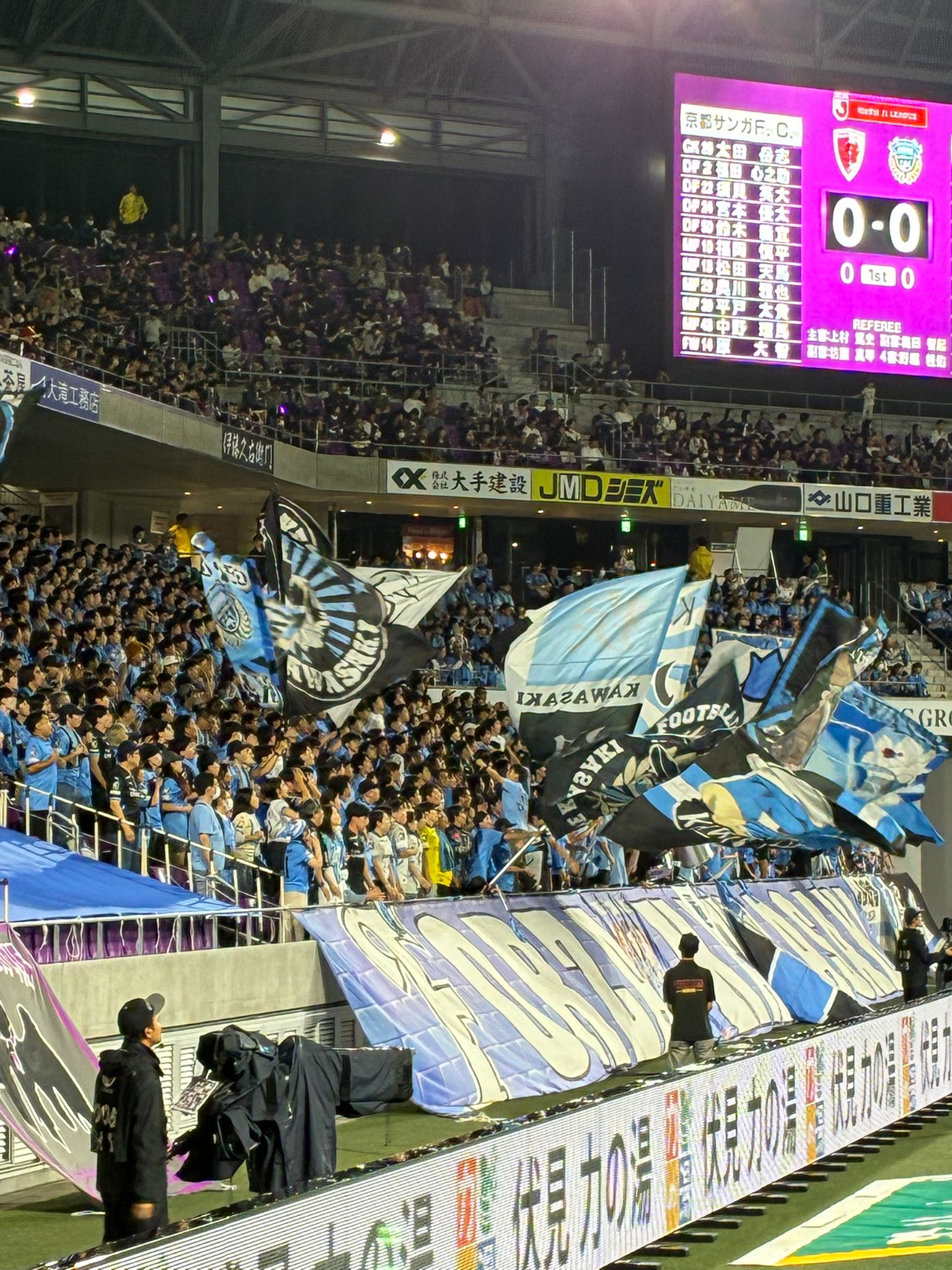
A visit to a football match, Kyoto Sanga at home to Kawasaki. Now, I go to Carrow Road to see Norwich play every home game – a penance that no-one really deserves, but there’s a comfort in football that I might have tried to describe on these pages before. Carrow Road holds just over 27,000 people, and on a good day, will be a noisy, shouty, exciting and chaotic place to be. Kyoto’s home ground holds 5,000 less fans, and has an atmosphere that you’d expect from a stadium twice its size. Twice the noise of Carrow Road, and probably ten times the effort put into making this an exciting place. Every seat sold out, home fans pretending to be ultras at one end, and at the other end, fully a third of the total seats filled by travelling Kawasaki fans. (Note at this point that these two cities are about 5 hours apart by car – that would be like Norwich Fans taking about 10,000 to Middlesbrough on a Friday night, which has never, and will never happen). The game itself was not overly exciting, but the fans at each end didn’t stop jumping and singing (all in perfect unison) for the whole game. At the end of which, all the players went around the pitch applauding the fans, before lining themselves up in front of the directors’ box, and bowing in unison. And afterwards, everyone filed out without pushing fans from each side shoulder to shoulder, and all carrying their own litter, which everyone queued up to give to the stewards holding bin bags on the way out. Norwich are at home to Bristol City on Saturday, and, although I’m looking forward to getting back to that dirty, grubby untidy match day experience, I can’t help feeling that I’ve recently experienced how it could be done – maybe any British football club exec who claims that it’s all about the fans should whisk themselves off to the Japanese leagues for a view on how fans actually like to be treated.
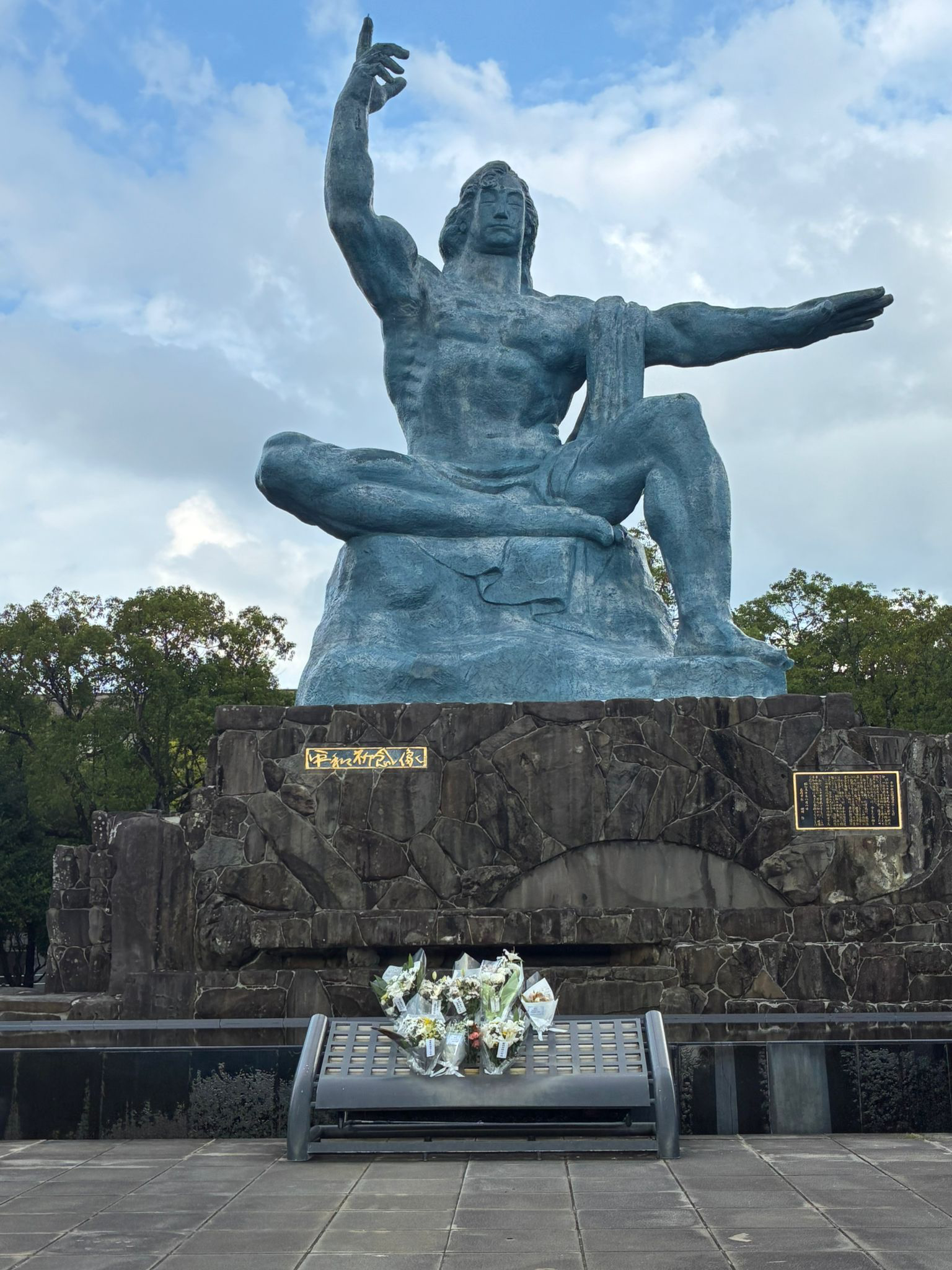
A couple of day trips to Kobe (wonderful, calm, non-touristy) and Osaka (manic, and crashing a party for one of #3 friends, at least one too many drinks for us all), then, having spent a fair chunk of change on the Shinkansen, south to Nagasaki, where we found ourselves in the middle of a three day festival of dragons and quarter size ships being paraded by enthusiastic monks through the busy streets. Tried not to look too hard at the food stalls, which seemed to specialise in sea creatures on skewers. We later learnt that we’d missed the real festival food favourite, which involved cramming as many quails eggs as possible into the inside of an octopus. Wandered around the Peace Park and the Peace Museum, which was quite sobering, and hiked up to the top of Mount Anasa to see the views over the city; we could see where the bomb had dropped and the destruction it must have caused – although Nagasaki was the secondary target for the second bomb (the drop on Kokura had been abandoned due to cloud cover and smoke) – it was effective in the same way as Hiroshima had been – both cities are surrounded by mountains, so the radiation was contained.
Nagasaki was really important as a manufacturing city as well, and that had partly come about through the semi-colonialisation of the city in the late 1800s, by shipping and manufacturing entrepreneurs like Thomas Glover. It’s worth wandering around the Glover estate if you get the chance – it overlooks the city from the other side to Mount Anasa, and is presented with quite a bit of affection and respect for the families that came over and made a bundle from Japanese trading. And when you’ve done looking at colonial style homes built by Japanese carpenters, and tropical gardens on the Glover estate, then you can head to the waterfront and visit Dejima, an artificial island which has now been absorbed into the port area, that was set up as a trading post, initially for the Portuguese , until the mid 1600s, and then the Dutch, who ran it until 1858. Again, colonialism presented with some affection, which felt a bit odd, as those words don’t normally go together but there’s (I think) a genuinely positive feeling about how Nagasaki managed to assert itself through western links as Japan developed into the twentieth century.

Back to Takeo-Onsen on the Shinkansen – we’d decided to stop for the night, based on the promise of a wood panelled hotel, and after a certain amount of searching, found it, just outside what the roadsigns called the ‘Hotel Town’. Wood panelled it was, and featured a number of items that would have fitted well into Mrs E’s ‘creepiest place’
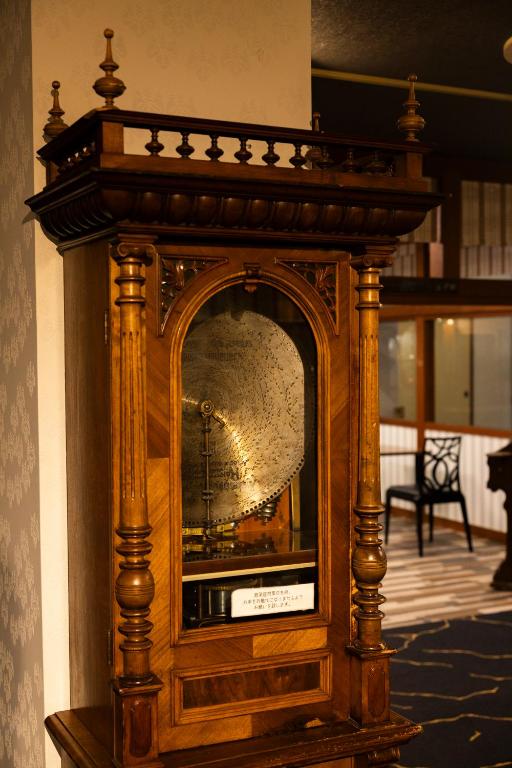
It was, by any definition, a strange hotel. And made even stranger the next morning when I popped down to reception to get a coffee, to be accosted by a Japanese lady, well into her 90’s by any stretch, offering to DJ on one of the decks for me. Again, my Japanese failed me, and I must have given the impression that I thought that it was a good idea, and a full music box orchestration of ‘Rule Britannia’ was soon filling the ground floor at no small volume. If I could have ‘made my excuses and left’, as the Sunday papers used to say, I would have done. Instead, I just left. But even now, I can still hear that tune…

Back to Kyoto then, a couple of days decompressing from the Japanese Mrs Overall and her peculiar brand of morning entertainment, and then a last night with #3, which brings us back to the start of the blog.

So, if that’s what we did, what about the pithy observations?

  1. Americana is still writ large, but it feels like it might be fading…

Every city has a collection of secondhand/vintage shops where you can mix and match your eclectic wardrobe from a selection of tatty American castoffs. There’s an awful lot of western tourists in these shops, which makes a bit of sense when you look round and see Japanese people wearing much plainer or neater fashions. There are a few gothy and punky types wandering about, but American fashion is far from mainstream. As with most things, there’s a value in authenticity, and you don’t get the bargains that you might have found in the past – I saw a pair of brand new shrink to fit 501’s in a glass case in a shop in Nagasaki, prices at a cool ¥149,900 (about £750). Not my size, unfortunately. And for all the falling out of love with Americana, there was queuing round the block for Onitsuka Tiger trainers, which were more expensive than in the UK…

  • The way of the Onsen

We returned to onsen life like we’d never been away, public baths in Kyoto, hotel onsens in Nagasaki and in Takeo-Onsen. Towards the end of the holiday, we were averaging a couple of onsens a day, alternating between hot and cold baths, saunas and sit down showers. We reached a state of cleanliness that I suspect we’ll never get again. If you’d rubbed your thumb against our arms or legs, it would have made a squeaking sound. Once you get used to the idea that this is Japan, so you have to avoid eye contact and still not look in the wrong place in a room of naked people, you’re fine. And don’t have a tattoo. And if you have to carry a modesty towel, don’t let it touch the water. And use a mat to sit on in the sauna. And wash yourself with cold water from a bowl before going in the cold pool. And wash down the sit down shower area before and after use. And don’t speak unless you’re spoken to. Honestly, it’s fine. 

  • Litter

There’s still no litter. I thought this was amazing first time round, and got to observe it a bit more this time. It’s not that litter doesn’t get produced – if you eat food from the combini convenience stores, for example, there’s loads of packaging – but there are very few bins and in the parks on the cities, so if you end up with some rubbish, you just put it in your bag and take it home to recycle. 

  • Trains

The four of us were travelling on the subway on #2’s last night, one of us made a joke that made all of us laugh, and an elderly Japanese lady shook her finger at us, and pointed to the sign that said no talking. Really embarrassing stuff, so much bowing and quiet apologising, but the point was well made. You don’t travel in Japan to make a noise and potentially annoy other people. You just get on with the journey in your own world. Apart from the Shinkansen, there’s no eating or drinking on the trains. And of course, no litter. Once you’re on the big trains, it’s like getting into a business class plane seat, and of course, they’re really comfortable, and spotless. We got a connection between Shinkansens on the way back from Nagasaki to Kyoto, so got to see the train being prepared. One cleaner per carriage, every tray table taken down, cleaned and dried then put back, then vacuumed everywhere – each carriage got the same treatment and it probably took about twenty minutes, just for the one hour shuttle to Hakata. And let’s face it, you’re not going to litter something that’s been looked after that well anyway, are you?

  • About the language. 

I made a commitment to learn a bit of Japanese so that I could at least try to say something other than thank you. I’m rubbish with languages so at least I didn’t disappoint myself – I am nearing the vocabulary of a toddler but have no idea how sentences fit together and my comprehension is still non existent. But there’s something straightforward about sounds with meaning that make up a language, even if they don’t always obviously fit to any of the three indecipherable alphabets. Kyoto (Kee yo to), for example, means big city, as it was the original capital of Japan. Tokyo (to kee yo), means city that’s big; it took over from Kyoto as capital in 1868. So there’s a logic there – getting to grips with it so far has been impossible, but I can’t help feeling it’s worth persevering.  

  • Toilets

It was a truly sad moment when, a few minutes before boarding our plane home, that I had my last sit down on a Toto Washlet. This was just for old times sake really, I didn’t need to use it, but I just wanted that nice warm feeling on the tops of my legs, and to hear the wand come out to give me a little colonic irrigation with some delightfully warm water. Honestly, if I lived in a house that had a Toto installed, I can’t see that I’d get anything else done. 

That wasn’t the paragraph I wanted to end on, so here is a bit of final thinking – we will definitely head back to Japan, not just because #3 has extended his contract for a further year, but because we’re developing a real taste for even a light improvement on our understanding. And as you get a bit more knowledge, you begin to realise what you don’t know – I know next to nothing, for example, about history, politics, nationalism, language or literature from Japan. No ambitions at all to become an expert, but I know that getting to have just a little more understanding might be a lot of fun. So…back to the duolingo then. Shitsurei shimasu (possibly) x
In Search of the Perfect Boot

Our regular reader will be aware that the Emu’s past travel plans have featured, and occasionally been beset by, the hidden agenda of one of the participants. Last year’s excursion to Berlin, for example, necessitated a fairly unremarkable pilgrimage to a place where David Bowie had once drunk a cup of coffee, or the trip to Budapest in 2014 where I forgot to mention (or Mrs E wasn’t listening) that the Budapest marathon happened to be taking place the very weekend we were visiting. Or a trip to Venice where we spent an inordinate amount of time in search of the perfect boot. That particular mission was successful, and the perfect boot was found; Italian made, finishing just shy of the knee, inside zip and a heel perfect for both walking and, in an emergency, a stirrup.

But apparently, like so many things in our lives, the concept of the perfect boot changes, and these days, by all accounts,* TPB is made in Portugal, has a block heel, chunky sole, Chelsea boot style elasticated gusset and can progress upwards into either a short elastic sock or a finishing strap as required. A lot less horsey inspired, a lot more violent goth. It’s what every 58 year old woman is wearing this season.

And with this not very well hidden agenda in mind, we set off to Lisbon last week, leaving behind the sub-arctic conditions of the UK, hoping to catch a bit of January sunshine, some Portuguese culture, some gentle R&R, and, of course, to tour the many shoe shops that Lisbon has to offer.

If you’ve not been to Lisbon, see if you can correct that some time soon. It’s really relaxed, has some stunning architecture, the people are lovely and the food and drink is wonderful, particularly if you’re keen on sardines. And port. It has a tram system that crosses the town’s many hills, and which hasn’t been modernised since the 1930’s, and an underground and train system that makes sense, runs on time and takes you places for next to nothing. You wander from huge pristine squares onto cobbled alleys and into beautiful parks, up to fabulous monuments and into little bars which are more inviting than almost any pub I’ve ever been to. And it is host to a dazzling array of shoe shops, many of which we were lucky enough to spend time in.

We’d decided to make some inroads into the childrens’ inheritance by staying in a fabulous hotel in the centre of Baixa, which was great, as everything we wanted was on our doorstep, including trains out to Belem, metros in all directions, and a tram stop right outside. Plus dozens of decent restaurants and bars within stumbling distance, easy access to runs along the riverfront, and hundreds (probably) of shoe shops. The hotel was great, and offered a walking tour every day, so we spent our first morning getting our bearings around Baixa, which is beyond elegant – really wide streets and 5-6 storey blocks that lead into the squares, most of which have statues of kings on horses wearing big hats. (The kings, not the horses). The reason for the building uniformity is all due to the triple disaster of 1755, a story of bad luck that would have had the early Lisbon monarchy saying ‘Doh’ increasingly loudly. Firstly, the earthquake, on 1 November (All Saints’ Day), that opened up 5 metre wide fissures in the city centre. Naturally, the good people of Lisbon who had survived rushed towards the docks, as it was the only area of clear open ground, and witnessed the sea-river receding into the distance. Then, 40 minutes later (you may be ahead of me here), there was a massive tsunami which covered most of the city centre. Because of the earthquake, the candles that had been lit for All Saints’ Day fell and set fire to the parts of the city that hadn’t already been destroyed. Most of the central city was destroyed and almost a quarter of the population died. The recovery from this devastation was astonishing – the decision was made to completely clear the Baixa area and build new ‘Pombaline’ blocks, separated by 12m-wide roads and paths, and featuring anti-seismic devices based on flexible wooden structures. These were tested, apparently, by filling the squares with soldiers and getting them to march up and down to see if the buildings moved (or, presumably, fell down on top of the soldiers). And they’re the reason why there are major restrictions on changing any interior walls for shops or apartments. All of which means that it’s a pretty cool place to be, as it looks pristine, like it hasn’t been changed for 250 years.

It’s important on holiday to plan for how you aim to spend the week ahead, and I decided on the flight over that I should develop a taste for port. So, with an excited spring in my step, I led Mrs E into the hotel bar, and ordered a cider for her and a port for me. Mrs E had settled into a comfortable seat and was leafing quietly through the menu before jumping up and swearing fairly loudly. She’d found the page with port on, and objected that I might be spending €20 of her shoe budget on one drink. So the holiday plans were adjusted back to a much more reasonable €4.50 for a large Super Bock beer, and that set the standard for the rest of the break.

I could give you a day by day account of what we got up to for the next week, but I fear that would be even more tedious to read than normal. But we had a fabulous time and did a load of things…

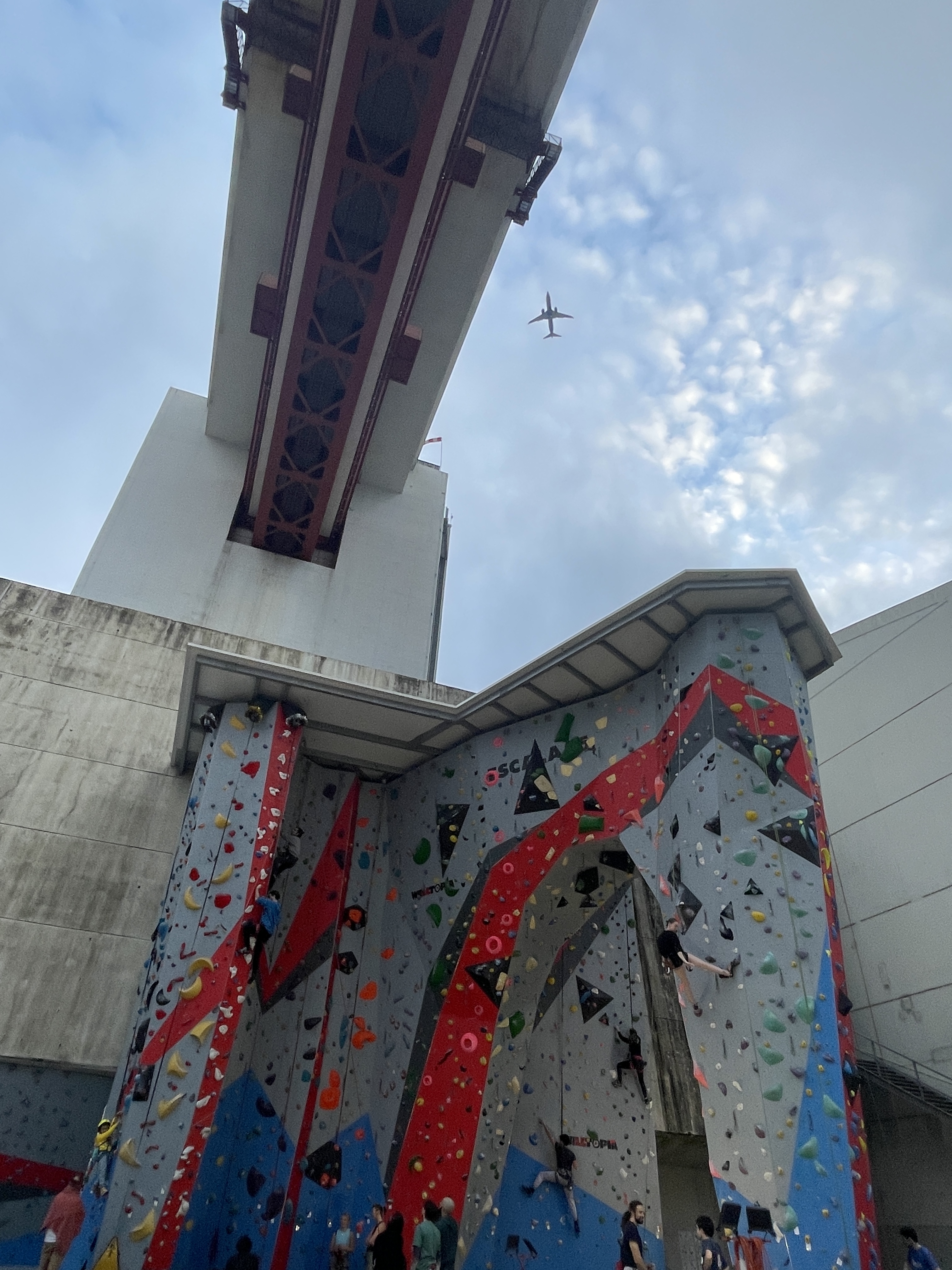
We mooched about Alfama which meant a lot of hill climbing in the rain, looking enviously at the warm dry tourists in the trams, but loving the cobbles on the hairpin pavements. We went to the Resistance museum, which told us that the 1974 revolution that had overthrown Salazar’s regime was just one in a long line of revolts dating back to the 14th century. We drank beer and cider in the fruit and vegetable market by the river. We headed for the National Swimming club, which boasted on Google of its outdoor pool which turned out to have shut down five years ago, so we swam in a huge indoor pool instead. We walked up to Estrela park and wandered around inside a huge deserted basilica. We queued up with all the other tourists to take the 28 tram from Martim Moniz to Campo Ourique, stopping occasionally to avoid hitting wayward pedestrians or delivery drivers, and rattling through tiny streets that were so close to the tram that the doors and windows of the houses would have to be opened really carefully. We walked to the foot of the suspension bridge, 1 km long, that connects Lisbon to Almada, and snuck into the climbing wall site, where we drank coffee and looked up at the climbers, grabbing the odd picture that showed climbers, bridge and a plane passing overhead in one busy shot:

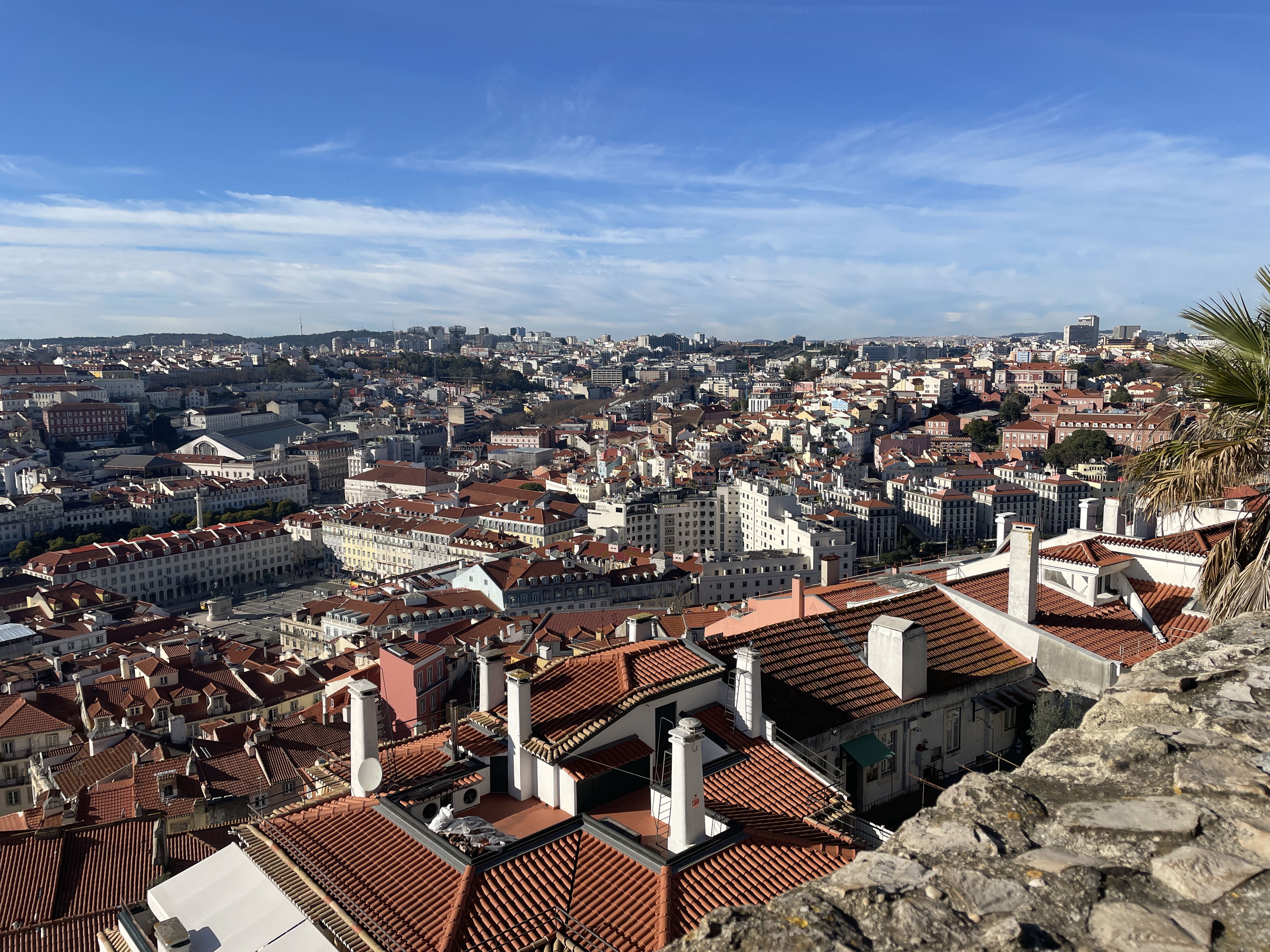
We went to the museum of Lisbon in the Pimenta palace, and learnt more about the early revolutions, and we headed up to the castle to see the fabulous views and stand where some of the pre-Salazar revolts had taken place:

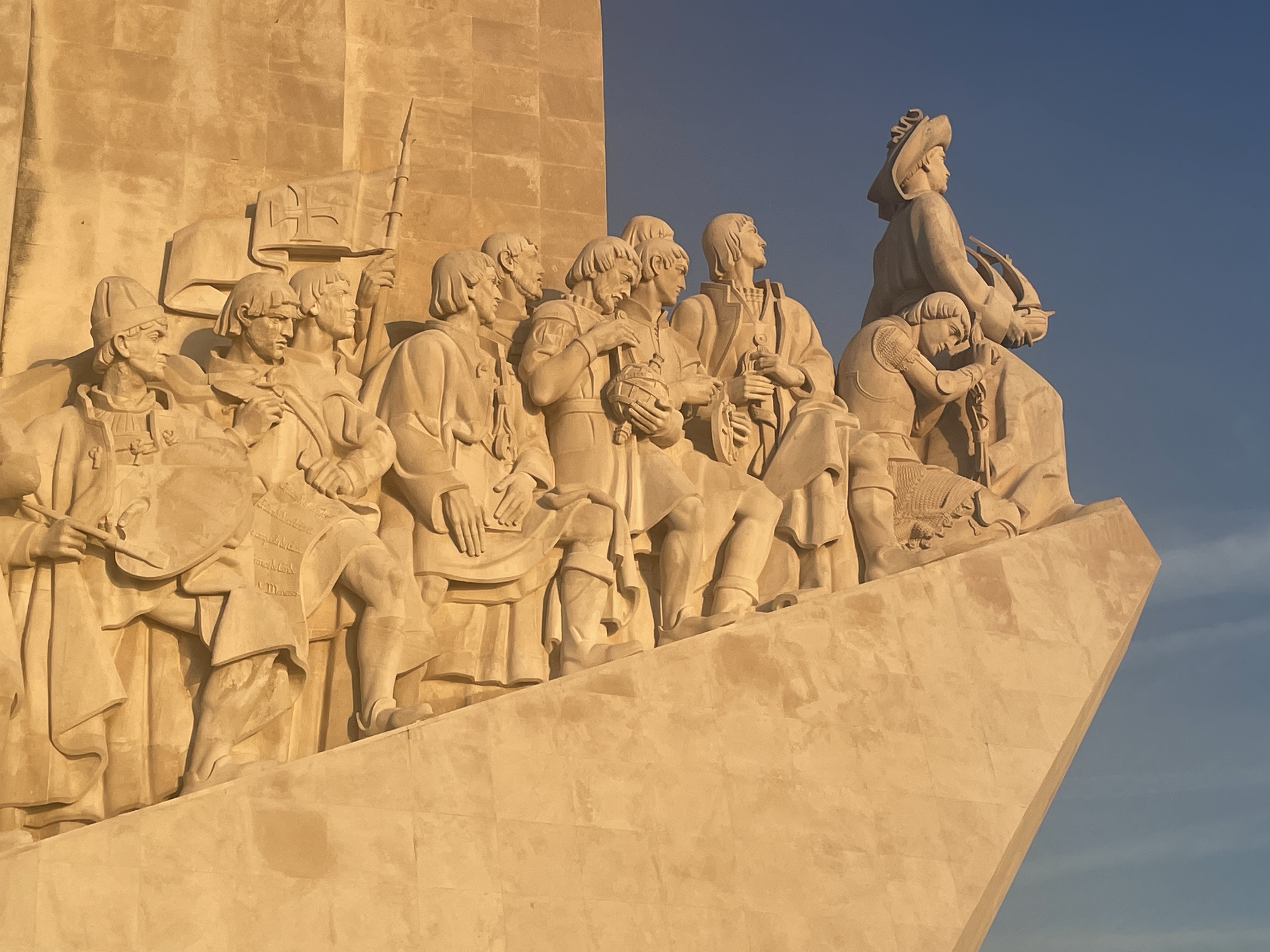
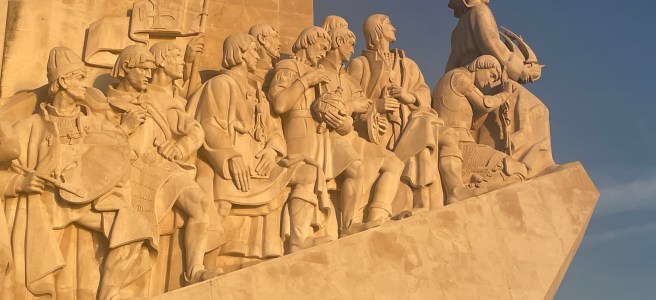
We took the train out to Belem to see the Discovery monument and Belem tower, where the King would stand watching for returning boats.

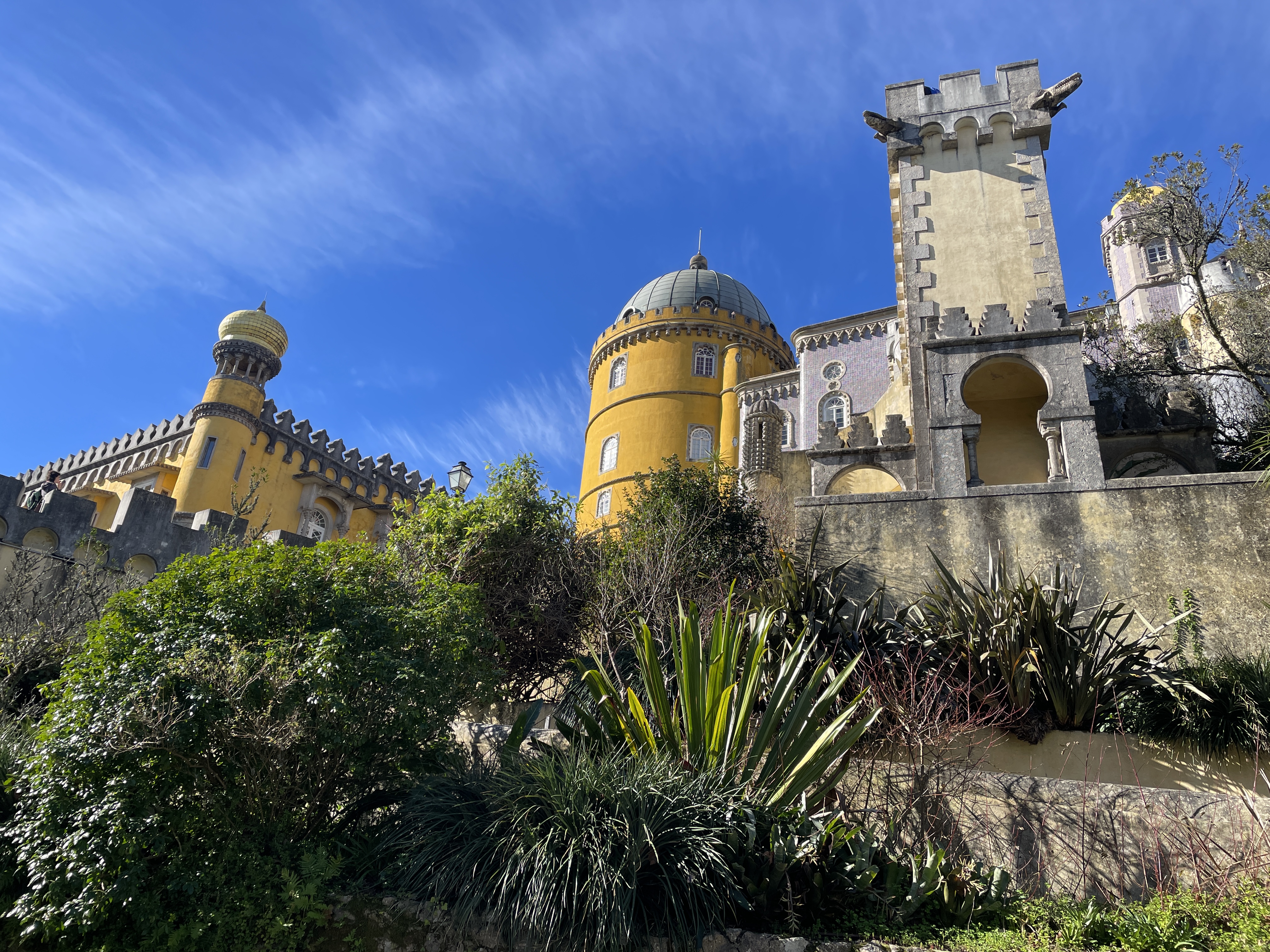
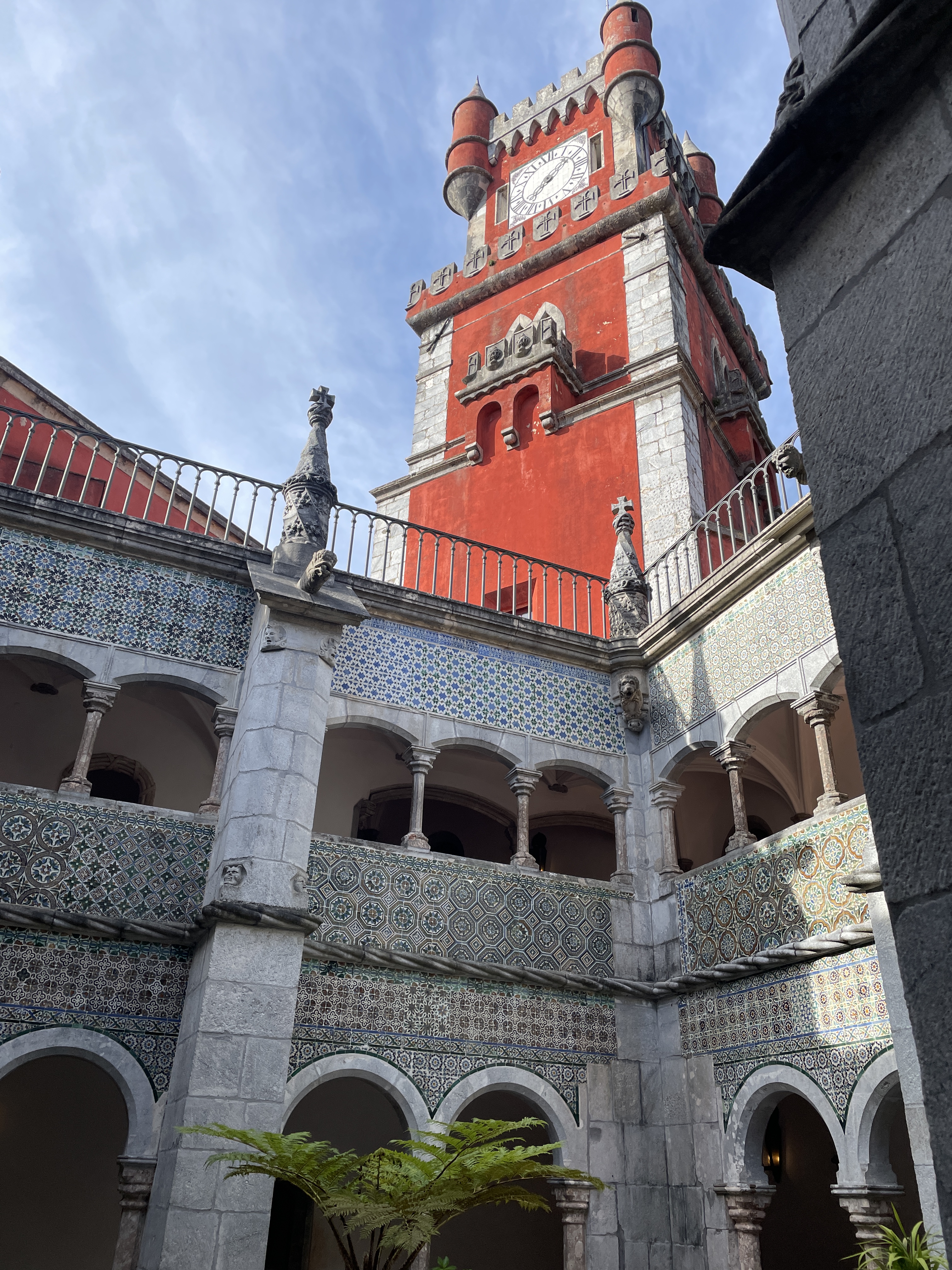
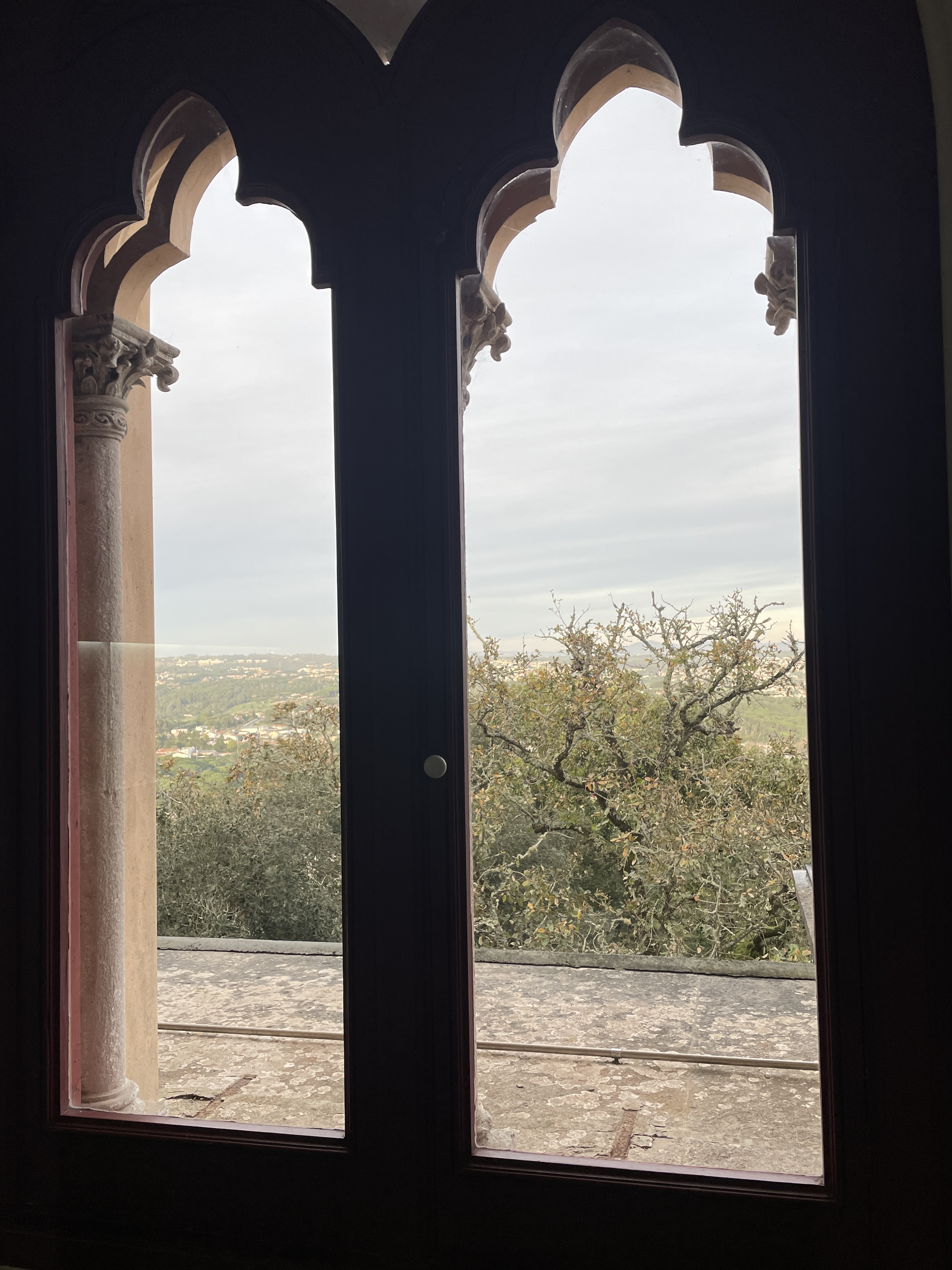
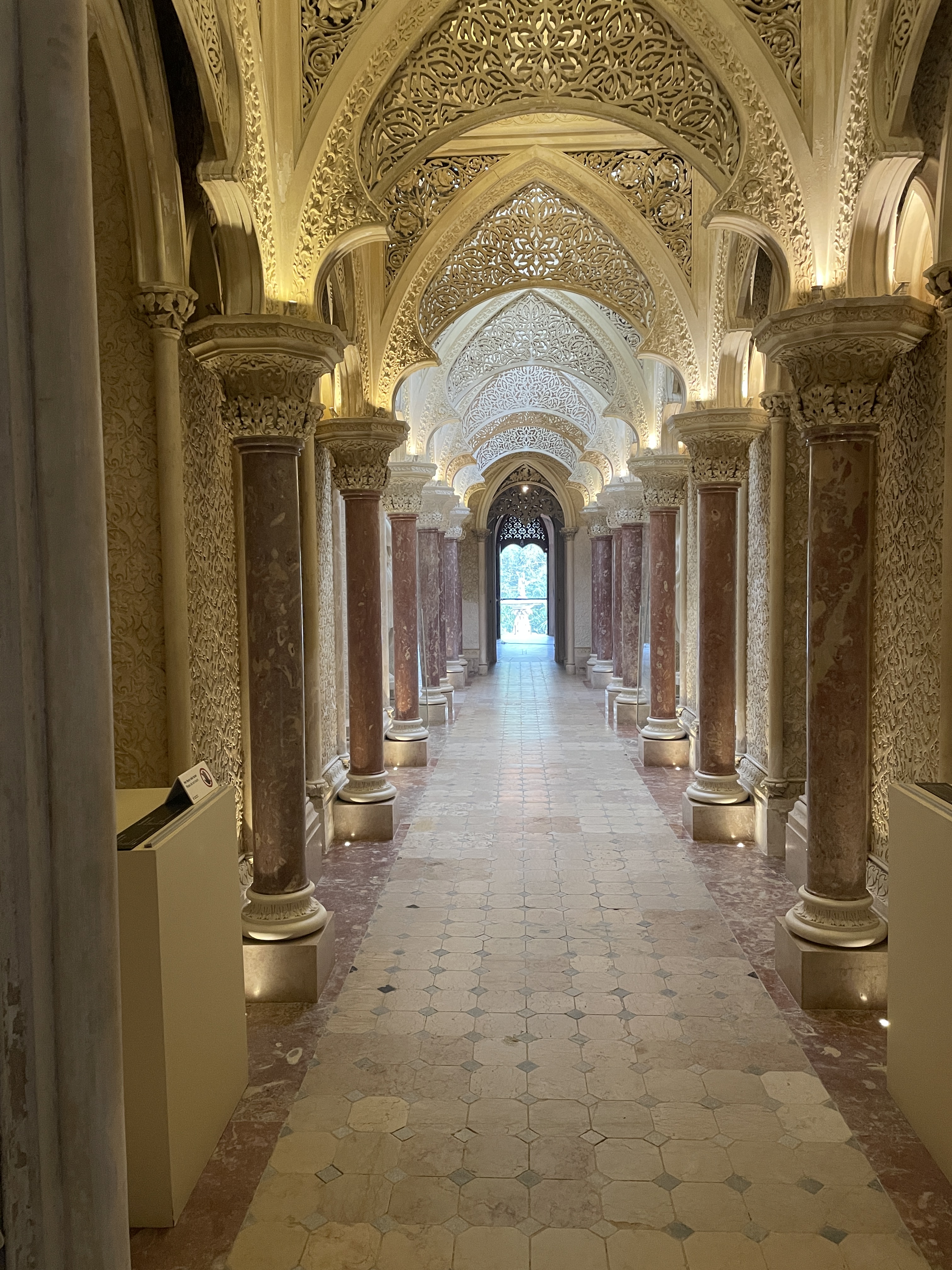
We took the Elevador Santa Justa to the Bairro Alto, then wandered down the cobbles again. And we took the train out to Sintra, first to the Palicio de Pena, striking a bold red and yellow pose on top of a stupidly steep hill, and then to the mansion at Montserrate, which was restored by Francis Cook in the late nineteenth century as a homage to romanticism, so you can’t move for stunning windows, tiles everywhere, internal galleries and Greek statues.

And we took another train out, this time to Entroncamento, to visit our friend A, who had come out here eight years ago, ostensibly for 3 months, but had just forgotten to go home. A seems to have landed an idyllic lifestyle amongst the orange and lemon trees, surrounded by dogs and horses, in a beautiful house that she’s converted from a very basic shell. We went for a beer on the way home to her local bar, where we were quizzed by other people on when we were planning to move out here, and we were tempted to say ‘quite soon’.

And in amongst all of these adventures, the spectacle of returning home without TPB loomed large. There are many branches of Seaside shoeshop in Lisbon, and we visited each one, hoping that TPB would appear by magic, in the same way that I used to go into record shops and hope that by going to enough of them, eventually I’d find that The Bible had released a third album. We got stunningly close near to Rossio Square, where Mrs E tried on an almost PB, but was put off by a man gently hovering nearby, who wanted exactly that boot in that size for his daughter. So Mrs E gallantly gave them up, declaring that they weren’t quite the fully PB.

And so Mrs E returned empty handed, or possibly empty footed. She didn’t seem too disappointed, already making plans to return in a few months to visit A to ride horses and walk dogs. Although I’m sure she’ll take in a few shoe shops on the way.

*note, when I say ‘all accounts’… that’s not necessarily what I mean

East is East

If I ever decide to jack it all in and pursue something vaguely creative, I’m going to become a photo journalist. And I’m going to spend all of my time at railway stations and airports, trying to create portraits of travellers at the end of long journeys, meeting people they’ve not seen for a long time, who they’ve missed deep in their stomachs for an age. There will be pictures of lovers meeting and embracing, of of mothers seeing their children and meeting their grandchildren, and maybe even pictures of people recognising their names written on those little whiteboards that drivers hold up at the airport.

And so it was as we dragged our way into Osaka airport – we’d been travelling for 36 hours with no sleep, but there, just behind the barrier, next to the official drivers holding up their whiteboards, holding up his own paper sign with ‘Mum & Dad’ on it, smiling the thousand watt smile that he’s had since his hair was cut with the aid of a bowl, was ⌗3. There are certain moments when you want time to stand still, where you want to bottle the sheer joy that you’re feeling right at that time , and this was one of them.

⌗3 had travelled out here in March, deciding that the world of medical magazine sales was not for him, and getting approved to teach English in a Japanese school near Kyoto. He went out with, by his own admission, the Japanese vocabulary of a two year old, and went to live in an area where he’d only be able to get by if he spoke Japanese. Mrs E and her friend have a saying that goes along the lines of ‘you’re only ever as happy as your unhappiest child’, and we were keen to know where he was, happiest wise, in a way that we weren’t ever going to get from video calls. And the answer seemed to be very happy indeed – he’d made a lot of progress speaking, writing and reading Japanese, his entertaining approach to teaching English seemed to have resulted in some fabulous feedback from his children and adult pupils, he’d made some Japanese friends, hiked different parts of the country on his days off, gone running most days in Kyoto, and generally seemed to be having a whale of a time.

And because of all of the above, he turned out to be the perfect guide – he had a couple of extra days off just after we’d got there, so in a delightful role reversal, he held our hands through the challenges of getting to our hotel, of finding places to eat, of talking to people on our behalf, of finding interesting places to go; so much so that by the time he.went back to work and we headed to Tokyo on our own, we realised just how lazy we’d been, having to navigate our way about in a city of 37 million people. But more of that later.

We spent the first couple of days in Kyoto, we’d transferred from Osaka on the Huruka ‘Hello Kitty’ themed train, which was, of course, spotlessly clean, on time, and, as it was the end of the line, a guard went into every carriage, pressed a button and the seats all rotated 180 degrees to face forward. Incidentally, guards on trains, after walking through a carriage, will turn and bow to the carriage and its occupants. Something you hardly ever see on Greater Anglia.

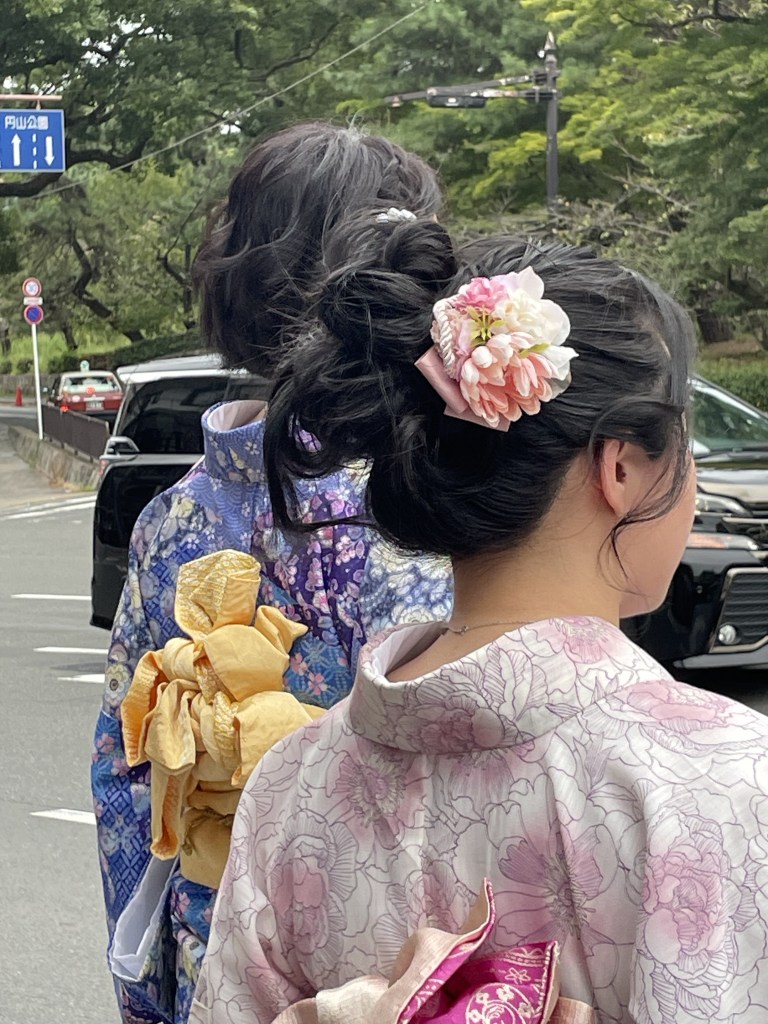
A slightly bizarre night eating Japanese pizza, drinking beer and holding hands with the boy; obligatory conversation about Arsenal (& Tomiyasu’s defensive qualities) with the Japanese drinkers at the table next door; then to a hotel for a jet-lagged sleep/non-sleep, before heading out into Kyoto the next morning. Wandered around Kyoto’s temples and shrines and back on the Philosophers’ path, which takes a route around the outskirts of Gion, the historical and slightly touristy district. Gion is also known as the Geisha area, and there are quite a few Geishas walking about – they take very short steps and never seem to travel particularly quickly – we weren’t really sure if that was a style thing or a function of wearing tight kimonos or ridiculous shoes. Gion does a roaring trade in kimono rentals – visitors seem quite keen on the idea of dressing up to wander about between temples, often as couples – as a result, it can feel as if you’re walking about between a series of traditional style newlyweds. Temple wandering was taking its toll just before Mrs E spied a French cider shop just off the Philosopher’s path (what were the chances?) so we got well and truly stung for a couple of miniature glasses of Normandy cider. ⌗3 took us to a specialist vegetarian restaurant that night after he’d finished work – a lovely experience, although the boiled tofu course, served with an enthusiasm and in depth introduction to the restaurant’s approach to tofu manufacture, including the white, green and brown varieties served in a temperature controlled soup dish, really failed to deliver. Effectively, it was like eating three different colours of cardboard – it may have been that our western palates were just not sophisticated to appreciate the nuances involved in tofu appreciation, but it could also be that boiled tofu is about the blandest, most uninspired food on the planet. Still, at least we ate it at optimum temperature. Back to Shimogyo, and to the Izakaya (bar) next to ⌗3’s flat, where he was welcomed like a homecoming king by the bar owner, the cook, and most of the regulars. He showed us a notebook of all the Japanese that he’d learnt from his trips to the Izakaya – what a way to learn! One of the phrases, which he was met with when he went in, was ‘Otsukaresama Desu’, which, roughly translated means ‘Thank you for your hard work’ – it’s used to appreciate anyone who has been at work, earning a crust, keeping the economy going, and for teachers, it’s a very different way of appreciation than what we might be used to at home. ⌗3, like all teachers, is referred to as a Sensei, which translates as ‘Master’, it’s the same for any respected profession. Another expression, by the way, when you want to state an amazing piece of good luck, or to say that a sucker is heading your way, is ‘kamo ga negi wo shottekuru’ which literally translates as ‘here comes a duck carrying a leek on its back’, ie just begging to be cooked.


Morning run to Nijo-jo castle with ⌗3, blistering heat (32 ° at 0800), followed by a walk up to it after a breakfast of Onigiri (rice balls) and coffee from Lawson. There are branches of Lawson absolutely everywhere – you never seem to be more than a block away from one, and if you can’t see one, then there are Family Mart and 7-11 stores which sell the same sort of stuff. They’re known as Konbinis – they’re open all the time and have reasonably decent food and drink which you’re encouraged to eat on the little tables inside the store. It’s frowned upon to eat on the street and definitely on public transport, although on every street, in every station and on the top of mountain summits, you’ll always find a vending machine. Normally drinks, including the weirdly named ‘Pocari Sweat’ sports drink, but also all forms of food, including pizza, souvenirs and toys. ⌗3 gave me a jar of marmalade that he’d bought from a vending machine in the middle of nowhere while on a hike. Despite all of this, there’s no litter anywhere. And no bins – if you have rubbish, you take it home. We walked and ran about in Kyoto for days and didn’t see any litter at all, and it was the same in Hiroshima and Tokyo.

Nijo-jo was worth a visit – it was the original Emperor’s palace, an elaborate structure with Japanese and Chinese painted walls in every room, and a system of status-based waiting rooms, all completely empty of furniture, as all meetings and receptions were held kneeling on the floor. The floors on the walkway around the rooms are made with an elaborate system of supporting joists, and the nails that were used move around when you step on the floorboards, so the building sings – it’s known as a ‘nightingale floor’. It was thought that the squeaky floors were there to alert residents of intruders, although the current thinking is that it’s a design fault. But we’re in Japan, where the idea of a design fault seems very unlikely.

Walked up to the Kiyomizu-dera temple, which was rammed with tourists, but worth it for the views back down over Kyoto and the stunning architecture – most of the buildings were constructed in 1633 and were made without using a single nail. And they’re still up, despite weather and earthquakes, and presumably don’t squeak. To the Izakaya with ⌗3’s friend W for food and more Orion beer in the evening. W is same age as ⌗3 and has already had a past life as an Indonesian Christian missionary before his current role as an engineer. And he’s a big fan of the truly awful ‘Mind Your Language’. So there was quite a bit to unpack there.

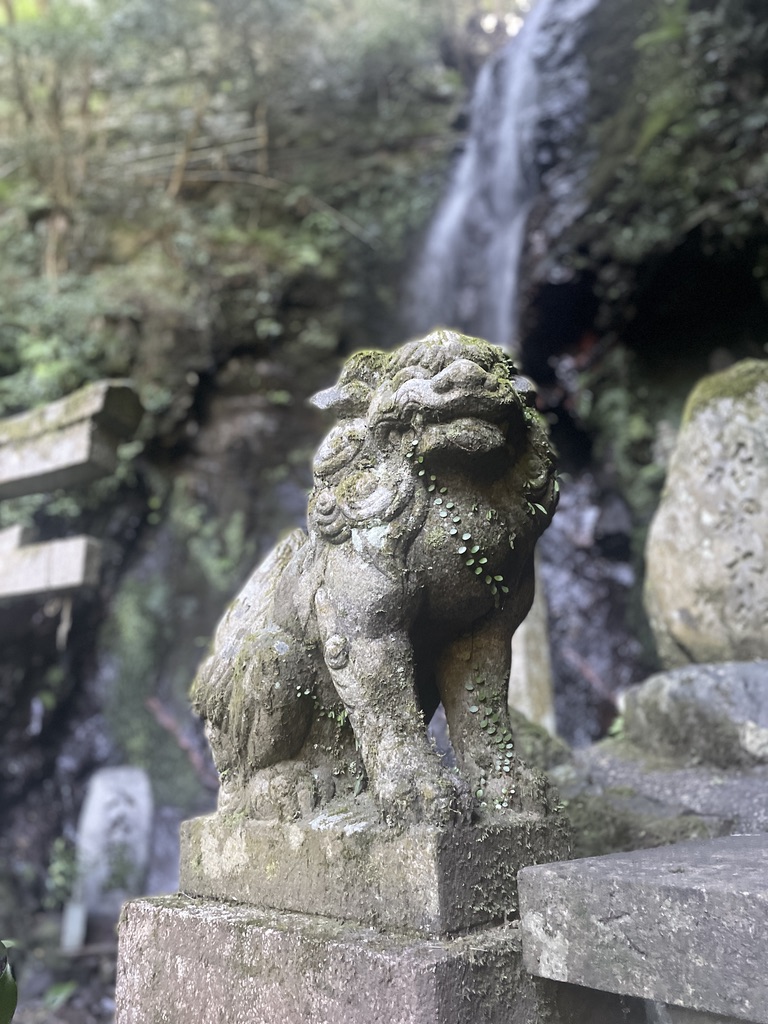
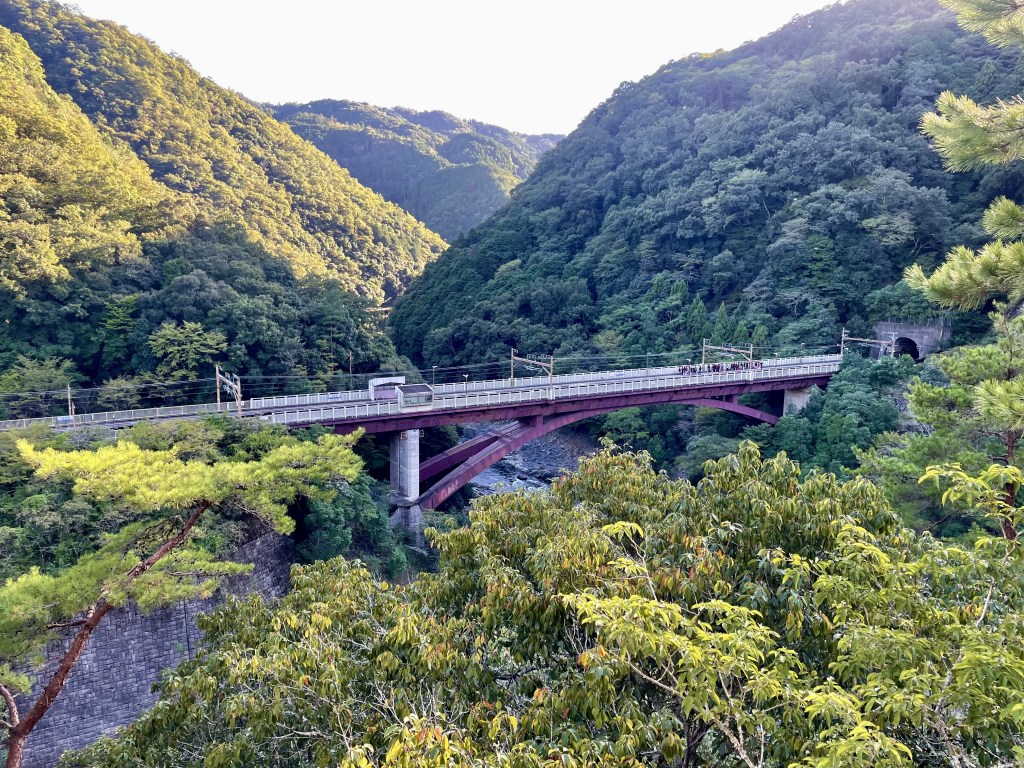
⌗3 had a couple of days off, so we spent the first of them hiking from Takao to Hozukyo – taking a bus there and a train from a stunning, if precarious looking, bridge back. The hike started near the Jinjuji temple, where we bought tiny karawake discs to throw into the valley below to cast away bad spirits, then hiked underneath (watching out for flying bad-spirited pottery) to see many more shrines, then to an amazing waterfall reached by hiking up through a small village that had been completely abandoned following a landslide. Fairly creepy, but ⌗3 had told us that he’d done this hike before, and got to the the waterfall where there seemed to be a strange cult ceremony, where an old man appeared to be anointing a series of nubile girls who’d been camping there – they all stopped and stared silently at him when he came into view. He’d done that hike on his own, so I think he was quite grateful of both our company and the cult-free status of the waterfall when we got there.

Back to Kyoto where we spent a reasonable chunk of ⌗3’s inheritance on tickets for the Shinkansen trains for later in the trip, then on to a fabulous restaurant in Karasuma, where we met ⌗3’s friend N, who was good enough to take over the fairly complex ordering process. Amazing food, including a forever soy stock that had been added to each day since the restaurant opened, and some fairly extreme sashimi. N brought us gifts, which made us both grateful and awkward, and mentioned that she had trained Olympic show jumpers and loved animals and liked running – almost as if she’d researched ⌗3’s parents for approval.

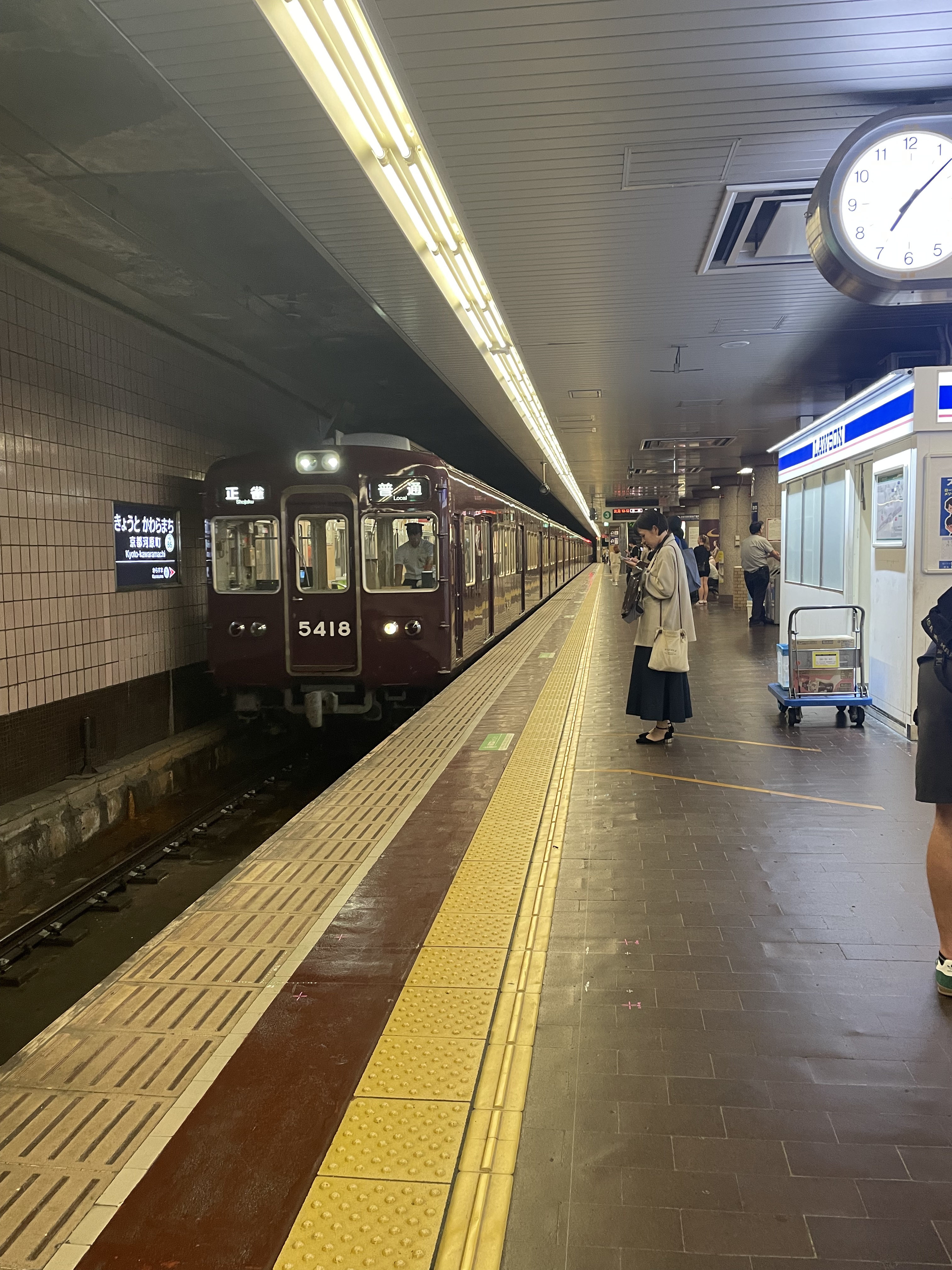
Took the Shinkansen to Hiroshima – the Shinkansen was something we really wanted to do – we’d both grown up hearing about the bullet train, so it shouldn’t have been a surprise to see the signs saying it was celebrating its 60th anniversary, but it was, as it just feels so new. And clean. And fast. The seats are like being on a really good aeroplane, similarly the carriages are sealed to avoid passengers hearing the sonic boom that the train makes going into a tunnel. The trains are controlled automatically and were built to avoid roads, so they just ping along at 200 mph on their wide gauge rails which also allow the train to lean without the carriages tilting. Even the bows of the train crew are a different class. And while we’re train-spotting, a quick shout out to the Hankyu line, running between Osaka and Kyoto – worth going on, partly because it’s delightfully retro in style, but also if you wait on the platform to wave to the conductor as the train leaves, he or she will lean out of the back of the train and wave back; not a stately wave, but a proper Japanese one; the conductors all wear white gloves and wave really quickly with their fingers parted, like cartoon characters.

I could go on. Maybe I will, another time. Suffice to say that if all you did when visiting Japan was travel about on the rail network, you’d have the time of your life. Actually, that ‘if all you did’ might equally apply to meeting Japanese people, using the bathroom or going to an onsen, but more of that later…

We only really knew Hiroshima from what we’d learnt at school about the war, and the constant re-watching of some of the post-bomb footage that was so much a part of growing up. So our association was with some harrowing images and real human tragedy. And so we were always going to start our visit by paying our respects at the Genbaku dome (the derelict shell of the only building that remained in central Hiroshima after the bomb) and the rest of the Peace memorial park. As you’d expect, the whole experience was sombre, respectful and challenging; it was definitely peaceful, but in an almost collegiate sense, hard not to be mindful of the people from all nationalities, but mainly Japanese, everyone with their own connection. ⌗3’s Japanese friend told us that almost every school in the country will organise a trip to Hiroshima once a year – there were loads of schoolkids of all ages, all in identical uniforms, being steered through the park and the museum in respectful silence – probably as impressive as the museum itself. The memorials in the park are really moving – one is to the students killed on August 6th; thousands had been ‘mobilised’ into the city to help with building demolition to build fire breaks against future bombings, so were all working outside – another is a memorial to the children who had been killed – many in their schools in the centre of the city. This statue is of Sadako Sasaki, two years old when the bomb dropped, and severely injured, and who died of leukaemia ten years later. She’d been inspired to fold paper cranes by the legend that if you fold a thousand cranes you’ll be granted a wish, so set out to do that, using medicine wrappers and paper given to her by other patients. So that’s why folded cranes became a symbol of peace; thousands of them are brought as gifts to the memorial each year.

Away from the peace park, we ambled around Hiroshima, still very conscious of its history, not least as every building has been put up in the last 75 years, but the feeling of peace and respect seems to have travelled alongside the rebuild – there’s more greenery than any other city that we visited; it’s got a peaceful feel about it which is really calming. Having said which, our quest for Hiroshima okonomiyaki took us to Okonomi Mura, where there are five floors of absolute chaos, where you queue to sit on a low stool and see a chef sweating over the griddle between the two of you. Probably the most disorderly way of getting a meal possible, least of all for three hungry people, so we opted out.

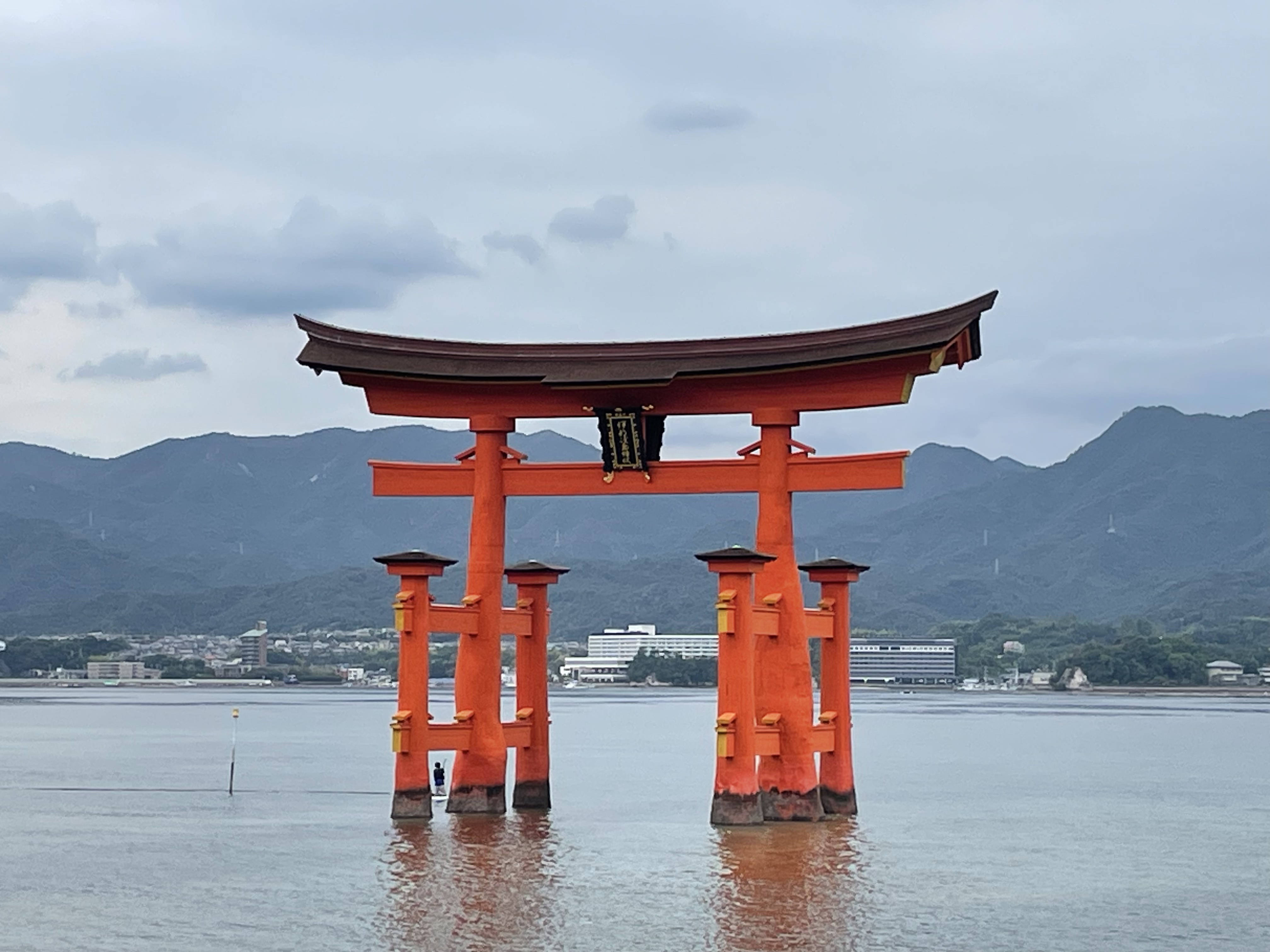
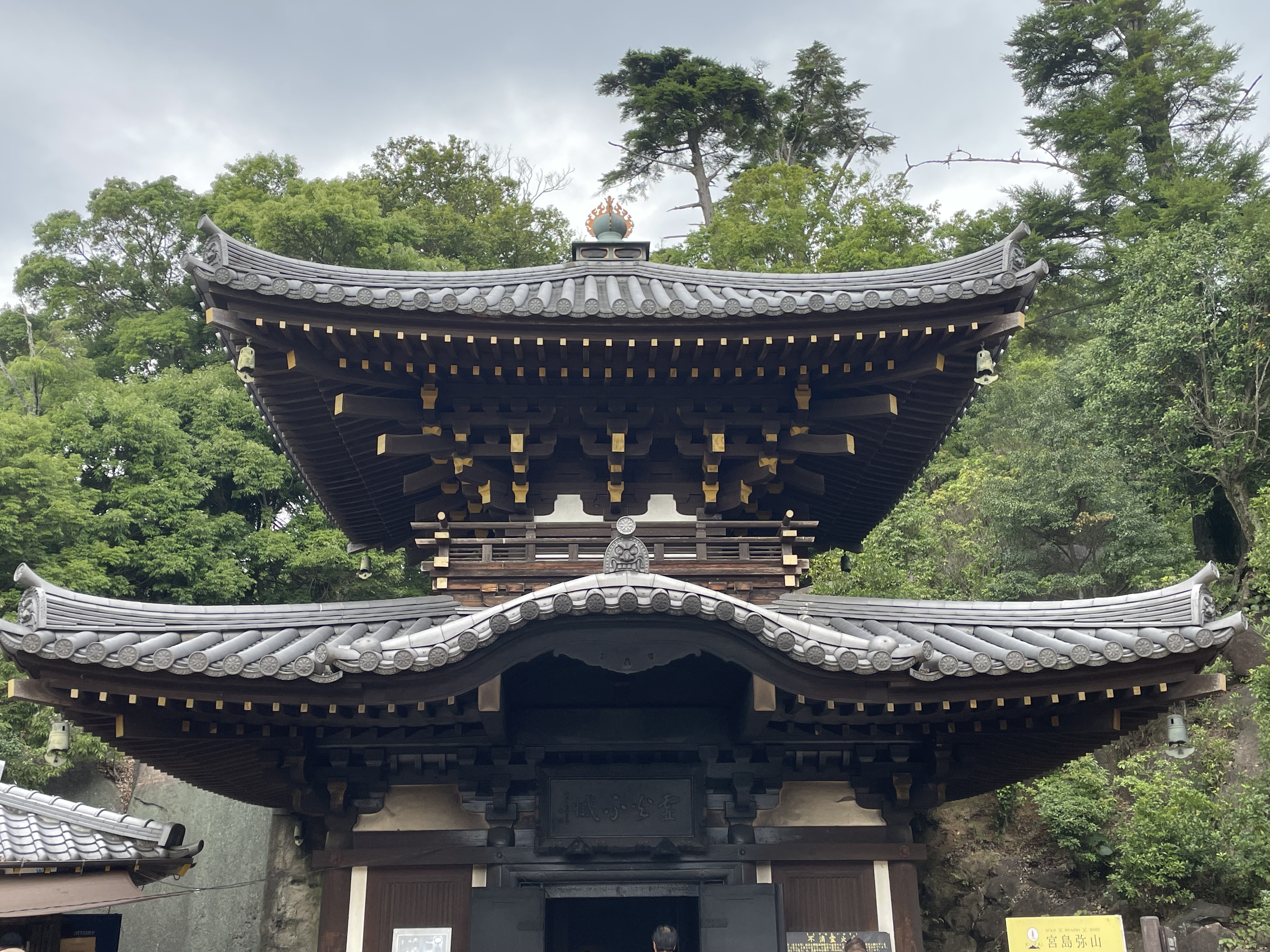
Next day, we took the ferry to Miyajima island for a trek up to Mt Misen. The ferry passes a ‘floating’ Torii gate in the bay, then you troop off onto the island, which is sacred, to the extent that apparently no-one has ever been born or died there. Hard to believe, as there were lots of people on the ferry, including kids going to school in both directions, and the hike to the top of Mt Misen is fairly arduous, although for the faint hearted there is a cable car (ropeway) to the top. We hiked up, which took a couple of hours, punctuated by shrine visits, amazing views, and treks through bamboo forest. Got to the top, wandered around for a bit, inspecting the eternal flame that had already burnt down a couple of shrines, then got the ropeway down to the port. Deer everywhere, especially around the port, where they’re quite keen on getting involved with your lunch.

Back to Hiroshima on the ferry for more wandering about, ending up at a Chinese vegan place where we ate mabo nasu and drank lemon sours made out of huge industrial Suntory optics. Wandered back to our hotel through what turned out to be the red light district – 8 story buildings with a bar on each floor. Had a couple of Suntory highballs in a meat restaurant, next to some sararīman (salarymen) who were cooking their meat on a central burner; plastic over their hanging jackets so they wouldn’t stink afterwards. We had a look at the menu out of interest, which included uterus sashimi & beef lung, which had a direct translation of ‘the fluffy texture makes it popular with women’. On the way out we were offered a selection of mints and chewing gum, which were probably quite helpful if your breath was stinking of uterus and lung.

Morning run the next day to Hijyama park, we were out at 0730 and mixing it on the roads with loads of kids in their neat uniforms pedalling to school. ⌗3 teaches kids as young as 4 through to high school and told us quite a bit about the school regimes that they have – pre school activities like swimming and athletics, school, then maybe a language class or two and more activities before they return home, sometimes as late as 10-11pm. Quite young kids take the train to school on their own, and each station on most train lines has its own tune that plays when the train stops so they know when to get off. ⌗3 sometimes has to wake up kids who are asleep on his train home from work if they’re asleep, and also has to deal with kids falling asleep in his classes if they’re at the end of a long day.

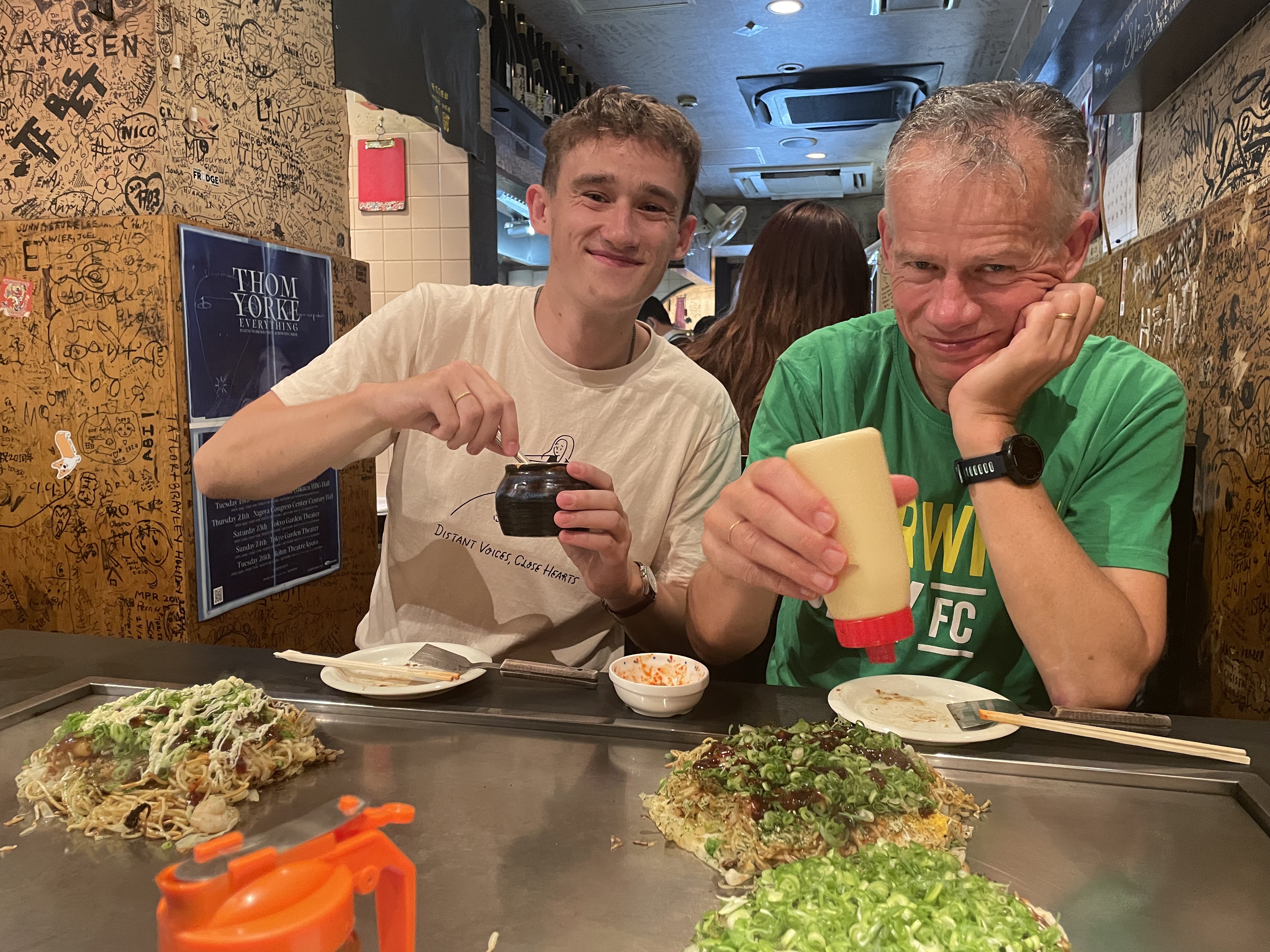
Toured around the faithfully rebuilt Hiroshima castle, then finally got our Hiroshima okonomiyaki – brilliant food – layered batter; cabbage; shrimp; soba noodles; seaweed; spring onions, (kewpie) mayonnaise; okonomi sauce (secret ingredient: worcester sauce); pickled ginger. All cooked in layers on a griddle in front of you, and quite a huge meal. When we got back from Hiroshima, ⌗3’s friend N told us that it was quite unusual for people to order a okonomiyaki for each person, information that would have been quite useful had we known it in advance of ordering. Theres a phrase in Japanese (hara hachi bun me) that translates as 80% full- eating to this level is considered a very good thing in keeping body and mind in good nick. You can read about this (and lots of other interesting stuff) in Adharanand Finn’s excellent ‘The Way Of The Runner’, all about the world of Japanese running. To the best of my knowledge, there’s no phrase for 120% full, which is very much how we felt after exiting the restaurant.

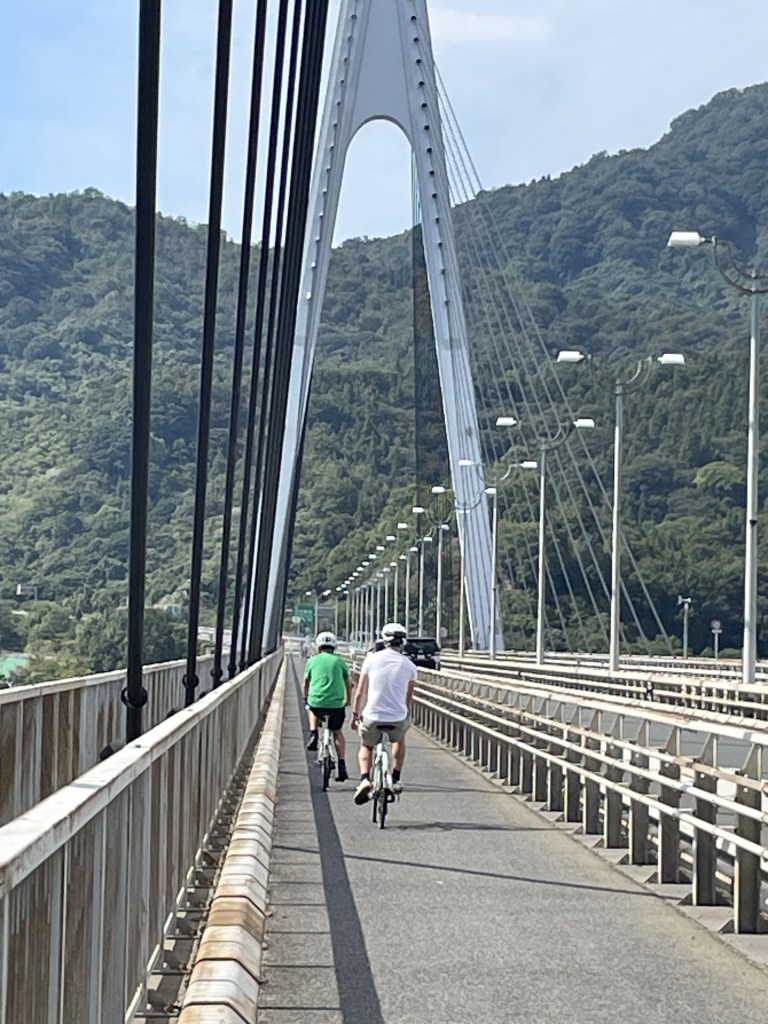
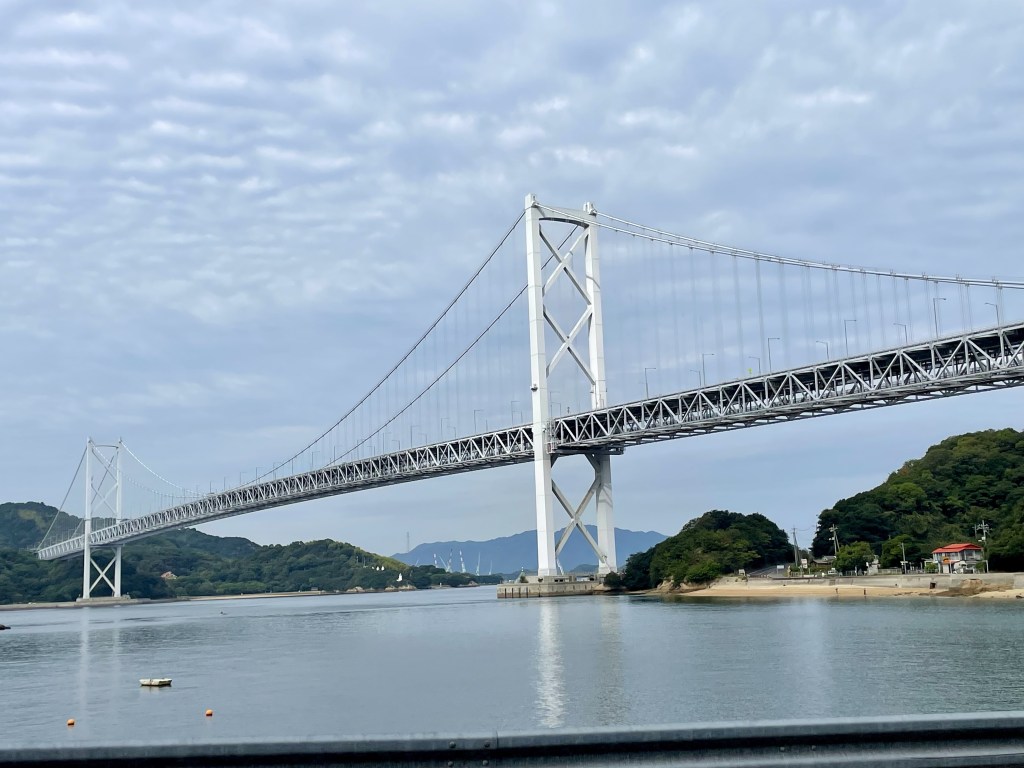
Took a train to Onomichi and found our hotel in the dark. We went there to cycle part of the Shiminami Kaedo route, which connects some of the islands south of Hiroshima. We rented bikes that were at least two sizes too small for me & ⌗3, then took an early morning ferry across to Mukaishima island with hundreds of school kids, then cycled across some spectacular bridges and across Mukaishima, Innoshima and Setoda, where we dropped the bikes off and caught another ferry back. It wasn’t a massive ride, but twenty miles on clown bikes felt like enough, and we needed to get back so we could get our Shinkansen back into Kyoto. But we managed to spend a bit of time in Setoda, – apparently the lemon capital of the region, and one of those places where everything follows that theme – if you’re ever in Japan and you feel the need to buy a lemon, a lemon fridge magnet, a lemon themed cycling shirt or a lemon cake, the do head for Setoda.

Stopover in Kyoto to pick up some clean clothes, then the Shinkansen to Tokyo – again, marvelling at 60-year old technology that whizzed us along at pace with loads of clean legroom. We’d got seats on the Mt Fuji side of the train, so it was a bit disappointing that it was so cloudy, but we would have passed it so quickly we might not have had much of a chance to see it anyway.

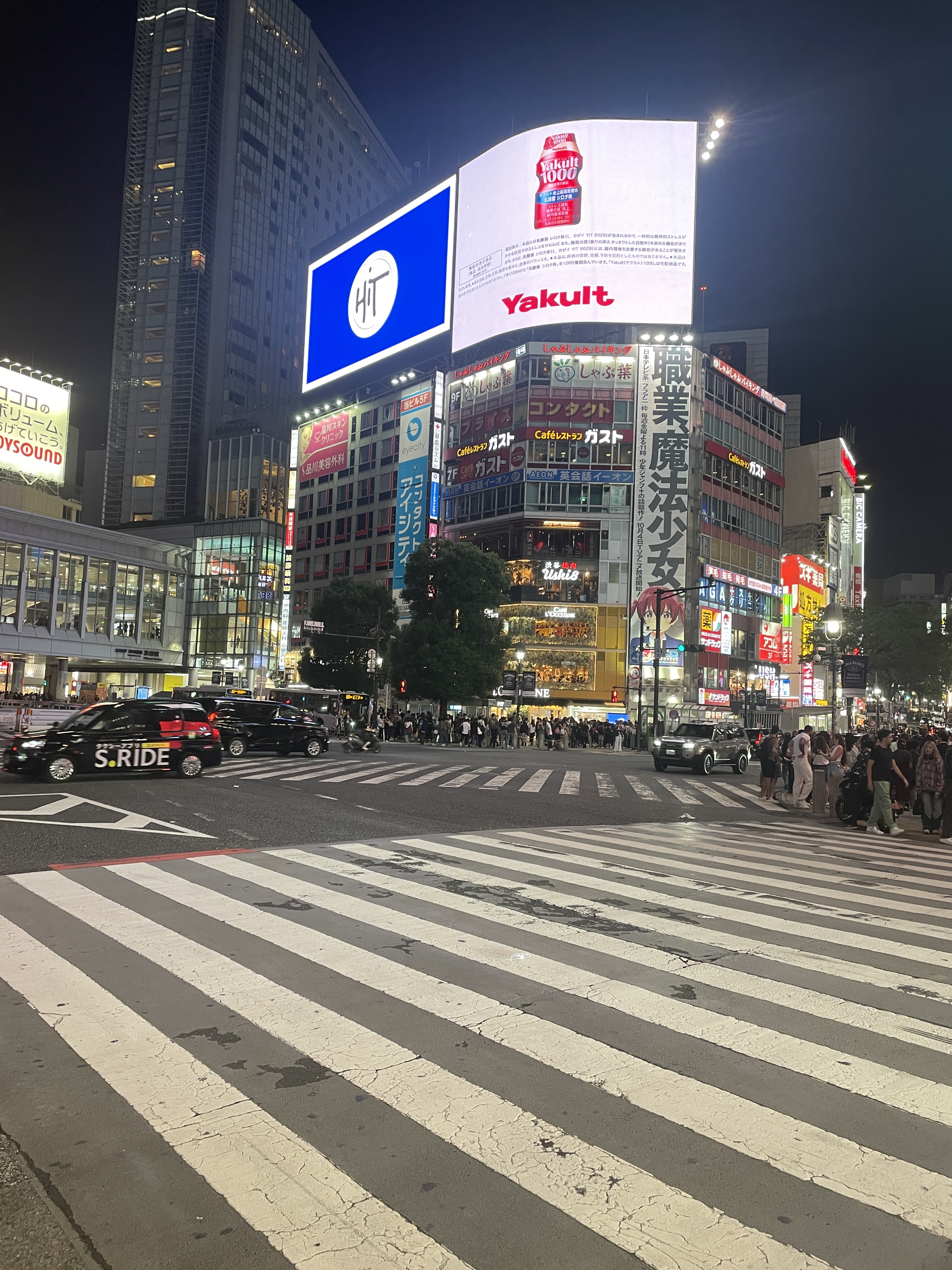
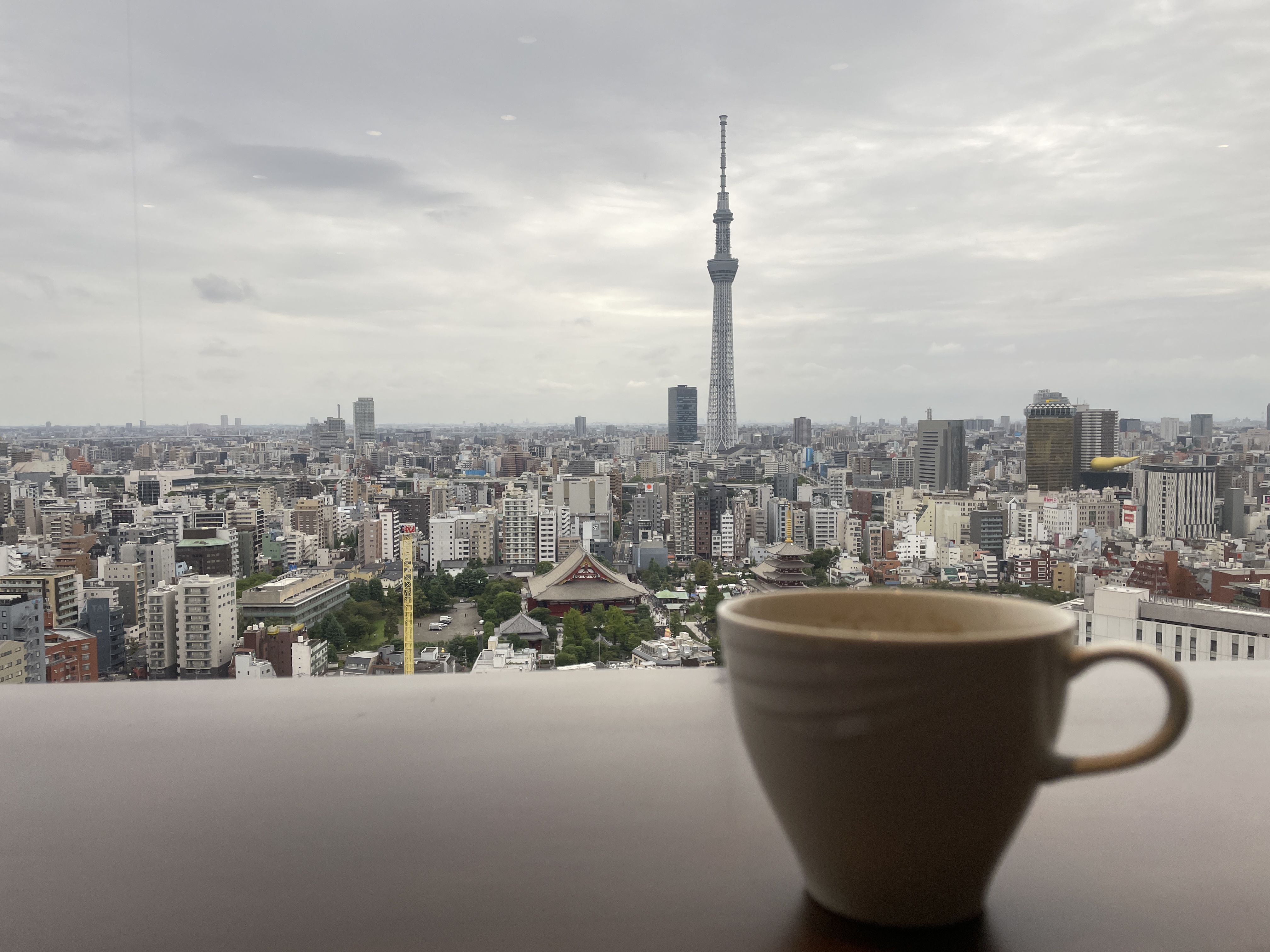
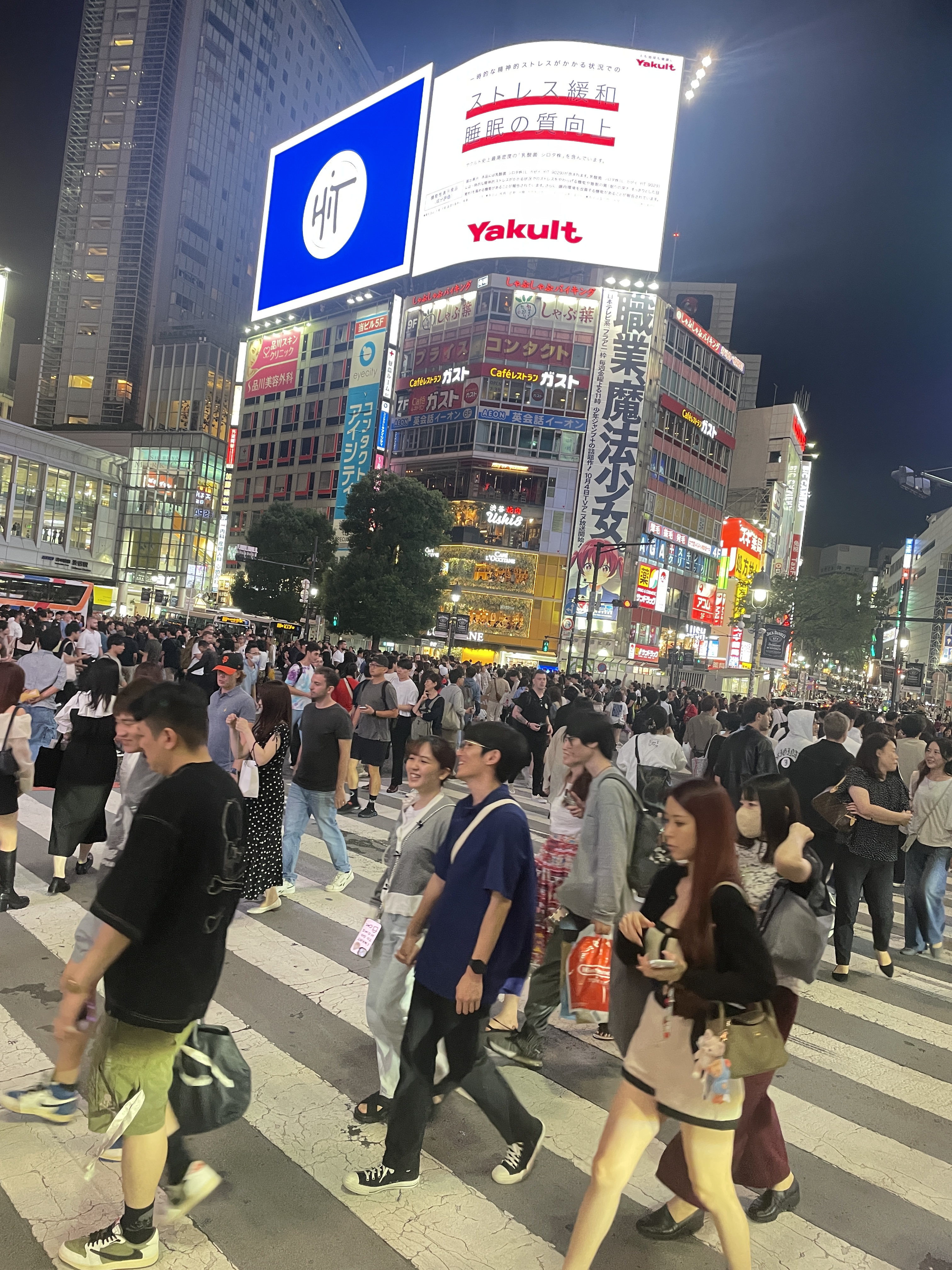
And so to Tokyo, the world’s largest city, home to 37 million people, most of whom had been good enough to turn up to the station to welcome us. We saw quite a bit of the rest of the population over the next few days as well, dodging them on early morning runs to the river, avoiding their purposeful striding around the designer shops at Ginza Six, and definitely keeping out of their way at the Shibuya scramble crossing, where up to 3,000 people cross whenever the pedestrian man turns green. We had a fantastic hotel room with a view of the Tokyo Skytree tower, and, although we were on the 20th floor, we couldn’t see to the edge of the city. Or anything green, at all. If we looked hard, we could see the elevated highways and the Shinkansen lines, so it looked a bit like a scene from Metropolis.

Mrs E had told me that the fashionable part of Tokyo to see and be seen in was Harajuku, which we went to on our second day, and where I was reprimanded by Mrs E for not remembering its name or how to pronounce it. On further investigation, however, it became clear that the reason she felt the need to go there was partly driven by the lyrics to ‘I’m A Cuckoo’ by her second favourite Scottish indie band, Belle And Sebastian. I’ll do a blog some time about her first favourite – Hamish Hawk, where she is apparently, Gold AAA Pass Fan ⌗262, but that will have to wait. In the meantime, she bows to few others in her encyclopaedic knowledge of the twee Glaswegian jangle-merchants, and in particular, their singer and lyricist Stuart Murdoch. In ‘I’m a Cuckoo’, Murdoch rhymes, not so much with an elegant pen, as with a mallet:

I’d rather be in Tokyo
I’d rather listen to Thin Lizzy-oh
Watch the Sunday gang in Harajuku

Mrs E thinks it’s a work of genius, but I guess it’s our differences that keep us together. But Harajuku was very good for the second hand shops that sell loads of vintage clothing. We were in the States a couple of years ago, and arrived with very little luggage, hoping to pick up vintage shirts and jackets in thrift stores, and were hugely disappointed by what we found. And it looks like the answer is that it’s all in Tokyo and Osaka, where there are a load of shops selling letter jackets, Arrow shirts, Levi’s, bowling shirts and leather jackets. You see a lot of people shopping for this stuff, but very few people wearing it – the style of all the cities we visited was much more French in its look – muted colours and simple styles. It would be fairly easy to dress just by shopping in Muji and Uniqlo (which is where the other crowds of shoppers were). There are exceptions, particularly for girls in their late teens and early twenties, who are quite keen on the American oversized t-shirts and sweatshirts, preferably with some writing on. If they’re from thrift stores, you might see a young girl wearing a shirt saying ‘Proud Republican Father of Five’ or ‘Little Falls Idaho – PTA camp out 2010’ or something similar. If they’re new clothes, it tends to be an assortment of random words, a bit like the sweatshirts that you saw in the UK in the 90’s which had words like Authentic, Original, Brand in a randomised order. I saw a really expensive sweatshirt in a designer shop that read: ‘I am a Mr K. Like is Music, Fishing, Camping, Trekking, Cycling but most of all nerd fashion. Life Goes On Cityboy. Chill Time Coffee.’ Maybe the designers are being taught English by ⌗3, I don’t know.

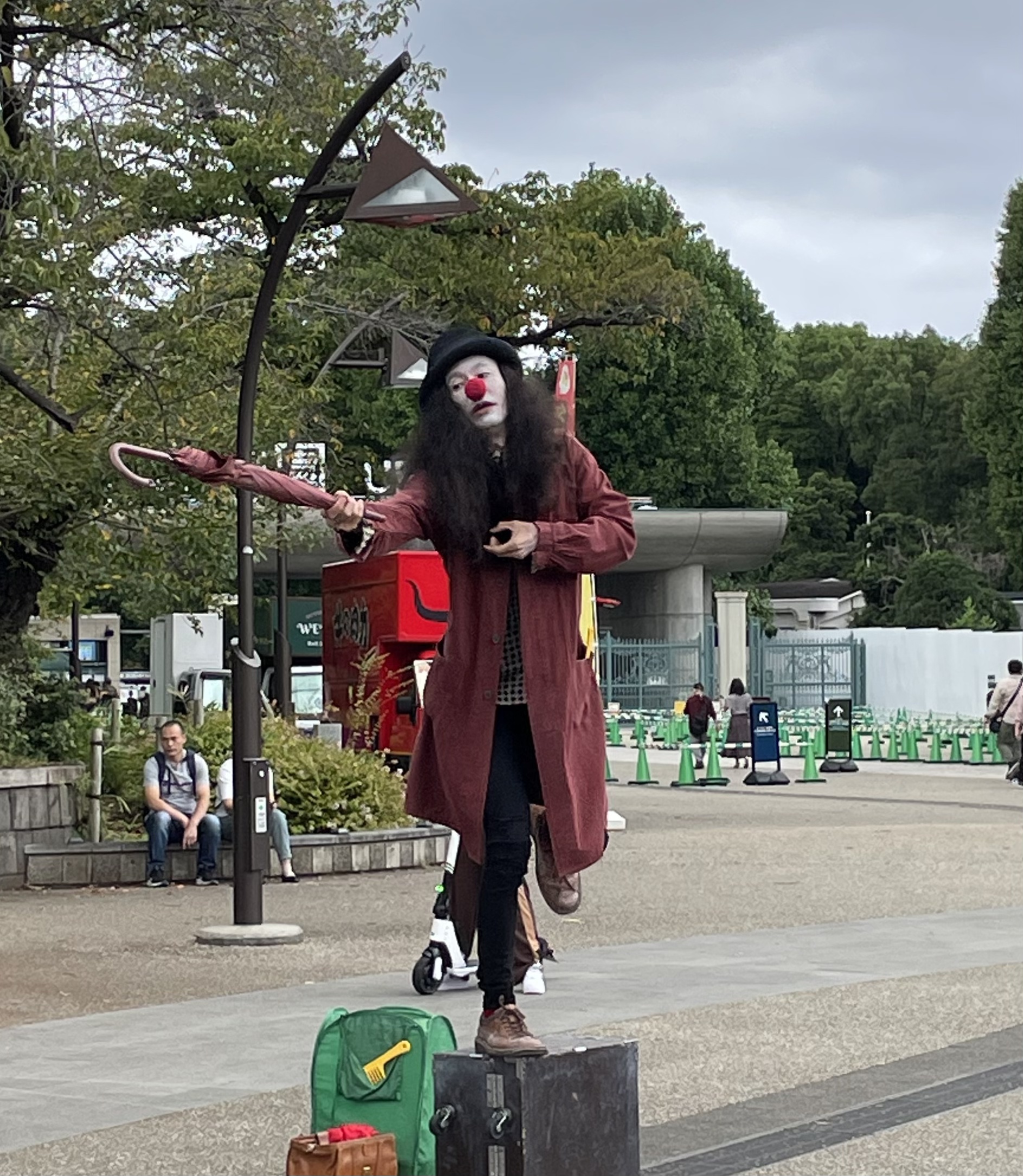
We did manage to find a bit of greenery, in the form of Ueno park, which we visited on Sunday, with lots of relaxed locals and tourists enjoying the trees, and the street entertainers, really good fun, even if they did have something of the childcatcher in Chitty Chitty Bang Bang about them. Hardly anyone visiting the museum of Western Art though, so we had a couple of hours of air conditioned comfort in touching distance of paintings by Miro, Picasso, Monet and Jackson Pollock that had been bought up over the years by Kōjirō Matsukata and then left to the country in 1959. We’d been told that a visit to the Hibiya Okuroji market under the railway arches was a must, but after a few hundred metres of wall to wall tat, we re-classified it as a must not, and went for something to eat. We hunted for over an hour for T’s Tan Tan vegan restaurant, which we eventually found next to one of the rail platforms in Tokyo rail station. Really worth the hunt, and indicative of the whole underground worlds that exist in all the major railway stations that we went to. There are supermarkets, fashion malls, specialist shops and amazing restaurants all hidden away, and very much part of the commuter culture. You don’t eat on Japanese trains, with the exception of the Shinkansen, so if you fancy some dumplings, ramen, sushi or really anything else, you eat at the station before or after your journey. The food is really fresh, fast, and because you’re eating at a restaurant, there’s no litter afterwards. Another thing about restaurants – the culture doesn’t allow for tipping, which is seen as a bit of an insult. What you do is go in, have a lovely meal with excellent service, get the bill, then pay the exact amount at the till as you leave, safe in the knowledge that everyone in the restaurant or bar is being paid a living wage. Doesn’t that sound good?

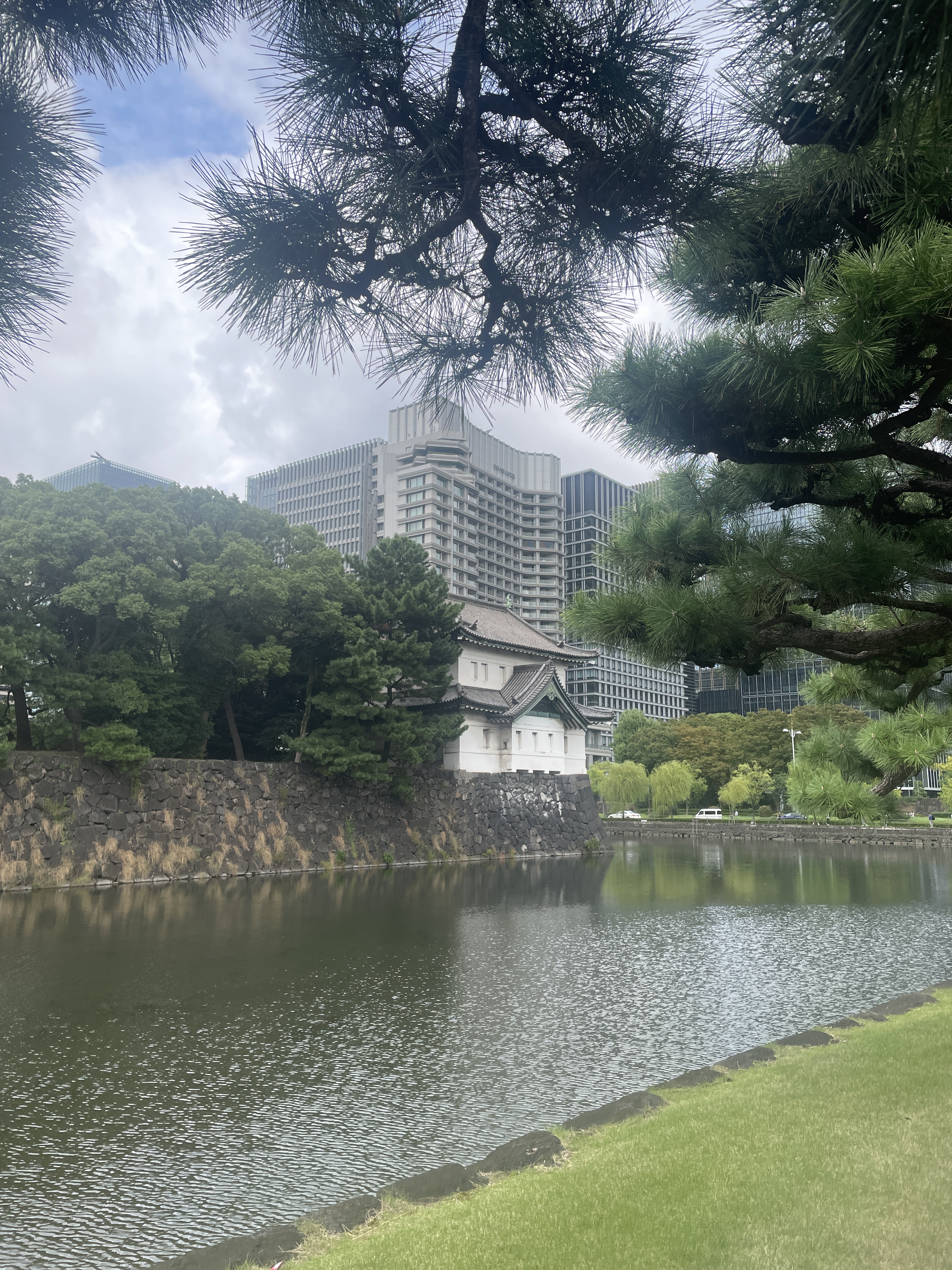
We were staying near the Senso-ji shrine, so trawled round there the next morning, a beautiful place and a great example of how all Japanese cities maintain these places side by side with new development. Senso-ji is really big, and full of tourists, but shrines exist on most streets, people stop, pray, leave an offering and move on as part of their normal day. Found another green part of the city in the imperial palace and grounds, filled with 2,000 Japanese black pine trees, and in the evening made our way to the Tokyo tower – a 333 metre tall structure which is lit up like a neon Christmas tree at night. In any other city, this sort of structure would be in a park, but in Tokyo, there are skyscrapers, office buildings, apartment buildings, churches and shrines all nestling up against the base.

A slight divergence at this point. It has always been the aim of the Emu to keep things very much above the waist, but every now and again, an exception needs to be made. And today’s exception comes in the form of the Toto toilet, Japan’s standard facility in a world of substandard facilities. You find these toilets, not just in hotels, but in homes, low end restaurants and public toilets. Let me just tell you about the basic controls. There’s nothing to control the heating for the seat, it just seems to know what’s comfortable. But reading right to left, you can press the automatic deodoriser, the wand clean (not sure what that does) , the ‘music’ button, which plays white noise to cover up any noises that you might make yourself, the front bidet and the rear bidet, both of which deliver a stream of water which you can, of course, adjust in pressure or temperature. Now, I’ve never liked spending more time than I need to in the toilet, but I think if I was the proud owner of the latest Toto model and, say, a portable radio, I might enjoy most of my leisure time there. Finally, there is a level of (ahem) cleanliness that the Toto user experiences that I think will be unknown to the non-user. We decided some years ago, for the sake of our marriage, that I would never waste money on white underwear, but if we lived in Japan, those white Muji boxers could become a real possibility.

We took the Shinkansen to Shin-Fuji then two bus rides into the country outside Mount Fuji – this was a bit of a challenge as our non-existent knowledge of Japanese meant that we couldn’t match bus stops to bus, but we almost managed it. Almost, because we got off at a campsite rather than the hotel, which was fortunately only a 15 minute walk away. This would have been fine if we’d not bought most of Muji’s autumn collection in Tokyo the afternoon before, so we turned up at the hotel carrying multiple bags, sweating buckets and still no further on with our language skills, beyond hello and thankyou. After a fairly stilted conversation between us, the receptionist and Google Translate. we got pointed in the general direction of the room, which we’d been told didn’t have a bathroom, as the hotel had its own onsen. The room was fantastic, with a window that, without cloud, would have been completely filled with the perfect triangle of Mt Fuji, and no furniture – we’d been told that we needed to make up the futon bed from the cupboard when we wanted to sleep. We decided to give the onsen a go – if you’ve not heard of an onsen, it’s a combination of a bathhouse and a mineral bath. It’s strictly separated men and women, you need to be completely naked to take part in the bathing, and there are a number of fairly complex rules that you need to follow. You get undressed in a changing area, then holding a miniaturised modesty towel, pass through a curtain into the onsen itself. There you sit down on a plastic seat and wash yourself very very diligently – you mustn’t let any dirt or soap go into the mineral bath. Then you lower yourself into the onsen bath, making sure the water goes no higher than your shoulders, and that your modesty towel doesn’t touch the water. And finally, you’re doing all this in respectful silence and, in my case, avoiding eye contact at all times. It’s more fun than it sounds, honestly, and you do feel remarkably clean afterwards.

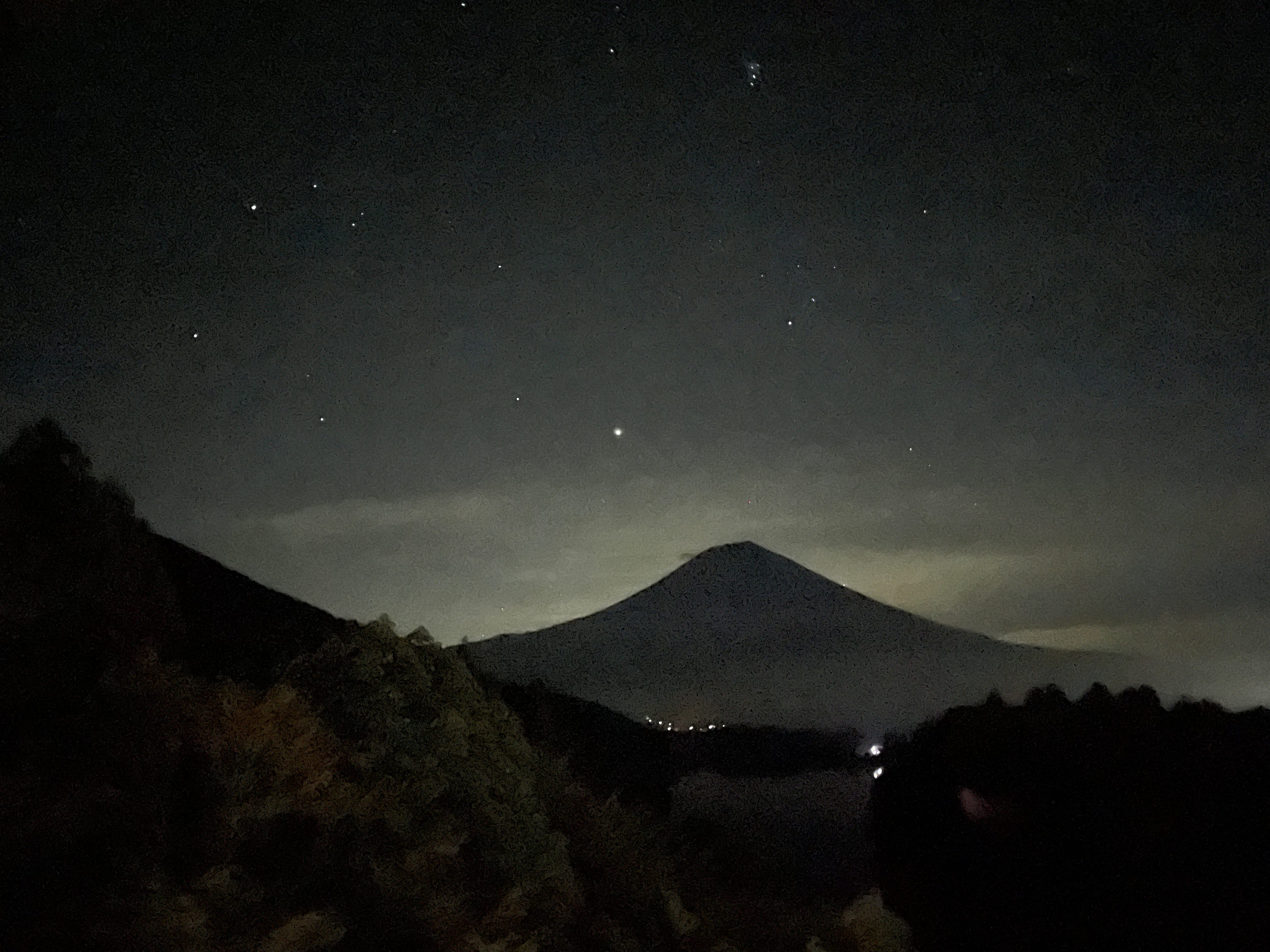
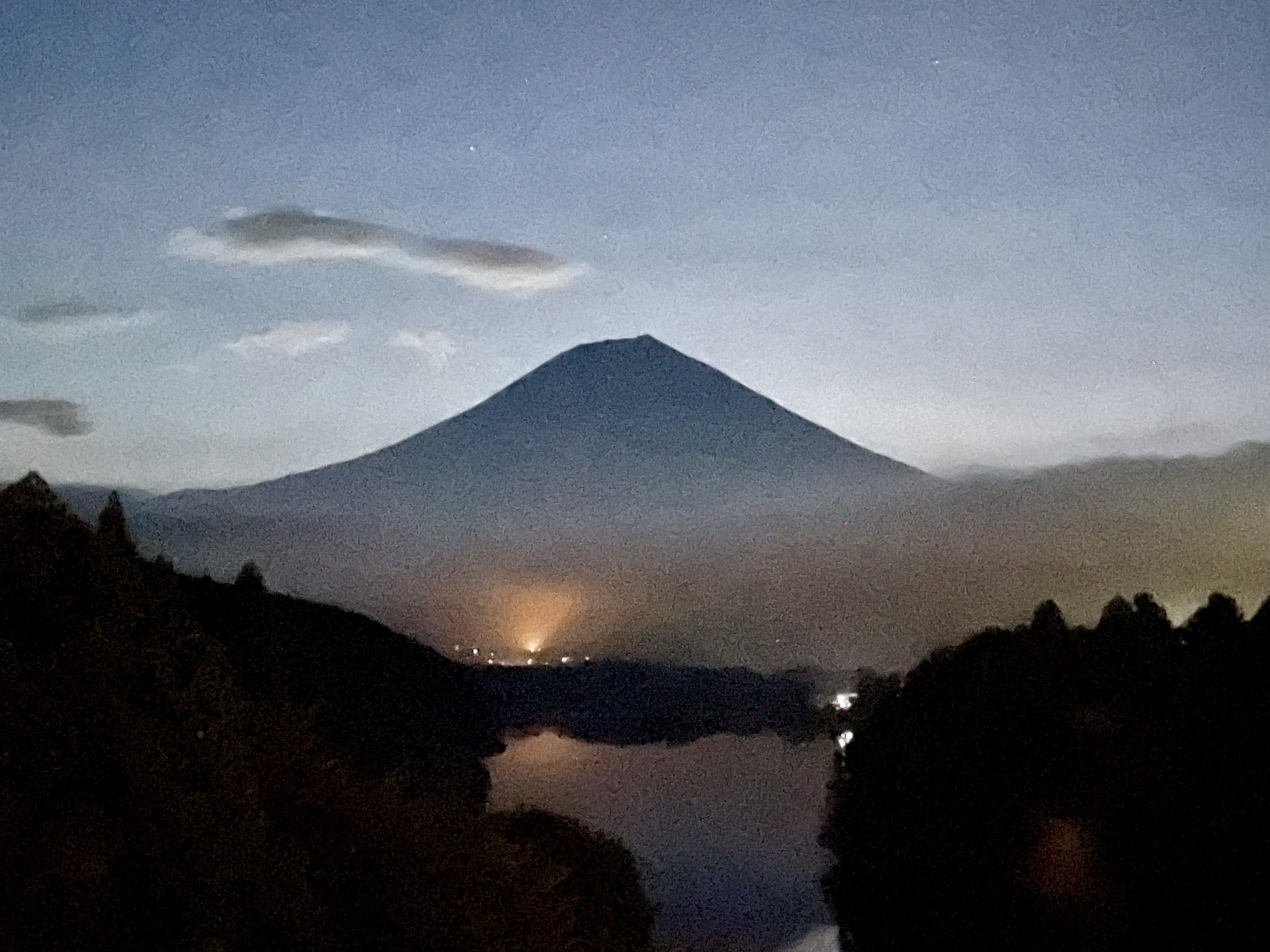
We went to bed that night on the futon mattresses, both on our sides and looking out of the window, and after an hour or so, the clouds lifted and the mountain was lit from behind by the moon, filling our room with a huge dark outline. The dilemma of whether to sleep or not while we were seeing this wasn’t helped by the need to follow the results of the Norwich vs Leeds game, which had kicked off at a very unreasonable 3:45 am. Dipped in and out of a sleep, during which I dreamt of seeing a huge mountain, Norwich going ahead and Leeds equalising, then woke up at dawn as Mrs E was photographing the sun touching the mountain for the first time, unable to distinguish dreams from real life.

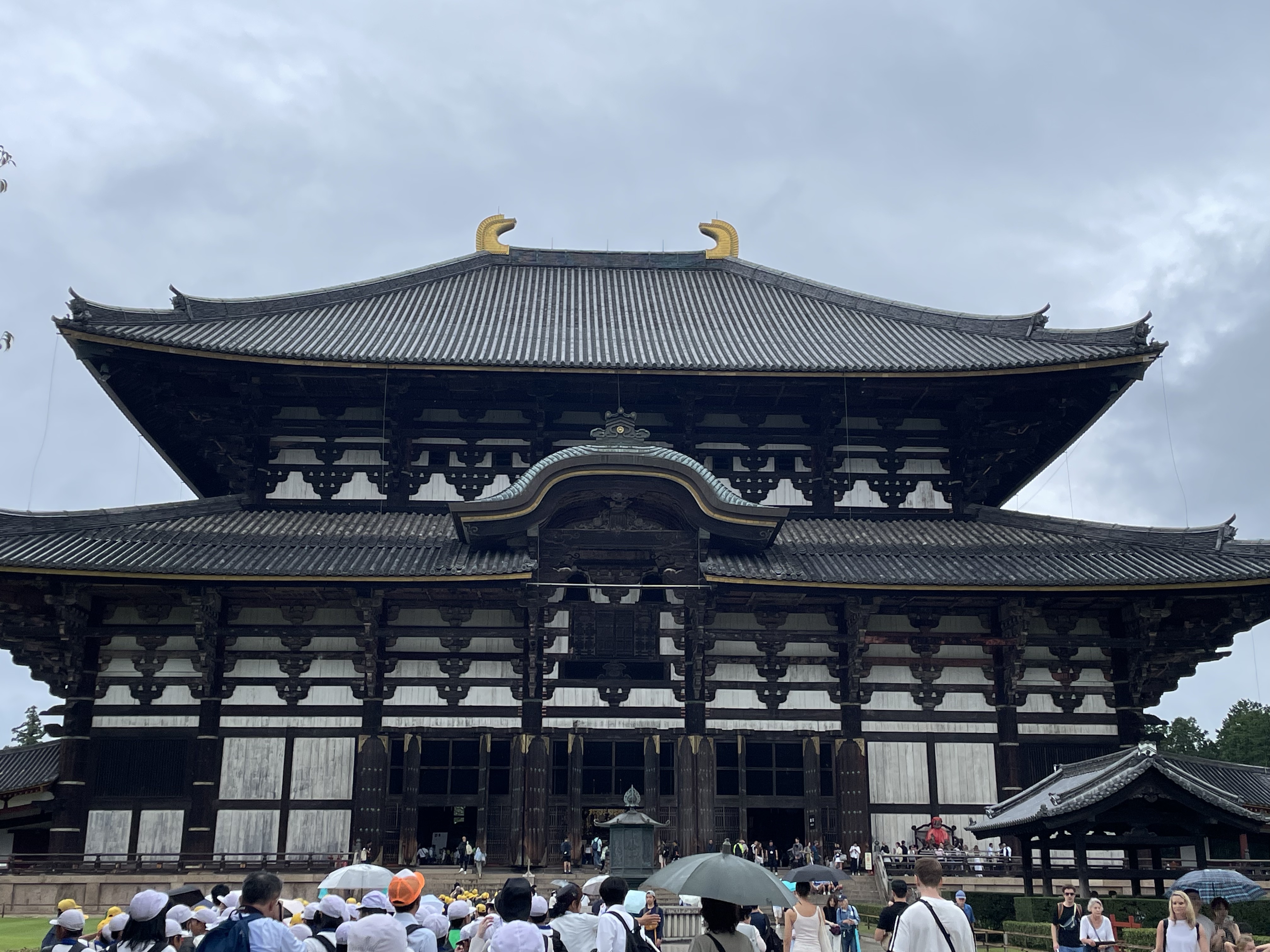
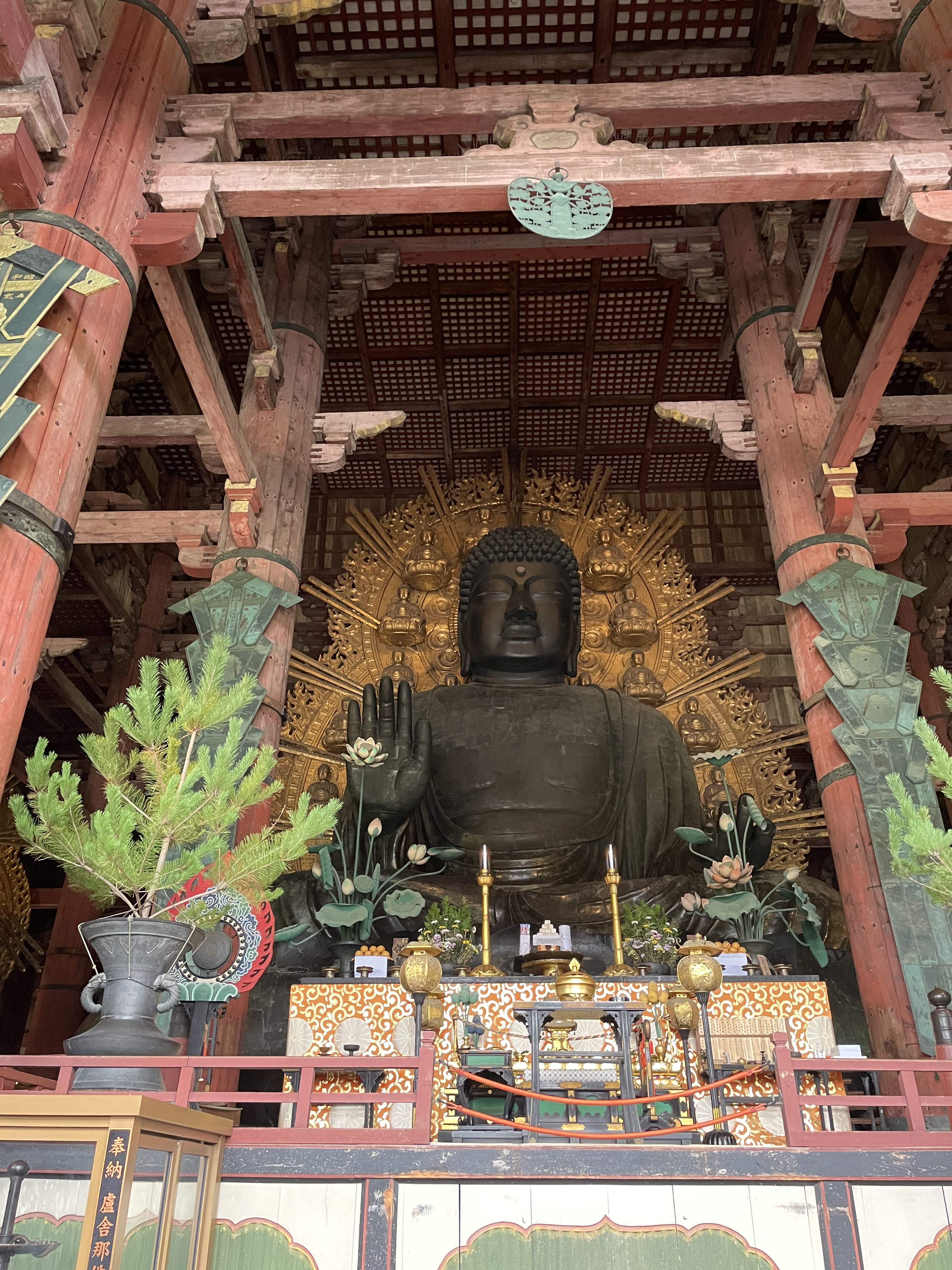
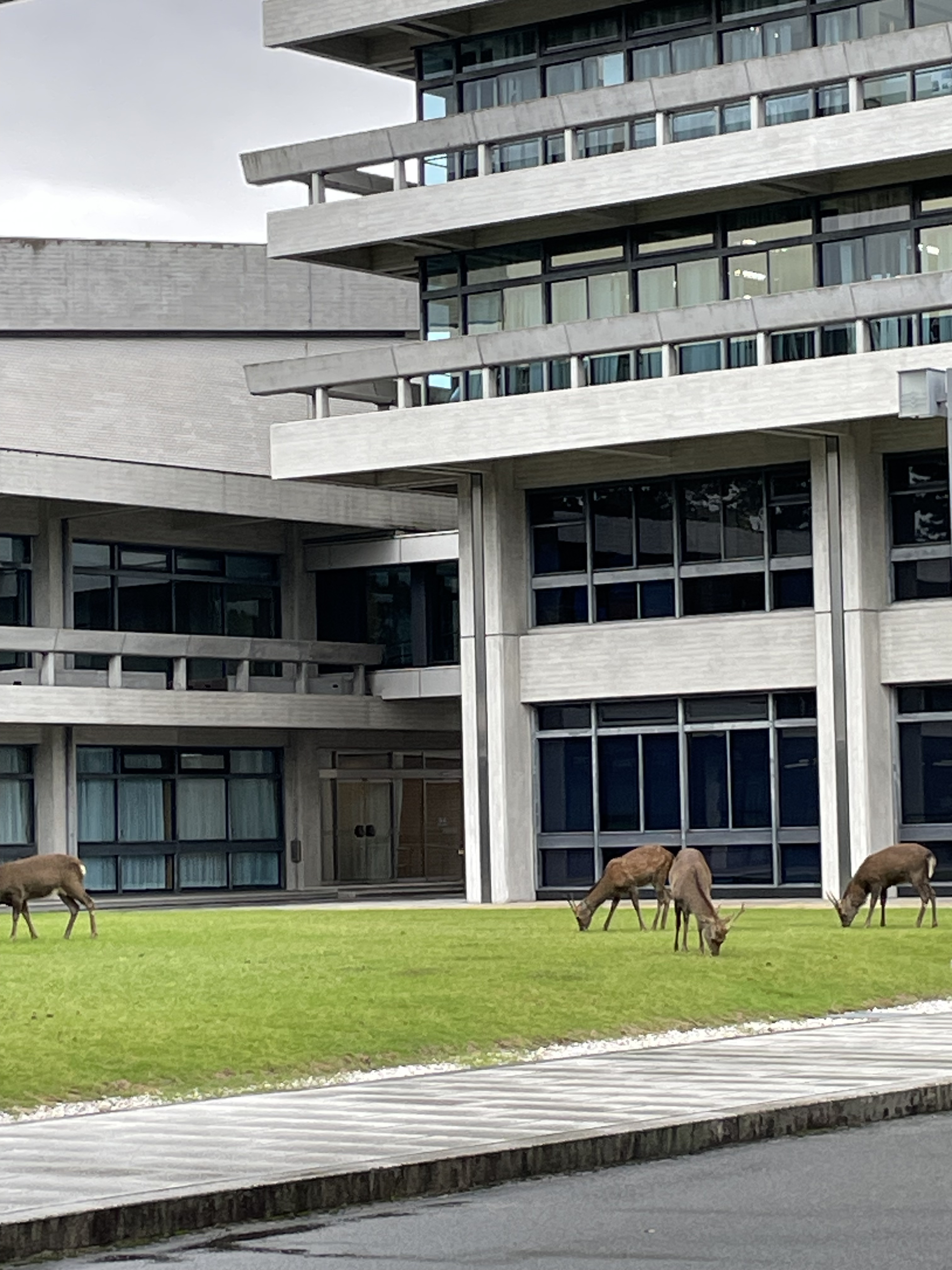
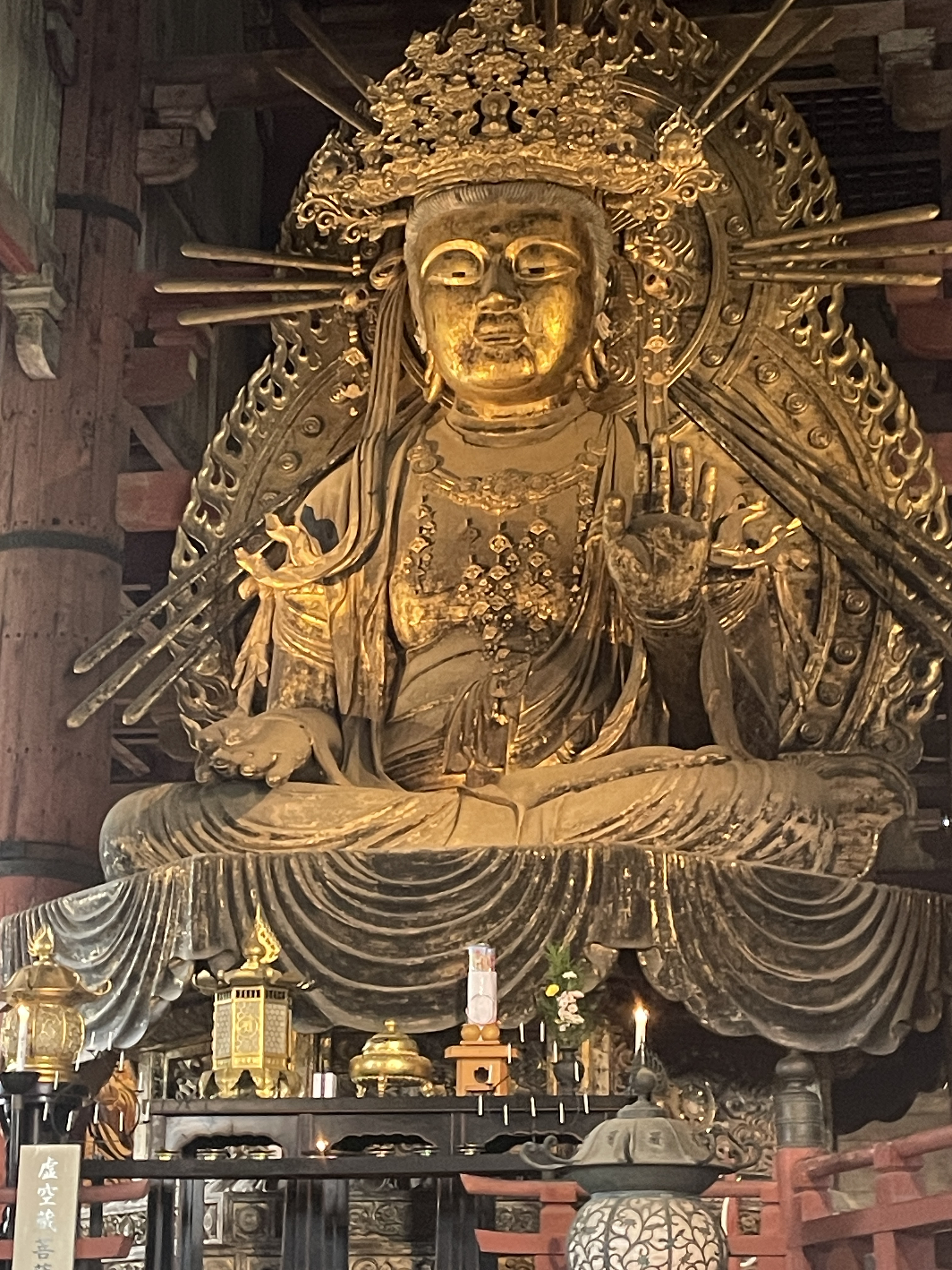
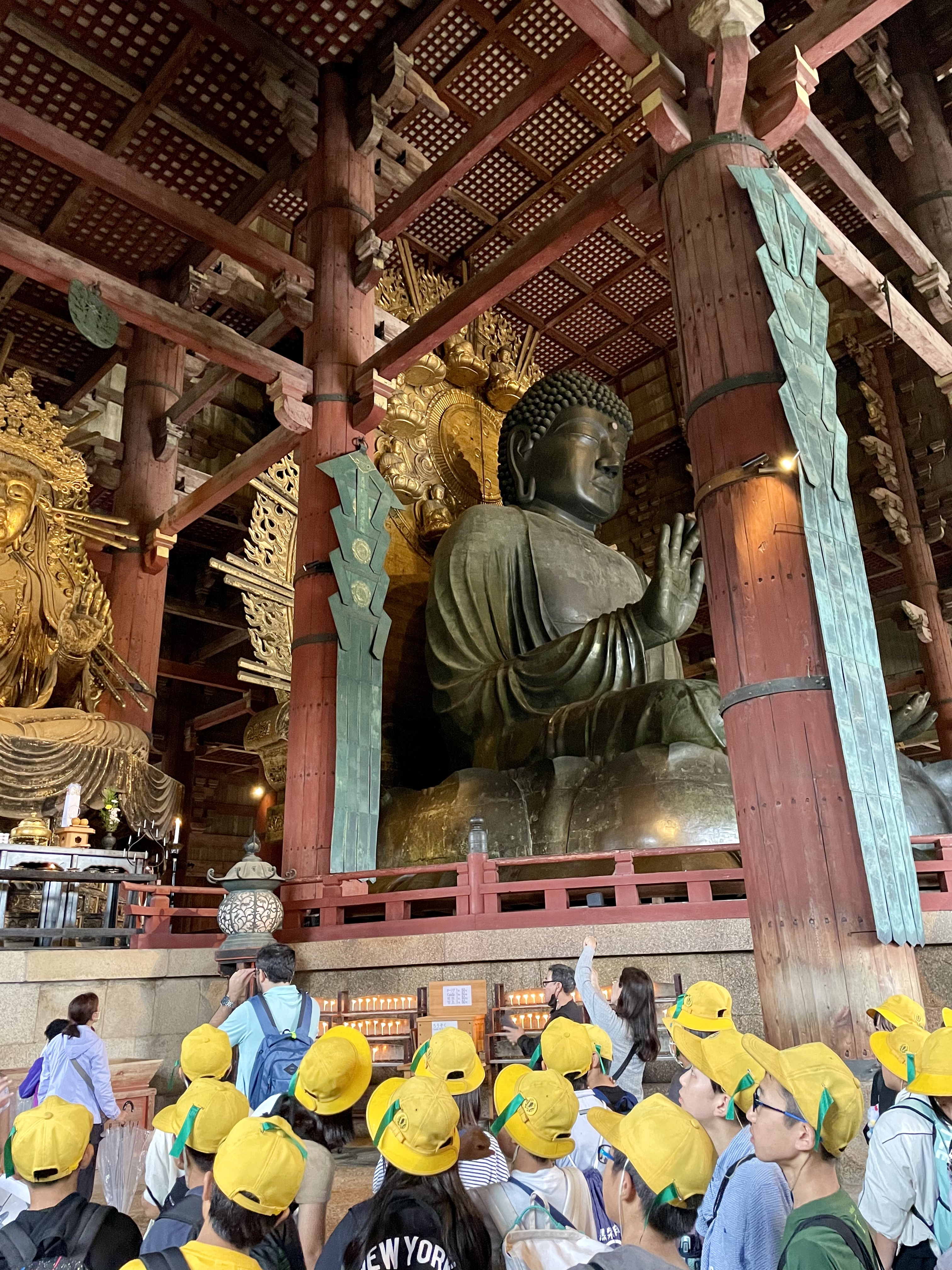
Negotiated two more buses back to Shin-Fuji, again getting off at the wrong stop, although this time on the instruction of some Indonesian tourists who’d been at the hotel, so at least it was someone else’s fault for a change. Onto the lovely Shinkansen again and back to Kyoto to do our laundry and sort out some food, then off again in the morning for ⌗3’s two days off. Firstly to Nara, a beautiful town completely overrun by sacred deer, who all had limited road sense and enthusiastic appetites. Up to the astonishing Todaiji Temple (the largest wooden building in the world, fact fans) with its 18m high Buddha, built over three years in 762. Absolutely stunning, and really hard to do it justice with words or photographs, although this site does a pretty good job.

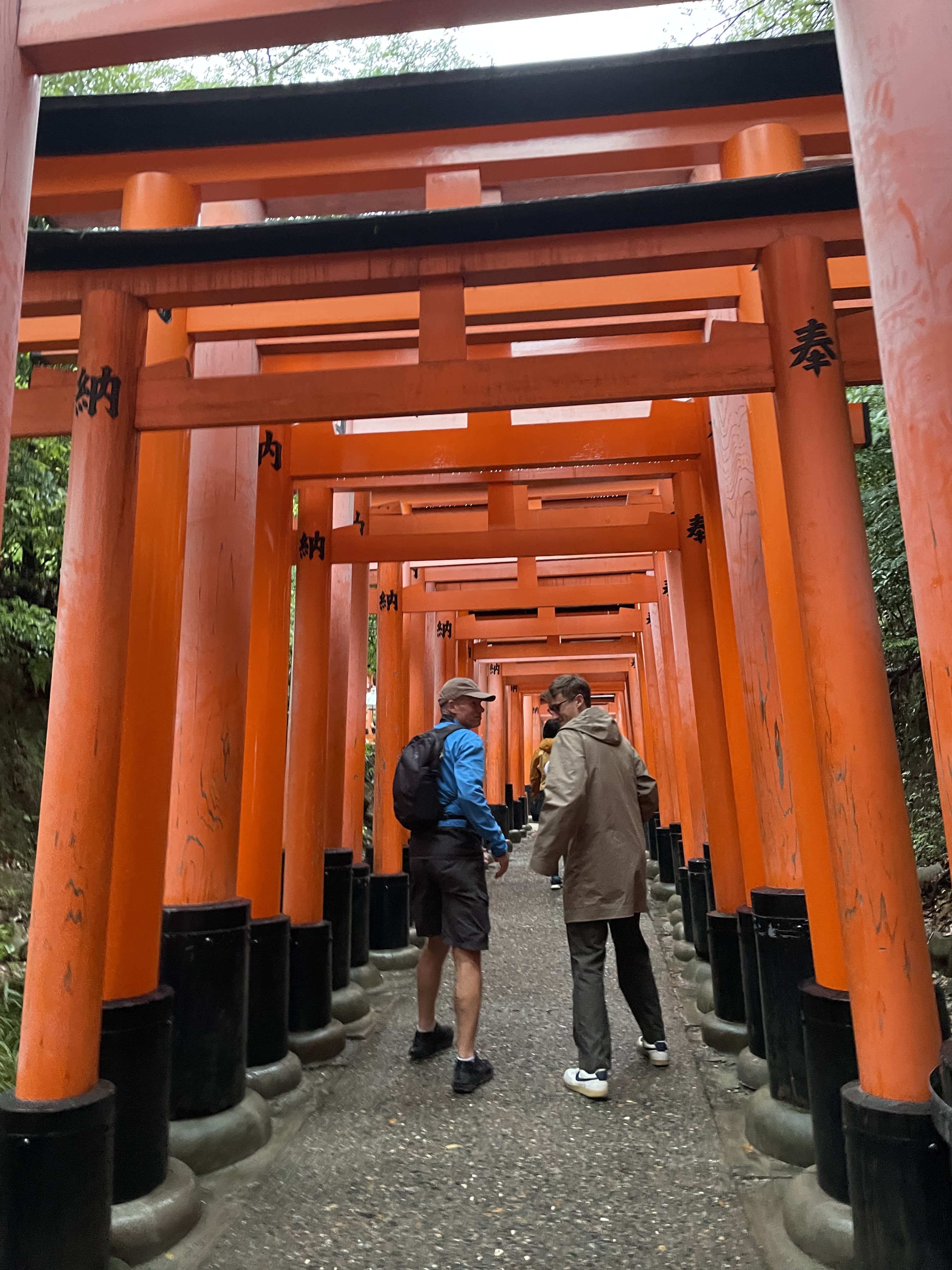
Hiked through the Fushimi Inari gates – it was teeing it down with rain so very slow progress climbing up, so ⌗3 took us on a side hike, away from the gates and up past hundreds of shrines and jungle forest to the top, by which time there were very few people about; we descended down precarious slippery slopes in the dark with all the gates, if not the steps, lit up to guide us. There are around ten thousand torii gates, all painted in the familiar vermillion colour, each sponsored by a business keen to associate themselves with the passage from this world to the next. .

Then back to Kyoto for vegetarian ramen with ⌗3’s Japanese friend, who we lightly grilled on just a few of the very many things that we wanted to understand about Japan. Like everyone we’d met, she was so thoughtful and considered in her explanations. Although the stricter Buddhist practises may be less obvious in current Japanese culture, there’s definitely a sense of internal comfort and a very clear reluctance to make an exhibition of themselves that still permeates. It all makes for a calm amongst the chaos; you see this all the time when you’re walking about in cities – people queue politely for everything, including crossing the road – no pedestrians ever step onto the road unless there’s a green man, even if there’s no traffic about.

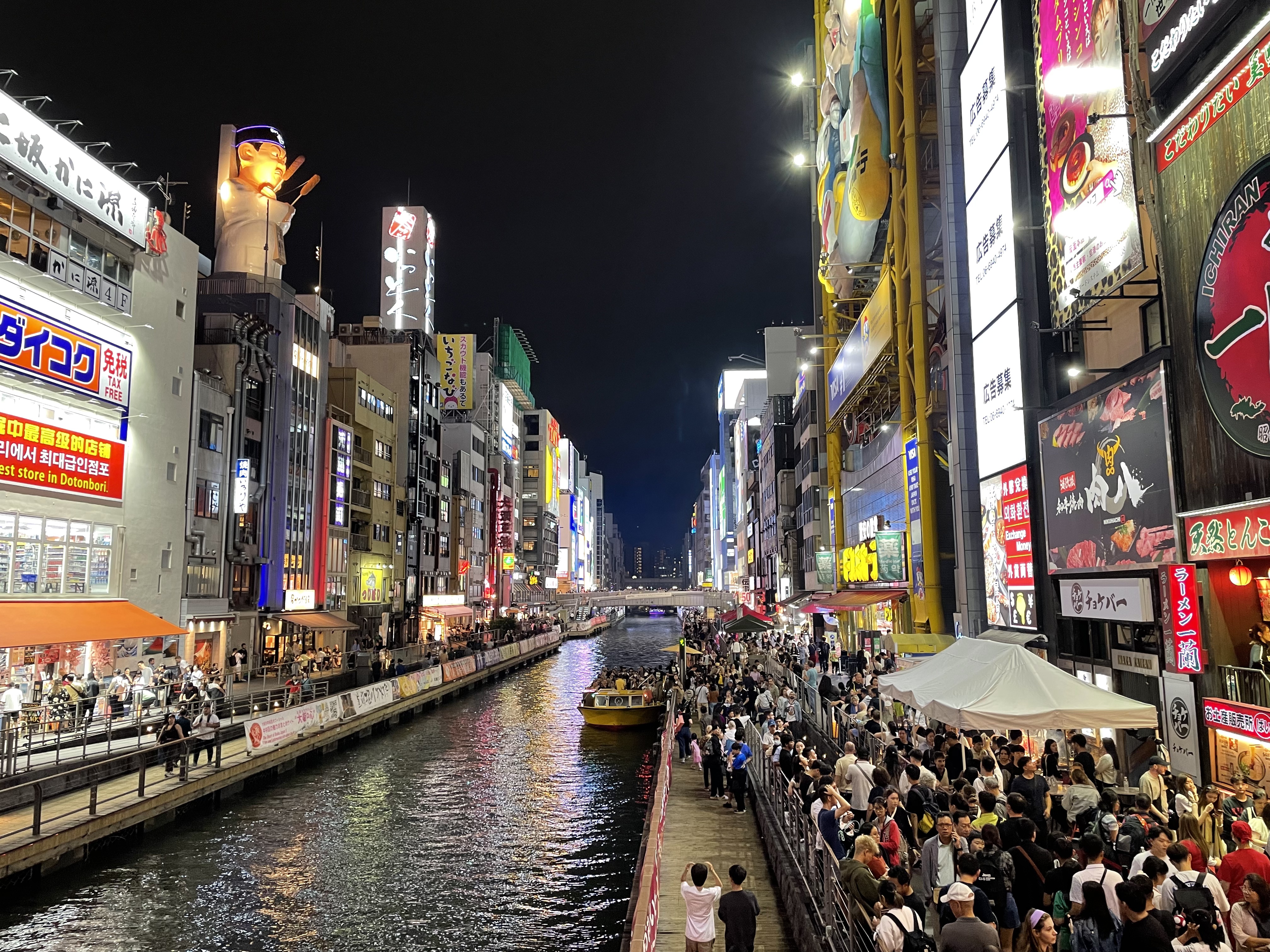
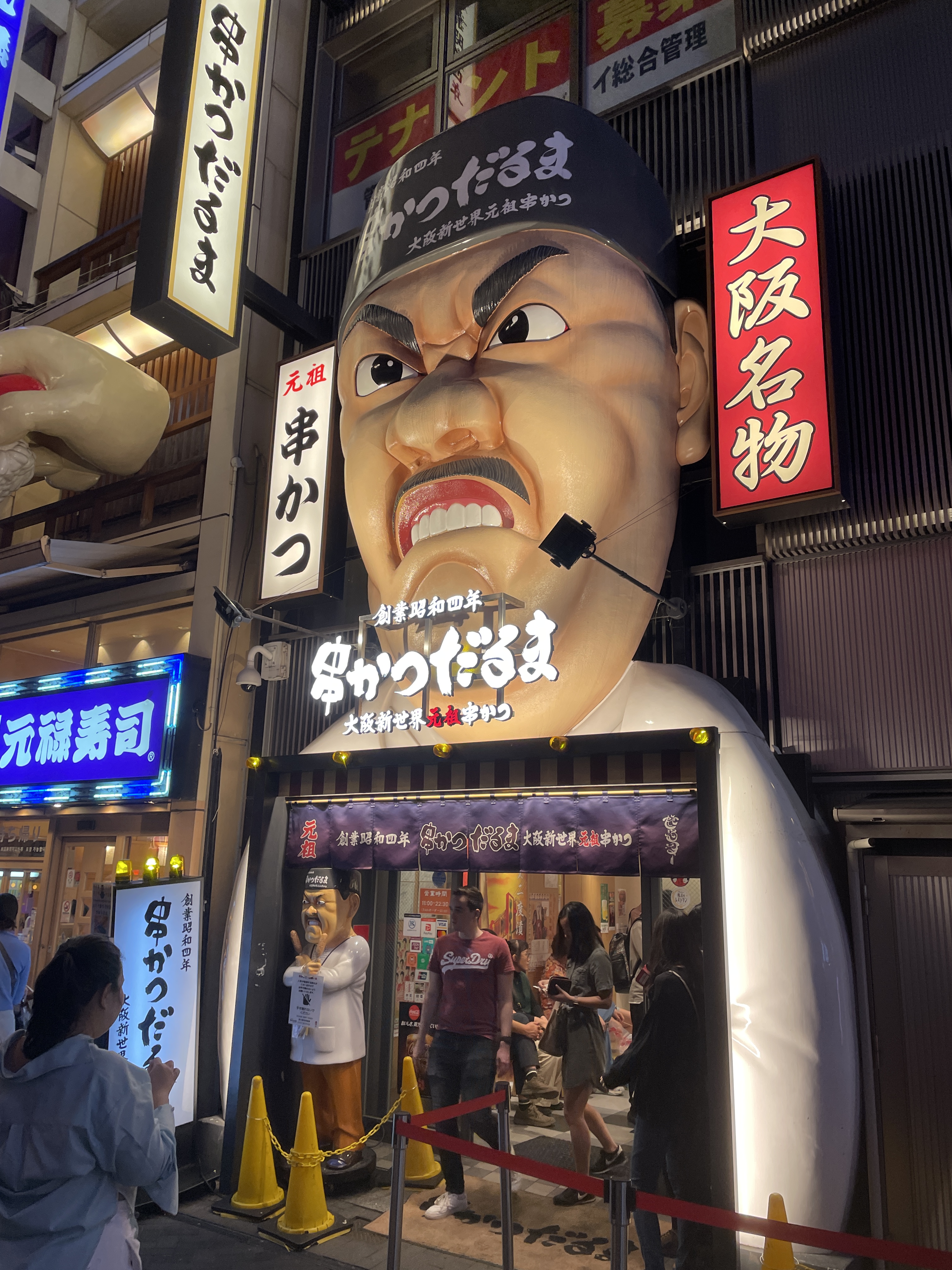
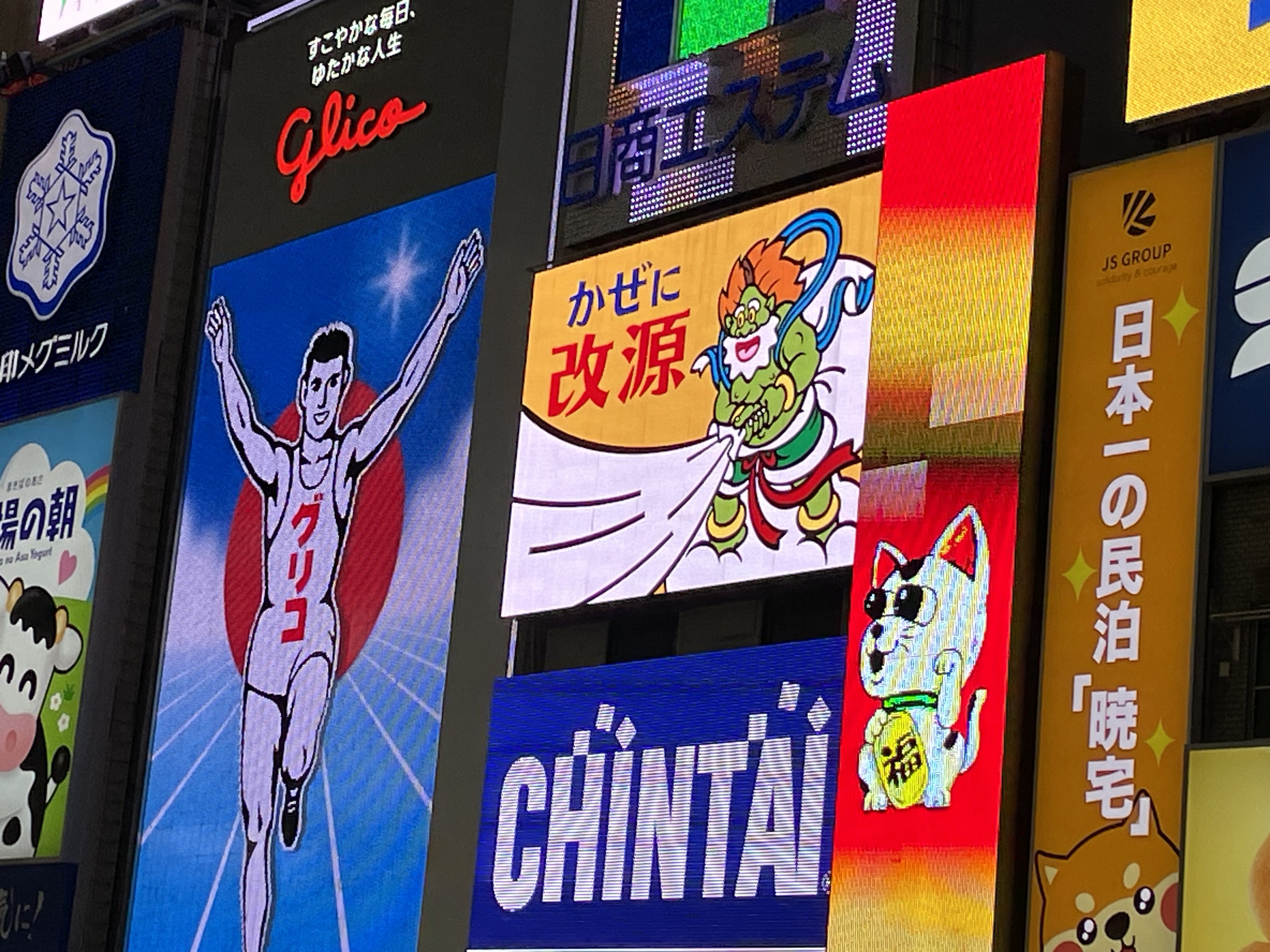
To the railway museum in Kyoto the next day – fantastic stuff, made all the more enjoyable by the adorable kindergarten school parties in matching uniforms and hats, holding hands in pairs in a crocodile formation, and doing the little head bow thing when they met someone, and even when they came across a particularly impressive train. Then to Osaka, where we got to the 39th floor of the Umeda sky tower, before Mrs E discovered new levels of vertigo from the glass walled lift and we had to abort the trip, then South to Dotonbori, which is like a constant stream of Times Square billboards; really lively and quite a contrast with Kyoto. Osaka is huge, second to Tokyo but still the world’s 10th largest city, with 19 million people. And the Dotonbori area feels like a desperate last party, with hundreds of bars and clubs and restaurants vieing for attention. We met with ⌗3’s American friend here and had a great night drinking beer then eating pizza in a rooftop restaurant before just catching the last train back to Kyoto.

Next few days were in Kyoto, still loads to explore, both at night and during the day. We had an unintended big night out with ⌗3 and a couple of his friends, which started with a couple of cans by the river. This is the place where young people go to hang out, and where they just go on a date, a couple of cold drinks from the konbini, sitting together looking out over the river. It’s all quite sweet, respectful and well behaved – I went for a couple of early morning runs along these stretches of river and there was never a scrap of litter from the night before. Our evening got a little messy as we progressed from bar to basement restaurant to hidden bar, where we drank glasses of sake and shochu and then to the Ing rock bar, hidden away in an apartment building, where they serve serious strength Sapporo beer until 5am every morning, and play very good music, very loudly. ⌗3 told us that he’d been here before, but stood no chance of finding it without his friend J, who was with us and described it as his second home. Grateful as ever for Mrs E’s relative sobriety – she’d stopped drinking several rounds before I did and successfully steered us both home. I think I was suitably contrite and apologetic the next day, which was a bit of a hungover write off.

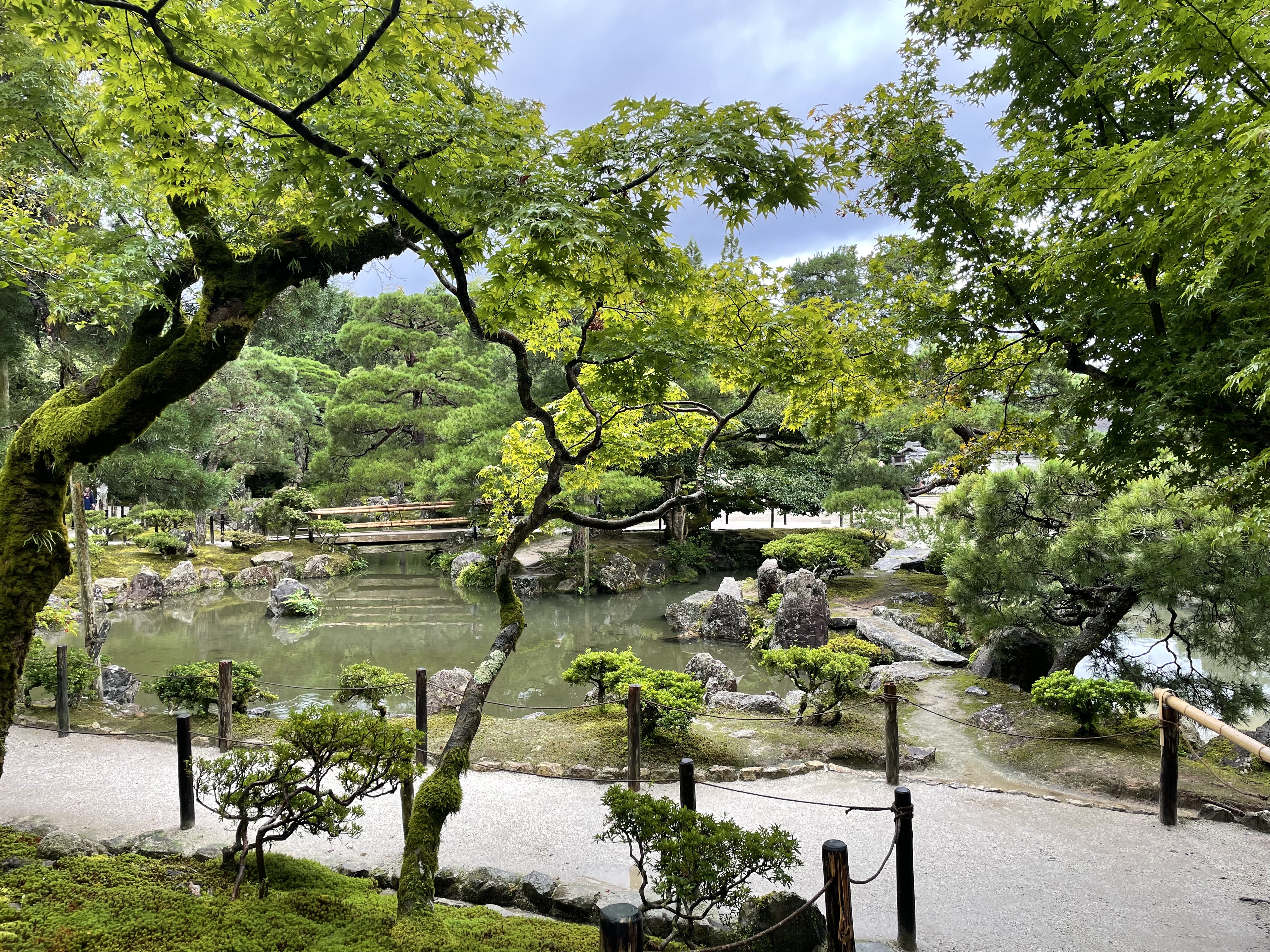
To the Ginkaku-ji temple – a huge Japanese garden surrounding a temple complex in the centre of the city. Serene surroundings, really green, with moss and rock gardens intersected by waterfalls, rivers and statues. Very few people about, which made it even more peaceful.

⌗3 had a late start the next day, so we took the train out to Arashiyama, where tourists go to see the temples and shrines; we hiked through the bamboo forest, then up past the Jojakko-ji Temple to look back over Kyoto, then across to the other side of the river to Kameyama-koen Park, where at the top you find yourself in the middle of a monkey sanctuary. We were warned in the strongest terms on signs going up to avoid eye contact with the monkeys, and not to point cameras at them, which seemed to be advice dutifully ignored by most of the other tourists.

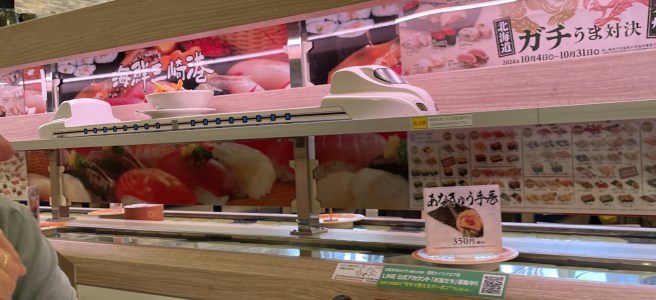
And before we knew it, it was time to head home. A last trip out to Kusatsu, where ⌗3 works, a fair sized city which seems to centre around a huge shopping mall, which includes not only the English school, but a sushi restaurant that delivers the food to your table on miniature Shinkansen trains. Clearly this was not an opportunity to be missed, particularly for Mrs E, so that’s where we had our last meal together.

Did a bit of wandering around before ⌗3 had to go to work, then said our goodbyes. I never know what to say when I say goodbye to any of my kids, I think it’s because I might say the wrong thing, and one day, that’s all one of us will be left with. So I tell him that I love him, and so does Mrs E, and he says it back, and then we don’t see him anymore. and Mrs E has a bit of a cry, so we try to distract ourselves by wandering around Muji one last time. Then it’s time for some serious travel back, which neither of us really wanted to do, but there’s always stuff to get back to, even if it has to be reached with packed planes, dirty trains and dodgy taxis. And the dog was very pleased to see us.

We managed to get through the best part of three weeks on two words which I’d recommend learning. We did try to learn a lot more but very little stuck. So if you’ve managed to get this far, I’m very grateful…Arigato gozaimasu ! x

It’s The End Of The World As We Know It

So we escaped the hullabaloo of a collapsing government, an increasing volume of vociferous gammon, and an overexcitable media to head for the relative calm of the Galician coast. Fairly skipped out of the country, we did, in the hope for simple hiking adventures in the bright June sunshine of the Spanish countryside.

And it’s not like we didn’t have the odd warning on the way. Our first warning was a phone call next to the Ryanair gate at Stansted. I’d had an MRI scan a couple of weeks before, after going to my doctor and telling her that I was struggling to stand up if I’d sat down for any length of time. This phone call was from the triage doctor, following up on the scan, and asking if I’d had any further issues. Not really, I said, it’s just really painful and I look like I’m about ninety when I stand up. Incidentally, my mother, who has just actually turned 90, can easily beat me in the getting out of a chair without complaining stakes, particularly if it’s 6pm and time for a drink. Anyway, the lovely doctor said that he’d refer me to someone who could see me and the scan in the same place,, at the musculoskeletal (MSK) clinic and recommend some sort of intervention, which sounded ominous. Incidentally (again) – I saw my GP in May, had an MRI scan later that month, had this phone call mid June, and now have an appointment at the MSK clinic at the end of June. I absolutely bloody love the NHS. Anyway, at the end of the phone call, the lovely doctor told me that I’d better not do any walking between now and the MSK appointment. Ooops.

Second warning was the actual booking. We were due to walk the ‘Wild Atlantic Coast’. I didn’t really worry about what actually made it wild until we started. Maybe it was going to be the wild flowers, or the wild sense of abandon you felt as you skipped along it’s banks. Or maybe it was wild like a wilderness, a leafy green expanse of rolling green that we’d skip along as we held hands along manicured footpaths. Wild in a Kate Bush style, if you like. Well none of that. The Wild Atlantic Coast really should have the Wild Atlantic bit in bold. and underlined. When the Atlantic gets enthusiastic around these parts, it really makes itself known. Wild in more of a Keith Moon/Oliver Reed style then. We were walking the lighthouse way, from Laxe to Finisterre, and it’s known as that because you can’t walk for more than a couple of hours without tripping over yet another lighthouse. And you need them here because otherwise there’d be even more shipwrecks. Did I mention the shipwrecks? Well, one of the first things we did, when opening the map of the route, was to ask what Costa da Morte meant. Our Spanish isn’t that great, but our French is ok, and surely no-one would ever name a touristy destination the Coast Of Death. Well, they did, and it’s because there’s a long history of shipwrecks along the coast – galleons, fishing boats, german submarines, oil tankers – they’ve all misjudged the waves and the winds and the rocks and understood a bit too late what the Wild Atlantic is all about. We stayed in a hotel that showed all the shipwrecks on a series of maps along a corridor. They were very big maps, it was a long corridor, and the writing was very small – there have been over 600 shipwrecks since the 14th century, hence the need for lighthouses, although with that sort of record, you might want to have put a few slightly brighter bulbs in.

We set off from Santiago de Compostela, a beautiful city best known as the destination for the pilgrimage Camino walks that start all over southern France, Spain, and Portugal. Santiago is named for St James, whose relics are held underneath the cathedral, hence the pilgrimage destination, and there’s a long queue of pilgrims in the cathedral every day, queuing up to touch the shoulders of the statue of St James behind the altar, to mark the end of their journey, which may have been a six week hike. It’s quite emotional watching people get to the cathedral with their backpacks and walking poles, and quietly filing around the altar to get to this moment. We felt as if we’d be cheating if we joined in, so we went outside to the sunny square behind the cathedral, where pilgrims were arriving after their journeys, looking exhausted but elated, lying down on the cobbles, hugging each other, taking selfies and generally feeling very pleased with themselves. We spent half an hour here, soaking up the sun and atmosphere, and also managing to drop one of our passports on the floor, which we didn’t notice until a couple of hours and a 50km taxi ride later, when we tried to check in to our first hotel. Key travel tip – if you are going to lose your passport, make sure you do so in a crowded square full of elated and repentant Christian pilgrims, as they’re more than likely to hand it in to the police station. So, 100km of taxi rides later, we were back in Laxe, very relieved, and having a quick dip in the Atlantic before dinner and the start of the walk.

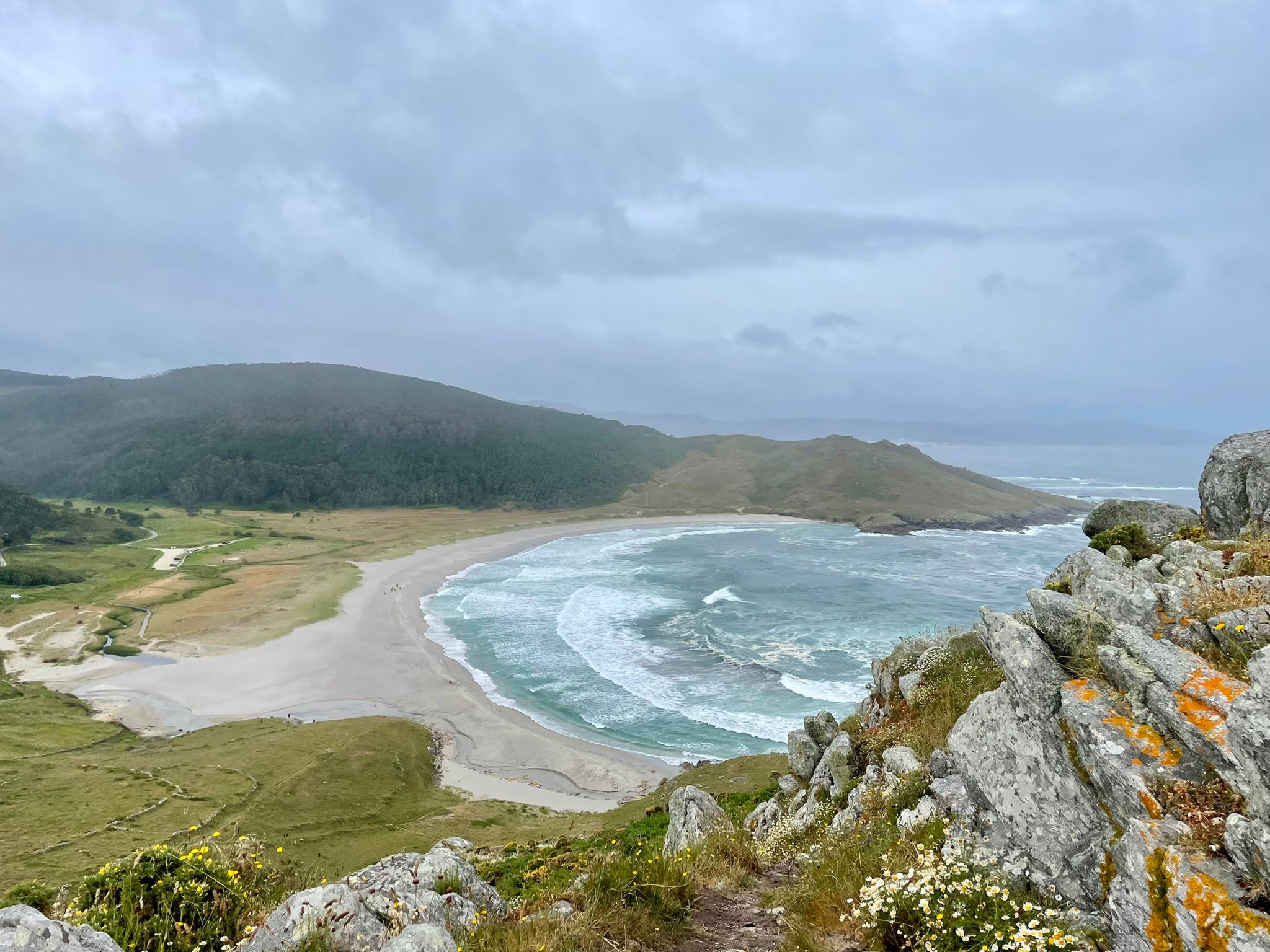
Laxe is a small fishing town and the start of the lighthouse walk which travels all the way around the Costa da Morte to Finisterre. Quite a few restaurants, all of which seemed very keen on local seafood, including pulpo feira, which is a kind of cold cake made of sliced octopus. Tastes a lot better than it sounds. Fortunately we both like seafood, as this was pretty much all we’d be eating for the next week. Started the walk the next morning, from Laxe to Arou. Quite a bit of up and down stuff, up to the top points to lookout to sea; down to the boardwalks and the beaches, with waters that looked fairly lively:

All was well and sunny, until it wasn’t, and when we hit a bit of rain, the walking suddenly got quite a bit harder. No slipping about on the rocks, thankfully, but the rain just kept coming, and managed to make its way inside our coats and boots so that when we finally arrived in Arou, we were fairly bedraggled. Whenever we do one of these walks, we tend to exhaust the conversations about the kids and politics fairly early on, so we’ll play games to keep our spirits up – the game today was alphabetically naming places we’d travelled to together; exclusions for Q, U, V, X and Z, with nominations for place we’d never return to (Sequoia, it’s a long story), and places we’d go back to like a shot (Kathmandu). Did our best to find places to dry boots and coats, then headed into town, trying to dodge the rain, Found the only restaurant in town, where Mrs E decided to indulge me by pretending to like beer (which she did, in a 1:10 mix with Sprite), and be interested in the football, although England’s uninspiring 1:0 win over Serbia really wasn’t a great introduction to the beautiful game.

We were hoping for better weather the next day, but we’d been warned about likely storms, which were confirmed in the morning. The advice was to skip the walking altogether, which, looking at the forecast, we agreed to, so we jumped in the taxi with our bags and headed to Camarinas. Part of both of us wanted to be walking, and the rain held off until about 10am, but after that it absolutely hammered down, so we made the best of things – me knocking out 5,000 words on the history of cigarette marketing, and Mrs E brushing up on her Galician history and language. As I mentioned, we can get by ok in French, but our Spanish is dreadful, and our Galician non-existent. They’re similar languages in many ways, but Galician has many more Xs, which are a bit confusing until you realise that they largely make a ‘sh’ sound, and lots of squiggly lines above the N letters. But the main challenge is in pronunciation. I’m all for rolling my Rs, but Galician takes it to a new level, so that any word beginning with an R starts off like a Formula One car, and there are plenty of other words that seem to involve coughing up about 10ml of mucus at the start of the word for the correct sound. And there’s a certain amount of pride in how fast you can talk as well, so we’re lost in a muddle of hawking and industrial purring and machine gun sentences before we ever get a chance to try to tune in to one word, just one word that we might be able to connect with. One of our sons is in Japan at the moment, where he’s gone to teach English, and assumed he could just wing it speaking Japanese with no prior knowledge. He’s taught himself a few useful phrases, including one that roughly translates as ‘oh really, how interesting’, which allows the conversation to rattle along while his brain shuts down. Incidentally, he also learnt the phrase ‘please, do sit down’, so that he could be polite to old people on buses and trains, before being told that his pronunciation was slightly off, and that what he was saying was ‘please, can you touch me?’. He also made the mistake of clinking glasses with someone in a bar and saying ‘chin chin’, which apparently translates in Japanese as the must depraved thing you can possibly say about a penis. More of this in a short while. Anyway, while writing my stuff (an absorbing project that I expect will have a voluntary readership of less than two people when it reaches a final draft next year), I found myself listening to the Galician equivalent of Smooth FM, which had a variety of show tunes and easy listening pieces on repeat. It was on the third rendition of My Way that I realised just what an appalling song it is. Actually, the third one wasn’t too bad in that respect, as it had a throaty saxophone over a lilting orchestra, but the previous versions were truly dreadful. And it wasn’t the versions themselves (one Tony Bennett soundalike, one slightly bossanova version with a impassioned Spanish tenor). It was the lyrics. And with that song, it’s all about the bloody lyrics. The version we all know was written by Paul Anka, whose pedigree ought to have put him above the tenuous rhymes that make their way onto My Way. It’s almost as if he came up with the title, then scuttled off to the rhyming dictionary and scribbled down the first things he found….highway/byway/shy way, then thought, crikey, I’m on a roll here, I’ll have a go at curtain/certain; mention/exemption; knew/chew; losing/amusing, and then I’ll plug them into a song about a self-entitled twit whose claim to fame appears to be that he’s rattled through a life where his top ten priorities are all about himself. And then, all being well, a whole load of people will line it up without any sense of irony to be played as their funeral anthem, Anyway, that’s what I thought when I was listening to it. And don’t get me started on Magic Moments..

Next day from Caramarinas to Cereixo, reasonably dry, and up and down again, onto tracks that looked as if they’d not been trodden for years, so that we dragged through soaking bracken and gorse to get to the top of some of the passes, then plunged down to beaches that looked like they were in the Seychelles.

Mrs E was very keen for a swim, and, having dramatically misread the map, I advised we’d be able to stop at a beach nearer the end, at which point we headed inland and it started to rain. We’d been walking for seven hours by the time we got to Ceriexo, where we were staying in a B&B out of town . Had a good meal there, with both cooking and entertaining from our genial Galician host, Julio, a man who by rights should have been sponsored by both the Galician tourist board and Grecian 2000. His after dinner presentation, which may well have been in either Spanish or Galician, was about the health benefits of a home distillery, At one point, with all parties being lost on where the conversation was going, we turned to the Galician to English setting on Google Translate. The very next sentence translated as ‘you will have no further fears for the mis-use of a penis’, which we all found a little baffling. But we stuck with the whole presentation and were rewarded by sampling his ‘digestifs’, one of which was fabulous (coffee) and the other one, which brought up memories of an unfortunate time when I tried to siphon petrol out of a mini clubman. Today’s walking game: alphabetic rounds of people we both knew, managed about six rounds of this with exclusions for X and Z, but the game fell into disarray when Mrs E denied ever meeting my last two Y’s.

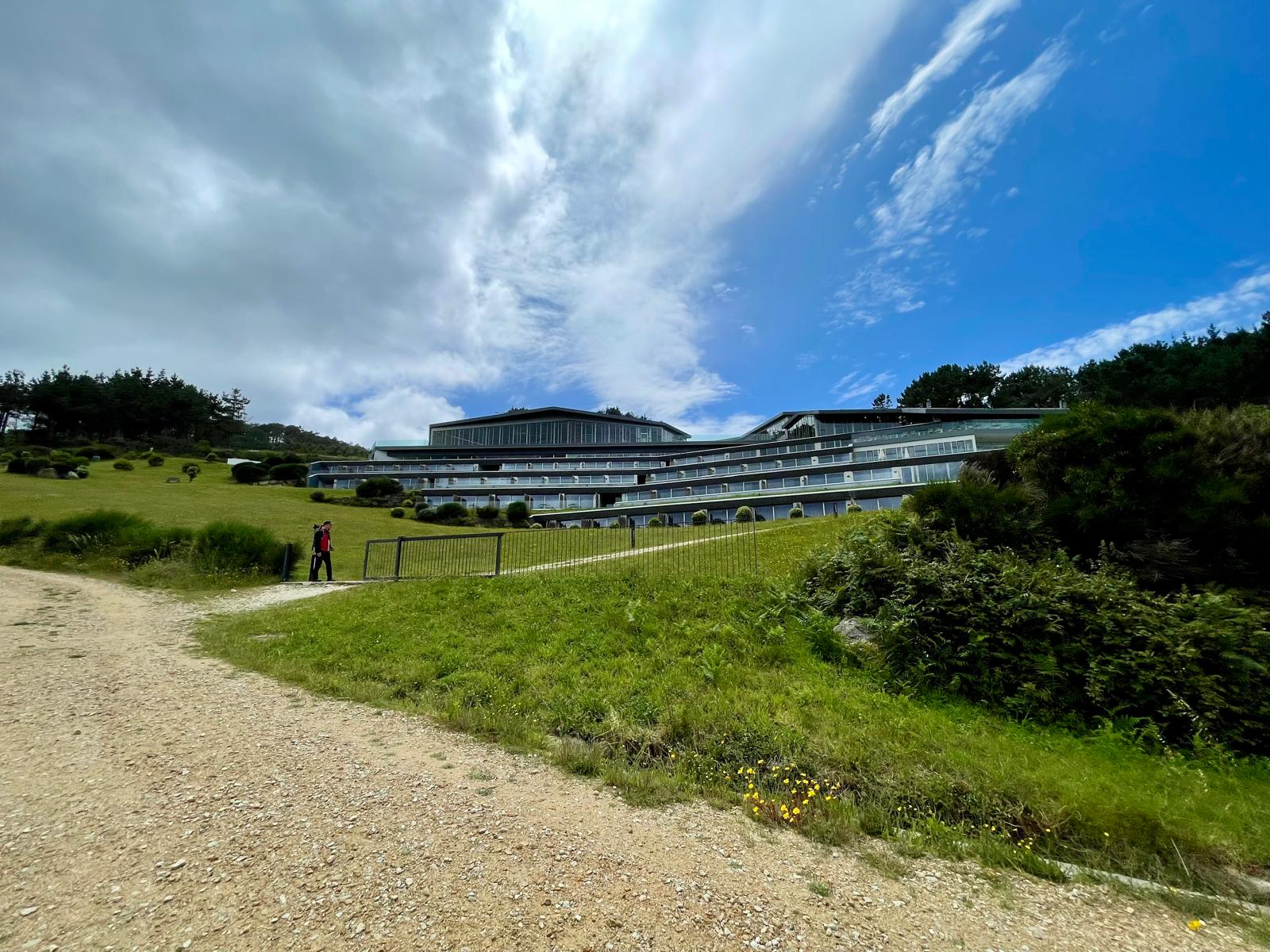
And so to Muxia, another challenging one with wet footpaths getting much wetter as it tipped it down for the duration – when it wasn’t raining, we always seemed to be in the jungle-y bits of the route, so our feet got wetter and wetter, and on the few bits of tarmac we both made a squelchy sound as we walked. Some lovely beaches, but all a bit wet and windy for swimming, and we had an appointment to keep at the Paradores hotel. This was a bit beyond Muxia, but we’d been drawn to it because it looked like a really lovely place to stop mid-hike. It’s new, huge, very modern, and looks a bit like Tracey Island, cut into the side of the hill, and up a long track from a sandy beach.

And very lovely it was inside too, it was on five floors, which were connected by a cross between a lift and a funicular railway. I think it must also be a place to stay for a pampering sunny weekend as well, the other guests all looked a bit fed up with the weather, and we stood out like sore thumbs with our hiking boots and poles (although we did leave them in the room when we went to the bar). Anyway, we did manage a swim, in the ‘seasonal’ hotel pool, which was lovely, albeit under the disapproving gaze of everyone in the cafeteria, looking on in disbelief as we swam in the cold drizzle. Today’s walking game: name one hundred famous Scottish people: we managed this fairly comfortably, but I was denied both Rod Stewart and Alistair Campbell (on the no accent rule, which Mrs E introduced mid-game), although I did score extra points for BA Robertson, and we had a happy twenty minutes not being able to remember any of his ‘hits’. I’m just writing this up, and Mrs E has gone into a tragic fit, as she’s just remembered that neither of us included Jeanette Krankie.

Another diversion in the morning, as we’d had a warning about a loose and large dog that had bitten a walker a couple of weeks previously. So we hopped in a taxi with a very nice man from Luton, who dropped us off beyond the range of the Alsatian which was, apparently, as big as a pony. We started near the Monte de Buitra, which we walked around first to give us a bit more mileage. It was (of course) wet, and fairly desolate, and reminded both of us of Craggy Island. A couple of mysterious farm buildings, a lighthouse (of course) and we only came across one other road user, also striding purposefully along:

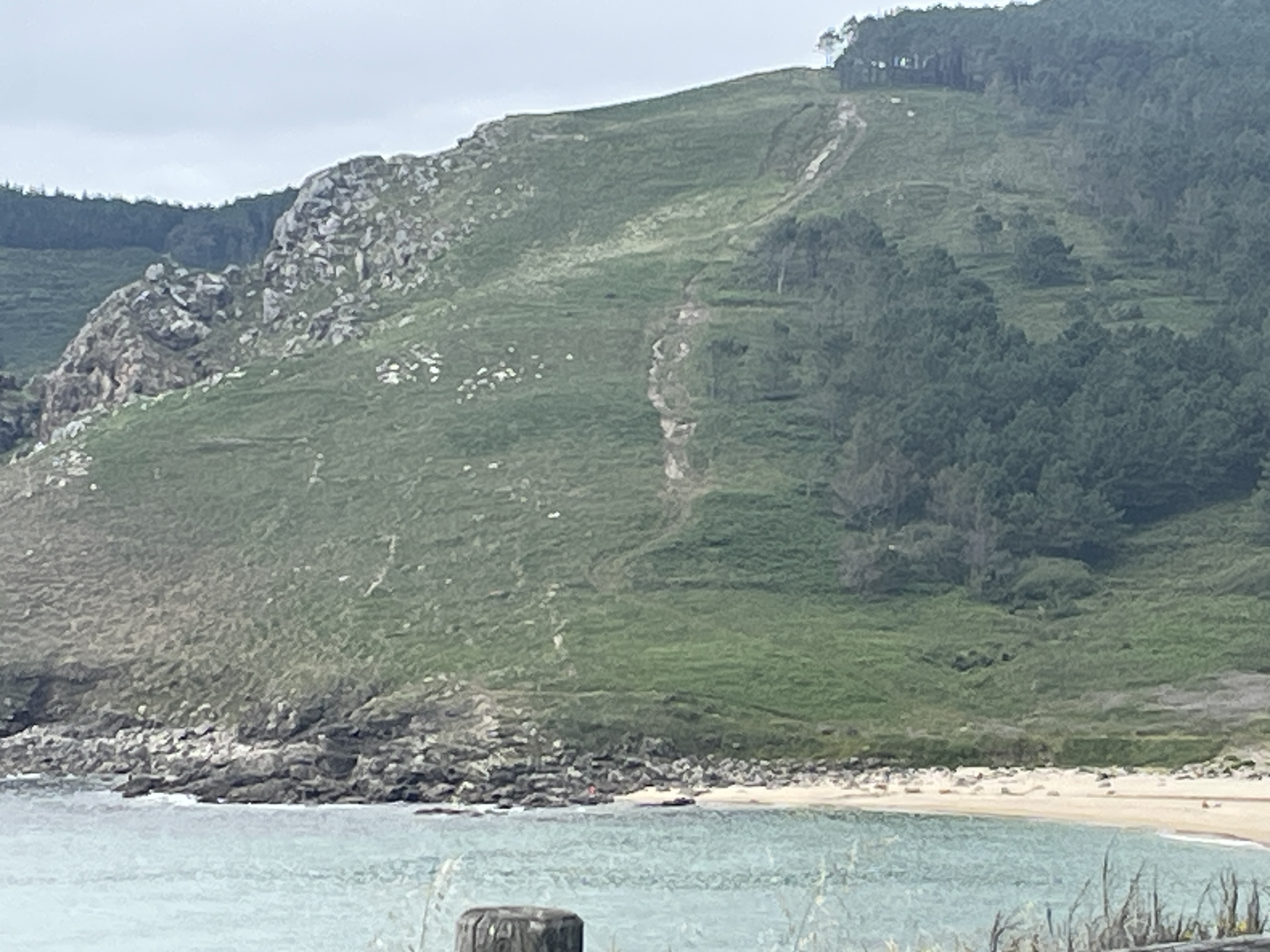
Then south through more rain, up a couple of challenging climbs, and down into Lires, a tiny village which fortunately had a fabulous restaurant where we ate cake when we arrived, dinner much later, and even bought our lunch from them the next morning – hands down the best food that we’d had all week. By now, there was no likelihood of drying out our wet socks or boots, so the socks headed straight for the washing bag, and the boots stayed outside the front door, thereby leaving an unpleasant smell at some distance. The views were amazing on the walk though, we saw hardly any other people this or on any of the previous days, and the footpaths, although marked with green dots, in the most green countryside we’d ever seen, were fairly easy to spot. There were some paths that were described as vertiginous, which were actually ok, and some that weren’t, which were fairly scary. There were definitely places that would have been described as dangerous at home, with sheer drops onto cliffs a hundred metres below, but we were ok sticking to the path, and of course hoping that nobody in their right mind would be walking towards us. Today’s walking game: Musicians as Animals. Mrs E’s winner – Llama del Ray. Mine – Elephants Gerald. Honestly, the miles flew past.

And then, the final leg, from Lires to Finisterre. We were told that we should allow ten hours to do this leg, which was fairly daunting, but in the end it took us just over eight. And probably the hardest walk in terms of climbing (some proper hands over your head stuff) and descending – the drop into Finisterre felt like it was near vertical, and looked like it facing back from the beach (it’s the worn bit in the centre of this this picture):

Finisterre means end of the earth, and it ought to be continental Europe’s most westerly point, given that it’s got the name and everything. But the cape at Touriñán, which we’d walked around the day before,, is further west, as is Cabo da Roca, in Portugal, but, as they say, why let the facts get in the way of a good story? What Finisterre has got, is the most western lighthouse, which pleasantly lit up our hotel room every 30 seconds or so, as we drifted off to sleep that night. Just beyond the lighthouse is a little strip of rock, where pilgrims complete the ‘extra bit’ after they reach Santiago de Compostela. They’re suppose to burn their capes and boots at this point, to formally end their pilgrimage, but apparently that’s now been outlawed – probably just as well, as flaming goretex wouldn’t be a good environmental look. Instead, they have photographs taken, which is better for everyone.

Headed across to the other side of Fisterra for the final night, where we at last managed a swim in the (according to Mrs E) warm Atlantic. Mrs E’s warm is anything over 8 degrees. Mine is above 65, and ideally in a sauna, so we are ill-matched on that front, but she tells me that cold water will be good for my back, and I believe her because she’s a nurse, and because believing her has served me very well for quite a long time now. And so when she says it’ll be a good idea to do one of the full camino pilgrimages next year, I’ll be there like a shot, even if I’m not allowed to burn my cape at the end.

This Is Water

We’d been talking about going to Nepal for about a year, off the back of some fantastic European hikes that we’d done previously. Nepal felt like the next adventurous and ambitious journey so we did tons of research, found a recommended trekking company and agreed a route that seemed to fit our needs. We described ourselves as experienced hikers, which we are, but it would seem that’s different to being an experienced Himalayan hiker, as we were to find out. But we did prepare, (as much as walking in Norfolk can prepare you for ridiculous elevation increases), and counted down the days excitedly. 

And so we left home on a cloudy September afternoon and found ourselves about 18 hours later stepping out blinking into the sunshine of the Kathmandu airport exit, and witnessing for the first time the absolute chaos of a Nepalese city. We managed to find a taxi driver in the throng of people near the exit, threw our bags in the boot and ourselves in the back, and went on the first of many bum clenching rides that we were to have in the next couple of weeks. Heading into Kathmandu meant more and bigger potholes that we’d ever seen, it meant near misses with other cars and scooters that seemed to be heading at us like a weird video game. It meant car and bike horns constantly sounding as vehicles overtook on both sides, and it meant that every right turn was preceded by a small prayer and a brush of the lucky Buddha tassels hanging from the rear view mirror. We had quite a few of these journeys to remember, many with our Italian friend Alberto in the front seat, regularly crossing himself. On a later bus journey from Pokhara to Kathmandu he told me that his watch had recorded 10,000 steps in four hours simply from sitting in the seat and going over the bumps. I’ll not describe every journey in detail, as it might trigger some latent PTSD, but you’re just going to have to take my word that, in the most peaceful and serene country that we’ve ever been to, travelling as a passenger in any motor vehicle is like watching Grand Theft Auto at double speed while someone holds a gun to the side of your head. And no accidents, or at least none that we saw – just as you think that you’re bound to be sandwiched by two other cars, or the pillion rider in the motorbike will fly off at the next pothole, time slows down slightly and order is briefly restored, just in time for you to open your eyes to see the next near-miss.

But trekking was what we were here to do, so let’s return to that. We met up with the trekking company the day after we got to Kathmandu, borrowing poles, sleeping bags and duffel bags for the journey, and, one curry, two beers and a sleep later, met up again at 0630 to take the bus to Pokhara.  We weren’t entirely sure even then who was going to be o the trip, but we were soon joined by our guide (Sandeep), porters (Anish and Nara) and another trekker, Alberto. We were incredibly lucky to spend the next couple of weeks in their company. Sandeep is funny, considerate and knowledgeable. Both porters astonished us by carrying about 25kg from a strap resting across their foreheads and marching across climbs and descents that we could barely manage with poles. And Alberto appeared to be immediately in tune with both of us – about halfway through the trek one of us mentioned David Foster Wallace and we had about 20 minutes on Infinite Jest while going uphill, completely forgetting that Mrs E had been left behind at the start of the conversation. He had quite a lot to share with Mrs E as well – they both had concerns about blisters, stomach issues and altitude sickness, with Mrs E falling to two out of three of these – Alberto was a trained pharmacist and appeared to have a bottomless rucksack containing a chemist’s solution to every ailment. 

So that was the crew that set off – first on the bumpy bus ride to Pokhara, then in a car to Nayapul, then our first trek to Hile. This was a relatively straightforward 10k hike, mainly uphill, but all done in a few hours and readying us for the experience of tea houses and longer days to come. 

We made eight tea-house stops on our trek, and they were all pretty similar – very basic rooms separated by plywood walls, occasional warm water, and communal eating areas where there was a standard menu set by the Nepalese authorities. A bit of variation in this as you get further away from the road, as everything has to be carried by mule or porter (and only by porter once you cross past the sanctuary border), so by the time you get to the base camps, everything that you’re eating, living in and using for power (eg huge LPG bottles) has been carried there by hand for at least two days. While tea houses aren’t necessarily the most sophisticated holdings by western standards, they still use plenty of aluminium doors, steel beams, corrugated iron, cement and timber – all lugged there on the backs of porters negotiating ludicrously steep steps and paths. The standard tea-house menu is fairly limited, but it doesn’t really matter as long as you like Dal Bhat – the Nepalese national dish that always has a bowl of dhal, a mound of rice and a vegetable curry, together with whatever relishes are available where you are. Most Nepalese that we met ate Dal Bhat twice a day if they can – usually with their hands, mixing curry and rice together on the plate and making little mouth sized balls. The portions are really generous, and there’s always an offering of more just when you think you might still be hungry. And they’re totally what you need to power your hiking. 

We were at almost 3,000m by the second day, and on the third morning hiked by head torch at 0430 to the top of Poon Hill, to watch the sunrise onto Annapurna, Dhaulagiri, Fishtail and Himchuli mountains. Mrs E gave up the 800m ascent at about half way, and lay down on a bench with Nara looking after her, but after we’d been at the top for about 20 minutes waiting for the sunrise, she emerged from the final steps with Nara grinning beside her. Apparently her main motivation for her Lazarus-like performance was a concern that I might be left on my own to describe the experience in the future. Proper FOMO! And she was right, as it happens. There wasn’t much cloud about, and it seemed to be clearing just before the sun emerged. I don’t really believe in God but if I did I’d be thinking that he had the biggest ever SAD light – the mountains changed colour completely, lit up in a deep yellow light. 

Three long days of hiking (and dragging up and down huge climbs and stony descents around 3,000m), and we were ready for the climb to Annapurna Base Camp at 4,130m. This would be the first time we’d gone over 3,200m, and we were both nervous about altitude sickness, which every other trekker we’d previously met before appeared to have had. In the event, it wasn’t too bad, although we both had a bit of difficulty catching our breath as we climbed, and Mrs E struggled over the final hour – we got to the Namaste sign below base camp and she burst into tears – she described it in the same way that she’d used when  finishing a marathon in 2006. 

Sunrise the next morning and a shorter amble to see God’s alarm clock light up. This time, however, there were mountains on all sides –  we’d trekked north since we left, then at Machhapuchhre Base Camp, headed west into the base of a crown of mountains. It was simply (& literally) wonder-full. 

Heading back along the trail was always going to be a bit anti-climactic, but we made the best if it, walking through forests with langur monkeys, past stunning waterfalls and over perilous rope bridges, and covering more ground than we’d planned originally, so we could spend an extra night in Pokhara. The final day of hiking was all downhill and largely on road, which was just as well, as the weather reminded us that we weren’t yet out of the monsoon season, and it tipped down all day. After finally getting down to Nayapol, we ate celebratory snicker bars (that had definitely seen better days), shook hands, hugged, put the bags on the roof rack of the taxi, then squeezed our six sodden bodies inside for the bumpy ride (this time with the added challenge of faulty windscreen wipers and opaque screen), to get back to Pokhara. 

A few goodbye beers for Sandeep, Nara and Anish, a great meal at the Little Windows restaurant (recommended, should you ever find yourself in Pokhara), a sleep, an attempt at a run in the rain, a visit to the international mountain museum (recommended as above…), a good curry and a couple of beers, another sleep, then time to head back to Kathmandu. We flew back and Alberto took the bus, which in the end took him 12 hours (it’s only 200km, but the roads are horrendous). We had the best part of the day in Kathmandu, had a couple of drinks with a very tired Alberto in the New Orleans bar (recommended if you find yourself thirsty in Kathmandu…), a quick nightcap overlooking the city, with the top of the Swayambhunath temple lit up (we’d visited a couple of weeks before and it was great, so if you ever find yourself in Kathmandu…), and then another sleep.

We’d arranged to visit the Pashupatinath Temple in the morning. This is one of the oldest and the largest Hindu temples in the world, and sits on the banks of the Holy Bagmati river, so it’s used for funerals, on one side of the river and annual celebrations of the passing of loved ones on the other. As we wandered into the temple complex, we were met by an ambulance which stopped and despatched a body covered in an orange sheet and decorated with flowers, onto a metal stretcher, to be carried round to the riverside. Keeping our distance, we saw the procession heading to the river side, the washing of the feet in the river, the anointing of the body and finally the procession to the pyre, which we were told would burn for 2-3 hours. A real privilege to be able to witness this – we were on the other side of the river for most of the time, so slightly bizarre amongst the celebratory nature of the other river bank. Finally said goodbye to Alberto, whose plan to have a ‘This Is Water’ tattoo in reference to David Foster Wallace was beginning to make a lot of sense (if you don’t know the quote, have a listen here – if only every graduation speech was like this!), then a taxi ride through the bumpy and teeming streets to sort out our flight back home.

In reading this back, I’m concerned that I might have underplayed the astonishingly poor state of the country. Like most tourists, we saw the bits that tourists see a lot of the time, but it’s impossible to ignore the desperate poverty in both the rural and urban areas. Nepal exports about $1.25 billion in goods every year (there are over 30 companies in the USA that make that each year in revenue), and it’s reliant on India and China for buying most of that, but also for providing almost everything that the country needs. The one exception is electricity, which Nepal has lots of, thanks to its network of hydro-electric dams. But it’s still a nation of subsistence farmers and hugely growing urban areas that seem to serve only to concentrate the poverty. 

Fifty years ago, my parents drove me to Heathrow airport and put me on a plane to Karachi, where I was to meet my cousins, aunt, and uncle, who were living and working near Rawalpindi. I was there for only six weeks, and a good deal of that was inside a US/Italian ex-pat compound, but we did manage to travel outside sometimes, and witnessing the poverty juxtaposed with the most astonishing sights of the Hindu Kush and the Kyber Pass was very similar to how the last couple of weeks have felt in Nepal. Pakistan has moved on a little since then, but it’s far from a success story in development terms, and if it takes another 50 years for Nepal to get to where Pakistan is today, then it won’t really say much for civilisation, will it?

Of course it’s wrong to think about this through a western lens and make judgements about how happy people are and what you’d throw away in order to bring whole populations into what we’d consider a better place, but it’s still worth thinking about. And if you think about it and consider it a worthwhile use of money that you don’t really need, here’s a link …

Farewell, Don Hector

Me and Mrs E had cycled in the Netherlands a couple of times before – the last visit was in November, when the weather was so cold that we had to buy ski mitts for the way home, and shivered our way back to the Hook of Holland past completely frozen dykes. So, naturally, we were up for some more of that, as long as the weather was going to be kind to us, which of course it would be, in early May.

Well, not if the weather forecast was to be believed. With a few days to go, the weather across all of Europe was looking a bit bleak, and where we were heading looked like it was going to be raining all day, every day. And with one day to go (actually, on the day of departure (actually, with about three hours before we were due to leave for Harwich)), when Mrs E asked me to check her bike and I found that the hydraulic brake was completely knackered, it was beginning to look like a pretty crappy time was heading our way. 

Mrs E owns two bikes.  One is her lovely bike that she’s had for a few years, and which has transported her on a few tours before – a great bike, although, as we found out quite late on in our planning, not very good at stopping. And her new whizzy Dutch E-bike, which has enabled her to get back from a shift at work in record time, and which she’s terribly protective of. Unfortunately, the problem with the other bike meant she had to ride her pride and joy, which left us with a few dilemmas for the trip. 

Firstly, it being a nice shiny new bike that she was still working out how to use, she was very protective and didn’t entirely trust all its complex features to always work. But her biggest worry was the likelihood of being able to charge the battery every day – especially since one of the design ‘features’ of this bike is a non-removable battery, which means that the whole bike needs to be near a socket to charge. 

I had a different dilemma though. For years on our bike trips we’ve been reasonably well matched, I tend to ride ahead of her and if she needs me to slow down, the deal is that she’ll ring her bell to stop me sailing off into the distance. The first time we cycled in the Netherlands we were heading south through Zandwijk, through all manner of pedestrian traffic, and all I could hear was a regular pinging of her bell. It reminded me of Don Hector, just after Lalo tells him that he can’t find any evidence that Gus is at fault and he’s going back to plan A. Note that you need to have a working knowledge of Breaking Bad/Better Call Saul for that to make sense. If you don’t, just imagine a really impatient hotel guest hammering away at the reception bell. Anyway, Mrs E wasn’t going to be making any Don Hector impressions. Quite apart from the fact that her e-bike has an eerie echo-y bell as part of its gizmo collection, she was never, ever going to be left behind again. I knew this, because when cycling with her in the past, I’d worked incredibly hard to keep up with her, and just as I got alongside she’d press the little ‘boost’ button on the handlebars and disappeared off into the next county. 

With all of this potential fretting in mind, we got the bikes on the ferry on Saturday night, had a short sleep in a fabulous cabin, got up at 6, and by 7:30 were pushing the bikes off the ramp, in our full wet weather gear. The fww gear lasted us about 400 metres, as we realised that all the weather forecasts had been wrong – there was no rain to be seen (and there wouldn’t be any for the next 48 hours). 

So we headed up the coast, a route we knew reasonably well, heading past Den Haag and Katwijk and Noordwijk, where we had the tour’s first appletaart, and on into Haarlem, where we sat down with some impossibly beautiful people and ate a very trendy Sunday brunch. Because we were off the ferry early, we’d travelled most of the trip by lunchtime, so pootled leisurely along to Zaandijk, where we were staying that night. The route through to Zaandijk has many things to love – fabulous cycle lanes, lovely villages, lots of wildlife, no litter, and not really much in the way of people. Those that you do see seem pretty happy to see you, although the ones that we spoke to seemed a bit nonplussed when we told them that we were here to cycle across the Maarkerwaarddijk. 

A word about those cycle lanes. I’ve waxed lyrical in this blog before about the wonders of cycling in the Netherlands. And if you’re bored with that then you can skip this next bit. But the network of cycleways in this country defies belief if you’ve spent your life mixing it with traffic in the UK. In the 1960s, it could easily have gone in a different direction – the Dutch car manufacturing lobby hired an American designer, David Jokinen, to help redesign the streets of Amsterdam and The Hague to make them more car friendly. One of his plans involved concreting over one of the main  Amsterdam canals to build a six lane highway.  Fortunately, a combination of finances and pressure groups stopped this happening. Key to these groups were the Provos, semi-anarchists who were represented on the Amsterdam city council, and the members of Stop de Kindermoord (Stop Childmurder), which was set up following the death of the daughter, by a speeding motorist, of an Eindhoven journalist.  By 1975 there was a standard design manual for road and street development which not only prioritised cycle usage, but complemented it with the concept of living streets and reduced traffic speed. Fast forward to today, and cycling has just become the norm across the Netherlands.  Very rarely do you have to have any contact with car drivers, but if you do, you normally have the right of way, it’s very clear whenever you don’t, and car drivers are, to a fault, polite and courteous. As are the cyclists. It’s almost as if there’s a respect for people riding bikes, which may be a surprise to you if you’ve been used to riding a bike in, say, the UK. The paths that we went on had fantastic smooth surfaces, were often well away from the roads in beautiful countryside, had no potholes, no litter, were clearly signed and just wonderful to spend time on.

Back to Zaandijk, which was great for a walk in the evening past all the working windmills and the sort of houses that you see here and almost take no notice of, but which if they were  anywhere else in the world, would have a preservation order and a turnstile in front of them immediately. My kids, when they were young, used to play with playmobil, and I never really understood the appeal of the buildings, but I think I do now, having spent a bit of time with the real thing – the buildings are cute but functional, and look like they’ve been designed by architects who are incredibly proficient but who never let go of their sense of fun. Huge windows, over-pitched roofs, shiny doors, intricate brickwork, immaculate gardens – like a set of childs’ toys increased to adult size without gaining any of the full sized mess. 

To bed then, and up for breakfast looking over the mist, to just about make out the windmills on the other side of the river:

We were headed for Enkhuizen this morning, via Hoorn, and planned to cycle over the Maarkerwaarddijk in the afternoon, ending up in Lelystad for the evening. On the way we saw yet more fabulous cycle paths, borders of grass and cowslips and elderflower along uninterrupted and unpopulated paths, and pastoral scenes of springtime that made Mrs E go aah in all the right places. We saw ducklings, goslings, lambs and foals in quick succession, so much so that Mrs E titled the road ‘post-natal avenue’ – she was a woman very much in her element. 

The Maarkerwaarddijk was a big deal for us, and almost the whole point of the trip. Mrs E has a thing about bridges – a few years ago we took a trip to Malmö, just so that we could go across the bridge that  connects Denmark to Sweden, which we did, four times in total. We’d originally planned to cross the Afsluitdijk to the north of here, but the mileages didn’t quite work out. There’s not much in it – the Afsluitdijk is 32 km long, and the Maarkerwaarddijk is 30km, so they’re both pretty sizeable pieces of engineering. 

Both dams were designed and built  by Cornelius Lely, who figured that the Zuiderzee would be a safer place for all concerned if it was closed in. This had a massive impact on geography, ecology, fishing and farming, made the resulting massive lakes into fresh water (I’ve no idea how), and massively reduced risks of flooding. The only reason I know any of this is because we’d made good time across to Einkhuizen, so decided to grab a coffee in the Zuiderzee museum, which has its entrance just before the Maarkerwaarddijk. Before we knew it, we’d bought tickets to go and look round the museum, and were told that it was just a 20 minute boat trip away. A little bit unsure about delaying our ride, not to mention leaving all our gear unlocked on the bikes, we still went over, and on the on the other side of the boat trip found a living museum, full of Dutch artisans in aprons and clogs, a full blown wedding in progress, loads of buildings restored to the 1900s, and an indoor museum which told us everything that we ever needed to know about the Zuiderzee. Just fabulous. 

And just a quick boat trip back to find our belongings still attached to our bikes, and to start the two hour journey over the dam   

Which was, of course, also fabulous. Huge sea lakes on each side of the road, great crested grebes that seemed to be located at exactly 50m intervals, and heads down for 30km. Unfortunately, heads down was about right, as we also had the company of about 5 million sand mites who were constantly swarming into our path, and mouths and eyes and ears. Horrible. They eased off after about 90 minutes though, and we had the last few miles of the road sweeping away from the dam and round into Lelystad, to ourselves. 

Into Lelystad, named after Cornelius Lely, and, in keeping, seemed to be full of big buildings made out of concrete. It was a bit of a shock after the nature trail we’d been on for the previous 50 miles, but very friendly, and we soon found ourselves sat down at a slightly bizarre all you can eat sushi techno-buffet, where we knocked back about half our body weights in won ton soup, sushi, fried seafood, noodles, and anything else that looked good on the menu. As a result, we both felt pretty sick for the next 24 hours, but we were on holiday and determined to get our moneys worth.

Up in the morning for a short ride to Amsterdam, which was just as well, as it chucked it down with rain all day. The sort of thing that would make a cycling holiday really hard work, unless of course you had an electric bike, which at least one of us did.  No shortage of water in general – as well as tipping it down from above, we had the Markermeer on our right for most of the journey, and sometimes to our left as well. Into Amsterdam then, and able to mix with lots of other cyclists, and to the Social Hub hotel, ostensibly a student hotel but with fabulous rooms, great food, really lovely staff and great facilities. The sort of place that no student deserves, of course. 

We’d got to Amsterdam early because we had a booked slot to visit Anne Frank’s house, which was suitably sobering, and made our way back out into the rain feeling a mixture of depression and inspiration. 

Wandered around Amsterdam in the evening, still marvelling at the architecture and having the sort of discussion that you have when you’re in a  city that you love (how would we manage if we lived here, could we afford to, what would we do with the dogs, would anyone ever come and visit etc etc) then back to the Social Hub, where lots of happy young people were chatting and working and playing fussball, despite it being way past their bedtimes. 

We expected rain the next day but again got lucky and headed out of Amsterdam to Katwijk, and down through the dunes towards  the Hook. We happened across an Ernest Hemingway themed cafe (as you do) on the side of a lake, where we recharged ourselves and Mrs E’s bike, then diverted into The Hague for some light retail therapy. The route out of The Hague took us past all of the embassy and ambassador buildings, which made us feel like we were cycling in Beverly Hills, and soon we were back on the coast, buying up a load of food in Lidl and then hauling it, our bikes and luggage onto the boat. A very civilised picnic in the cabin, a catch up on Teemu Pukki’s emotional farewell to Norwich City (me) and the German occupation of the Netherlands (Mrs E), a brief sleep, positioned so that when we woke up in the night we could see the stars out of the porthole, and a 0530 wake-up, and we were ready to head home. 

I’m writing this, having got back this morning to a lively reception from the dogs, and the day before I drive up to Scotland for #1’s stag weekend. This will, apparently, involve some drinking, some hi-jinks and some cycling. But it’s really going to have to go some to match the last few days. Proost!

County lines

The plan was pretty simple. I wanted to run/walk around the perimeter of Norfolk, with the minimum of support, and knock out around 170 odd miles in six days. Me and this route have had quite a bit of previous – I tried to run/walk it a couple of years ago, with disastrous results, and for many years I’ve been involved with the Round Norfolk Relay, a great event that follows a similar route, but with 60 teams over 17 stages of a continuous (and thereby, overnight) relay. The Round Norfolk Relay probably deserves a much better write-up than that, so I’ll crack on with that when I’m not wandering around with a stupidly heavy bag on my own.

As with most of these undertakings, I prioritised the playlist over any silly logistics like the best route or the right shoes. And so I set off, literally, with a song in my heart, courtesy of twenty of my favourite albums, a bunch of podcasts and, rather optimistically, a 54 hour audio book of David Foster Wallace’s ‘Infinite Jest’. If you’ve not come across IJ before, I’d recommend a bit of caution when approaching. It’s sometimes referred to as the last great American novel – mainly by fans of post modernist literature who rave on about its meta-fiction leanings and use of tennis as a metaphysical trope. I’m reading IJ as part of a 10 week course where we’re being asked to read 120 pages a week, and so far I’ve managed 120 pages in four weeks, finding bits of it impenetrable, so thought someone else reading it to me might help. Which it has, thus far, but there will get to a point, about 6 hours in where the audio overtakes what I’ve actually read and stops making sense. Which is a delightful segue to the first album to listen to, starting on the early morning train to Cromer, in a bid to decide my favourite live album ever by listening to them really closely. And by the time I’d held both semi finals (Talking Heads/Stop Making Sense vs Johnny Cash/Folsom Prison and the all-R&B battle of Dr Feelgood/Stupidity vs Nine Below Zero/Live at the Marquee), and then held a very close final between Talking Heads and Dr Feelgood, and then allowing THs to clinch the final, partly because of the quality of suits worn by Messrs Byrne & Brilleaux – well, by then I was a good 8 miles into the walk and somewhere between Bacton and Mundesley.

I’d gone wrong at Bacton before by staying on the coast path and not being able to get past the power station without making a 3 mile detour, so I stayed on the beach from Mundesley, hoping to beat the incoming tide, which I just about did. Bacton has put in what I assume are sea defences to protect the cliffs next to the power station – about 3 meters of banked sand which sits above the beach, but which seems to be being blown away by the wind that comes down from the north. So I was lightly sandblasted for a mile or so before heading for Happisburgh, and its postcard lighthouse and church, both sitting perilously close to the cliff edge.

Up along the dunes as far as Horsey, where I took a quick detour to look at the seals. There was a blackboard where the seal people (I assume) had noted that the current seal count was 1,920, although I can’t help feeling that can’t be a particularly precise science.

Stayed on the sand up to Hemsby, where I climbed the steps up to the town, hoping to get something to eat. But Hemsby was shut, as far as I could see. If I’d wanted to fill up at Jack’s Seafood, the Veggie Hut, or Benny’s Beach Kiosk, I was out of luck. And no joy at the Beach Shop or even the RNLI Shop, let alone the giant fibreglass caveman crazy golf course. If you’re from this neck of the woods, you’ll know that Hemsby has been in the news of late, as quite a bit of the town has been condemned to fall off the cliff tops as the sea has washed away what limited defences it has had. And because people can be quite snobbish and cruel, there’s been a fair amount of ‘who cares?’ comment – Hemsby is seen by quite a few people as a poor cousin of Great Yarmouth. But as you walk away from the sad attractions and past/under the town, you realise that that attitude is, well, snobbish and cruel. You can look up at the edge of the cliff, where only last year there were front gardens and the row of telegraph poles that marked the footpath, and now you see the edges of buildings and the poles toppled onto the beach below and it’s really very sad. People lived their lives in those houses, looked after their gardens, tolerated the constant pedestrian traffic in front of them, had kids, moved in, moved out, grew up, lived and died, and now everyone’s being kicked out for their own safety. There are a few disparate concrete and rock defences that have been put on the beach recently to slow down the erosion, but slowing down is probably the best that places like Hemsby can hope for.

On, then, to the hopelessly optimistically named California Sands, then along to Caister, by which time the novelty of the walking /jogging on sand was beginning to wear off (or wear out) , so up to the road again and walked the last bit along the promenade into Great Yarmouth.

My friend P raves about Yarmouth and its history, and I need to go on a visit with him sometime to understand the town a bit more, as up to now I’ve not found that much to love about it. And today was no exception – the quickest way to get to the railway station was through some nondescript streets, an underpass that allowed me sight of the station, and access if I was prepared to cross a few lanes of traffic and a steel mesh bridge. Which I was, cos I had only a couple of minutes before the train left. So I ran as fast as I could, which was an excellent way to get mile 32 on the board.

Day 1 summary – 32 miles, 8hrs 5mins, 66,135 steps, powered by Talking Heads, Dr Feelgood, Nine Below Zero, Johnny Cash, 5 hours of Infinite Jest, and a 3 bean chilli with rice & chips in Winterton.

.oOo.

I’d gone back to Norwich to see Mrs E, sleep in my own bed, and get the heavy bag with all the camping gear. I really wasn’t taking that much stuff but it’s amazing how heavy all this lightweight equipment can be once it’s all packed together and on your back. Everything was in my lovely and cavernous rucksack which I’d bought online purely because it weighed very little, without realising that it was exactly the same material and colour as one of those Ikea bags that you used to get. Cue hilarious jibes from Mrs E as I got everything ready.

I left early, almost managing to avoid waking Mrs E and the dogs, and got the first bus to the station, almost the first train to Yarmouth, and was on my way at exactly 8:08. Which reminds me that I need to write a blog about the number 808… The idea today was to walk, rather than try running, with the Ikea bag, as I only had 20 miles to go to the first campsite. Decided to change plans after the first few miles – the route went inland and I managed to get lost fairly early on, and perilously close to some drainage ditches in finding my way. As it was, with the grass so high and so wet, by the time I was back on decent footpaths my running shoes and socks were completely soaked, and there didn’t seem to be much prospect of getting dry. The walk itself was lovely though, and I made really good progress across fields with no distractions, other than lots of horses, one of which bore an uncanny resemblance to Joey Ramone.

Anyway, after about 6 hours I was nearly at the campsite and it was still only 1430, so I decided to push on to Harleston, get into a hotel which would have a radiator, and cancel the campsite. So this made a nice easy 20 mile walk into a 31 mile route march in soaking feet. Grabbed some food at the Wherry Inn in Beccles and pressed on, through some lovely south Norfolk villages and got to Harleston at about 1900. On the plus side, the room had a bath. On the minus, no radiator, so tried to dry out my shoes in the bar (‘Can I put my shoes by the fire?’ ‘I’m afraid not sir, that fire is just for decoration and produces no heat’) so optimistically put them on the bedroom windowsill and hoped they’d air dry. Which they didn’t.

Day 2 summary – 31 miles, 9 hours 39 minutes, 68,177 steps. Powered by Stevie Wonder/Hotter Than July, Camera Obscura/Let’s Get Out of this Country, 3x Stewart/Campbell leadership podcasts, none of which said anything about leadership, 3 hours of Infinite Jest, and a sweet potato curry & chips.

.oOo.

Woke up in Harleston to sunny skies and the sort of positive feeling that a planned 22 miles, as opposed to the original 34, could bring. And soon I was skipping away from the hotel, literally full of beans and with a another song in my heart (Oliver’s Army, seeing as you asked). Of course, it wasn’t long before I got lost again, and the feet were reassuringly wet before I’d gone more than a few miles. Back on track, I wandered west along the southern county boundary, hopping between Angles Way and Boudicca Way, fields all around for miles, and the solitude only broken by hares and deer running off the path as I approached them. Bliss.

Stopped for lunch in Kenninghall, which also had a Co-op, so I popped in and bought some plasters, as by then I’d had that tell-tale message from my right foot that I was about to lose a toenail. I wasn’t sure what the campsite might have to offer so I also bought some dates and, ever with an eye for a bargain, a half price cheese slice. 

This being Saturday on a bank holiday weekend, there were inevitably some other walkers, who seemed very happy to be alive, and a few large groups of teenagers, who didn’t. I met three of these groups, walking the paths with rucksacks even bigger than mine, and looking quite downbeat. You may be familiar with these groups, or even been in one yourself, if someone ever convinced you that you should do your Duke of Edinburgh’s award scheme at school. I’ve not got a lot of time for the royal family, but I do have a sneaking regard for the Duke’s legacy, as he seems to have managed to take perfectly happy teenagers and subject them to abject misery for entire weekends in the name of service. I saw the last group in the distance towards the end of the day, and they all had marching orange rucksack covers, so they looked like they were transporting radioactive waste across the border. I caught up with the group eventually, and cheerily asked the girl at the back if she was having fun yet. ‘No, not really’ she replied, looking pretty fed up with her lot, and for a moment I thought she was going to burst into tears. Thankfully she didn’t, and I walked along the rest of the group trying to be pleasant and positive, asking the lad in front, how much further they had to go. ‘Only another 4 miles’ he replied, in the sort of tone that he might have used to announce that he has double maths next, followed by geography with the creepy supply teacher.

Soon after the DoE encounter, I got to the campsite, which was ideally positioned at the bottom of Peddar’s Way, a path that follows an old Roman road North right to Hunstanton and the sea. It’s a great route and it’s amazing to trek along it, reminding yourself that there were groups of legionnaires putting their backs into making another perfectly straight road across the country. Although you can’t help wondering whether they all got together a few years later and compared notes on their legacy:

‘Well, my crew finished Ermine Street in record time, and I reckon they’l be using that for years to come, possibly renaming parts of it something like the A10’

‘Well, my lot built the Military Way, as a means to support Hadrian’s Wall, and I reckon people will still be admiring its breathtaking engineering for a couple of thousand years’

‘That’s nothing, my team built a road from just outside Thetford to Hunstanton, and I wouldn’t be at all surprised if it got turned into a barely used footpath in the future.’

Day 3 Summary – 22 miles, 6hrs 30mins, 48,833 steps, powered by Elvis Costello/Armed Forces, Gram Parsons/Grievous Angel, Best of Elmore James, 99% invisible podcast, and a few hours of Infinite Jest. And a veggie burger & chips.

.oOo.

Anyway, I got to the campsite, checked in and got pointed to a field and chose a pitch between a couple of motorhomes. Set up camp, and then went to check out the campsite facilities. The on-site pub would not be providing food, I was told, but they had a few things to eat at the reception. Unfortunately, the only thing that wouldn’t need heating up was a tin of beans. So, cheese slice, cold baked beans and dates for dinner then. Spent a very demoralising couple of hours watching Norwich get taken apart (again) by a fairly average West Bromwich Albion, and, there being very little else to do, decided to go to bed. Had I mentioned how cold it was? It was really cold. So, going to bed was a challenge in itself. I just about had enough clothes to keep warm inside my not-overly-warm sleeping bag. And by enough clothes, I mean socks, pants, tights, trousers, 2 t-shirts, two long sleeve shirts, a down coat, hat and gloves. I convinced myself that I could keep warm like this, if I kept my face inside the zipped up bit of the bag, and tried to sleep.

Sleep did not come particularly easily, and I was conscious at about 0100 that the motorhome next door had decided to play some irritating dance music. This was just about audible enough to be annoying, and annoying is what it was. I managed to drift off, but the music kept up, and it woke me up fairly regularly through the night until about 0400, when I decided that I needed to make some sort of protest. I knew that I should have extricated myself from my sleeping bag to do this, but I was fairly well wedged in, and really didn’t fancy getting cold and knocking on the door of the motorhome, so I took the action that any right thinking Briton and Monty Python fan would take, and decided to fart in their general direction. Now, I’m not one of those amazing people that can summon up tumultuous trumpets at will, but I’m not bad, and I knew the tin of beans would work very much in my favour, so summoned up all my effort into producing something truly reverberating. Despite the racket I’d managed to produce, there was simply no effect on the music, so all was in vain, and I realised all too late, that I’d failed to properly think through my plan. Because farting inside a sleeping bag under multiple layers of clothing, inside a tent, when the only way of keeping warm is to keep your face well inside the sleeping bag, is not to be recommended. The noxious coughing fit that followed the fart also had little effect on the music, so all I’d really achieved was to add toxic fumes to the giddy cocktail of cold, discomfort and noise that had stopped me from sleeping in the first place.

By 0630 and with very little sleep, I decided to get up, pack up, and go, making sure that I knocked on the motorhome door on the way out. Surprisingly, as I emerged from the tent onto the long and inevitably very wet grass, I noticed that the noise wasn’t coming from the motorhome at all, but from somewhere in the distance – it was still going on, and (very obviously now) was some rave event going on a mile or so away in the forest. Obviously, I was a little embarrassed, and I think I noticed the curtain twitch in the motorhome as I stole away in my wet running shoes:

‘I see that idiot camping next door is off early then’

‘Yes, did you hear him last night?’

‘Hear him? Couldn’t not hear him, a bloody sight louder than that rave’

‘Still it’s not surprising – have you seen what he has to eat at night?’

‘Yes, no wonder he’s on his own’

etc etc

Well, at least the early start would allow the long day (32 miles) to be achievable, and there was little chance of getting lost – where the Peddars Way isn’t completely straight, it’s pretty well marked, so I tuned into IJ for a few hours in the bright cold morning. This was the best bit of walking so far, although the silent forest was punctuated a fair bit by the Sunday morning trials bike riders who also seem quite keen on the soft sandy paths. And IJ was a lovely accompaniment. I wasn’t sure if I was really understanding it as deeply as I needed to (although it seemed to make a good deal more sense once I’d gone into that near-hallucinatory state that you get after about 7 hours of exercise), but I think that’s a feature of the whole post-modernistic schtick – if you don’t understand something, you can always tell yourself that the author never intended you to understand it anyway. I got a bit lost listening to a Thomas Pynchon novel once, and was half way through before I realised that the audio app was set on shuffle. So I started again, listening to the chapters in the right order, and it added absolutely nothing to my level of understanding.

Anyway, I was enjoying the whole experience, and decided after 10 miles to try to run for a bit – I was meeting Mrs E later that night and didn’t want to be late. I’d already sent her a series of ‘can you just bring’ messages (Walking boots! Ibuprofen! Nail clippers! Your warm sleeping bag! – it was almost as if I hadn’t planned this very well). I gave her a call and told her about the night’s events, and she convinced me to knock the camping on the head and get accommodation for the last couple of nights. I protested for a bit (my lovely lightweight tent was currently working out at about £50/sleep and I was quite keen to get a bit more use out of it), but I relented, not least as I know that my tent was wet and would be even less inviting next time I put it up. She later told me that, after hearing about the previous night, she was actually driven by the thought of me never, ever going anywhere near her sleeping bag in the future.

Stopped for lunch at a community pub that had just been renamed the King Charles III, and which was sporting a huge England flag outside. Inside, the small dog in the table next to me was trying to look fierce in a Union Jack collar. Almost managed to avoid conversation about the up-coming coronation. Away and a bit more run/walking, past the wind farm around Swaffham and soon got to Castle Rising, which I really wanted to stop at, but didn’t have time. And finally into Great Massingham, where the lovely people at The Dabbling Duck kindly ignored the smell (mainly my shoes) and pointed me upstairs to a room with a bath. Bliss.

Met up with Mrs E and took on clean clothes and walking boots in exchange for very dirty clothes and running shoes. She asked if I’d put the running shoes inside a couple of bags in the boot of the car, as they absolutely stank, and told me the next morning that even so, she’d had to drive home with all the windows open.

Day 4 summary – 32.3 miles, 8hrs 49mins, 67,421 steps, powered by Otis Redding/Soul Manifesto, Sturgill Simpson/Metamodern Sounds, 3 hours of Infinite Jest, and a nut roast & chocolate milk & chocolate drink (not all at once).

.oOo.

The days were going to get even better from here, the Ikea bag was much lighter without the camping gear, and I didn’t have the option of running, as I was in my boots. And the route was into North Norfolk, full of impossibly beautiful villages between great swathes of fields. More and more horse parsley on the road verges and the paths, which seems to be a coastal thing, and which smells of vanilla and celery. And a hill, which I got to after about 9 miles. So I’d been going for about 125 miles at this point, and this was the first hill, which tells you all you need to know about the landscape of Norfolk. Anyway, it’s called Bloodgate hill, and when you get to the top there’s the site of an iron age fort, and you can stand there, and because Norfolk is as flat as it is, see right over the the woods before the sea at the Burnhams, and out to properly shaped fields on all sides, today almost all dark brown and freshly ploughed, with an occasional flashes of early rape seed yellow. I could have stayed there for ages, but I was getting hungry, and headed north to Burnham Market.

Burnham Market has a couple of claims to fame – it was Nelson’s birthplace (although I passed a sign for Nelson’s birth a good two miles before I got to the village), and it’s known by people in Norfolk as Chelsea-on-Sea, for all the second homes and ridiculous cars that descend on it at weekends, spilling out Jessicas and Marmadukes and designer dogs and bemused young nannies. The village centre has a dozen or so shops, one of which is a Joules – hard to imagine that the local population (724 in 2021) can keep that one going. But there’s also a cafe (or, more likely a café) called Tilly’s that made me a sandwich and a coffee without pretending that we were in South Kensington, and I headed out shortly afterwards, narrowly avoiding a collision with a couple wearing matching Breton tops and non-matching but complementary gilets. They were hurrying to miss the rain – when I’d gone onto the cafe the sky had been a glorious blue but now it was really grey. (If you’re from Burnham Market and you’re reading this, it had gone from Lulworth Blue to Elephant’s Breath.) Dodging rain, and more Boden coordinated families, and soon I was heading for the sea.

There’s something wonderful about seeing the sea for the first time. It doesn’t matter if you’re 6 years old and competing for space to look over your Dad’s shoulder to be the first to say “I can see the sea”, or if you’re a 60 year old bloke on his own, climbing over a stile into a field with only half a mile between you and the water. And if you’ve got something wonderful in your headphones at the same time, well it just feels…right. And that’s why, if you’d been travelling on the road from Burnham Overy Staithe to Wells at about four o’clock on the first of May, you might have looked out of your window to see an old man standing on top of a stile, silently and enthusiastically dancing to ‘Life During Wartime’.

This part of the coast has lots of flats and marshes before you see too much water, but it’s beautiful nonetheless. I thought I was on my own when I turned on to the coastal path, but realised, sometimes quite late on, that I was sharing the path with quite a few fully camouflaged bird watchers, lying, sitting or standing perfectly still. They were friendly enough, but I sensed that they were a bit disappointed by their cover being blown by some twit with a big Ikea bag on his back strolling along and wishing them a good afternoon.

The grey sky now just a memory, I headed for Holkham. The beach at Holkham must be a good couple of miles across, and has enormous sandy beaches that wouldn’t look out of place in a brochure for the Seychelles:

After Holkham, across some dunes and woods and into Wells, which was selling Bank Holiday ice creams to familes on the front, and further back into the town, lots of beer to happy people with red faces. Found my bed for the night, left the Ikea bag in the room, and headed to join them.

Day 5 summary – 24.8 miles, 8hrs 08mins (there it is again), 54,881 steps, powered by Long Ryders/Final Wild Songs, Nick Cave/Abbatoir Blues, several hours of Infinite Jest, a demoralising Norwich City podcast, and a prawn sandwich and slice of Billionaire’s (I know, but it was Burnham Market) shortbread.

.oOo.

And so to the last day, the shortest leg, and the delights of the Norfolk coast path for the whole day. The sun was shining, my feet were dry and had the same number of toenails attached as when I’d started, and all was right with the world. And typically, this is where you’d find a ‘however’ thrown in to darken the mood. But there isn’t one, really. I didn’t want to rush this leg, so I just followed the long and winding sandy path past Stiffkey and Morston, passing the sort of harbour that ought to be in a Famous Five book:

Then on to Blakeney, and looking out to Blakeney point, still on the path, before turning back into Cley, crossing over the river and through the village and out again to the beach where, for the first time, I could wander down to the water edge. I say wander, but it was more like moonwalking, as the beach at Cley is gravel, and lots of it, and really difficult to walk on without sinking. And by lots of it, I mean miles and miles, all the way up to Weybourne, where at last you can get on to a cliff path again. The route from Cley through to Cromer is stage 5 of the Round Norfolk Relay, and I made a mental note as I waded through the shingle not to offer to run that leg in this, or any other year. Just before the end of the leg, there’s a climb up the ‘Beeston Bump’, which is one of those hills that is so steep that you have to use your hands to run up. I ran this leg a few years ago and can vividly remember panting my way to the top of the hill, and finding myself at eye level with the shoes of a couple of the running club’s supporters, who’d positioned themselves on the top bench with the express aim of watching their fellow runners go through agony after 10 miles of really hard slog. As I finally got to the top of the path, they both shouted out ‘Well done!’, and Great Running’, which are exactly the things that you shout at runners at any race, but this time I think they really meant it.

After the Bump, it’s a fairly easy stretch down to Cromer, with West and East Runton on the right, and the crashing sea a few yards to the left and lots of yards below. Eventually you get to the bit where you re-join the beach, and with only about half a mile to go, my fairly slow walk turned into a bit of a sulky saunter, as I realised that I didn’t really want this bit to end. It was 1630 and I’d not eaten since breakfast, so I was really hungry, and if I just walked to the steps and went up to the promenade, I could have my fill of anything that Cromer had to offer. Ok, this was basically chips or ice cream, but both sounded quite good. So I climbed the steps. I decided I couldn’t be bothered with chips or ice cream, so I sat on a bench, fished around in the Ikea bag and found a manky protein bar. And then I stopped my watch.

Day 6 summary – 22.3 miles, 7hrs 31mins, 52,465 steps. Powered by The Kinks, Hamish Hawk, Teenage Fanclub, Aztec Camera, T Rex, Velvet Underground, The Bluebells and The Staple Singers. And another 4 hours of Infinite Jest. And one manky protein bar.

.oOo.

Overall – 167.2 miles, 357,952 steps. I listened to almost 19 hours of Infinite Jest, which means I have a mere 37 hrs and 48 mins left. Oh, and 870 pages. Wish me luck x

Organised Grime

I’d been to Sicily once before, when I was young, naive and, for the duration of the entire trip, drunk. It was a university hockey tour, and probably not the best way to explore Sicily’s culture, geography and people. I look back on the trip with a bit of a shudder, but try to remind myself that everyone does stupid and reckless things when they’re young.

This time was going to be very different. Me & Mrs E wanted to walk the Magna via Francigena, which is a pilgrimage path running from Palermo through the centre of Sicily to Agrigento, and we were promised that we’d (and I rather obviously quote…):

  • Roam the pure natural landscape of Sicily’s rural backcountry
  • Stay in villages full of history, such as Sutera, with its Arabic maze of alleys
  • Experience the enthusiasm, hospitality and pride of the Sicilian people
  • Try traditional Cannoli pie filled with ricotta, pistachios and candied orange

That sounded like exactly the sort of things that we should be doing in March, so off we went.

Our arrival in Palermo was a bit less idyllic – it’s a big city, and the airport train took us to the centre through some fairly ropey areas, depositing us outside the central station, with Google maps assuring us that we had a 10 minute walk across to our hotel. Half an hour later, having wheeled our cases through cobbles, kerbs and lots of litter, we found the hotel, checked in, and wandered around Palermo looking for our dream candlelit trattoria. One brightly lit vegan burger later, we found a bar that served Mrs E some weapons grade Aperol spritzers , together with huge plates of bruschetta and chips, which were, apparently, a gift from our host, who must have thought that we looked hungry. Our Italian is very limited, so our conversation was a bit stilted, but it did allow him to say “Hello Baby” a number of times at various volumes, and to establish that Paul McCartney and Mick Jagger were both still alive, and that he’d like to visit us in Liverpool at some point. We made arrangements to come back after the walk for further entertainment.

We had a taxi pick us up in the morning to deliver us to Santa Cristina Gela to start the walk. Again, a challenging conversation but we did establish two important things. Firstly we should always follow the red and white path markings. And secondly that GPS was a very good thing indeed. There was some other stuff that may or may not have been about Mussolini and railways, but that was much harder to follow and probably best ignored.

Our walk to Corleone started gently on undulating, soft green grass tracks, shortly giving way to a bit of mud. The first 10km was fine, but then the mud started getting wetter and wetter and turned from mud to clay, and before too long was adding a couple of pounds to our boots.

We heard a couple of days later that Sicilians call people from Corleone ‘Men with feet of clay’, which I don’t think is intended as a compliment, but maybe we were acting like natives with our stupidly heavy boots. We discovered that many of the paths that we took doubled as streams, and quite enthusiastic streams as well, as it had started raining just as we’d started the walk. This meant going down was really scary, and going up was even worse. At one point, we went down a steep muddy path/river bed for about 2km, all the time looking at a river below which our notes said should be crossed carefully, and a grass/mud climb the other side that looked almost vertical. We managed to get across the river, with very fast water coming up to our thighs, and just about got to the top of the other side, despite picking up clay on our boots with every step. I tried to reassure Mrs E that not every day would be like this. I had absolutely no reference point to be able to say this, other than my sunny optimism, which was getting a bit of a soaking of its own. Mrs E was also less excited than me on the result of the Norwich game (a 3-2 win away at Millwall) which came through about half way up the climb.

Finally made it into Corleone, which most people will associate with The Godfather. Don Corleone is fictional of course, but there’s quite a lot of early mafia history which emanates from Corleone, and if we’d not been covered in mud and arriving two hours after it closed then we would have had a wander around the mafia/anti-mafia museum.

Instead, we trudged to the hotel, where we were greeted by power cuts and some firm instructions that we should be taking off our boots, after which we were directed, freezing, barefoot and outside, to the room furthest away from the main building, presumably because we offered a health hazard to other residents. Between our room and the main hotel there were an astonishing number of lights on every tree and every wall, and possibly giving a clue as to the source of all the power cuts.

Washed most of the mud off and opted to eat in the hotel, partly as it was still chucking it down and partly as it was the only place open in the town. An interesting experience, and again not quite the rustic candlelit trattoria that we’d hoped for – I don’t think I’ve ever been in somewhere so brightly lit, except when the power went off. We were ushered into the main eating area, and took a seat near the middle, and just as we sat down Mrs E asked if we could move – there was a smell coming from the middle of the room that was going to impact her dining experience. The smell came from the centre table, where a man in dungarees had sat, and Mrs E was absolutely right – he absolutely stank of urine, which appeared to have made its way onto the yellowing hoody that he wore under the dungarees. Feeling a bit more charitable than Mrs E (Norwich’s away win was still making me very upbeat), I suggested that he might be a local farmer, and that we shouldn’t judge, because it “might not even be his own piss”. This reasoning wasn’t really appreciated, and we noticed that the many other diners were also moving tables, so that we created a kind of neutral doughnut around the poor smelly bloke.

A succession of waitresses came to see us, our attempts to point at things on the menu and ask for them didn’t seem to work at all, and eventually the third waitress agreed that the point and say “Si” approach was acceptable, despite her attempt to upsell us the risotto. All of the staff looked as if they would much rather be somewhere else, but it may be that they were undergoing some sensory deprivation testing. In addition to the assault on their noses and the blinding lights, there was a sound system that would have done justice to one of the larger Ibizan clubs. It was mainly tuned into a local radio station, but at one point managed to mash up the radio with the football commentary from the huge TV screen in the bar, together with some romantic ballads on the restaurant speakers. A special mention for the only male member of staff, for whom the name ‘Lurch’ might well have been invented. Wordlessly and aimlessly he wandered between tables, occasionally picking something off one table to put it down somewhere else. His bow tie, which presumably had begun the evening at a steady East-West setting, had begun moving around of its own accord, a bit like a revolving tie with a very flat battery. Halfway through our meal it had gone from ESE-WNW to a jaunty SE-NE, and by the time we left it was creeping gently towards true north. Maybe that’s how you wear a bow tie in Corleone. But it’s Corleone so maybe best not to ask.

Up early the next day for the next leg, a 21km trek into Prizzi, which would have been stunning if it hadn’t been tipping it down with rain again. We’d had a hasty breakfast, sped up by the surprise arrival of Urine Man, who popped into the restaurant for a coffee and left behind a distinct reminder of the night before.

Walking up and out of Corleone past olive groves and broken down farms, an idyllic walk spoilt only by the amount of fly tipping on the side of the paths. Fly tipping feels like it’s something of a national pursuit round here – whole bathroom suites and tiles at one point, collections of kitchen contents next, clothes thrown onto the road, a bin liner which was split open and was spilling out human hair, and loads of plastic bottles and cigarette packets, often with branding that I’d not seen for years at home. I mentioned to Mrs E that there were loads of Chesterfields on the road, and she told me about an hour later that she’d been impressed that I could tell the type of sofa that had been dumped, just from a few springs and cushions. Alarmingly, there were lots of disposable gloves on the side of the road as well – now why would that cause any concern?

We saw no one else walking, but a couple of drivers took a bit of interest in us. The first one stopped his car so that he could shout a long and enthusiastic message of support, complete with lots of positive hand action. We decided that, as this was clearly a great place to waste enemies, that he was using us as potential alibis. He might well have been responsible for some of the disposable gloves. A few km later, a jeep overtook is up a hill and the driver jumped out, asking if he could take our photo, as his web site publicised the Magna Via Francigena pilgrimage. Or at least, that’s what we thought he said. There was definitely something about his web site in there, but it would have to be really specialist for a picture of two muddy tourists in walking gear for us to be the March calendar picture.

We saw a bit of wildlife, in the form of giant frogs, most of which had been flattened on the road, and vaguely domesticated dogs, many of which decided that we were deserving of a lot of attention.

Sicily has a number of dog breeds, but we mainly drew the attention of the Maremmano-Abruzzese sheepdog. These dogs, which look like oversized white labradors, are bred to protect sheep, and to bark if they see anything out if the ordinary, which definitely included us.

Apparently they’ll also attack, if provoked, and will only stop once the shepherd calls them off. Frustratingly, we saw a great many dogs, and no shepherds. Mrs E read up about the dogs later and found articles suggesting they weren’t recommended for keeping as pets in towns and cities, as all they did was bark all the time. Which led, naturally, to a conversation about Solomon, a dog who we will always miss when we go away, but will wish he could shut up within minutes of getting home.

Finally started the long climb into Prizzi, and with about 1km to go a car pulled up and the driver jumped out, addressing us by name, which was a bit unnerving, until it turned out that it was Salvatore, who owned the Airbnb that we were staying at that night. He’d noticed it was raining and asked if we wanted a lift for the last bit, but we took a look at the state of each other and the cleanliness of his car and thought better of it.

We met up with him later when we’d arrived and it turned out that he’d been a driving force behind the Magna via Francigena route – he assured us that the worst of the mud climbing was behind us, and pointed us to the only restaurant open in Prizzi that night, a very brightly lit Pizzeria which turned out to be staffed and frequented entirely with cast lookalikes from The Sopranos. At one point, Christopher’s double came in for a takeaway, while Uncle Junior held court with dozen of his family. Truly bizarre.

Prizzi is one of the towns that had offered houses for sale for €1, to anyone prepared to live in them for a couple of years. In some areas you’d also get a grant of up to €30k to spend on the property, again if you committed to live there. Cammarata, where we were walking to next, had made headlines a couple of years ago by waiving the €1 fee. You get the dilemma when you go through the towns – these are idyllic places to live but there’s no work about, and an aging population. There’s some indication that the incentives might have drawn some younger people back home, but from what we saw, probably 90% of the houses were shuttered up, and of the few people we did see, they were even older than us.

Not that we actually saw any people on that day’s walk. We did 25km on a very hilly path, mainly through the Carcaci nature reserve – more beautiful views over the mountains and deserted forest roads as we climbed up to just under 1000m. All was well until the rain kicked in again, this time with some added wind, which soon turned ridiculously strong. By this time we were descending along a cliff road, with vehicle detours in place because of falling rocks. It was probably the only really scary part of the trip, and we arrived in Castronova, making quite the bedraggled entrance into the only bar in town, and immediately being ushered into a side room for the sake of the public good, where the barman brought us hot chocolate and cannola, and suddenly all was right with the world.

We were half way through the walk now, and were in fairly good shape other than Mrs E’s blisters, which hadn’t been helped by having the previous three days walking in soaking wet socks and boots. The next day was to Sutera, another impossibly pretty town surrounding the Monte San Paolina, and it was only 15.5km, so we thought we were in for an easy hike. In reality, it was another tough one, the initial climb up to Aquaviva Platini was a challenge, then followed by a long and very muddy ridge walk to the long road up to Sutera.

Worth it for the views alone though, and we were sustained by a long round of ‘Finding The Band In The Hardware Shop’, with winning entries including Sister Sledgehammer, Sheryl Crowbar, Paint Guns and Hoses, Barbecue Streisand, U Bend 40 and Earth Wind and Firelighters.

We stayed a couple of hundred metres downhill from Sutera, and again, there was only one restaurant open, which was a little way away. Our B&B host was appalled at the idea that we might want to walk to it in the dark, so she called the owner, Franco, and arranged for him to give us a lift. Don’t think we’d get that sort of service at home. Anyway, we got picked up in a knackered Fiat with no suspension left, and we’re despatched at breakneck pace to Franco’s restaurant, where we had the best antipasti we’d had all week, then the best pasta we’d had all week. We both almost fell asleep at the table, as we had to wait for Franco to finish his pizza deliveries and lock the restaurant up, but well worth it nonetheless, and to get us home at a reasonable hour, Franco went for a PB on the way back.

From Sutera to Racalmuto then – another long day punctuated by stunning views, and very lively dog interactions, the scariest one being with six loud and lively sheepdogs at once who seemed to be keen on herding us toward their sheep, then immediately away from them. More stunning valley views and with the bonus of decent weather, the walk took around 7.5 hours – Mrs E concluded that her cut off point, for future reference, was six hours, which I look forward to forgetting when we plan future trips. Todays best game was ‘Famous People In Hospital’ and winning entries included Urinary Tract Geller, Cancer Ian McKellen, Jennifer Canestan, Rib Separatori Amos, Gina Lolladentalbridgeida, The Monty Burns Unit, and my personal favourite, The Brighouse and Gastric Band.

As ever, it was another climb into Racalmuto to end the day’s walk, but this time into a town centre with loads of pedestrians and cars. We managed to find somewhere to sit and watch what was going on, as we’d not seen so many people in one place since Palermo. It turned out to be a funeral at the church in the town square – we were assured later that it was normally much quieter, and sure enough, when we sought out the only restaurant open a couple of hours later, there was nobody around. There was a bit of confusion at the Airbnb that we’d booked before then though – we assumed that when we’d been let in, that we had the whole flat to ourselves, and so set up camp in the kitchen. I offered to get our boots cleaned, as the next day was the last day of walking and was mainly on the road – we didn’t want to trudge a load of mud into our last hotel in Agrigento. So I set to, cleaning hopefully the last bits of clay in the kitchen sink, which took a lot more time than I thought. Just as I was getting to the end, there was a loud Ciao Ciao downstairs, and into the kitchen stomped a vision in leather trousers, leather waistcoat and a very stern expression, which turned pretty thunderous when she saw what I’d been doing in her kitchen sink. Going ballistic is an overused expression, but completely valid in this case, and for the first time since we’d landed in Sicily, I was very glad that I couldn’t understand Italian. I did, however, get the gist, and apologised as much as I could, and also established that there were two other parties taking rooms in the apartment and that the kitchen was only to be used for breakfast. Cruella, who Mrs E had named within seconds of meeting her, was in charge of breakfast, which unsurprisingly the next morning turned out to be a rather spartan affair. But completely served us right.

And so to the final day, a short (11.5km) hike up to Grotte and then largely downhill on roads into Caldare, where we got a train into Agrigento. Still beautiful, particularly the start, but more houses, (mainly) chained dogs and litter as we headed towards the coast, so we were pleased to be able to get the train. We got into Agrigento and walked what Google maps had told us was 20 minutes to the hotel, and which ended up as 45. We really wanted to see the Valley of The Temples and were told at reception that it was a 15 minute walk, so Mrs R bandaged up her blisters and off we set for the last trek of the holiday. Unfortunately we took a wrong turning, ending up 45 minutes later at the wrong entrance, but that mattered a lot less as soon as we started to hike up the hill to see the temples. It would be worth going to Sicily just to see this archaeological site – it’s over 2,000 acres in size and is brilliantly preserved – The Temple of Concordia is the most stunning, and the one that you’ll see on the tourist sites – built in the 5th century BC and still looking pretty good:

We were knackered and ideally would have got in a bus back to the hotel, but there weren’t any buses or taxis, so we trudged up the hill back to the hotel, packed away our walking boots, popped Mrs E’s blisters, showered, and went into the restaurant to celebrate. It ended up being a bit of a muted affair, as we were both so knackered, but we still had a couple of days ahead in Palermo where we could get the right side of an Aperol spritzer or two, so we looked forward to that instead.

Next day, to the station and the train back to Palermo. Slightly demoralising to take 2.5 hours to cover slightly more distance than we’d taken six days to walk, but I guess the train had a lot less mud to contend with. And Palermo in the sunshine was lovely – really stylish and as effortlessly cool as many of the other Italian cities we’d been lucky enough to visit. An afternoon at the No Mafia Memorial was suitably sobering, but the Aperol was calling, and it was only a short walk away…

It’s called Iceland for a reason, dummy

Yet another ‘sorry I’ve not been bothered to write a blog for ages’ apology to start. Sorry.

In particular, sorry to the several (yes, several) people who mentioned this in the pub last weekend. And not that there’s been nothing to write about, either. Since the last time we met*, me & the Mrs have been on a few adventures, Norwich City have managed to drag themselves into new lows/highs/lows on a weekly basis, and there’s been fun & games with bicycles, running, dogs and music, often all in one day. So sorry. Again.

With that in mind, I’m going to start jotting down some thoughts on being away from home (incidentally, until recently the only place that NCFC have had any success this season), and, more or less in reverse order. And then it’ll be time to tackle some of the weightier questions of the day, such as how to manage when your dog becomes older than you, what age is appropriate to stop messing around in bands, and why your smoking history may say more about brand affinity than any market research programme.

First then, to Iceland. We’d decided to go to Iceland last summer, when you might remember, it was desperately hot. Unlike myself, Mrs E doesn’t really enjoy any temperature much above 15°C, so was quite keen on planning some time away, to go, I suppose, to a place not in the sun.

Taking this sort of decision was, in retrospect, a bit of a knee jerk reaction. Just like how you shouldn’t go to the supermarket when you’re hungry, get married for the presents or lead a government with no qualification to do so, booking a cold holiday for January when you’re hot in August should really take account of the fact that you’re going to be bloody cold for a good few months before you go. But we were also going because Mrs E believes that being cold, and in particular, being cold while submerged in water is good for her joints (insert your own joke here about making them difficult to light). So it seemed an ideal destination.

Mrs E is also fascinated by countries that can be dark all the time, or light all the time, and that’s a box that was ticked almost immediately on arriving in Reykjavik around 4pm in complete darkness, and by spotting the first tiny bit of sunlight just after 11am the next day. But Iceland seems to manage its way through darkness by making the most of it. We were there mid January and were surprised to find Christmas lights everywhere – we were told later that they stay up typically to the end of February, as they lift the spirits during the more depressing months of the year. Blocks of flats have matching lights across all the balconies, often paid for by the building owners, and we heard of fines being issued if you didn’t do your bit to cheer up your fellow man. Indoors seems to be a bit different – Iceland appears to have taken elements of the Danish hygge movement to its heart, so that any time you walk into a public building, hotel or restaurant you’re plunged into darkness, even during that narrow window of light outdoors. On a couple of occasions we had to search for things we’d dropped in the hotel room by using the torches on our phones , and we used the same technique in restaurants, fearing that if we didn’t get the order right that we might be landed with some of that tasty fermented shark that we’d heard about.

Reykjavik, some time between 11am and 3pm

Maybe these low wattage rooms were something to do with conserving energy, you might think. And you’d be completely wrong. Where the rest of the world wrings its hands and pays lip service to our apparent energy-driven oblivion, Iceland sits back with a pious grin on its face. It may not be that great for fresh food, or a stable tectonic environment, but it does very nicely for clean energy, thank you very much. Electricity comes from geothermic water processing and hydroelectric dams. Hot water goes straight from the geysers and underground sources into the pipes that provide domestic hot water, which is why in older buildings you can still smell the sulphur when you turn on the hot tap. There’s so much electricity being generated that Iceland has three of the world’s largest aluminium smelters, and Icelanders pay around €90 a month for all of their utility bills.

So, they’re pretty well sorted in lots of ways, and now that most people have forgotten the Icelanders’ part in crashing the world economy in 2008, they seem to be making up their economic numbers with a heavy focus on tourism, which provides about 40% of Iceland’s annual exports, 10% of its GDP, and 15% of the workforce. This is mainly focussed in Reykjavik, where curious tourists like ourselves can step out of their darkened rooms onto a dark streets and be picked up and transported across the dark landscape to lagoons and geysers and frozen waterfalls, all of which have a significant wow factor. And if you’re adventurous, and don’t mind being cold and very patient, you can go out and search for the northern lights, probably the greatest tourist money-spinner of all. We were very keen to see the greatest free show on earth, so forked out £60 each to stand on the side of a big boat for a couple of hours in -10°C at 10pm. The lights did make an appearance about an hour after we’d set off, and danced about the sky while about 200 tourists scrambled for their phones to take some very grainy photos. Our captain obviously wanted to get a good look as well, so turned the boat towards the lights, at which point all 200 of us rushed to the stern of the boat, in a scene eerily reminiscent of the last scenes of Titanic.

Not entirely satisfied with our dodgy photos from the boat, we chatted to a couple of Icelandic folk, who advised us that Thursday would be a far better night for chasing the northern lights, but we’d be better off going by minibus across the island and away from the light pollution of Reykjavik. It was going to be a bit more expensive, but the trip did include hot chocolate and, more to the point, ‘if anyone was going to find the northern lights, it would be the driver of that minibus’. So, we were duly despatched from the hotel late on Thursday, hopped into the minibus, and spent several hours experiencing the art of searching for the lights. In practice, this seemed to be about getting off the main road and heading into the heart of Iceland, on narrower and narrower roads, stopping occasionally for the driver to jump out, look up at the sky, tut loudly then jump back in the bus and drive on again. A word about Iceland’s roads at this point. There is a main road that goes around the island, imaginatively called the ring road. This is used a lot, and looks like it is gritted. As a rule, no other roads are. Certainly no footpaths are gritted, although some people clear the snow from outside their houses, and you sometimes see a bit of black ash scattered on the paths to make them a bit less slippery. But once you’re off the ring road, you’re driving on a mix of snow and ice. Or in our case, being driven at pace by a born again fearless Viking who was keen to get his charges to their destination in record time. We wouldn’t have been surprised at all if he’d put up a novelty fairground sign with ‘Scream If You Want To Go Faster’ written on it. So a long journey, but far from boring. We stopped, as above, to check to see if the northern lights were any more visible from a layby than from the windscreen. We stopped for hot chocolate, which was hard to drink with mittens and wrapped up like the invisible man, but delicious nonetheless. We even stopped to help our fellow tourists, as our driver skidded to a halt and cried (in a very non-Viking style) ‘Let’s go and do some good, guys’, and we piled out of the bus to try and push a hire car out of a snowdrift. I realised this was unlikely to work as I found myself waist high in snow as we tried to push the car out. But we were in the middle of nowhere, so at least we were able to give the three Spanish tourists a lift back to Reykjavik. You’d think they’d be grateful, but for some reason they weren’t too happy about being rescued when they heard they’d be out for another three hours – kept muttering about having a flight the next morning and needing to tell someone that their car was in a ditch with no known location. Anyway, they held back, looking fairly unimpressed when, half an hour after the rescue, the driver finally stopped the bus and let us out. The driver was very excited.

‘Trust me” , he said, “I think I see them”.

To be fair, the ‘fairly unimpressed’ feeling was quite contagious. We’d piled out of the bus, expecting bright green fires dancing across the heavens, ended up looking at a grey sky that was only slightly less grey than the ones we’d been looking at for the previous three hours. Echoing the punchline of the Emperor’s New Clothes, an apologetic voice referenced the whole grey/green dilemma.

“Aah, but look at the photograph!” triumphed the driver.

Among his many other talents, out reckless Viking driver was an enthusiastic photographer, and had set up tripod, support lights and very expensive camera, every time we’d stopped, and this time he was fairly skipping with excitement. Sure enough, as we lined up to look at the screen on the back of the camera, we saw quite a bit of green sky. Unfortunately, as the actual (very grey) sky was also quite visible, it took quite a bit of Viking mansplaining to tell us that his camera had a more sophisticated understanding of light than our own eyes. Having said which, who were we to pass up the chance of a free photo?

“I bet they’re right in front of us”, we were both thinking

I mentioned Mrs E’s enthusiasm for managing her well-being by getting extremely cold, and ideally submerged, and Iceland in January was, in many ways, her ideal destination. We spent time in the (not so) Secret Lagoon with quite a few other tourists, swimming around between temperatures from baby-bathing to vegetable-blanching, then getting out in our cossies to hobble across the ice to the changing rooms. We had what Mrs E described as possibly the best day of her life, at the Sky Lagoon, where we descended down tiled steps into 38°C water with so much fog that we couldn’t see beyond a couple of metres – it took us a while to get our bearings, and only after some light swimming, a submerge in the ridiculously cold plunge pool, a huge sea-view sauna, an invigorating salt scrub and a bit of a steam bath did we make our way back to the pool and locate the bar, where we spent part of the kids’ inheritance on a beer and a wine, to be enjoyed overlooking the edge of the pool while the sun set over the ocean. Awesome.

I’d made a bit of a schoolboy error in the Sky Lagoon, by not wearing a hat to go swimming. I’d seem people going into the pool in trunks and bobble hats, and decided that I wasn’t going to go for such a ridiculous look. Instead I kept from getting too cold by simply submerging into the pool whenever I started shivering. Unfortunately, as the air temperature was a bracing -15°C, this resulted in my hair freezing with a thick layer of ice within a few seconds. Never thought there’d be such a thing as bobble-hat envy, but there is.

All of this wasn’t quite enough cold water action for Mrs E, so we elected to walk a couple of miles to a local swimming pool a couple of days later. The weather forecast was quite bleak, with lots of snow, sub zero temperature, and what looked like a lively wind on the forecast. We’re used to lively winds at home, and I thought that the weather app was making a bit much of it – it looked like 22 mph to me, which might normally be described as fairly brisk. About halfway to the pool, after much sliding and swearing, I realised that I’d not read the app properly; I’m pleased to report that 22 metres per second is almost exactly 50mph, which is why we’d spent so much time being blown across the icy roads. The wind was still blowing when we got to the pool, still blowing when we got changed, still blowing as we gingerly stepped onto the ice surrounding the pool, and still blowing as we tried desperately to keep warm by swimming up and down, teeth chattering in the gale. Unsurprisingly we were the only people in the pool, and the only people flying back to the hotel in the wind.

There was lots more to occupy us while we were there – Reykjavik has loads of museums, particularly if you’re interested in dark age history or cod fishing, and there are some fabulous places to eat, although, again, a keen interest in cod fishing is helpful. It’s horribly expensive and ridiculously cold, but for all that, coming home to only have to wear two jumpers indoors and managing to get a pint for a fiver suddenly felt like we were living a new dream.

So, if you have a chance, go. Take lots of money, a torch, and a hat to match your swimming trunks.

*Can’t say ‘Since the last time we met’ without reference to :

Since the last time we met I’ve been through
About seven hundred changes and that’s just a few
And thе changes all tend to be somеthing to do
But you’ve got to believe that they’re all done for you, for you

You will win my undying admiration for placing this lyric without the need of t’internet.

Adventures on less than two legs

Apologies for the radio silence from the Emu blog. Like most people, I’ve had a rubbish 2020, followed by a rubbish 2021 and I’m not sure that sharing any of that is going to be of any help to anyone.

However, what I have noticed over the last 18 months or so, is that everyone has been able to derive some sort of enjoyment from other people’s misfortunes. So here’s a blog about misfortune, disaster, stupidity, weird cows and stagnant water for you all to enjoy. Here goes:

Like many other people with time on their hands during lockdown, I decided that I was going to do something exciting once I was allowed to be properly outside again. What I had in mind was a really long run over quite a few days. I’d been talking about this for a while with Mrs E, who approved of the project on condition that a) I didn’t do anything stupid or injuring and b) it didn’t cost too much money. So b) put the idea of running between luxurious B&Bs across the country into the long grass, and I started planning a more spartan event, involving a small tent. I started training properly, and planning routes between campsites, which were beginning to open up in May. And, most excitingly, started ordering all manner of ultra lightweight equipment. As each piece of lightweight gear arrived, I unpacked it, held it gently in my hand, and marvelled at its delicate being. It didn’t strike me until much later that combining lots of lightweight gear in one place would make for something that was actually quite heavy, and that may well count as my first school boy error.

I planned a route over six days, which roughly covered the perimeter of Norfolk, on long distant paths. By the start of July I had all of the routes downloaded, all of the kit bought and paid for and all of the campsites booked. By the start of July I was ready to go – I tried out the tent, albeit in the living room with unwilling volunteers pretending to be tent pegs, because it was raining, and it seemed to work. I could even just about sit up in it. On the 2nd July it had just about stopped raining, and at first light I was ready to go, just managing the time so that I could bring Mrs E her morning cup of tea. Rubbing the sleep out of her eyes, she looked me up and down; the first time she’d seen me in my new lightweight gear.

“Those trousers are ridiculous”, she said, instantly putting me at my ease before my big expedition.
“They look like the sort of thing that Lionel Blair would wear. And they woke me up.”

To be fair, they were a bit ridiculous. Alongside an elasticated waistband that was straight out of the Damart catalogue, they also boasted a roomy nylon fit with long side zips to allow for speedy changing without shoe removal. This was the first time they’d been worn, and she was right, they really did make quite a noise, a sort of shushing, swishing noise that I could only avoid if I walked like John Wayne. I wasn’t really sure about the Lionel Blair reference. Somewhere on the internet there is video evidence of our band playing on TV with Lionel Blair introducing us, and dancing along as we played. I suspect it was more memorable to us than to him, but I have no recollection of him wearing noisy lightweight running trousers. Anyway, armed with this peculiar insight into my wife’s waking thoughts, off I went.

I hopped noisily onto a train to Cromer about half an hour later, with my lightweight/heavyweight bag on my back. Got to Cromer, walked down to the sea, removed the Lionels and started to run, keeping the sea on my left. The plan was to get nearly to Caister-on-Sea, then turn inland to Martham, and then on to Clippesby, where a pitch with my name on it would give me a well earned night’s rest.

Day One was relatively uneventful. Even by keeping the sea on my left I managed to get slightly lost, and had to circumnavigate Bacton power station, which I can report is a good size bigger than it looks on the map. And as I was on the the Norfolk coastal path, unsurprisingly a lot of the running was on sand, so quite a bit of this soon turned to walking. No matter though, and 29 miles later I jogged into the campsite, bought an ice cream from the reception area, found my pitch and (you’ll have to forgive me here, cos I’m new to this camping parlance) ‘set camp’. The campsite even had its own bar, where they were showing Spain vs Switzerland on the TV and serving food. So, one veggie burger, a caramel slice, three pints of Guinness and one penalty shoot out later, I staggered back to my very small tent, and negotiated with my sleeping bag and inflatable mat. The three pints of Guinness were probably my second schoolboy error, as exiting your way out of sleeping bag and very small tent several times during the night is not to be recommended, particularly if your legs are complaining about a long run the day before.

Refreshingly though, I found that I could move fairly freely in the morning, and I’d (apparently) ‘broken camp’ well before my fellow campers had changed out of their jim-jams.

Day Two involved getting onto the Wherryman’s Way, which runs between Great Yarmouth and Norwich – I was going to follow this to Loddon, then pick up the Angles Way, which by the end of day three would land me somewhere around Thetford. I’d decided that today was going to be more walk than run, so had slipped into my Lionels, and made my way noisily out of the campsite, no doubt waking many of the other campers as I shuffled past.

“Did you hear that noise, Brian? Fair woke me up. Any idea what it was?”

“No idea. But it sounded strangely like….well, Lionel Blair, going for a walk”

Off I set along the route, when a voice in my headphones advised me to turn left onto the hiking path. I mentally made a note to write a charming letter to the navigation software company when I finished, as without their help I’d have completely missed the small gap in the hedge which led onto a narrow path.

A few minutes later, and I’d redrafted my note a couple of times, as the path gave way to a jungle of nettles, thistles and reeds which I had to negotiate like an Amazon explorer. Each time I got to a clearing I checked my tedious progress on my phone, and I was still on track – river to my left, field to the right, so there was nothing for it but to press on. In actual fact there was a very clear alternative, which was to turn round, go back to the road and to stop entrusting my well-being with a silly black line on my phone, but for some reason I wasn’t thinking of that as an option. And while I wasn’t thinking of that, a very loud bark was barked from across the field. The weeds and grass were up to my shoulders at this point, so I wasn’t able to see anything that was in there. I’m not by nature a fatalist, but I have read the legend of the Bungay Black Shuck, and I was headed in that general direction. I hoped that me shouting ‘Sod Off!’ very loudly would do the trick. It didn’t, and I was replied with a louder, more menacing, and worryingly closer bark. So I stood as still as I could, like a meerkat, popping my head above the nettles and swivelling around to survey my impending doom….

,oOo.

Meanwhile, about twenty yards away, a frustrated deer put his head above a similar set of nettles, looked in my general direction, barked again, and wandered off. Relieved, I just tried to remember whether deer got particularly aggressive during rutting season, and for that matter, when rutting season actually was. Tentatively I carried on, and finally was rewarded up a climb to a jungle free bank of a field. Checking on my trusty map, I saw that I was still on the hiking path, and off I jogged, with not a care in the world, other than the thought of lunch that no doubt awaited me at some Broadland inn en route.

Crossing the field, I came to a drainage ditch. It was about 3 metres across, and thankfully some kind soul had put a couple of logs across it, and I balanced like a tightrope walker with a bad case of DTs. As I lumped across to the other side, I looked behind me, and saw the log disappear into the stagnant ditch. ‘Ah well’, I thought, ‘no going back now’. It was amongst my more stupid thoughts of the morning.

Along the next field, still no noticeable path anywhere but on my phone, and I got to another drainage ditch. No kind souls placing logs in advance here, and a couple of metres across – too far to jump, even without a ridiculously lightweight/heavyweight pack on my back. What I really needed was some sort of pole, so I could reenact one of those village sports days where they vault across a river. I should confess at this point that I never, for one moment, considered that a ridiculous idea. I found a tree nearby that looked like it had been struck by lightning, and managed to pull off a branch that, to all intents and purposes, looked like something that the Slag brothers from the Wacky Races would carry:

I’m not entirely sure how I managed it, but with a bit of fancy footwork and the help of a muddy island and my caveman club, I managed to get across to the other side without getting my feet wet. Again, the familiar ‘no going back now’ thought rattled around in my head, almost as if it was a good thing.

I strode on purposefully across the next field, still on the path, with a drainage ditch to my left, and still holding my trusty club. I was about halfway across the field when I noticed a cow to my right. And another, and another, and another. In fact, quite a few cows were headed in my direction. I don’t like cows. Never have and never will. They’re gormless, dangerous and the wrong size for their brains. By rights they should be British political leaders, haha. Anyway, several of them were headed in my direction. I tried the tactic that had worked so well with the deer/Black Shuck situation.

“Sod Off!”, I shouted. And to my surprise, they did.

I felt quite pleased with myself, but this was quite a short-lived experience, because as I looked up, I saw many more cattle, all headed in my direction. Clearly the first lot had found my ‘Sod Off!’ so amusing that they’d been to get all of their mates. They were all headed in my direction, and by the time they were a few yards away, I was beginning to panic. I tried ‘Sod Off! and a number of variations on that theme. I tried waving my trusty caveman club around, and over my head. They inched forward, and started to pin me in. Finally I tried.a line that had only previously worked outside a chip shop in Edinburgh, around midnight, about forty years ago, to a drunken charmer who was offering to beat me up.

“I’M NOT FROM ROUND HERE!”

Maybe it was the volume of the voice, the anxious tone, or the combination with the caveman club wave. Or maybe they understood every word, and decided, as did my Edinburgh opponent all those years ago, that if those were the best words that I could offer, then I really was a pathetic specimen that deserved to be left well alone. Whatever it was, they turned on their ridiculously tiny heels and stampeded off in the other direction.

I wandered on towards the edge of the field, still holding onto the club, just in case. Gently stepping on to some reeds, I lost my footing and fell directly into a drainage ditch. By the time the water hit my waist, I’d managed to use up almost all of the swear words I knew, and was cursing on repeat as I threw myself across the reeds to the other side. The bottom half of me was covered in a sludgey mess from the ditch that absolutely stank. As I scrambled up the side of the bank, still cursing, I thought again that at least today’s hike couldn’t get any worse than this point. On reflection, this was a hopelessly optimistic thought. By now, the route had mysteriously disappeared from my phone, as had any mobile signal. So even if I’d wanted to call my wife I’m not entirely sure what I could have asked her to do. My cheery optimism started to peter out.

Seeing an abandoned windmill a few fields away, I decided to head for it, on the logic that there still ought to be some sort of path to it that didn’t necessitate diving gear. I navigated a couple of further ditches semi-successfully, although by now I wasn’t overly worried about getting a bit wet.

.oOo.

I can’t remember the sequence of events that led to the next disaster. One minute I was finding my way towards the edge of a field, looking for a way across the widest ditch I’d seen so far. The next minute, I was in it – I’d fallen through the reeds, I was literally up to my neck in drainage, and my feet weren’t touching anything other than water. The lightweight/heavyweight rucksack was pulling me down, and I wasn’t able to turn around, so I kicked as hard as I could against the reedy bank and launched myself across to the other side. Fortunately I managed to keep my head above the sludge, grabbed onto the reeds on the other side, and hauled myself out. It doesn’t sound too bad written down like that, and it was over very quickly, but I was as scared as I think I’ve ever been in my life. A couple of other thoughts struck me. Firstly, that I’d exhibited astonishing levels of stupidity – if any of my children had been half as idiotic on an adventure as I had in the last couple of hours, then I’d have sounded off at them for being ridiculously irresponsible. And secondly, that if I were to have any say over when I got to meet my maker, then it definitely would not be in a Broadland drainage ditch, dragged out goodness knows when and in goodness knows what condition.

Away from the ditch, I did my best to assess the situation. Mentally, I was now, by a country mile, the most stupid object within a five mile radius. Including the cows. Physically I was tired, and I’d managed to knock my back and left knee so that neither was very keen on any further movement. Stylishly, I had rather lost the edge. My lionels had lost their jaunty swish, and, like all of my clothing was now clinging to me unhelpfully, under a carpet of slime and small-leafed greenery that until recently had been laying peacefully on top of the stagnant ditch. And pungently…well , I was in another place altogether. If every farm animal in the county had shat on me from a great height for 24 hours, I think I would have smelt slightly fresher.

‘Ah well’, I thought, ‘I’m not sure it can get any worse’.

And naturally, it did, but fortunately only for a bit. After climbing up the bank, I found myself in a very large field, fairly close to the windmill. I wandered around the perimeter, peering into the drainage ditches that surrounded it on all four sides. Thankfully there were no cows, but that was probably because, other than airlifting them into position, there was no obvious way to get them onto the field. I considered the situation as best I could. Despite the submerging incident, the waterproof rucksack had lived up to its billing, and everything inside, which included a tent, sleeping bag, two chewy bars and a bottle of water, was all usable. My phone had been in an unzipped pocket but had miraculously not disappeared into the drain – it was complaining of being wet, and was still functional, but without any signal. So things weren’t exactly desperate, but there was still no obvious way to get out of this miserable field.

Walking back around the field again, I noticed that a corner had been fenced off with barbed wire. Behind the wire was lots of reed bedding, which I assumed led to the connection of two drainage ditches. I didn’t have much option but to try it, to see if there was a way of getting across, but I was very nervous about going into an area that was fenced off, given how precarious the unfenced area had been. I said a quick prayer before passing my bag across the barbed wire. Thankfully the bag didn’t sink, and neither did I, as I tiptoed through the reeds. After about twenty yards, I came across a brand new galvanised five bar gate, and beyond that dry land which seemed to lead up to a path. It suddenly struck me that the gate and the barbed wire were there to stop idiots like me going into the field, rather than stopping idiots from getting out, and I fair skipped up the slope, as well as my left leg and lower back would allow.

I realised that I’d managed to get myself onto the Wherryman’s Way. I realised this partly because I knew that the path follows the river Yare, and beyond the path was a huge river. And in the river were the sort of pleasure boats that you only ever see in summer in Norfolk. There were quite a few of them, many piloted by cheery souls in captain’s hats, and they merrily waved at their fellow nature lover standing on the footpath. I waved back, trying to forget that I looked like Stig of the dump, and hoping that they were upwind of me.

I couldn’t run any more because my knee was still complaining. I checked my phone and was delighted to see that I had a signal. So I phoned Mrs E, who was slightly put out to have her Saturday morning dog walk interrupted. I don’t think I’ve ever actually cried down the phone before, but the threat of this must have come through to her, and she said she’d come out to Acle to meet me. Optimistically I asked her to bring a change of clothes and some wet wipes so I could carry on.

I made my way to Acle, found somewhere that sold coffee, and even better let you drink it outside, and waited. Mrs E turned up in a cloud of dust in the car park. She said she had the clothes ready if I wanted to change and carry on, but by then, I was completely fed up and my left leg had given up the ghost. I asked if she could take me home so I could get a shower, lie down, and forget about the last few hours.

On the way home, I asked if she wanted the window open.
“That’s alright”, she said, “you don’t smell too bad. Those bloody trousers were a mistake though”.