
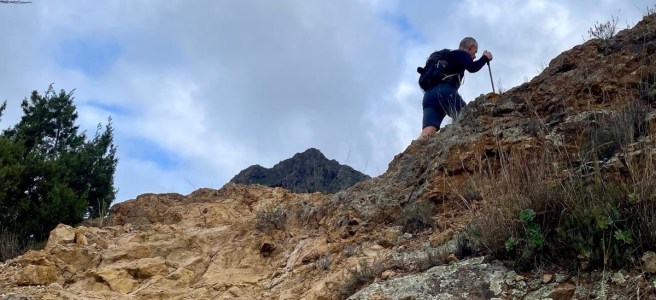
I don’t know if you’ve noticed, but it’s been a bit chilly in the UK over the last few months. We’ve allowed ourselves the heating on from 6 until 8 in the mornings, and from 4 until 8 at night, so spend much of the daytime shivering and waiting for 4pm, or going for walks in big coats. Still, it’s only another few years until we get our bus passes, so then we’ll be able to travel round all day in relative warmth.
So in a bid to go for a walk wearing something a little more flattering, we decided to head South to the Canary Islands, and specifically to La Gomera, an island thrown together by volcanic eruptions about two million years ago. It’s fairly small, about 20km from side to side, and has only 22,000 inhabitants, although that number is a lot more once you add in all the tourists. Like a lot of the Canary Islands, tourists are attracted by the opportunity to sit by the side of a pool and do sod all for a few days, but La Gomera also attracts hikers who, like us, had read about the sub-tropical paradise (over half of the island is a national park) criss-crossed by hiking trails with amazing views. Well, that’s what drew me in, anyway, along with the whistling.
The indigenous Canarians had been whistling to each other for a couple of thousand years before the Europeans popped along for a little light conquesting in the 15th century. Silbo Gomero, as it’s called, was a really useful language, as it could be used to communicate over valleys and ravines, up to about 3km away, so ideal if you were trying to get last minute instructions to a shepherd, or if you’d left your sandwiches at home. I can’t find anything to suggest that there was another language used indoors so I like to think that there wasn’t, because those noisy conversations around the indigenous dinner table would have been quite funny. The language had almost died out by the 1970’s so the government decided to act to ensure that every Gomeran school child would learn whistling as part of their primary and secondary education, which they’ve been doing since 1999. Consequently, every Gomeran born after 1990 knows how to whistle. On the second day of hiking, we climbed up to a viewing point, and I could hear whistling ahead of us. Immediately I thought of those shops that you’d go into in Wales, where they’d start talking in Welsh as soon as a tourist came in, and how I’d always wanted my superpower to be to speak any language just so I could tell them to sod off. Turned the corner expectantly hoping to have the same experience, but the bloke just stopped whistling to say ‘Hola’, which, as you might know, is what British people say when they’re in Spain, to avoid sounding like they’re British. Anyway, he was from Harlow and was whistling because he was being happy.
I digress. What I was really excited about on the Silbo Gomero front, was the reaction of Mrs E to the prospect of the valleys and ravines echoing with the screeched whistles, reminding people 3km away to get some milk on the way home. Because Mrs E has an aversion to whistling in the same way that others dislike nails on blackboards, or crying babies, or the entire works of Barry Manilow. She absolutely hates it, and there are numerous ways to exploit this, such as sneaking a couple of Roger Whittaker hits onto her playlist when she’s least expecting it. She loathes it to such a degree that she can’t stop herself from saying ‘shussh’ really loudly, sometimes to complete (and invariably happy) strangers. So I was really excited about the prospect of her shusshing loudly across valleys, trying in vain to quell the ancient language of the Gomerans.
In the event, none of this happened. The only whistling we heard while hiking was the bloke from Harlow, although we did get on a bus ride down to San Sebastian where quite a few schoolkids were whistling – that may or may not have been the Silbo Gomero, and it didn’t really matter, as Mrs E was far too busy being thrown about by the bus (standing room only for the last two passengers) to worry about shusshing. Although after ten minutes of death defying hairpins, she’d been shaken down into the stairwell of the emergency exit, so I may have missed something. By the bye, that was the worst part of the trip by a country mile. The rest was idyllic, and wonderful, and exhilarating, and exhausting, and generally pretty life affirming…
Well, except for the flight out. That was pretty rank. Last couple of plane journeys I’ve been sat next to passengers who have started off the journey very large, then seem to have got bigger during the trip, spilling out over the armrest and into, well, me. So initially I was quite pleased as a Polish family sat themselves strategically around us, placing their angelic son, who must have been no more than nine, and with a delicate frame that wasn’t going to go anywhere near my armrest, next to me. All was well until a few minutes into the flight, when he started shuffling about uncomfortably, and pretty soon the unmistakable scent of a nervous child with an uneasy stomach, came wafting across the seats. It’s been a while since I spent any time with smelly nine year olds, but I had a feeling that this would last quite a way into the four hour flight, and I wasn’t wrong. And the sight of his doting mother patiently feeding sausages into his upturned beak made me worried all the more. If you’ve spent any time in proximity to keen meat eaters, you’ll know that particular noxious scent that they can emit. And so it was that we landed, with me, Mrs E and several others trying to breathe through our shirts, while the young Polish boy on the Atkins diet slipped away, still quietly farting, probably unaware of the lasting damage that he’d caused.
But onward, and onto a ferry to La Gomera, into a taxi to Hermigua, and ready for the first days hike, to Vallehermoso. Within the first few hours we noticed a couple of things that we’d not accounted for. Firstly, the scenery was jaw-droppingly beautiful. Neither of us had spent any time in sub-tropical paradises before, so we didn’t have a great deal to compare it against, but it was stunning – massive climbs to the top of volcanoes, dramatic plugs from volcano blasts, laurel forests, palm trees and huge cacti everywhere. The second thing was that in order to take stock of all of this, in fact, in order to do anything, you had to go up. And up. And up. The first day we climbed around 1100m, including a diversion that looked before we started like it went straight up the side of a volcano:
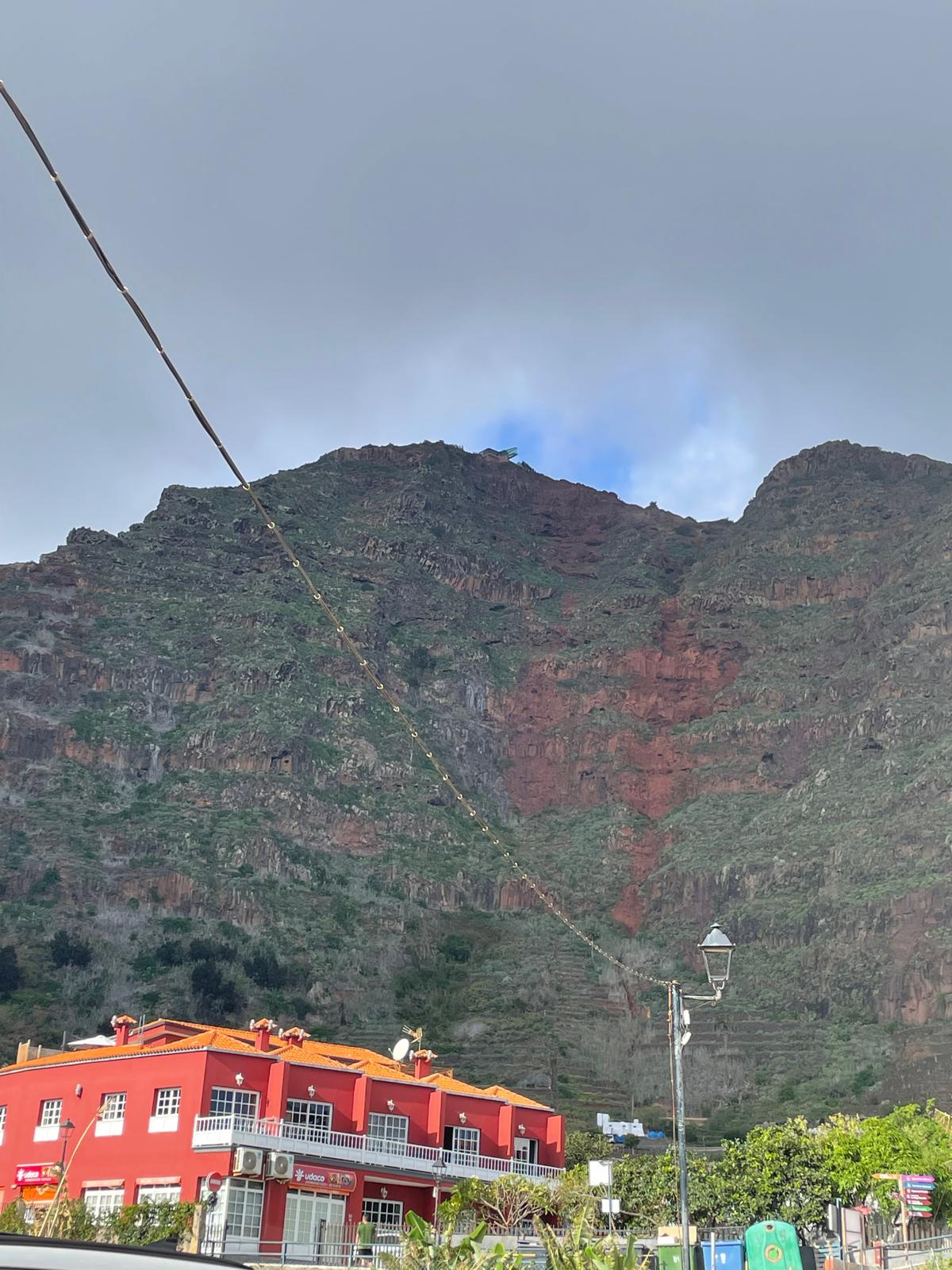
And when we were part way through, the climb, we realised that’s exactly what it did. If you carried on the line of the lamppost in the picture to top, you’d be more or less following the path. It’s hard to describe how steep it was, but I’ll give it a go. Imagine you live in a terraced house, and you decide to remove every other stair from the staircase. then you pour down a load of boulders, stones and gravel to fill the gaps. Then you haul yourself up, navigating your way as best you can between the stairs that are still there, that ought to be there, and are underneath boulders. Then you repeat, say, fifty times. Well, that’s your warm up.
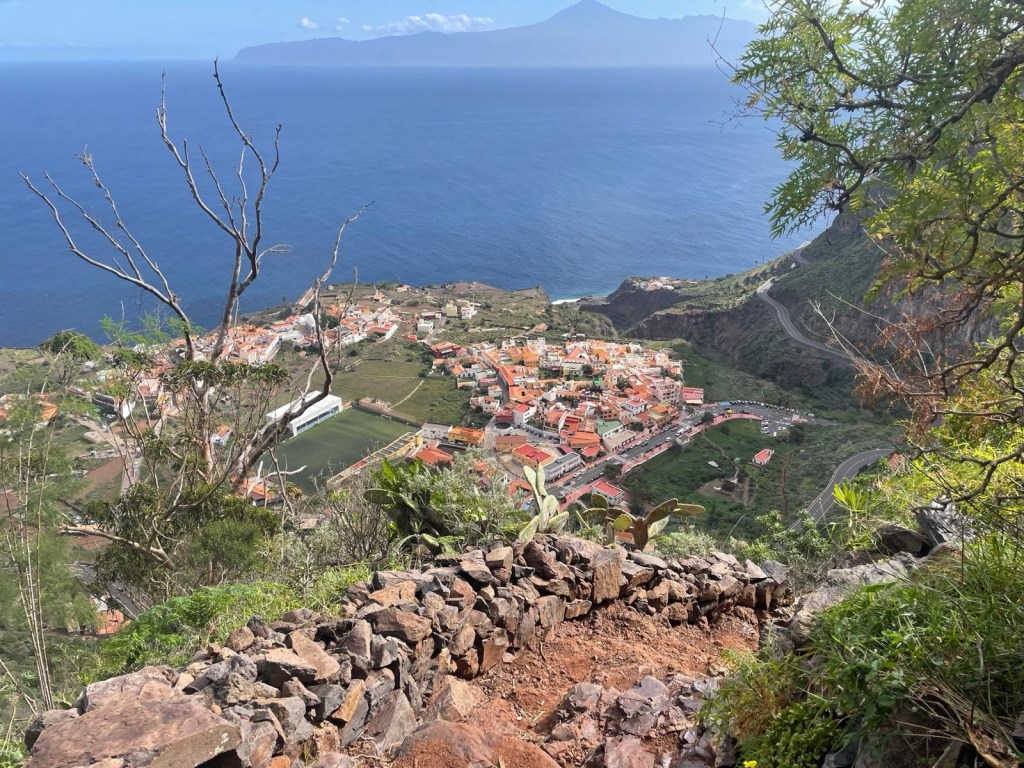
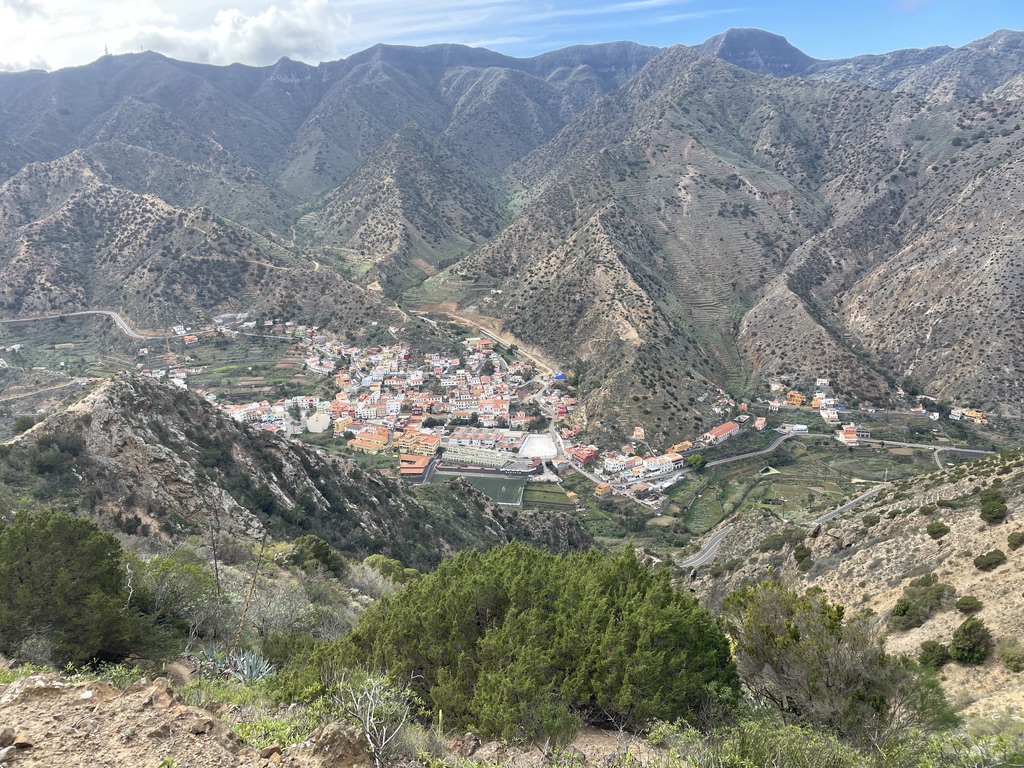
Then you have to do that until you get to something called a Mirador – you can see the viewing point of the Mirador in the centre of the picture with the lamppost- it has a glass floored viewing platform which is a challenging place to eat your sandwiches. Anyway, you turn round at the top of any of the Miradors and look at how far you’ve come, and it’s all very much worth it:
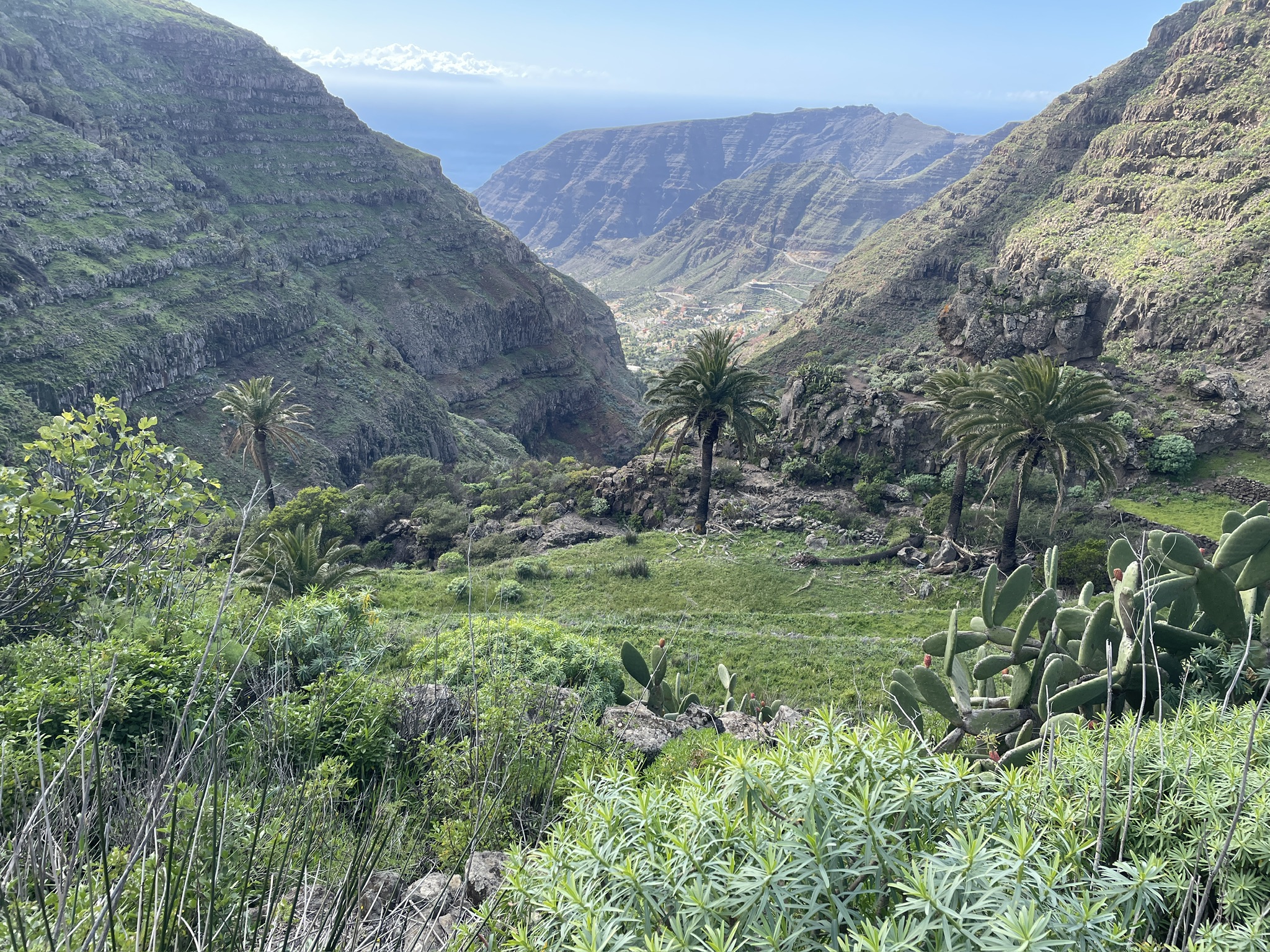
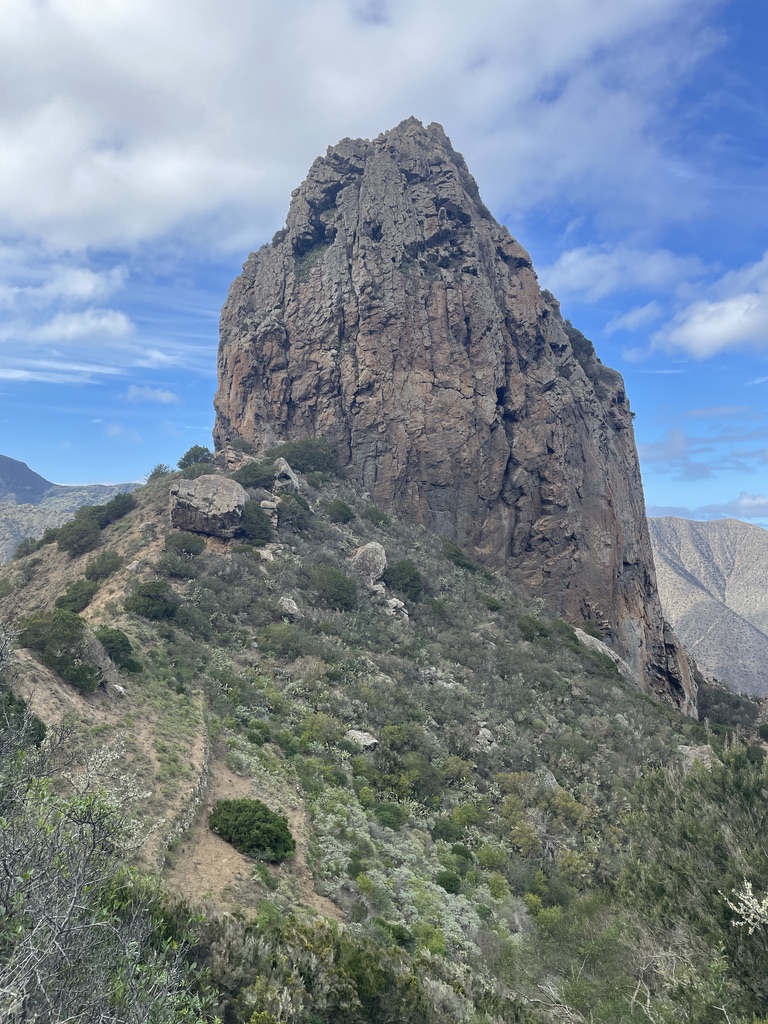
It took us seven hours to travel the ten miles that got us to Vallehermoso, skirting around the huge Roque Cano above the village, which translates, quite accurately as ‘Beautiful Valley’.
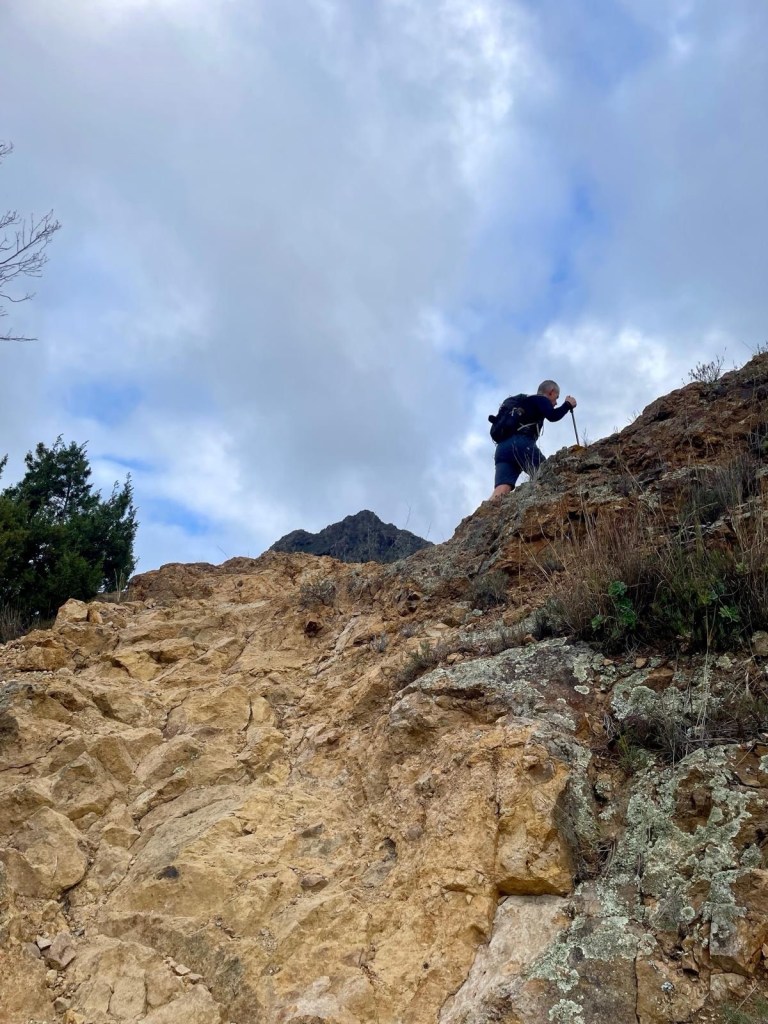
We thought we’d done the toughest day first, but it turned out that day two was billed as even harder – 1300m of ascent, and ending up in Chipude, the hotel full of beaming walkers, hobbling to and from their rooms ready for the next day’s challenge. The route map had some notes that said it started with ‘just enough undulation to remind you that you are exploring a volcanic island’, and it didn’t stop reminding us all day. At one point, Mrs E took a picture of her companion up ahead doing a passable impression of Old Father Time:
But we got to see the more stunning valleys and ravines; the sort of views that you hardly ever get when you’re walking in Norfolk:

And so to day three, which we were pleased to see was billed as medium-hard, a gentle step down from the previous two days. In reality, it didn’t feel like that at all; we were still climbing that bloody staircase for the first half of the hike, up to Alto Mt Garonajay, where you could look out in different directions to Mt Teide on Tenerife, El Hierro or La Palma. That was the highest point, and the middle of the day, so you’d expect the second half to be easier, but it was a challenging descent, and Mrs E’s happiness self-timer, which resets after six hours of any hike, was tested by a good couple of hours.
Eventually we got to the end-point, a bus stop at Degollada, where we could jump on the bus and have a truly disturbing thirty minutes in the company of several whistling teenagers, and the psychotic driver reliving a scene from The Italian Job.
We played a number of games, as we tend to do on these trips, especially on the uphill bits. Probably the best game was on day one : ‘Things you can say in the bedroom and when hiking’, to which there were a number of winners, my favourites being ‘have you tried adjusting that pole at all?’ ; ‘it’s all up and down with you, isn’t it?’ and ‘the problem with doing this in a large group is that there’s always some bloke at the front that wants to come first’.
Inevitably, this led to quite a bit of innuendo opportunity for the rest of the trip, and I’ll admit that I did manage to get a couple of German hikers that we met to admit that they found it harder going down. Childish, I know, but it kept us amused. If nothing else, the spirit of Finbarr Saunders lives on.
And having, in those last two paragraphs, scuppered my chances of winning any kind of travel writer award, I’ll sign off. Until the next time, gentle reader x

 The Emu